A look at the launcher and multipurpose tools for the decentralized Autonomous Organization (DAO)
Good News for DAO Participants: Initiators and Multitools at a Glance
原文来源: 白泽研究院
Decentralized autonomous organizations (DAOs) have no centralized leadership, and bottom-up decisions are overseen by communities around specific rules. The early DAOs allowed investors to pool their capital into a Treasury, allowing them to participate in early ventures and projects while sharing the risks and generated benefits. But the Treasury can only be accessed with a member's permission, because blockchain records all transactions and anyone can audit the built-in Treasury, so the DAO is also completely transparent. Permits or any decisions are voted on by the community over a period of time.
The interests of token holders are aligned because the nature of the DAO incentivizes them not to do bad things. They want to see the DAO organization flourish because they have a vested interest in it. To do otherwise would be a betrayal of their own interests.
Daos have a significant advantage over traditional organizations because they are Internet native. The lack of trust is a key advantage of daOs. While investors in traditional organizations need to have a high degree of confidence in the founders behind them, daOs only need trusted code. Trust code is easy to implement because the code is open source and anyone in the community can thoroughly check the DAO before it is released.
There is no hierarchical structure in such an organization. Nevertheless, it allows stakeholders to govern through voting on native tokens, while also allowing participants to perform tasks that enable the entire DAO to flourish. Because there is no hierarchy, any stakeholder can contribute ideas, turn them into proposals, and the entire community can evaluate them through a vote.
Today, however, daOs are maturing. From social movements to financial transactions, from legal documents to applied science, DAO has penetrated many fields and is still growing and expanding rapidly.
DAO initiator and tools
In this article, we analyze two important components of DAO: DAO initiator and DAO tool, and chart from DAO data platform DeepDAO.
The DAO launcher is a platform that allows easy deployment of new DAOs to manage protocols, funding, ownership, and so on. The "launcher" here may be a stand-alone product or a collection of features used to create daOs. The DAO tool, on the other hand, can complement what the launcher does not provide to the DAO with additional functions such as accounting, analysis, and identity.
DAO initiators are functional frameworks that can be used to start and run DAOs.Different DAO initiators can give DAO different sets of functionality. It is also possible to deploy daOs without initiators, but this may require specific skills that most communities (and even good programmers) cannot easily master.
DAO tools can help teams create custom functional modules or facilitate management by DAO participants.For example, taking snapshots, adding decentralization for pure token voting, and specific functions such as "governance proposals for allocating Treasury to token holders shall not be passed for a period of one year" require DAO tools.
DAO initiator and tool layout
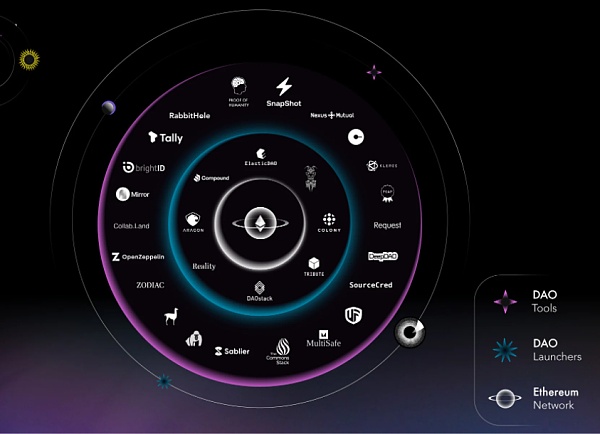
The following figure lists a number of DAO initiators and tools that have been reviewed. It is shaped like a doughnut and represents the DAO world on Ethereum. At the center is the Ethereum blockchain, the second layer is the DAO launcher, and the outermost layer is the DAO tool.
But the map is not "complete" : first, the scope misses the major Web2.0 tools that facilitate DAO communication, content, and community building, such as Discord and Discourse, Telegram, and other forums, as well as blogs, media, and social networks. Second, the DAO space is evolving, and many projects in beta are not written.
The DAO starter
In the figure below, the DAO launcher is split based on the functionality it can provide. The different colors and ICONS at the top of the image represent different features, while the bottom of the image shows what features are included in each of the major DAO initiators.
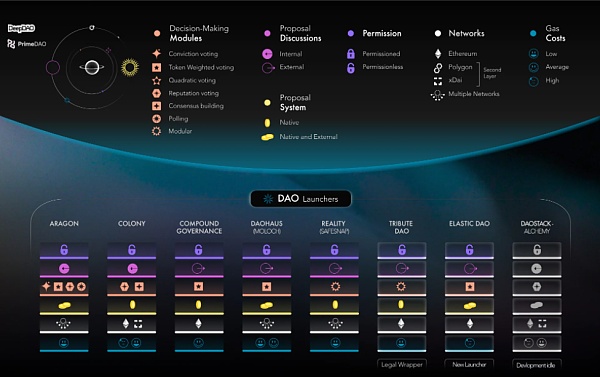
Aragon (client, governance) : has governance, proxy and financial plug-ins, zoom voting and cheap execution, dispute resolution networks, and more.
Moloch (V2) : You can create a minimalist and viable DAO that supports a variety of profit-oriented but decentralized use cases, including grants, venture funding, and incubators.
Elastic DAO: This initiator focuses on creating DAO that governs fairness and allocates tokens to members.
Colony (V1, V2) : Focuses on organizational ownership, structure, power, and financial management, specifically incentivizing positive contributions, e.g. through reputation.
DAO Stack: Governance protocols and easy-to-use interfaces for creating and managing DAOs.
Tribute: This is an NFT-enabled DAO launcher designed to add functionality freely.
Compound Governance: Creates Governance tokens, weights votes, and includes execution delay, delegation, and emergency capabilities. It is mainly used for DAO of DeFi type.
The DAO tools
The following is an overview of the DAO tools. It centers on the DAO, with tools hovering around it.
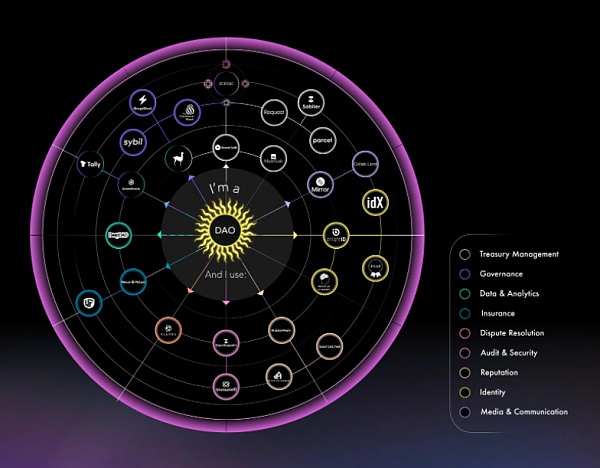
Gnosis Safe: A multi-signature wallet commonly used to manage community coffers.
Snapshot: Offline voting platform for simple token governance.
Discourse: Multi-channel, media-rich forum used for community building, updating and thematic discussions, including governance and proposals.
CollabLand: Provides token one-click access and bots to community groups.
Coordinape: A coordination tool that determines which contributors will receive token awards.
Parcel: Money management that makes it easy to keep track of Treasury movements and send payments.
SourceCred: Tracks community participants and rewards active members.
Mirror: Funding creative projects through tokenisation crowdfunding.
Tally: The governance history query, which tracks on-chain voting history across different protocols.
Boardroom: a governance center for token holders to make key decisions.
Sybil: Creates and tracks on-chain governance delegates.
RabbitHole: Reward token for completing a specific task on the chain.
BrightID: Social identity network that does not store personal data.
IDX: a decentralized protocol for interoperable digital Identities (Credify).
Proof of Humanity: Registered verified users with biometrics.
POAP: A decentralized network of authentication through token of attendance.
Commons Stack: Addresses DAO governance and accountability, funding, and feedback to promote sustainable, holistic incentives, and community governance public goods.
Sablier: Create a steady, constant flow of money between the wallet address and the application.
Request: Private, cross-chain encrypted payment.
Nexus Mutual: Provides insurance for token management or distributed smart contract risk.
Unslashed Finance: An insurance-like DAO for common cryptographic risks.
Immunefi: White-hat hacker marketplace offering bug bounties, professional technical forum.
OpenZeppelin: Secure Smart Contract Auditing and decentralization programs.
Llama: Crypto Community Treasury Center, designed to help communities manage their on-chain Treasury.
Zodiac: A collection of governance tools, including various functional modules and other governance functions.
DeepDAO: Manages daOs, administrators, content, and ecosystems. Lists a complete list of all DAO platforms for financial, social, and governance data visualization.
Emerging tool
In addition to the platforms and tools already in use, many others were under development as the report was written. Here are some emerging tools:

Prime Deal: Interface for DAO interactions, such as token exchange, liquidity provision, and joint Treasury formation.
Superfluid: in-chain payment. It is currently in the early access stage.
XMTP: Web3 communication protocol that can be used for messaging between wallets.
Multis: Automatic payment, transfer receipt and wallet tracking.
Agora Space/Guild: bridge the gap between Web3.0 tools and Web2.0 social platforms
conclusion
DAO initiators are much more diverse and modular than they were a year ago. In addition, versatile DAO initiators seem to be a growing trend. As the chart above shows, initiators already provide a variety of DAO governance suites, modules, governance, and other infrastructure. DAO tools are also evolving and diversifying to cover the needs of more and more DAO creators and participants.
It remains to be seen how the DAO space will further explore new open, interoperable capabilities. As the DAO ecosystem and its tools grow and diversify, and more new functional modules emerge, more and more organizations are likely to adopt DAOs to help manage some of their operations.
The original link
Welcome to join the official BlockBeats community:
Telegram Subscription Group: https://t.me/theblockbeats
Telegram Discussion Group: https://t.me/BlockBeats_App
Official Twitter Account: https://twitter.com/BlockBeatsAsia
 Related Articles