How is Terra's ecology developing?
Overview of Terra's Ecological Development based on the "Top-level Design" Approach of UST
Source: ChainNews
A poplar tree
Launched in 2018 as an algorithm-based staboin Protocol, Terra Protocol aims to provide a stable and widely adopted staboin system, and for three years the entire Terra ecosystem has indeed been working around the two core goals of "price stability" and "widespread adoption".
Especially since this year, as stabocoin UST continues to capture territory on the chain (Mirror Finance, Anchor Protocol development, expansion to Solana, Harmony and other blockchain networks) and off the chain (Amazon gift cards, Travala.com payment integration), With the launch of the Columbus-5 upgrade in September and the anticipation of multi-chain assets from the Wormhole cross-chain Bridge, Terra Ecology has recently received renewed attention from the market.

Just this past July 7, 2021, Terra announced the launch of the $150 million Eco Fund, which will be used to fund projects built on Terra's ecology to move Terra into the next phase of development and enhance accessibility for mainstream adoption of its ecological projects.
"One core, three grips, N ecological protocols"
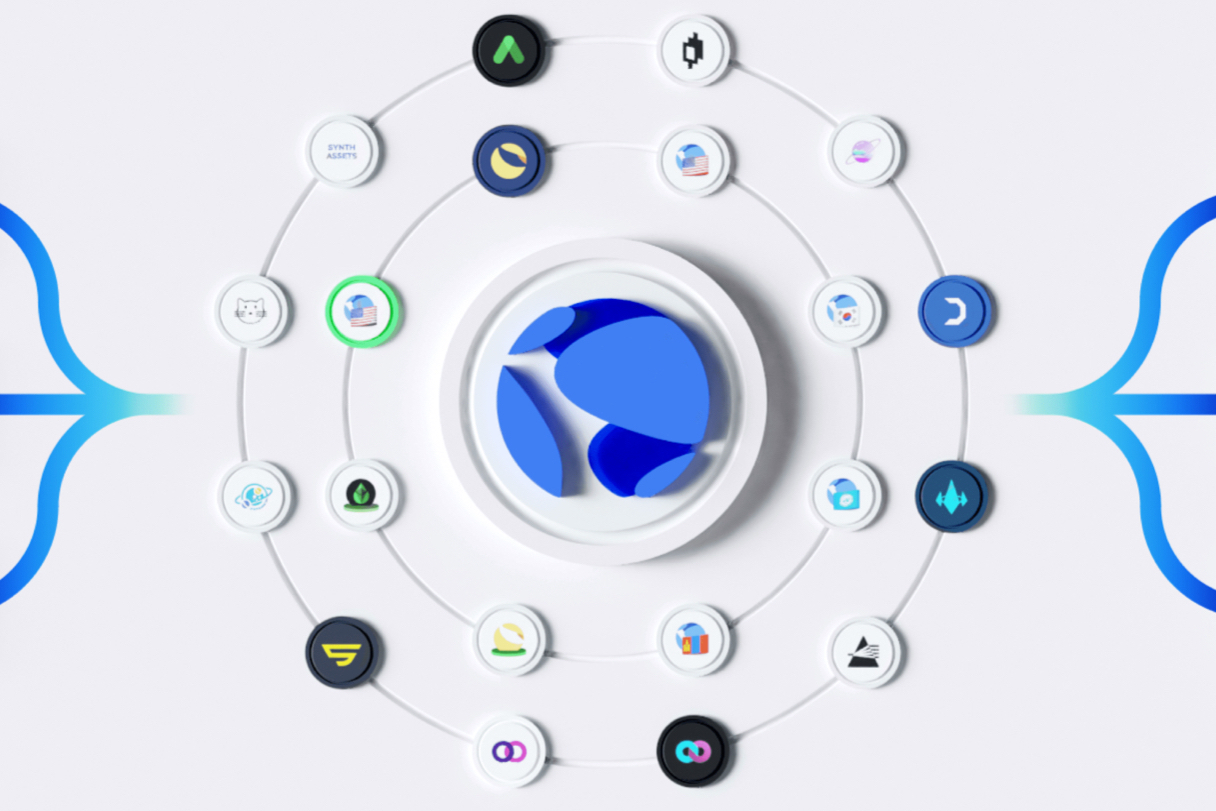
Terra ecology can be summed up as "one core, three grips, and N ecological protocols".
The "one core" is the stabler currency UST (the other two stabler currencies on Terra are the STABler currency SDT of THE IMF's Special Drawing Rights SDR and the stabler currency KRT linked to the Korean won, which has the same idea as the UST). Currently, the total market capitalization has reached $2.44 billion (as of September 7), ranking only behind USDT, USDC, BUSD and DAI.
The whole design idea of Terra Ecology is all about how to expand the use scenario and payment demand of staboin UST, and the operation of UST adopts dual token design:
· Luna: governance, pledge and verification token;
· UST: stable currency pegged to the original US dollar;
To put it simply, every time an UST is created, a dollar's worth of LUNA must be burned, and LUNA helps maintain the link between UST and the DOLLAR through arbitrage mechanism:
Each time a UST transaction is higher than the hook, the user can send $1 worth of LUNA to the system and receive a UST. Conversely, when UST trades below the hook, a user can send a $1 UST to the system in order to get $1 LUNA. In both cases, users were incentivized to arbitrage, helping to maintain the UST peg to the dollar.

The "Three Grips" are Mirror Finance and Anchor Protocol, two of Terra's official on-chain eco-hit products (sponsored and launched by Terraform LABS), and Chia, a payment application that supports the actual demand of payment scenarios under the chain.
Among them, the payment program Chai has experienced more than two years of development test in the offline payment scene in South Korea, with stable growth according to data. Mirror Finance, a synthetic asset protocol, has become the industry's largest trading platform for synthetic U.S. stocks. Anchor Protocol, as a fixed interest rate Protocol, introduced bETH in August and ushered in significant growth in lock-up ecology and volume.
In general, Mirror Finance and Anchor Protocol, two flagship products, play an almost central role in Terra's on-chain ecosystem. In addition, the coverage of off-chain payment scenarios of Chai has captured a large number of novice users who want to try to access the crypto world from the three aspects of payment, investment and savings.
The "N Ecological sub-protocols" are a number of Terra ecological projects currently in the pipeline around UST, such as Prism, Nebpa, Apce, etc. (according to the incomplete statistics of Terra.smartStake. IO, there are more than 60 of them).
The world lines of these ecological protocols eventually converge to the use scenarios and consumption demands of stabocoin UST by cooperating with the combined benefits of Mirror Finance and Anchor Protocol.
An overview of Terra ecology
A closer look at Terra's ecological layout shows that, first of all, through the payment application Chai, IT enables UST to be used for payment and consumption in the offline real world, rapidly narrowing the distance between the encrypted world and the traditional world, and constructing the primary usage scenario for UST based on the payment demands of the real world. Making UST more than just a stablecoin in the crypto world, but a real payment method.
At the same time, traditional financial assets are synthesized to the chain through Mirror to set up the investment usage scenario on the chain for UST, and then assist Anchor to earn 20% of stable currency income to set up the savings usage scenario on the chain, so that the basic demand pattern of UST can be determined.
Later ecological projects are mainly carried out around this, in order to further strengthen the scene demand of UST from the three channels of payment, investment and savings, and achieve the holy grail of staboin "price stability" and "wide adoption".
Three important grips
Chai mobile payment app
Launched in June 2019, Terra launched its first eco-project, Chai, as a government-regulated fiat currency payment gateway connecting about 15 major banks and aiming to become the payment app of choice for Korean merchants.
Its main settlement unit is also based on Terra's Won stabilization KRW. According to Chaiscan, Chai had 59,000 daily active users as of August 28, with more than 100,000 daily transactions and 2.084 billion KRW ($1.8 million) spent per day.
For users, consumers can get discounts or points back by using Chai apps or Chai debit cards at partner merchants;
For merchants, Chai fees are around 0.5%, far lower than the 2-3% transaction fees charged by other Credit agencies in Korea.

In addition to Chai, Terra ecology has other payment apps such as MblockquoteePay (Mongolia), which are built around the actual offline merchant consumption scenarios.
Therefore, different from Mirror Finance and Terra's ecological "twin star" status in Anchor Protocol chain, AT present Chai has supported the main payment scenario requirements of UST with its own efforts. It is also one of the few blockchain applications that bring cryptocurrency into the real world as payment.
Mirror Protocol Protocol for synthesizing assets
Mirror Finance now covers a wide range of synthetic assets, including US stocks (Apbaba, Tesla, Robinhood, etc.), crypto assets (BTC, ET H), and so on, thanks to Terra's typical low Gas cost and high scalability. And has been the industry leader in synthetic U.S. stock trading.
The casting process of Mirror Protocol is similar to Synthetix in that it is overmortgaged, except that Mirror overmortgaged to produce synthetic asset tokens via staboin UST or mAsset (synthetic assets on the Mirror).
The UST minimum collateral ratio is 150%, mAsset minimum collateral ratio is 200%, and the us equity synthetic asset token that is pledged is also on-chain and can be traded on Uniswap and Terraswap.
In short, any investment demand in the Mirror based on synthetic assets such as U.S. stocks will eventually feed back into UST, providing value to Luna and UST.
And Data Don't Lie: Why Synthetix has Been so sluggish lately? The paper also makes a detailed comparison and analysis of Mirror Finance and Synthetix, an established leader of synthetic assets based on Ethereum, in key protocol indicators such as lock-up volume, fee income, lock-up volume and number of users, especially in the synthetic U.S. stocks. Mirror Finance has become the largest synthetic US stock trading platform in the blockchain world.
Especially since Mirror V2 went live on June 25, three key new features have been added:
· New collateral LUNA, MIR, ANC, aUST;
· Short incentive (sLP generation);
· Allowing pre-IPO assets to come online further solidifies its leading position in synthetic US equity trading.
This comes after Uniswap Labs restricted access to tokenized shares in July, citing the "changing regulatory environment," which created some market sentiment concerns and regulatory uncertainty for Mirror Finance.

But as of August 29, Mirror's Terra+ETH lock-ups stood at about $1.87 billion, matching Synthetix's $1.9 billion lock-ups during the same period. More importantly, Mirror Protocol has outperformed Synthetix in the past 24 hours alone with 26,794 transactions and over $10.53 million in transactions.
Anchor Protocol Fixed interest rate Protocol
Anchor, as a low-risk financial instrument with fixed interest rate income, openly promises to provide savings products with an annual return of up to 20%. Even in the DeFi world where high returns are common, it is also an extremely attractive investment choice to promise to provide 20% annual return stably no matter niu or Xiong.
But Anchor will accept nothing else than assets that are native Staking as collateral for loan-traditional PoS blockchain assets, such as Ethereum, Polkadot, Cosmos, Solana, etc.
Their collateral derivatives on Anchor are called bAssets, just as bLUNA is the first-level derivative of LUNA, the original asset of Terra blockchain, and is currently the main force in the collateral of Anchor Agreement.
But in early August Anchor Protocol entered into a partnership with Ethereum 2.0 pledge agreement PDO Finance and launched bETH, which is an important step in introducing off-chain assets -- as stETH's mapping token in Terra Ecology, BETH can be used as collateral for users to get mortgage loans and Anchor liquidity mining rewards. BETH is the first mainstream crypto asset introduced into Terra ecology through Anchor.

As of August 29, Anchor Protocol locked up positions (TVL) were about $3.7 billion, with total collateral value of $2.34 billion, of which bLUNA collateral value was about $2.09 billion, bETH collateral value was about $250 million, Although bBLUA still dominates, bETH's growth rate has become obvious in less than a month.
And perhaps Anchor's ambition is just like this -- along with the prosperity of PoS and the collateral ecology behind it, especially the further introduction of ETH, SOL, ATOM and other pledged assets, through becoming DeFi interest rate savings product covering mainstream PoS assets, Build a key bridge for Terra ecology to absorb multi-chain assets and ultimately feed back UST needs.
Other ecological sub-agreements
Currently, Terra ecological projects centering on UST, such as Prism, Nebpa and Apce, are mostly in the stage of project perfection or even DblockquoteO idea, and they are basically designed based on the combined revenue of Anchor. It is expected to be launched in the next six months or so.
Orion Money Cross-chain Stablecoin Bank
Cross-chain stablecoin bank Orion Money, winner of the Delphi Digital hackathon, built a cross-chain stablecoin revenue aggregator that aggregates revenue by converting stablecoins from different chains into wrapped assets, In short, it aims to connect stablecoins on Ethereum to Anchor Protocol.
Therefore, the emergence of Orion Money can be regarded as a "supplement" of Anchor Protocol, which is more to fill the dilemma that Anchor Protocol only supports users to obtain stable income of stabocoin UST, but not other kinds of stabocoin income. There are three main products planned: Orion Saver, Orion Yield Insurance and Orion Pay.

Orion Money recently launched its first product, Orion Saver Alpha, and is about to launch some new versions that may embed other revenue products and offer more high-value services.
Orion Money raised $1.7 million on June 19 and $7 million on August 12, respectively. Investors include Delphi Digital, Terra's eco-veteran investor, Do Kwon, Terra's co-founder and CEO, and Matthew Cantieri, General manager of Anchor Protocol.
Mars Protocol Money Market and Lending Protocol
Mars Protocol is based on a dynamic interest rate model designed by the Delphi Digital team. It aims to be a money market for all assets within Terra's ecosystem, creating a bank of the future that supports eslocation-free, open source, transparent, algorithmic and community governance, with a core goal of depository and lending. Manage both illiquidity and insolvency risk to effectively improve the capital efficiency of each ecosystem within Terra.
But unlike other traditional banks, Mars Protocol is a fully automated on-chain credit tool managed by a decentralized community through a transparent governance process, with all decisions made by the Martian Council Committee. And its lending types are mainly divided into two categories:
The pledge type,
Similar to Compound, collateral is deposited into an agreement and the desired asset is lent at a rate of pledge. The collateral that's deposited is also earning interest rates. Initially, the supported token types were UST, ANC, MIR, and LUNA.
· Non-pledge type
In fact, Mars' non-pledge loan is not really able to realize the unsecured loan. The non-pledge refers to the liquidity on Mirror and Anchor as the certificate, without depositing the token into Mars.

Pylon Protocol
Pylon Protocol is a set of savings and payments DeFi products built on the Anchor Protocol that introduces a new paradigm of incentive coordination between payer and payee, consumer and creator, patron and artist, investor and entrepreneur, borrower and lender, and more.
What is publicly available is a fair project launcher called Pylon Gateway that allows crowdfunding and revenue, with users depositing UST into a pool to receive their share of token allocations. Tokens for the project are allocated in proportion to investors' shares in the pool.
The Pylon protocol token "MINE" mimics Luna's casting/destruction role in the UST mechanism by absorbing the value of tokens launched by projects on Pylon -- up to 10% of proceeds generated from project launches will be used for MINE buybacks.
Liquidity agreement for Prism's future earnings
As another official hit product launched by Terraform Labs, Prism Protocol allows users to sell the future earnings of their holdings in a time period of their choice, thus obtaining liquidity through the borrowing and borrowing of the future earnings without facing any principal liquidation risk under the traditional mortgage model.
Apce high yield and instant payment network
Apce takes advantage of the yield rate of Anchor to cut off all middlemen. Users can only connect their own bank accounts and directly earn high returns based on Anchor. Meanwhile, instant encrypted payment between different accounts can be easily operated.
Nebpa ETF issuance and investment platform
According to the information disclosed so far, Nebpa is more like a multi-asset ETF issuance and trading platform targeted at Terra ecology.
Terraswap asset exchange platform
Terraswap is Terra Eco's official exchange platform for trading Terra Eco assets -- stablecoins like UST, synthetic assets like Luna, MIR, ANC, and mAsset.
"Top-level Design" around UST scenario Requirements
At present, the competitive public chain of rival ethereum such as Solana and Fantom is in full bloom, covering various circuits such as lending, decentralized trading, derivatives and NFT. The self-combination between protocols is like a chemical reaction.
Relatively speaking, Terra is extremely vertical. Whether it is Mirror, Anchor or ecological project in the (pre-) start-up stage with a certain scale, the meaning of "top-level design" is very obvious.
Each protocol plays its own role. Through the "combinability" of this design, different protocols gradually cover most financial scenarios such as investment and savings, realizing an increasingly obvious vertical financial public chain ecology, so that Terra community once proposed the concept of "TeFi" after imitating "DeFi".
In the context of the growing pie, how to coordinate the progress and arrangement of these tens of ecological projects is particularly challenging for Terra's ecological development wisdom. After all, this may be a phenomenon for ethereum and others to worry about and even to rejoice in -- ethereum's permissibility and borderless composition, through its high fault tolerance, has brought endless imagination and amazing innovation to the entire Ethereum ecosystem.
However, for Terra, which has always been committed to "top design", it is also a "sweet annoyance", because the "top design" type of open financial ecosystem has obvious advantages and disadvantages.
The advantage lies in that each ecological project can be directly combined with each other like building blocks. Therefore, the scheduling of the underlying design can avoid the waste of resources and maximize the synergistic effect. In recent six months, Terra has been feeding UST and ecological development through the underlying design of Mirror and Anchor, which is a relatively successful example.
But again, the downside is that execution is critical here, as Mirror V2, Anchor, and Columb-5 have had an overall impact when compared to their original plans.
The key to Terra's ecological growth is to design the protocols that can be assembled and to ensure that each of the protocols is delivered on time and not slowed down by the delay of a single piece of the ecological puzzle.
The original link
Welcome to join the official BlockBeats community:
Telegram Subscription Group: https://t.me/theblockbeats
Telegram Discussion Group: https://t.me/BlockBeats_App
Official Twitter Account: https://twitter.com/BlockBeatsAsia
 Related Articles