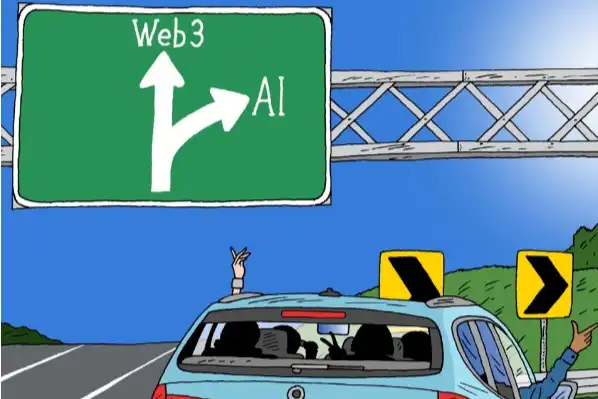
The Web3 Ark in the Web2 flood
People who are dominated by Web2.0 platforms are becoming numb. When we open our eyes each day we see what our conscious mind wants us to see. When we close our eyes we silently say to ourselves, "That sounds good too." There's no denying that Web2.0 has ushered us into a new era and is still changing the way millions of people live, but there's no denying that it has devastating problems. We don't know if the bright future Web3.0 envisions is really that good, will ever come, and whether it will solve or minimize the existing problems. We can only keep an open mind, see the problem clearly, and explore the most efficient solution at the moment.
This article, from darkstar.mirror, discusses the problems of the contemporary Web2.0 platform and discusses the possible future shape of Web3.0. The full text is translated by BlockBeats:
The meaning of "Web3" refers to the expectation of iteration. In technology, the version is the replacement. When a new model comes out, we upgrade, and the old model is replaced and forgotten.
Is this what we mean when we say Web3? Will it replace the principles, technologies, and behavior patterns of Web2 as we know it? (Is this even how the phases of the Internet work?)
Many blockchain enthusiasts seem to be suggesting the same. As the term Web2 comes to be associated with centralized social networks like Twitter and Facebook, and as these networks become more meaningful -- and yet their internal policies can be modified at will, potentially to the detrimentally of society -- we often hear crypto practitioners imply, Decentralized applications may be a better solution. Community-owned networks are more equitable, as users who create content attract more participants into the community as coin-holders and into the value they create. Content can be spread based on value dimensions such as reputation or professionalism, rather than hype. For governance, the designations of policies, for example, will be driven by overall community trends, not by a small group of executives and their lieutenants based on their own interests. The beauty of this model is that it will attract more opinion leaders, provide a better user experience, and drive the transition from old social platforms to new ones.
However, we don't know if this will happen. If encryption has done anything, it seems to have made the "old" centralized social networks, particularly Twitter, more centralized than ever. How many opinion leaders use their fans to cash out easily in currency? How many important projects use social media to find and recruit participants? Are there other ways to MLM new tokens and let users know their usage scenarios and meme stories? Where else can we show off our CryptoPunks, Hashmasks and Bored Apes? What bitcoin day trader hasn't been keeping an eye on Elon's Twitter feed over the past few months? Social media is so important to DeFi, otherwise you don't know what's going to be hot next. There is no doubt that the virality of centralized platforms is so valuable for crypto marketing and communities.
Given this, is such a shift realistic? Or are we actually trapped in a deeper centralized system? So what's actually wrong with Web2?
What's actually wrong with Web2?
In 2004, "Web2" was popularized at a conference that tried to ask the same question: "What's wrong with Web2?" . The organisers of the first Web2 conference argued that confidence was needed at a time when the industry had "lost its way" after the dotcom bubble burst. In particular, it has been suggested that vertically integrated portals, such as American Online and Yahoo, trapped users and their data in unsustainable ways, and hampered the innovation of small startups, eventually leading to the bubble and its bursting. At first, Web2 was about understanding and mimicking the ideas and design concepts of the open source movement, but it was also a great example of companies like Google and Amazon expanding and growing despite depleted resources.
At the time, Google was heavily held up as a role model because it offered users the best search resources. Google doesn't capture 100% of the value, it tries to make the whole ecosystem better. Its symbolic idea is "open API". Everyone should build on each other. In fact, one of the most important lessons we can learn from the surviving companies is that user-generated content and data can serve as a source of sustainable competitive advantage, while simultaneously improving the user experience for everyone. Instead of being relegated to the comments section at the bottom of the page, the user becomes a first-class contributor and is the main character of these new open systems. Developers will entice users to use and contribute by offering a greater degree of freedom and flexibility. Better companies are platforms that provide and create more value for the entire ecosystem.
But the problem is that this is not a sustainable long-term strategy, at least not one aimed at fostering an open ecosystem. User-generated data is susceptible to a series of sub-optimizations, such as Goodhart "s Law, which uses" a certain criterion "as an" evaluation coefficient "to reduce the value of that criterion. If you set up recommendation rankings on Google based on neutral web links, you will quickly adopt an SEO strategy that is misguided by "standards." If you're on Amazon and you're asking for reviews, you're going to be inundated with fake reviews. If you're using Facebook's recommendation algorithm, what you see is what you personally think you want to see.
The relative competitive advantage of these "standards" will gradually disappear, as companies will use them as a dimension of optimization. As a result, these companies are naturally forced to increase their ability to manage and manipulate users in order to maintain their advantage. In fact, data is like a way to reduce friction, improve the experience, and focus converged requirements, reworking all the weaknesses of the past system and giving it a new nickname, when in fact the two are not much different. For the most part, these successful companies are not really platforms, but aggregators that focus on customer needs and centralize control, although admittedly they do provide a great user experience.
This "lockout" of users is arguably the root cause of today's anger. However, Web2 in 2004 was considered a failure on the market side, and Web3 in 2021 was considered a failure on the client side. We're a bunch of people who failed the marshmallow test, always optimizing for less friction, more dopamine, and a shorter feedback cycle. We claim to want richer experiences, support independent participants, despise centralization and demand more valuable connections and higher-quality content. But then we turned on our phones. So the success of Google, Facebook, and Twitter in monetizing ads based on data and optimizing the user experience is now the problem, not the solution.
As Web2 companies began to see the potential of their innovations -- game-like clicks, follow lists, algorithmic information feeds -- they became adept at clever tactics. Instead of being permanently open, they will offer new user tools and developer apis and encourage the community to build on them. If the results work out in the company's favor, they may let these innovations flourish for a while, but soon they will either charge for successful products or make acquisitions and improve on them.
It's hard to blame them for doing this. Because it works! Twitter, Facebook, and Google are all for-profit companies, and this mechanism is not new to "platforms." Microsoft, the giant of the open source community, used a similar strategy in its heyday. But it is the development and explosive growth of smartphones that has made them so ferocious.
There are mobile devices and their app stores, memes, cameras, notifications and, most importantly, a constant sense of touch, which is a perfect match for the "Web2" social network. Every new phone buyer is a potentially heavy social user, and the network of relationships that quickly form is so dense that few can resist the temptation.
This cycle triggered an influx of new and highly engaged users, a state of affairs unprecedented in the history of technology. People around the world who previously had no access to the Internet now spend their days checking their news feeds. The "attention" of each family and individual adds to the value of the experience, the depth of the interconnectedness, and the viral expansion of the web. Mobile and social have become a second brain, and "push notifications" a sixth sense. So even though content creators and app developers know that the "game" is being "manipulated," they can't resist the huge opportunity. Perhaps, they reasoned, if their brand or invention was first in its field, and it was the best, it could be one of the few companies that has grown so fast that it has reached some sort of escape speed to escape the social networking vortex. After all, it does happen. Social apps and content have the right mix of uniqueness, design, and luck to reach millions of users in a matter of hours. As a result, they are pouring their ideas, talent and money into these platforms, adding more engaging media and interactivity, and promoting deeper engagement without increasing the cost of the network. All this makes the Internet all the more important, despite complaints that it is unfair and potentially addictive. A steady influx of users.
We're in the middle of this wave right now. It's a world of social activity, a world in which institutions are pulled by a new, crazy, unpredictable environmental wave. Our kids dream of becoming Instagram "thought leaders" when they grow up. Our pop charts are the most popular songs on Tiktok. An outlier group on Facebook attacked the U.S. Capitol building. Even social platforms have been hit by the storm caused by their technology. Aside from making their position more important and central, their efforts to assert control have achieved little. So it is in the context of this world on the wave that Web3 is so alluring as a poster child for generational change.
Platform wealth and economic sharing: Currently, creators and consumers contribute to platforms in order to gain social and economic status. But the status is actually rented (the status is limited to the platform and the revenue is shared directly with the platform). In Web3, this status can be owned by the user. Not only is social reputation portable, but the association with different IP addresses on the platform is also user-owned and portable.
Content ownership and related rights: Web3 introduces ownership as a process. As the IP is published on the web, it is stamped on the chain to verify its provenance and to give the creator the right to distribute and use it. All of this is done at the level of the individual rather than the platform.
NFT surprise: It is becoming increasingly clear that the value of some objects on computers in the open, interoperable world is comparable to the value of real objects. While no one is quite sure why this is, given that the NFT is unique to the blockchain architecture, this is a considerable advantage.
Lies, hype and bots: People can still choose to build whatever they want. However, under the reputation incentive system, people want their status to be as virtuous as possible. It also helps people better find opportunities to do good.
Governance, personal influence, and moderation: As we discussed earlier, ownership has a greater impact on society than money. In Web3, individuals have influence within the organization in which they hold their tokens, enabling them to drive decisions that lead to a healthier community.
Permission-free development and composability: Today's platforms control content audit within their networks. This also allows each user to start from the same starting point. In Web3, development is unlicensed, because licensing rights are directly tied to an individual's reputation. Every decision they make is about who they are, so before you make every decision think about whether you want your identity to carry the result of that decision. Everything on the agreement is a foundation on which others can build directly. So instead of starting from scratch, everyone can build together, piecing together their work like lego.
New work and collaboration models: Web3's business model encourages collaboration. In Web2, all revenue is rewarded to the output side (advertising for published content, subscribing to finished work). In Web3, we can see the business model on the input side. Crowdfunding and social tokens allow people to invest in creative ideas before the cost is complete and encourage collaboration from all participants in the creative process from the very beginning.
It's an imaginative architecture that answers Web2's most deadly questions directly because it's been around for almost 20 years: ownership, governance, openness, motivation, reputation. In many ways, The solution proposed by Web3 is the opposite of the solution offered by social networks, better for users, creators, and developers, and valuing team and individual input rather than giving more control to the owners or operators of the network. This raises another question: Will Web3 replace Web2 if it's better for more people? And why not?
There are three possible answers:
No - Web3 is best understood as an "economic" extension of Web2, especially social media, which will grow along with Web2.
To some extent -- important parts of Web2 will be better executed by Web3 systems, and the two powerful systems will be running symbiosis and parallel.
Yes - over time, all the key components of Web2, including the centralized social network, will be replaced by Web3-style user-led and managed protocols.
We can think about it on three levels :(1)Web3 as a test bed, (2) as a supplement, and (3) as a critique. As for the first, Web3 may be an open experimental platform whose success will eventually be swallowed up by the existing architecture. The test platform exposes various deficiencies, such as the inefficiencies of the Web3 database structure that do not yield any long-term benefits. This second type of complementarity result occurs as various aspects of Web3 flourish alongside and even enhance the value of Web2. This seems to be the case with Twitter, which is probably the largest user entry point for Web3, and clearly plays an important role in the ecosystem. The third and most extreme outcome is that we might see Web3 as an inherent critique of Web2. The success of Twitter, Facebook, or Paypal is to some extent considered a failure of Web3, and at this point, a replacement seems necessary.
What's different about today's environment from 2004 -- when we've largely transitioned to the social/mobile Web2 era -- is that the big tech companies that have practiced their strategies are in place, and the newcomers are on the defensive trying to emulate and improve on them. Twitter, for example, acts as a portal for encryption to promote scarcity, the NFT and amplify FOMO sentiment. Today's function is to spread the narrative and create FOMO sentiment for the market in Web3. But what happens as many Web3 markets grow exponentially? Web3 is supposed to offer an escape, but it's not clear whether it's a financial scarcity game with a red herring or a new playground with fair rules. We are trained to play the game well, not to play the game fairly.
Now, and for the foreseeable future, the fan graph on centralized social networks is an important and enduring source of value. In every aspect of society we can see how effectively this influence is translated into economic, political and cultural benefits. So another way to ask the question is: will there ever come a time when identity and credibility on the chain will be more valuable to users than their profile of followers in a centralized social network? These three answers represent different levels of optimism.
Given the current trajectory of the latest technological era, it is easy to be pessimistic. Many of the things that people thought were possible in 2004 now look ridiculous and pollyannaish. The situation we're in right now, while centralized and chaotic, is not as bad or intractable as it might seem. The mobile Internet and social transformation are still pouring billions of people into the Web2 world, and this transformation is also the beginning of human innovation and connectivity. In the face of the manipulations of algorithms and the clever incentives of social networks are billions of free-thinking people. They are not pre-programmed robots. In fact, they will determine the future. But they won't do it solely on the vague ideal of decentralization. If Web3 can truly make their lives easier, they will push the traditional web system to the next level.

The original link
Welcome to join the official BlockBeats community:
Telegram Subscription Group: https://t.me/theblockbeats
Telegram Discussion Group: https://t.me/BlockBeats_App
Official Twitter Account: https://twitter.com/BlockBeatsAsia

 Related Articles