Wanxiang Blockchain Xiao Feng: Digitalization has helped human society expand a new space
Wanxiang Blockchain Xiao Feng: From Network Platform to Urban Platform -- An Alternative Reflection on Urban Digitization
Source: Xiao Feng, Wanxiang Blockchain
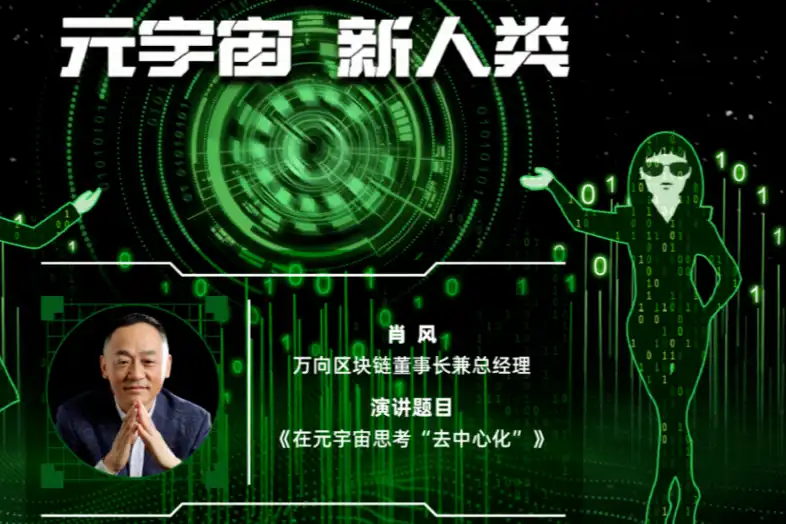
On June 22, "2021 Blockchain Industry Development Summit in Suzhou High-tech Zone and Launch Ceremony of Wanxiang Blockchain Suzhou Research Institute" was held in Shishan International Convention Center in Suzhou High-tech Zone. Xiao Feng, chairman and general manager of Wanxiang Blockchain, delivered a speech titled "From Network Platform to Urban Platform -- An Alternative Reflection on Urban Digitalization" at the event.
The following is a slightly abridged transcript of the speech, which is taken in shorthand.

Xiao Feng, chairman and general manager of Wanxiang Blockchain
Distinguished guests, I am very glad to have this opportunity to share with you my new thinking. We've seen Internet companies using a range of digital technologies to build a vast network of platforms, so much so that there's now a global debate about whether to use antitrust measures to break up these platforms because they have too much power.
Sometimes, we wonder whether a city can also use a series of digital technologies to build a city platform just like an Internet company to build a network platform. That's what I want to talk about today.
One of the themes of today's conference is digital transformation. First, I'd like to review the evolution of digital technology and the changes in business models that digital technology has brought about. Over the past 100 years, digital technology has gone through three stages.

The first is the late 19th century, when the invention of the telegraph and telephone brought about great changes in business models. We call this period the explosion of communication technology. The second is the outbreak of information technology and computer, Internet and other information processing technology in the middle of last century. Third, at the beginning of the 21st century, cloud computing, big data, AI, blockchain and other digital technologies have entered a centralized outbreak period. This is the process of technological iteration over the last 100 years.
Iteration in technology leads to iteration in business. In the era of electrification, many representative enterprises based on communication technology emerged, such as GM, Ford and AT& T. With the explosion and maturity of information technology in the middle and end of the last century, a number of new enterprises emerged, such as Microsoft, Intel, and IBM, which had done well in the era of electrification. One book, "Who Says Elephants Can't Dance," details IBM's transformation from a leader in the electrified age to a leader in the information age. At the beginning of this century, with the maturity and outbreak of digital technologies such as cloud computing, AI, blockchain and big data, there emerged enterprises that grew and developed based on digital technologies such as Google and Facebook.
If we summarize the characteristics of these digital technologies, we will find that this series of digital technologies are extremely disruptive.
First, digital technology has completely broken the limits of physical space, in which it is difficult to identify the attributes of country, region or time.
Second, once the limitations of physical space are broken, there can be no barriers to cross-border flow, such as an E-mail that can be freely sent abroad or even anywhere on the planet.
Third, the more digital, the lower, or even zero, the marginal cost of economic activity. In the old days of listening to music on CDs, if one person listened to a song, one CD would be made, and if 10,000 people listened to a song, 10,000 CDs would be made. But in the digital age, where everyone listens to music through digital software like QQ or netease Music, the marginal cost for 10,000 people listening to a song on the platform is almost zero.
Fourth, digital technology not only subverts the concept of time and space, but also reconstructs the laws of economy, promoting commercial organizations to open source, open, sharing and co-ownership. Blockchain will enable communities to operate in more diversified ways. In the future, the organization and operation of economic or business activities need not be in the way of companies.
Fifth, data has become a new driver of business and economic development as never before. Some people say that data is the oil of the new age, and that the whole economy and business are driven by data.
Sixth, the company's employment relationship has changed a lot. The relationship between the employees and the company, the relationship between the management and the employees of the company, and the way the economy is organized have all changed a lot, and the sharing economy has emerged. The main feature of the sharing economy is that it is a usage-based economy rather than an ownership-based one. New economic models, such as outsourcing economy and gig economy, are becoming more and more popular around the world. Especially since last year, under the influence of the epidemic, the way to contribute the value of one's labor by sharing outsourcing gig jobs and get returns has become more common.
According to news reports, it wasn't until this month that many of the largest Wall Street firms in New York began asking their employees to return to work after the outbreak began. Most Wall Street firms couldn't -- or didn't -- require employees to return to a fixed office. So that brings us to the seventh change, which is that you don't need a physical place to work, you can work in the cloud, online, online. Driven by the epidemic, this way of working will become more common and more permanent.
And finally number eight,Digitalization technology has turned what was once an untradable commodity into a tradable commodity. For example, the advent of the Internet allowed an English teacher living in New Jersey to teach English online to a Chinese child. In the past, teaching was not a tradable commodity. People had to go to school to be educated. In the future, with the further maturity of virtual reality and augmented reality technology, more non-tradable goods will become tradable goods.
For example, we can let our friends in Shanghai enjoy the beautiful scenery by the Taihu Lake in Suzhou through AR, VR headset or glasses. Now the team that wins the Champions League may be worth around a billion dollars, but in the digital age it could be worth tens of billions. Because through AR, VR and other technologies, even if the audience sitting in their own living room, they can also feel as if they are in the arena, and there is no difference between watching the game on the spot.
Digital technology has reorganized space, commerce, economic rules, and the way of working, bringing about a series of disruptive changes. The transformation and migration of digitalization can be summarized into three levels:

The first level is called digital twinning, where we take something in the physical world, in real space, and digitize it, and map it into a digital body, but it has a prototype in the physical world.
The second level is called digital native. The digital native is a digital universe that we reconstruct parallel to the physical world, where everything in the digital universe has no prototype. Digital native technology is maturing, and more and more cases are happening.
Third, the virtual and the real world are born together. There will be many interactions between the real world and the virtual world, and between the digital twin and the digital native, which will bring about economic and business model innovation.
Finally, let me summarize the digital transformation and digital migration. There's been a lot of discussion about this, but there's one thing I don't think there's been enough discussion about. Perhaps the biggest and most central value that digitization brings to us is that it helps human society expand a new space.
What are some of the more valuable things we can do to digitize our cities?
First, we can build a digital twin of the city, breaking the physical space limits. For example, when we talk about Suzhou, we mean a geographical location, a physical space. If we reconstruct a digital suzhou in the digital universe, the digital suzhou is not limited by physical and geographical space, and the things that can be done in the digital suzhou are not limited by physical and geographical space, thus giving us a larger space of imagination.
Second, digital residents based on digital twins can break the limits of so-called city dwellers. We can build a global digital entrepreneurship program in Digital Suzhou, network global talent, and build a global community of entrepreneurs on the cloud, online and online through the new features of digital technology that I mentioned. Global entrepreneurs from Finland, Norway, the United States and other places do not need to visit Suzhou, but through a set of digital methods to build a digital entrepreneur system, to contribute to the development of Suzhou's digital economy. On this basis, the management and services provided by the government for the digital economy, digital Suzhou and digital entrepreneurs can also break the restrictions of administrative jurisdiction and provide digital services online and on the Internet.
I believe that in time a second, third, fourth or even fifth GDP system like the present Suzhou will be created, and a second, third, fourth and fifth third space like Starbucks will also be created. Can Suzhou imagine using digital technology to create a second space, a third space, or a second Suzhou, a third Suzhou, and a fourth Suzhou to accommodate a larger economic aggregate and more economic activities?
I think this question is worth exploring. We can learn from the pattern that Internet companies obtain a very large network effect by building their own network platform, and imagine how to help a city build an urban platform through a set of digital technologies, so as to obtain a larger ecological effect than the network effect.
Cities are an ecology. There have been articles on why cities on average have much longer life spans than businesses. One reason is that cities are open ecosystems, not closed systems like corporations. Open ecosystems will live longer.
This is not to say that cities do not rise and fall. The New York Times has an article with a very interesting title, "Kaifeng to New York." What does this title mean? More than 1,000 years ago, Kaifeng was a central city in the world, with a population of more than one million. People from all over the world came to Kaifeng. At that time, it was also the capital of the Northern Song Dynasty, with prosperous commerce. More than a thousand years later, New York is the center of the world. People from all over the world do business in New York.
So you can see that there are also changes in cities. As cities rise and fall, we need to seize many opportunities.
A certain city may have been the center, the hub, and developed into a thriving city because of the developed transportation conditions such as river transportation. But in the digital age, we may really have to reconsider: in the next 100 years, will a city continue to rely on its hub position, like the ancient people living with the water, or will it need to rely on digital development?
Blockchain technology is actually the cornerstone of digital technology, and it is the steel and cement of the whole digital technology. Whether it is a digital city or a digital enterprise or a digital business, it may eventually need to be built on a blockchain. Blockchain + Internet of Things can build a trusted digital base. How to ensure the credibility of the data is a big problem. It may be possible to have a centralised approach to ensuring that data is trustworthy, but it is likely to be expensive and commercially unfeasible.
We have talked a lot about Blockchain + Industrial Internet today. It enables enterprises to be truly networked and interconnected, and at the same time enables their data to be intercommunicated with each other under the premise of privacy protection. Smart contracts, sharing economy, gig economy, etc. on blockchain can help enterprises to achieve efficient and low-cost operation. Based on the economic incentive mechanism of blockchain, businesses can build a self-organizing, open, ecological, distributed and dynamic economy. Blockchain-based distributed ledgers also make digitization of assets and digitalization of digital assets commercially viable, providing a good foundation for blockchain-based digital identities and digital cities that break down the limits of time and space. At the same time, blockchain +AI can also make urban governance become very intelligent.
Today, Wanxiang Blockchain Suzhou Research Institute was officially completed. Next, we will officially launch the Shishandao Camp. Shishan Camp is a blockchain training camp. I will serve as the class teacher and gather top teachers from Wanxiang Blockchain and the whole ecosystem of Wanxiang Blockchain, including top blockchain celebrities and theoretical researchers from China and even the world, to hold a special training camp on blockchain in Suzhou High-tech Zone and Shishan Business District.
Welcome all the partners who are interested in blockchain, want to participate in blockchain investment, start a business in the blockchain field, and are interested and willing to join Wanxiang blockchain ecology. Please actively sign up for ShishandongCamp to explore the future of blockchain and digitalization together. Thank you!
The original link
Welcome to join the official BlockBeats community:
Telegram Subscription Group: https://t.me/theblockbeats
Telegram Discussion Group: https://t.me/BlockBeats_App
Official Twitter Account: https://twitter.com/BlockBeatsAsia

 Related Articles