On reflexivity and imitation: "Speculation is eating the world"
Original title: "On Reflexivity and Imitation: What Tesla, Bitcoin, and DeFi Have in Common"
Original Source: Babbitt
This article is an exploration of the current market and valuation. In part one, we used Occam’s razor principle To show how soft money (soft money) releases reflexivity, and the truth that "the mind tells the market how to operate, and the market tells the mind what is desirable". In this essay, I would like to discuss how the digitization of our lives amplifies this reflexive and mimetic influence.
The theory of reflexivity describes the "cognitive function" (world → thinking ) and "manipulative" (mind→world) interact (and sometimes interfere with each other). In other words, the perspectives of the participants influence the course of events, and the course of events influences the perspectives of the participants.
Imitation is the intermediary of this process, and the market is the concentrated expression of desire . Think of the market as a general model that people can imitate, and the reflexivity of assets is really a side effect of the imitation.
Imitation is a form of communication that humans are wired to imitate. As we mentioned in a previous article, imitation enables reflexivity to shape the world according to our will, and humans could not exist without imitation.
Reflexive corrective power is driven by desire and when satisfied When feelings are limited, desires are endless. Durant wrote:
"...achievement can never be satisfied, and nothing can be more fatal than the realization of ideals."
These Desire-driven pursuits make the world go round. When discussing lust, it is inevitable to mention money. The price signals that mediate human communication are expressed in money. Desire, imitation, reflection and money – they are all connected.
"Everything else can only fulfill one wish, Only money is absolutely good...for it is the abstract fulfillment of every wish." (Schopenhauer)
Money regulates the information of the price system - the market. "Describing the price system as a mechanism for recording change is not merely a metaphor," Hayek explained. In a sense, abstract Hayekian markets may be the first instance of two-way scalable information transfer.
The invention of the computer and the Internet started the information revolution. We found ourselves mastering the actual mechanics of registering and creating change.
Optionality is eating the world
;
I was the first to notice when Arjun Balaji published the statement that "speculation is eating the world" and this is Marc Anderson Andreessen's "Software Is Eating the World". Arjun's tweet was (probably) referring to the growing number of people playing with stocks and cryptocurrencies, and the discrepancy between fundamentals and valuations.
What exactly does "speculation" mean?
Speculation, as discussed in this article, refers to a practice in which money is not a means to an end, but the end itself. According to this definition, speculators are not directly trying to participate in shaping the world, but trying to guess how the world will shape itself next.
For example, Fiskantes entered the market to buy a goat because he wanted to make goat cheese. (This is more of an investment than speculation)

< br>
Su Zhu bought all the goats because he suspected that demand for Fisky goat cheese products would drive demand for goats. (This is more of a speculation than an investment)

Speculators focus on signals and act on the market interactions of others. Their main purpose is to increase money. In the example above, Fiskantes also wants to make money, but he intends to create a product.
Thus, we can describe speculation as transactions that are not directly connected to an output/product. Let's look at a trickier example:
Hasu wants to buy a decent sized house, so he seeks an investment to make money. He decided to buy Fisky's goat cheese stocks and hold on to them.

Although one would think that is an investment, but for the most part, it's just speculation. This suggests a false dichotomy between speculation and investing. Everyone engages in some level of speculation in some form.
For the purposes of this article, I would like to Idea speculation. So when we say "speculation is eating the world," we mean people prefer unlimited options, and money becomes more valuable than anything anyone can possibly do with it.
People invest in AMZN (Amazon), TSLA (Tesla ), (Fisky Goat Cheese) to diversify into stocks such as Fisky Goat Cheese, because the founders and employees of these companies have given up (partial) options.
If Fisky spends his time making goat cheese, he Will give up some options, but will create potential options for Su Zhu, Hasu, and many others. The deals that Su Zhu and Hasu worked on also created options for others, and so on.
My understanding of "speculation is eating the world" is like Optionality is eating the world. This is manifested in increasing participation in the stock market and in the crypto and hyperfinancialization of the economy.
There is an assumption that computers are a big mover. To gain an understanding of today's marketplace, we'll explore the computer and digital world and the associated optionality it creates.
Uncertainty breeds optionality. Optionality then introduces more uncertainty to the outcome. Uncertainty makes optionality more valuable, etc. The more uncertain we are, the more we search for answers.
Infinite possibilities and unlimited competition
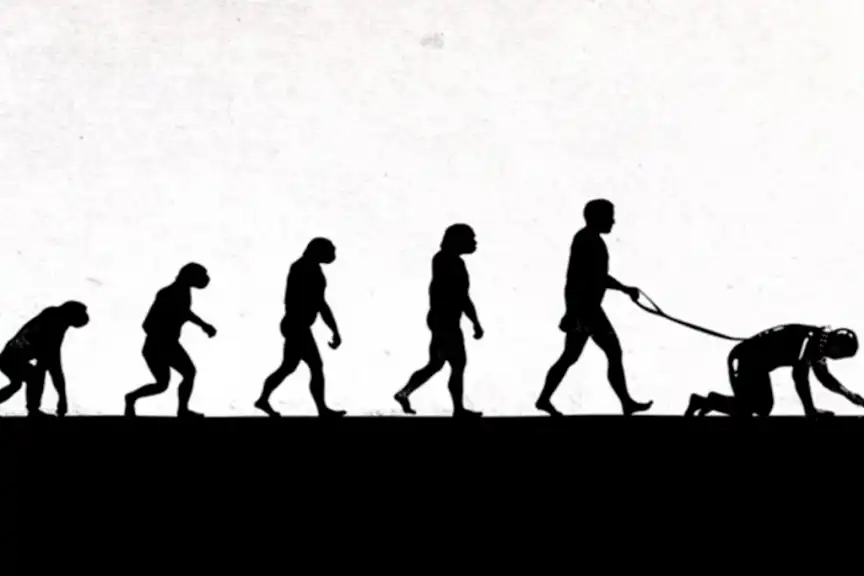
Atoms of the physical world seem limited compared to the temptation of bits to satisfy infinite imitation. Computers and the Internet are the enablers of mass replication and mass competition.

In the digital world, copying is everywhere . This manifests itself in two ways: the instant duplication of files and code, and the duplication of human actions (and desires) by another.
A popular counter-narrative says that we reduce technology to information technology, and described screen obsession as an inward retreat. It has become a famous saying that software eats the world.
Software transcends physical properties, it creates new worlds, It also connects distant locations in the physical world. Therefore, the signal propagation speed in the network is faster, and the mimicry and reflexivity are also faster.
People copying each other leads to competition. Rivalry is a form of validation that ensures a man's object of desire is truly worthy of his attention. Authentication of peers mediates self-authentication. We feel so relieved when people do the same.
This competition has been upgraded in the bit world, this The competition has always been there, but it's largely innocuous (for now).
“…the digital network is a powerful Amplifiers...they allow for endless conversations, they are also amplifiers for the fierce competition that exists between individuals...this includes a perpetual quest for attention as each tries to become role model for others. "(Antonio Machuco Rosa)
Through the interface of social media, we enter a A global talent show where you compete with your acquaintances. As software infiltrates our everyday lives, we begin to gradually turn inward. Stare at the screen that becomes a mirror.

When people turn computers into Computers have been used to inform people about the world long before it became our (almost) entire world. In the case of markets, software begins as an interface to the market. Software must become a market, and the market must become software.
Bringing financial markets to social media is a copycat trap. We get recognized not only by adding money, but also by likes. Money is love and love is money.
If Schopenhauer is still alive today, he Might tweet:
"Digital The world...is ready to transform itself into whatever their wandering wishes or desires of all sorts dictate." and "Everything else can only satisfy one wish, and only the computer is absolutely good...because it is every The abstract fulfillment of wishes.”
By enabling runaway imitation, reflexivity and consequent Computers have also enhanced our ability to create and sustain financial bubbles.
Charlie Munger once quoted the famous The "Lollapalooza effect," another name for the turn of reflexive sex into financial frenzy. Imitation is how the Lollapalooza effect occurs:
“… Munger cites open outcry auctions as an example of the Lollapalooza effect. Participants respond because of reciprocity (“I should buy because I was invited to the auction”), consistency (“I’ve been on record saying I like this, so I must buy It"), commitment propensity ("I've already made an offer, so I must continue"), and social proof ("I know it's good to buy because my peers are doing it") compelled to bid.
Sometimes the Lollapalooza effect can have positive results, which is when the madness of the crowd manages to turn itself into become the wisdom of the masses. In fact, the frenzy of the Internet bubble promoted the development of the Internet.
As markets start to exist in the digital space, we can actually By going to market through screens, our ability to create the Lollapalozas effect has multiplied. The digital age allows for limitless competition and limitless possibilities.
Lots of optionality and lack of direction are the hallmarks of the digital age sign. This means that "probability and statistics are the main ways of understanding the world...random walks define what the future looks like". In such a world, it is almost impossible to copy or imitate.

Ultimate
Competition in the digital field is different, we are The games played in Bitworld seem limitless. Like a video game with infinite lives, the purpose of this game is to keep playing, not to win.

The modern world is more malleable (and probabilistic) than ever before. That is, our interpretation of the world is more plastic than the world itself has changed much.
So we go back to the idea of reflexivity, information from a thought flow into the world, and interfere with the flow of information the other way. The barrier between price and narrative is less and less apparent.
The preference function is no longer properly informed by the belief function, but It's a melting mass of shapeless matter. "Pumpamentals" become the fundamentals, the price is the news, and then the fundamentals (probably) will follow the price.
Our full attention is on the numbers on the screen, optional for those in favor For a person with sex, other things basically don't matter.
Universa's Mark Spitznagel employs a well-known tail-hedging strategy , it has nothing to do with the actual position, but with the meta positioning. He called it a roundabout approach, focusing on the indirect means rather than assessing the end itself.
In such an uncertain world, we can only Entertain yourself. We confuse our preferences with those of others. The world has become a Keynesian beauty contest. We try to guess what other people are guessing, and then we try to guess what other people are guessing...
Keeping the game is more important than winning. In a world of instant and infinite replication, where the Lollapalooza effect is magnified, it's important not to be the last man in it.
When one realizes the outcome of the game , timing becomes very important. The world has become an ultimate early game where being early means being right.

People care less about what the signal actually means, and instead focus on receiving it before anyone else. It's as if we try to interpret our own signal, change it when we come up with a new explanation, and end up changing it again.
Biggest deal in trading history (maybe ever)
Another explanation could be that selectivity is an illusion and all bets are just macro bets as the world are reduced in relation to each other. In 2008, Thiel wrote:
The extremes of recent Valuations may be an indirect measure of the narrowness of the road ahead of us.
Thiel pointed out , the vision of a globalized world can only bring about two outcomes: utopia or dystopia. Insane valuations are either a sign of utter desperation or blind hope born of a lack of alternatives. The investment metatheory of our time is numbers going up. A less cynical way of saying this is that fundamentals follow prices.
Thiel predicts that after the coming crisis, globalization will either Intensify, or regress. Divide the political agenda of globalization from globalization, and actual globalization is not reversed.
Globalization can be understood as homogenization and duplication. While the political agenda seems to be put on hold, the world hasn't stopped globalizing or imitating.
On the contrary, imitation intensified. The statement that "the greatest investment of our time remains the most leveraged investment for true globalization" remains a valid and successful investment thesis today.
The longer the post-2008 boom lasted (TSLA and AMZN are at all-time highs), the more urgent it is to ditch the old economy. The market's optimism is perpetuated by two (contradictory) main beliefs of the new economy.
First Musk, Bezos and other great entrepreneurs Technical assistance brought about by his talents. The second is the massive redistribution propagated through the Modern Monetary Theory (MMT) and Unconditional Basic Income (UBI) meme.
Thiel predicts that the 2008 financial crisis will destroy the "Ideological support". Ironically, we've actually doubled down, and it seems we're stubbornly heading in one direction.

The money printing press has never been more brutal, China is on full swing, Web 2 is being replaced by Web 3, we are ditching hedge funds in favor of passive investment strategies.
Same bubble, new name, imitation and replication across the globe There are no boundaries in the modernized world of bits, and all bets are a bet.
As the road ahead of us narrows, Wall Street is Twitter and Reddit replaced. The fruits of the overfinancialization of our time are no longer reserved for bankers in Zegna suits.
Software is unleashing a monster - Foam Scylla, i.e. all the bubbles are rolled into one giant monster.
“Those who limit themselves to the Investors within normal and reasonable limits are unprepared for the age of miracles and wonders they are living in. The twentieth century was great and terrible, and the twenty-first century will be an even greater and terrible century. In a normal economic cycle In a broken world, classic investment strategies no longer work.” (Peter Thiel)
Conventional wisdom doesn’t help. Maybe that's true, and we might be living in a new paradigm in which bubbles are mathematically impossible. The world doesn't care what it is, it cares mostly what it might be. With revisionist forces at play, what becomes something is more valuable than what is something. Can anyone escape Flywheel?

This explains Thiel's "the greater the difference in valuation between rounds of financing, the greater the degree of undervaluation of a startup" hypothesis, that fundamentals follow prices. In a digital age where the power of reflexivity has become overwhelming, the Lollapalooza effect could literally transform a car company into the world's largest sustainable energy and automation company.
With this interpretation, we run the simulation. Markets exist in digital structures that we run in our own computers. The computer, like money, has become an abstraction of every desire because it is a proxy for what our heart desires. Digital technology allows us more than ever to alter reality to our will.
“For policy makers and investors , the challenge is to find a way out between outdated wisdom and nihilism.”
In a world where there seem to be many choices on the surface but few in reality, it’s no wonder people prefer money and optionality. But some money is better than others, and some fantasies are more outrageous than others.
For us, to understand what might happen in the future , just imagine that the dot-com bubble actually took place in a globally interconnected, massively imitative digital world. The most surprising plan will be the one that wins.
Since the market and financial world cannot calculate the end times, it is not worth downloading The opposite bet.
Original link
Welcome to join the official BlockBeats community:
Telegram Subscription Group: https://t.me/theblockbeats
Telegram Discussion Group: https://t.me/BlockBeats_App
Official Twitter Account: https://twitter.com/BlockBeatsAsia

 Related Articles