Global Asset Meltdown: What Happens When the Bet on De-Dollarization Fails?
Original Article Title: What Happens When The Bet Against America Fails?
Original Article Author: @themarketradar
Translation: Peggy, BlockBeats
Editor's Note: In the current environment where "de-Americanization" and "de-dollarization" have almost become market consensus, this article attempts to remind readers that the real risk often lies not in being right in one's judgment, but in whether everyone is already on the same side. From the crowded trades in emerging markets, the speculative surge in precious metals, to the highly consistent narrative of a weakening dollar, the market is reenacting a not-so-unfamiliar script.
The article does not deny the possibility of a long-term structural change in the world, but brings the focus back to a more realistic cyclical level: once the dollar stops weakening, when monetary discipline returns to pricing, and the U.S. economy does not slow down as significantly as expected, those trades built entirely on a "single tailwind" may unravel at a much faster pace than anticipated. As we learned from our experience in 2017 to 2018, when consensus becomes too unanimous, the reversal often comes swift and harsh.
In this framework, the article presents a contrarian but serious judgment: what may be overlooked is perhaps U.S. assets themselves. Not because the narrative is overly optimistic, but because when the tide of crowded trades recedes, capital tends to flow back to the most liquid and structurally stable places.
The following is the original text:
Currently, there is a narrative in the market that is almost irresistibly compelling: the dollar is being debased; emerging markets are finally having their moment in the sun; central banks around the world are selling U.S. debt and increasing their gold holdings; capital is rotating out of U.S. assets into the "rest of the world." You can call it "de-Americanization," "de-dollarization," or the "end of American exceptionalism." Regardless of which label you use, this judgment has already formed a high degree of consensus.
And precisely because of this, it is exceptionally dangerous.
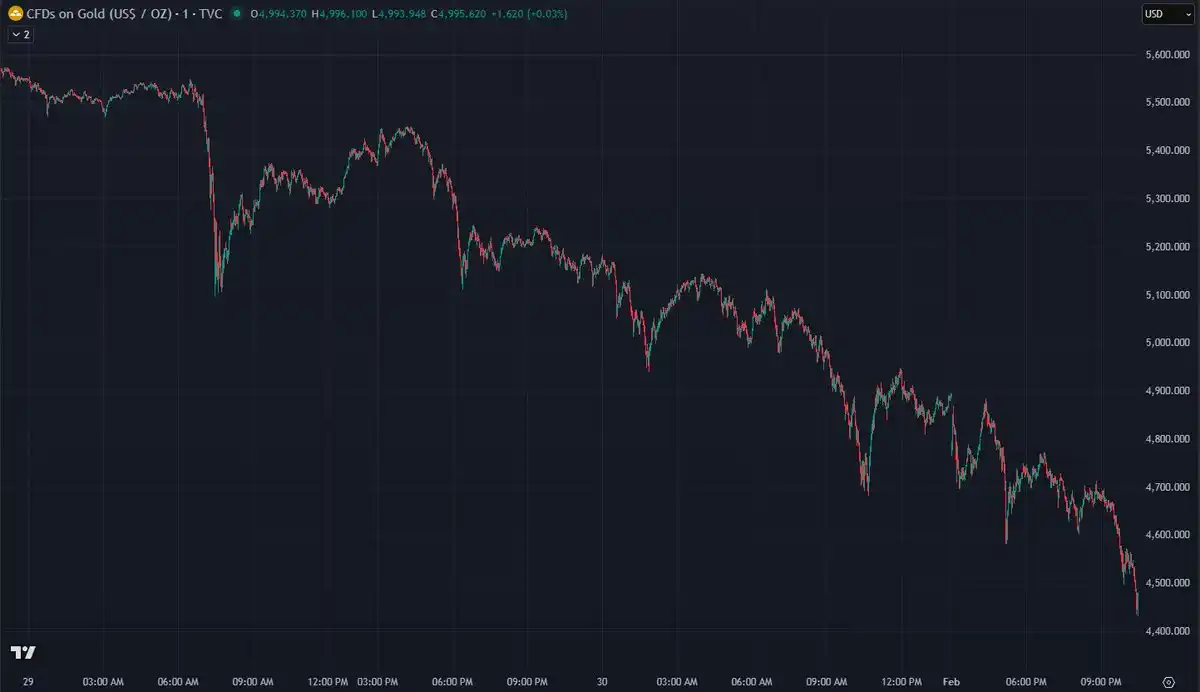
Last Friday's market performance precisely demonstrated what happens when highly crowded trades encounter unexpected catalysts. Gold plummeted more than 12% in a single day; silver experienced its most brutal day since 1980, with a drop of over 30%. The entire precious metals sector saw a market value fluctuation of up to $10 trillion in a single trading day. Meanwhile, the dollar surged sharply, and emerging markets experienced a noticeable decline.
Superficially, all of this was triggered by Kevin Wash's nomination as Federal Reserve Chairman; but the real key lies not in a single personnel appointment, but in a position structure that has already reached an extreme and is ready to "close out and retreat" at any excuse.
We do not believe the world is turning its back on the United States. Our assessment is that the "de-Americanization" trade has become one of the most crowded macro bets of 2026 and is on the cusp of a reversal.
In this analysis, we will systematically break down the deep-seated macro mechanisms supporting this view, not only explaining what we expect to happen but, more importantly, why.
Consensus Positioning
Let's first take a look at how one-sided this trade has become.
In 2025, emerging market asset returns reached 34%, marking the best annual performance since 2017. Of particular note, in the first sustained "emerging markets outperformance period" in over a decade, EEM outperformed the S&P 500 by over 20%.
Fund managers and strategists are almost unanimously aligned. JPMorgan states that emerging markets are "more attractive than they have been in 15 years"; Goldman Sachs expects a further 16% upside for emerging markets in 2026; Bank of America even asserts that "those bearish on emerging markets have gone extinct."
In 2025, emerging market securities saw the largest inflow of capital since 2009.
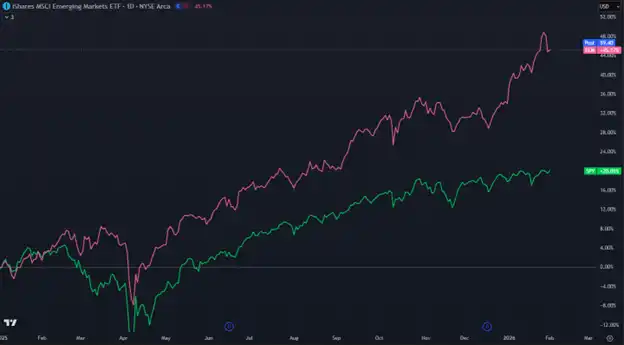
Meanwhile, the US dollar recorded its most significant annual decline in eight years. Gold doubled in price over 12 months, while silver's rise approached quadruple digits. A bet known as the "debasement trade" quickly took the lead, with its core logic being that the US is marginalizing itself through relentless money-printing. This narrative has gained widespread popularity among hedge funds, family offices, and even retail investors.
US Treasuries are also under pressure. China's holdings of US Treasuries dropped to $689 billion in October, the lowest level since 2008, representing a 47% decline from the peak of $1.32 trillion in 2013. Global central banks have been increasing their gold holdings at a rate of over 1,000 tons per year for three consecutive years, clearly indicating a need for diversification away from US dollar reserves. The "sell America" narrative is now fully formed.
However, all of this is heading for a change. What remains undecided is what will trigger the reversal.
Reasons for Dollar Stability
The central premise of "de-Americanization" is a sustained weakening of the US dollar. But the dollar's decline in 2025 was not due to structural collapse but was driven by a series of specific policy shocks, the effects of which have largely been absorbed by the market.
The primary catalyst was the so-called "Liberty Day." When the Trump administration announced widespread retaliatory tariffs in April, the market quickly plunged into panic. The "sell America" trades made sense at the time: if the world couldn't smoothly trade with the US, why would it need so many US dollars and treasuries?
However, the tariff impact has since been gradually absorbed. A series of trade agreements provided a stable anchor for the market; the Xi-Trump meeting in October sent a clear signal of moderation; and the deal with India reduced Trump's previous 25% tariff to 18%. The lower the tariff, the stronger the fundamental support for the US dollar. The market is realigning its expectations, shifting focus back to fundamentals—and at the fundamental level, the US dollar still holds a key advantage.
The interest rate differential still favors the US dollar.
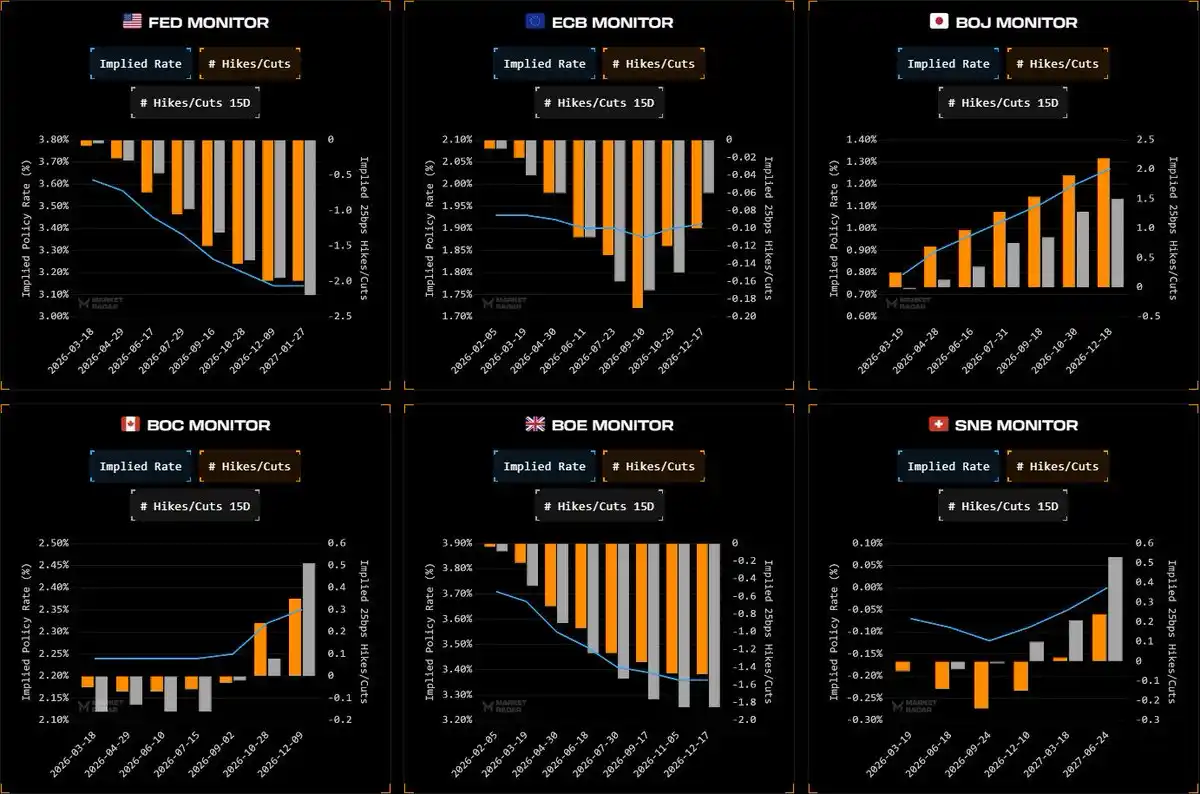
Despite the Fed having cut rates by a cumulative 175 basis points since September 2024, US interest rates structurally remain higher than all other developed economies. The current federal funds rate range is 3.50%–3.75%; the ECB rate is 2% and has signaled the end of its rate-cutting cycle; the Bank of Japan has just raised rates to 0.75%, with a possible increase to only 1.25% by the end of 2026; and the Swiss National Bank still holds at 0%.
This means that US Treasuries still provide a significant yield premium relative to German, Japanese, British, and almost all other sovereign bond markets. Through carry trades and international asset allocation, this interest rate differential continues to create demand for the US dollar.
It is expected that by March 2026, the Fed will have completed all rate cuts in this easing cycle; and most other G10 central banks will also be nearing the end of their respective rate-cutting cycles. When the interest rate differential no longer narrows, the most core force driving a weaker US dollar will also disappear.
For the US dollar to continue to fall, capital must have somewhere else to go. The problem is that all alternative options themselves have unavoidable structural flaws.
Europe is deep in structural trouble: Germany is trying to support growth through fiscal stimulus, while France is moving further away in an unsustainable fiscal deficit; once the economic environment deteriorates again, the policy space available to the ECB is very limited.
Japan's policy mix also struggles to support a stronger yen. The Bank of Japan is moving policy normalization at an extremely slow pace, while the government is pursuing a policy of reflation. The 10-year Japanese government bond yield has just risen to 2.27%, reaching a new high since 1999. According to Capital Economics, around 2 percentage points of this come from inflation compensation, reflecting the price pressure in Japan's reflation process. Japan's inflation rate has been above the Bank of Japan's 2% target for 44 consecutive months. This is not a signal of a stronger yen but a market demand for higher yields to compensate for the persistent inflation risk.
Let's talk about gold again. In this macro environment, it is undoubtedly one of the best-performing assets. However, last Friday's movement exposed its vulnerability. When gold experienced a single-day drop of over 15% following a personnel nomination announcement, with silver plunging 30%, it was no longer exhibiting the normal behavior of a safe haven asset but rather highly crowded trades masquerading as a safe haven asset.
The dollar may not be perfect, but as the saying goes: "In the land of the blind, the one-eyed man is king." Capital fleeing the dollar has not found a truly attractive destination at a scalable level. Gold and other metals once acted as a "pressure relief valve," and we believe that this phase is coming to an end.
Kevin Wash has been nominated as the Federal Reserve Chair, sending a signal that the monetary policy stance may shift. Widely viewed as one of the most hawkish candidates, he has publicly criticized quantitative easing, advocated for balance sheet discipline, and prioritized inflation control. Whether Wash will actually implement a hawkish policy is not the key issue. What is truly important is that the market's unidirectional bet on the "long-term weakening of the dollar" has been positively challenged for the first time. Wash's emergence has brought back the notion of "monetary discipline" as a real threat, while the market had already priced in "permanent easing." This is the change that the highly crowded "devaluation trade" least wants to see.
But there is a crucial detail here. No Federal Reserve Chair, not even Wash, would be willing to sacrifice trillions of dollars in stock market value just to push inflation from 2.3% or 2.5% down to 1.8%. If inflation is only slightly above the target, no policymaker would want to be the one to "knock down the S&P 500 by 30%." They are more likely to wait for inflation to naturally decline rather than take drastic action. Just the "threat" from the hawks is enough to disrupt the devaluation trade; actual policy does not need to be harsh.
The dollar does not need to surge, it just needs to stop falling. Once the core tailwind supporting emerging markets outperformance and the surge in metal assets disappears, these trades will reverse.
Why the U.S. Economic Growth Still Shows Resilience
Another premise of the "de-Americanization" narrative is the weakening of U.S. economic growth. However, the structural foundation of the U.S. economy is far more robust than depicted in this narrative.
Our growth index illustrates this well. Indeed, the growth momentum for the fourth quarter of 2025 has slowed. The index broke below the momentum line in mid-October, briefly turning bearish, further fueling the "de-Americanization" narrative. However, growth has not accelerated downward towards a collapse but has stabilized. By early January, the index reclaimed the momentum line, briefly turning bullish, then falling back to the current neutral range.
The U.S. economy has absorbed the shock of "Liberation Day" tariffs, endured higher interest rates, and yet continued to move forward. The growth in the fourth quarter did slow down, and it had all the conditions for a "collapse"—but it didn't. Its failure to accelerate into a bear market trend is a signal in itself. We believe that after months of sideways stock market consolidation, the market is approaching the "slingshot" phase.
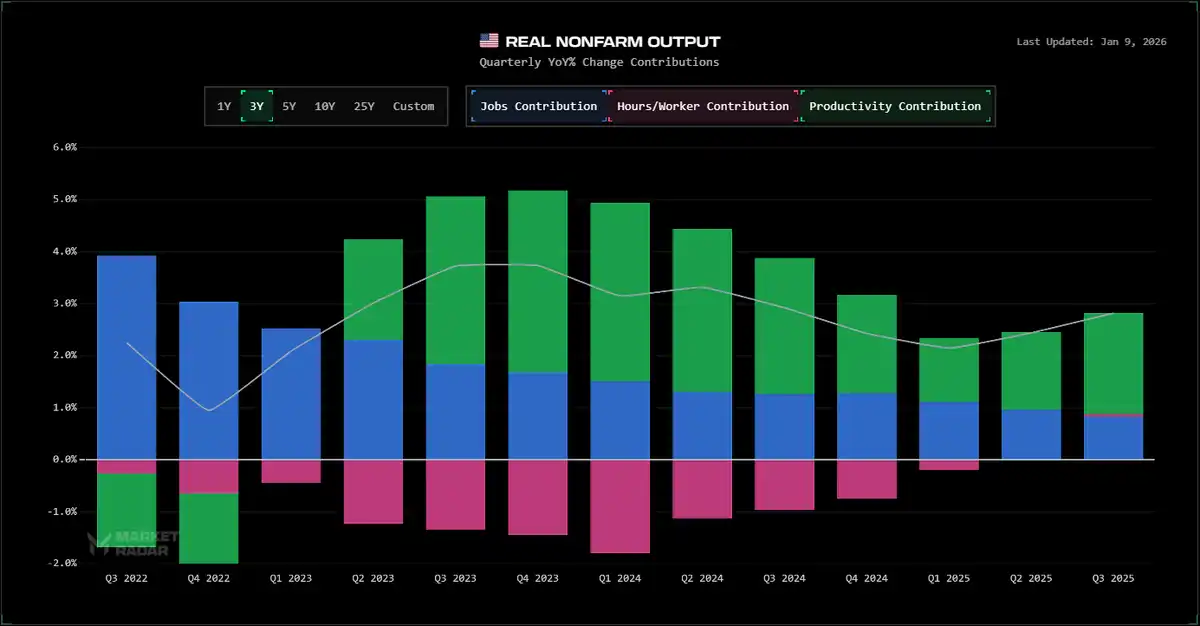
The actual GDP remains significantly above the target level of growth; initial jobless claims have not risen significantly; real nonfarm output continues to rise, and productivity, after contracting throughout 2024, has once again expanded; only household consumption contributed 2.3 percentage points to the growth. This is not an economy on the brink of losing its competitive edge.
Moreover, the fiscal dimension, mostly overlooked by analysts, firmly favors the U.S. The U.S. fiscal deficit is over 6% of GDP, and the "One Big Beautiful Bill Act" is expected to unleash an additional $350 billion in fiscal stimulus by the second half of 2026. In contrast, Europe's fiscal rules limit stimulus even in a downturn, and Japan has long exhausted its fiscal space. Only the U.S., with both the will and the ability, can continue to ramp up spending in times of economic weakness.
Why Positions Were Forced to Liquidate in Such a Dramatic Manner
The highly crowded "de-Americanization" trades have created a vulnerability that transcends fundamentals. When everyone is on one side of the boat, even the slightest shift in direction can trigger a chain reaction of liquidation. Last Friday's performance of gold and silver was a textbook demonstration of this mechanism.
When the news of Powell's nomination came out, it directly hit the market's consensus—that the Fed would maintain loose policy for an extended period and the dollar would continue to weaken. However, the subsequent price action was not investors calmly reassessing the fundamentals but a brutal mechanical response as positions began to unwind.
This situation has been playing out across the entire metals complex. Looking back over the past few months, you'll find a key differentiation: copper prices are falling, while gold and silver are rallying. This is crucial. Copper has significantly more industrial applications. If this round of metal price increases is truly being driven by fundamentals—such as AI data center demand, renewable energy construction—then copper should be leading. But the reality is quite the opposite: copper lags, while the "monetary metals" are soaring. This indicates that the market is driven not by fundamentals but by speculative funds. And speculative trades, once they reverse, often see the most severe declines.
"De-Americanization" trades are inherently reflexive. They self-reinforce: a weaker dollar makes dollar-denominated emerging market assets more attractive; funds flow into emerging markets, boosting their currencies; the strengthening of emerging market currencies further depresses the dollar. This virtuous cycle may seem like fundamentals are "validating" the narrative, but it's actually positions begetting more positions. However, reflexivity is always two-way. Once the dollar stabilizes for any reason, the cycle will reverse: the attractiveness of emerging market assets declines, triggering outflows, suppressing emerging market currencies, and in turn strengthening the dollar. At this point, the so-called "virtuous cycle" can rapidly spiral into a vicious cycle.
Script of "Trump 1.0"
We've seen this movie before, and we know how it ends.
Let's rewind to 2017. The US dollar was plummeting, recording its worst annual performance in 14 years, with a drop of about 10%. Emerging markets emerged as the biggest beneficiaries of this dollar weakness, soaring 38% for the year, marking their best performance since 2013. Emerging market currencies were generally appreciating against the dollar. Analysts spoke of a "golden girl" environment—everything was perfectly aligned for overseas assets. Jeffrey Gundlach publicly urged that emerging markets would continue to outperform. By January 2018, the market consensus was so strong, to a point that should have raised red flags: Emerging markets were seen as a once-in-a-decade trading opportunity.
Then, the US dollar found its bottom.
What followed was a sharp reversal. The Federal Reserve tightened its policy, and the impact swiftly transmitted to fragile emerging market economies. The Turkish lira collapsed, the Argentine peso saw its largest single-day drop in three years. By August 2018, the EEM dropped to $41.13, erasing nearly all of its 2017 gains in just a few months. The so-called "generational opportunity" eventually turned into a generational trap left for those who came later.
Now, fast forward to the present. In 2025, when did the US dollar see its largest annual decline since when? It was in 2017. What was the percentage drop? Again, about 10%. Emerging markets rose by 34%, almost mirroring their 2017 performance. Analysts declared that the "Emerging Markets short trade is extinct"; Bank of America proclaimed, "The next bull market has begun." This high level of consensus now looks eerily familiar.
The power structure is the same, the position structure is the same, the narrative is the same.
Even the governing government is the same as the one that watched all of this unravel years ago.
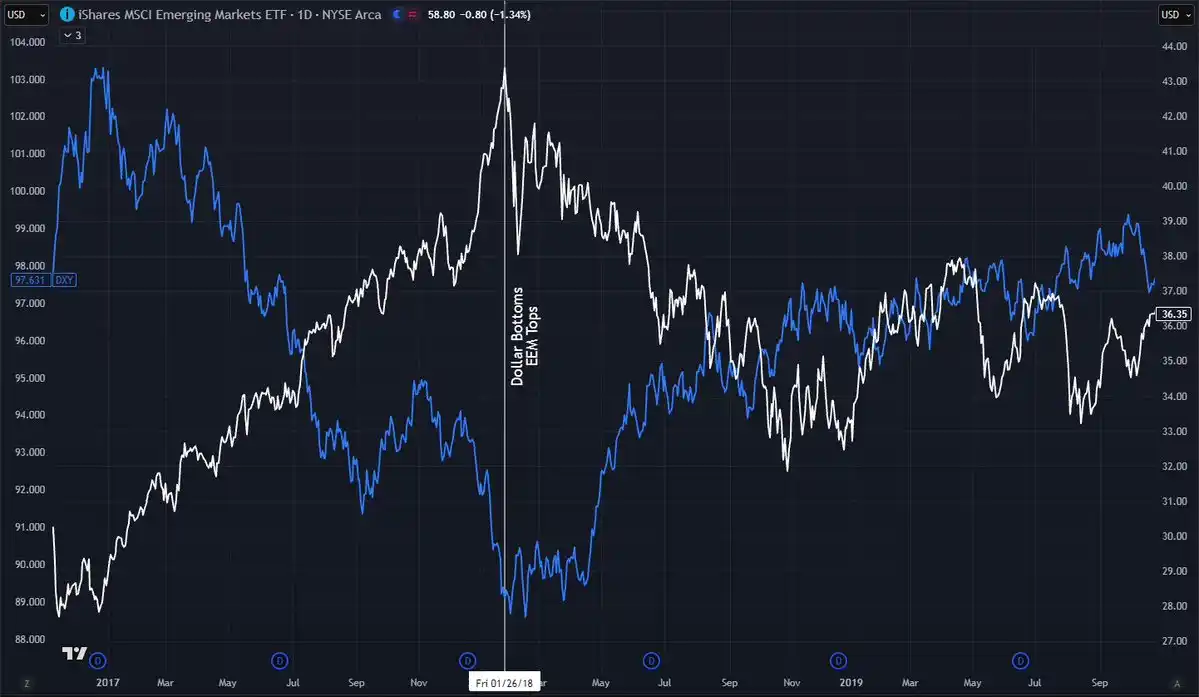
This is a template that has repeated itself under the same political backdrop: the same volatility triggered by tariffs, the same consensus euphoria, and this is exactly what we are witnessing today. The end of that 2017-2018 cycle was not due to a collapse in emerging market fundamentals or an impending economic downturn; it ended for one reason only—the US dollar stopped falling, and that was enough. When the core tailwind disappeared, positions built on that tailwind disintegrated at a staggering pace.
We do not predict a mechanical replica. Markets never entirely repeat. But when the conditions are highly consistent, history provides a valuable prior: the same trades, the same consensus, the same government. The burden of proof has shifted. Those who continue to bet on the long-term dominance of emerging markets need to explain why this time is different. Because last time, in almost the same circumstances, the reversal was both rapid and real.
The Underrated Trade
One point that the "de-Americanization" camp continues to overlook is: the S&P 500 is fundamentally a representation of global growth.
The world economy largely operates on the foundation of U.S.-listed companies. For overseas pension fund managers or hedge fund managers, making a clear decision to systematically not allocate to the U.S. stock market is almost equivalent to declaring that they do not want to hold a significant portion of the world economy. To consistently win on such a bet, the global economic structure must undergo a drastic and profound transformation, which is currently not realistic.
There is no scaled-up "foreign version of Google," no "foreign version of Meta," and no overseas competitor that can rival Apple. The strength of U.S. tech dominance is a fact that proponents of "de-Americanization" are more willing to overlook.
Looking at the current market structure: Oracle has dropped about 50% from its high point; Microsoft has underperformed; Amazon has almost stood still. These giants have almost been absent from this rally, but the Nasdaq continues to set higher lows. What does this mean? It means that even in the absence of these mega-cap companies participating, the index has been maintained at a high level for quite a long time. Now, imagine this: if Oracle finds a bottom, if Microsoft starts to attract buyers, even if these companies rebound by 20%–50%, they may still be in a bearish trend; but once they start, where do you think the index will go?
The real contrarian trade is actually U.S. stocks. Everyone is focused on the decline of the U.S. dollar, fearing that the era of U.S. assets is coming to an end; but the Nasdaq is quietly preparing for a round of "catch-up." The AI theme that pushed the index to a historic high last year briefly stalled: concerns about capital spending emerged, expectations were set too high, and AI growth struggled to materialize. The market did not crash but completed a correction through months of volatile sideways movement.
Now, expectations have fallen back to a more realistic level. As long as growth can break through and AI expectations truly translate into cash flow, the market is poised to rise again. The metal theme may be ebbing; once this wave subsides, a new theme will emerge—U.S. stocks, the underrated theme.
What Form Will the Reversal Take
If the "De-Americanization" trade begins to unwind, its impact is likely to transmit across asset classes in a predictable manner:
Emerging market equities underperform: Dollar strength structurally suppresses USD-denominated returns; reflexivity loop reverses, fund flows flip; the narrative of a "generational opportunity" fades as investors recall why they were underweight EM to begin with.
Metals see further retracement: Last Friday was not an isolated event but the start of a larger repricing. What propelled the prior rally was not fundamentals but speculation; and speculative trades tend to unwind most violently. Gold and silver represent the purest expression of the "debasement thesis"; if this thesis is losing traction, metals still have significant downside ahead.
U.S. equities reassert leadership: Regardless of how "rotation" is framed, the U.S. market still embodies the highest-quality companies, deepest liquidity, and most transparent governance. If the dollar stabilizes and growth persists, capital will revert to where it has long been most comfortable.
Timing and Catalysts
We are not calling for an immediate EM collapse or a straight-line surge in the dollar. Our view is more nuanced: "De-Americanization" has become a crowded trade, presenting asymmetric downside risks; and last Friday, the narrative showed its first clear crack.
The timing hinges on several key factors:
Dollar price action is crucial: DXY must first reclaim the 97.50 mid VAMP, then break above the 99 momentum level to confirm the reversal. Until then, despite fundamentals, the dollar remains technically in a downtrend.
Fed communication shaping expectations: If Powell's reappointment process reinforces hawkish expectations, dollar buying pressure will strengthen.
Economic data altering sentiment: Any upside surprises in U.S. GDP, productivity, or employment will directly challenge the "American decline" narrative.
Our system currently indicates: a Risk-On dynamic in an inflationary environment, but neutral growth intensity. We are at the edge of "slowing down" and "Risk-On": inflation momentum is on the strong side, while the growth has not solidly turned bullish. The structure is fragile enough that a return to "slowing down" or even "Risk-Off" is not far off. We will let institutional signals guide positions; however, the macro backdrop is increasingly favorable for U.S. assets rather than the highly crowded alternatives.
Why It Matters
The danger of a consensus trade lies not in its being necessarily wrong but in its being too crowded. When the narrative fractures, crowded trades often unwind most fiercely.
From the perspective of decades, "de-Americanization" may eventually prove to be right; the long arc of history may indeed veer away from U.S. dominance. But in the next 6–12 months, we believe the risk/reward has flipped.
Everyone is positioned for a weaker dollar, outperformance of EM, and a dumping of U.S. debt. Last Friday showed what happens when this consensus trade faces an unexpected shock. We do not think it was random; we believe it was a warning.
The world has not left America. It is preparing to remember why it was there in the first place.
Welcome to join the official BlockBeats community:
Telegram Subscription Group: https://t.me/theblockbeats
Telegram Discussion Group: https://t.me/BlockBeats_App
Official Twitter Account: https://twitter.com/BlockBeatsAsia