Bitcoin briefly fell below $71,000, how much HODL faith is left in the crypto community?
Original Title: "Bitcoin Dips Below $72,000, How Much Faith Is Left in the Crypto Space?"
Original Author: Yang Chen, Wall Street News
Bitcoin dipping below the $72,000 mark (Update: Bitcoin has now dipped below $71,000) has brought the "faith" issue in the crypto market to the forefront. Against the backdrop of a sharp decline in global risk appetite, investors are reevaluating Bitcoin's position in the market turbulence, and the narrative of crypto assets as a hedge is being questioned.
According to Bloomberg, Bitcoin on Wednesday dipped to $71,739 in New York's closing, marking the first dip below $72,000 in about 15 months. Compared to its peak in October last year, Bitcoin has retraced over 42%, with a year-to-date decline of around 17%, falling to its lowest level since November 6, 2024.
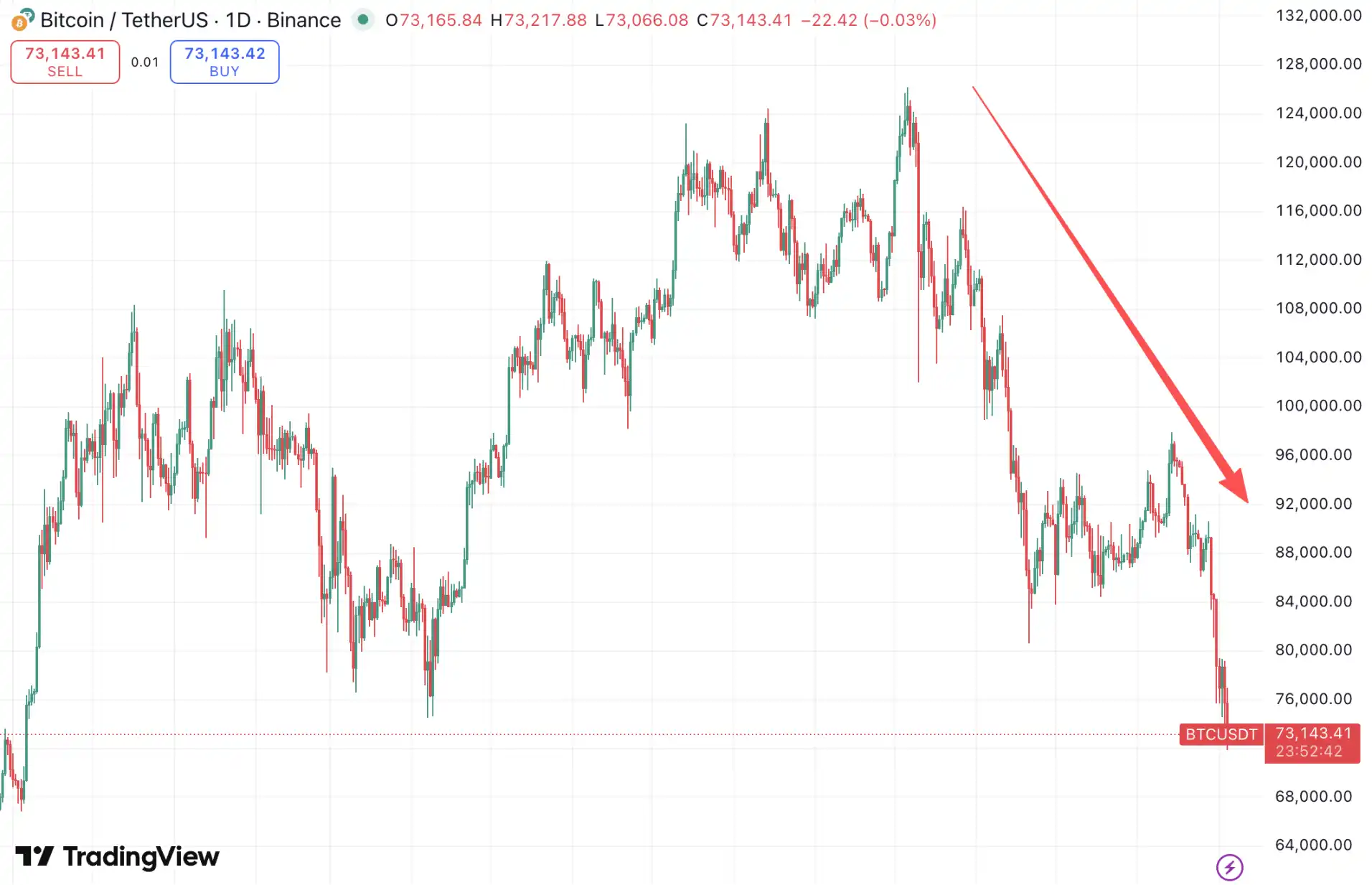
This round of decline is no longer just a deleveraging within the crypto market but is due to broader cross-asset pressure. On Wednesday, global markets experienced synchronous selling, with the Nasdaq 100 index dropping over 2%, sectors more sensitive to interest rates such as software and chips were generally under pressure, dragging Bitcoin down along with them.
On an emotional level, a "crisis of faith" is brewing. Shiliang Tang, managing partner at Monarq Asset Management, stated that the market is undergoing a "crisis of faith."
Andrew Tu, Head of Business Development at Efficient Frontier, also noted that market sentiment in the crypto space is currently at "extreme fear," and if $72,000 is breached, Bitcoin could drop to $68,000 or even fall back to the low range before the initial bounce in early 2024.
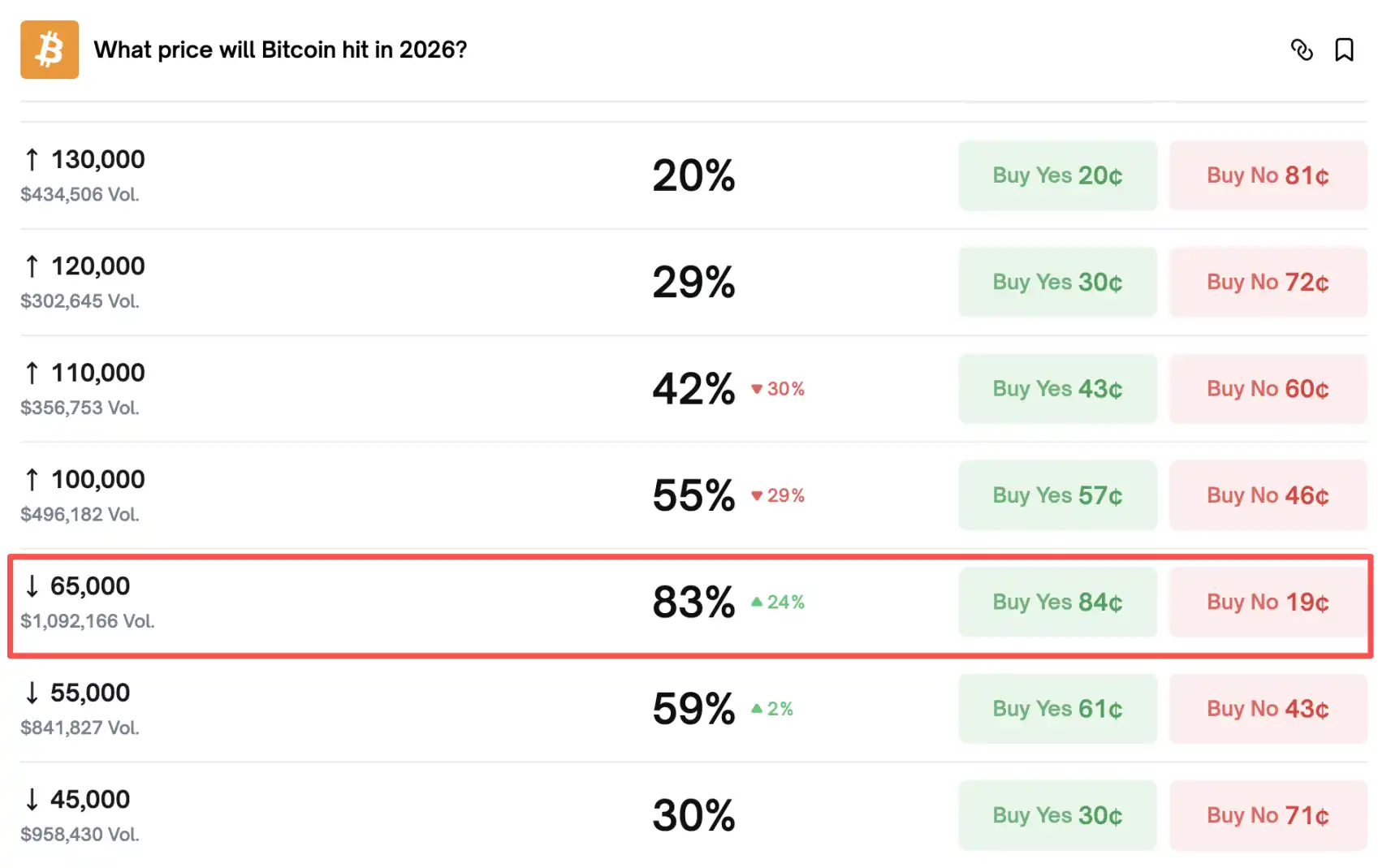
According to Polymarket, there is an 83% probability that Bitcoin will drop to $65,000 this year, and the probability of falling below $55,000 has risen to about 59%.
Risk Aversion Sudden Turn, Bitcoin Labelled as "High-Volatility Risk Asset"
According to Bloomberg, the pressure on Bitcoin on Wednesday was related to broader cross-asset tension rather than solely being driven by internal crypto asset liquidation. This is significant for investors because as the market entered a phase of synchronous selling, Bitcoin did not demonstrate resilience independent of risky assets but rather resembled a high-volatility long tail risk asset.
The Nasdaq 100 Index experienced a daily decline of over 2%, dragging down sectors such as software and semiconductors. On the same trading day, Bitcoin dropped below a key psychological level, reinforcing its market perception as being correlated with risk appetite.
With a 42% Retreat from Peak, the Crypto Market Evaporated Over $460 Billion in a Week
Price retracement is rapidly transmitting through market cap contraction. According to CoinGecko data, the total market capitalization of crypto assets has shrunk by around $1.7 trillion since last October's peak. In just the past week, the crypto market cap has decreased by over $460 billion.
As the largest cryptocurrency, Bitcoin's magnitude and speed of decline have a "anchoring effect" on market sentiment. When Bitcoin's year-to-date decline widens to around 17%, risk control, margin management, and fund redemption pressure often rise simultaneously, further intensifying overall volatility.
How the "Crisis of Faith" Emerges: From Liquidation Shock to Sentiment Dissipation
Market participants' expressions indicate that emotional shifts are becoming a core variable. The "crisis of faith" as described by Shiliang Tang points to investors' simultaneous doubts about the long-term narrative and short-term pricing mechanism of crypto assets.
More importantly, there has been a shift in the driving force behind the decline. According to Bloomberg, the earlier downward phase was more driven by crypto-specific liquidation, while Wednesday's pressure came from broader cross-market tension.
This means that even if the internal leverage unwinding in the crypto market comes to a halt, as long as external risk assets remain under pressure, Bitcoin may still lack an independent catalyst for a rebound.
72000 as a Short-Term Watershed, Market Predicts a Fall to 65000 by Year-End
Many traders view $72,000 as a key short-term price level. Andrew Tu points out that if this level cannot hold, Bitcoin is "likely" to fall to $68,000 and may revisit the low range before the initial rebound in early 2024.
According to Polymarket, Bitcoin has an 83% probability of falling to $65,000 this year, while the likelihood of dropping below $55,000 has risen to around 59%.
The funding side is also sending out mixed signals. According to Bloomberg compilation data, a U.S.-listed Bitcoin spot ETF recorded around $562 million in net inflows on Monday, but quickly turned into net outflows of $272 million on Tuesday, indicating that incremental funds are not stable.
Amid price declines and fund flow fluctuations, skepticism in the market about Bitcoin's role as a "safe-haven asset in times of pressure" is on the rise.
Welcome to join the official BlockBeats community:
Telegram Subscription Group: https://t.me/theblockbeats
Telegram Discussion Group: https://t.me/BlockBeats_App
Official Twitter Account: https://twitter.com/BlockBeatsAsia