7 Biggest U.S. Regulatory Cases Involved in Cryptocurrency in 2020
Original source: Cointelegraph Chinese
Original author: KIRILL BRYANOV
As digital assets stride toward mainstream status in 2020, guardians of the existing financial system have been working hard to minimize disruption from their integration. Throughout 2020, U.S. regulatory and law enforcement interventions have stalled some projects, opened up traditional investors to crypto, and sent some clear messages to crypto service providers around the world. Naturally, the steady legalization and expansion of the crypto space has prompted regulators to intervene in it more than ever. Here are the top 7 cases of U.S. regulators and law enforcement getting involved in crypto that have arguably had the most significant impact on the relationship between the crypto industry and state power in 2020.
SEC vs Telegram
In 2018, TON raised about $1.7 billion by selling contracts related to its native token Gram to qualified investors. Concerned about potential conflicts with the SEC, Telegram followed a framework called the "Simple Agreement for Future Tokens" (SAFT). The first stage of this fundraising process involves selling the contractual right to purchase tokens when TON goes live. Although these legal rights are being sold as securities, in which case the tokens are issued under Regulation D exempt from registration, they are not, in theory.
SEC disagrees with Telegram’s approach and has taken emergency action against Telegram and Telegram Open Network in federal court. The SEC argued that a two-stage token distribution scheme still constitutes a sale of unregistered securities, a position that the court ultimately upheld. The federal court finally fined Telegram $18.5 million, and Telegram should return more than $1.2 billion to investors. TON failed to go live in the end, but the confrontation between it and the SEC has become history, and it may be the last act of the ICO era.
OCC authorized cryptocurrency custody service
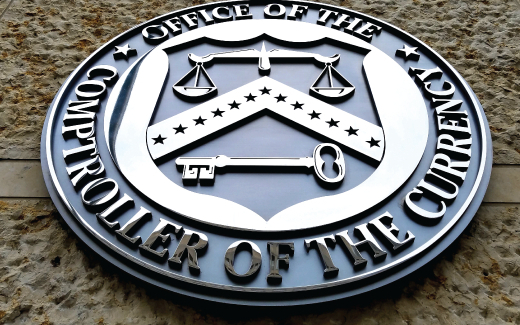
The Office of the Comptroller of the Currency (OCC) is an independent agency of the United States Department of the Treasury. The role of the OCC is to charter and supervise national banks and savings associations. If U.S. financial institutions want to operate nationwide, they must undergo a comprehensive review by the OCC.
On July 22, 2020, the OCC issueda Letter of Interpretation authorizing federally chartered banks Provides cryptocurrency custody services. For institutions within its purview, the OCC has never prohibited them from holding digital assets on behalf of their clients, but a complete lack of guidance and legal transparency has prevented many credit institutions from expanding their services into the digital asset space. If a client is interested in a bank offering custodial services, the bank might say to them, "there's too much risk now".
The letter of explanation states that cryptographic key escrow services are equivalent to physical safekeeping of assets .
This forward-looking approach by the OCC to digital currencies may have something to do with the fact that OCC Administrator Brian P. The Administrator role follows two years as Chief Legal Officer at Coinbase.
U.S. Department of Justice seizes one billion dollars in bitcoin
During the fall of 2020, the U.S. Department of Justice (DoJ) spent a considerable amount of time strengthening regulations on cryptocurrencies under a new set ofguidancepublished by the Office of the Attorney General. Enforcement Actions by Relevant Investors. The process culminated in the Department of Justice's seizure of $1 billion worth of bitcoin in early November. The funds are believed to belong to an unnamed hacker who previously stole them from the Silk Road darknet market, which is now defunct. Blockchain analysis firm Chainalysis has assisted U.S. government investigators in tracking down the record-breaking collection of digital assets.
DoJ and CFTC vs BitMEX
What happened to cryptocurrency derivatives platform BitMEX shows that the same could happen to firms that impress U.S. regulators. BitMEX, founded in Seychelles,has long been suspectedof serving U.S. customers, and as such the exchange is subject to U.S. anti-money laundering and derivatives trading regulations.
Earlier October 2020, the U.S. Department of Justice launchedcriminal charges against the founder of BitMEX, alleging they "willfully failed to develop, implement, and maintain an appropriate anti-money laundering (AML) program," while the CFTC filed a civil lawsuit against the company alleging that it facilitated U.S. residents traded unregistered securities, and BitMEX has suffered a two-pronged blow. BitMEX has been forced to makeemergencychanges to its top management andhirea Chief Compliance Officer.
Perhaps SEC Commissioner Hester Pierce put the gist of the matter aptly when she said BitMEX The case is a clear message to the global crypto industry. "When a product or service has American users, it's subject to U.S. law enforcement intervention," she said.
FinCEN vs self-hosted wallets
A week before Christmas, the U.S. Department of the Treasury’s Financial Crimes Enforcement Network (FinCEN) released One proposal, FinCEN proposeslong-term deterrent regulations aimed at increasing transactional transparency in the transfer of digital funds from centralized exchanges to private wallets. Without any changes, the rule would require exchanges to collect wallet owner personal information from senders if transfers exceed $10,000 in one day, or $3,000 in a single transaction.
In addition to adding a lot of extra work for cryptocurrency exchanges, the proposed rules may The concept caused yet another bashing. However, some observersbelieve that for those wishing to return to the realm of anonymous transactions, simply moving their holdings from the wallet of record with FinCEN to a new wallet will be sufficient up.
SEC vs XRP
In late December 2020, the SEC filed a suit against Ripple, claiming that XRP is a security and The distribution of the tokens is equivalent to offering an investment contract. The news sent the price of XRP plummeting and caused several major exchanges to delist XRP. Although the trial of the case is still several months away, it is clear that the SEC's move will profoundly change the balance of power in the encryption field.
U.S. Treasury Department vs BitGo
In the closing days of 2020, the U.S. Treasury Department’s Office of Foreign Assets Control reminded cryptocurrency businesses with U.S. ties that another source of regulatory scrutiny is compliance with various sanctions programs. The U.S. Treasury finally reached a $98,000 settlement with cryptocurrency custodian BitGo for 183 apparent violations of U.S. Treasury Department sanctions between 2015 and 2019. Among the company’s violations was its failure to prevent users residing in sanctioned regions such as Crimea, Cuba, Iran, Sudan and Syria from using the BitGo online wallet.
Original link
Welcome to join the official BlockBeats community:
Telegram Subscription Group: https://t.me/theblockbeats
Telegram Discussion Group: https://t.me/BlockBeats_App
Official Twitter Account: https://twitter.com/BlockBeatsAsia

 Related Articles