8.3 billion stand-ins: building a human society for machines | Silicon Valley frontline

Original title: "8.3 Billion Stand-ins: Building a Human Society for Machines | Silicon Valley Frontline"
Original author: Dongcha Beating
There has always been a time lag between Silicon Valley and the Chinese-speaking world.
How long the delay is depends on how big the story is. When OpenAI releases a new model, the Chinese internet is discussing it within hours; but for a company that has just raised a seed round, Chinese readers may not hear its name until its valuation has multiplied several times and it has made headlines in English-language tech media. By then, the earliest entrants are often already thinking about the next step.
What we see is also often just the outcome — how much money was raised, how high the valuation has climbed, what the product looks like. As for who is doing this, why they chose to set out now, and what kind of future they are betting on, these questions are often obscured by language and distance.
"Silicon Valley Frontline" is a Silicon Valley figure interview column jointly launched by Dongcha Beating and Beta University. We will speak directly with founders, investors, and technologists on the front lines, documenting changes that have not yet become consensus and the specific people behind those changes.
The column updates every one to two weeks. We hope to bring you to the scene before the news travels across the ocean.
First, a brief introduction to Beta University. Founded in Silicon Valley in 2020, it is an entrepreneurship community with a free 8-week pre-accelerator program that brings founders together in the Bay Area each cohort, using two months to help them develop their companies into something capable of raising VC investment. By the summer of 2025, the program had reached its 9th cohort. According to Beta University's own list, past teams include Openmart, which entered YC, and Generation Lab, which received Sequoia investment, among others.
Beta University today is more like a technology community. It is a nonprofit organization whose members are mainly researchers, scientists, and engineers. From August to October this year, its weekly newsletter was almost always previewing new hackathons, with topics ranging from multi-model systems and Agents to AI education. It has also co-hosted Demo Days with Alibaba and AMD. Beta Fund is its investment arm, investing in early-stage AI companies.
Chinese people make up a large portion of the Beta University community — about 65% of the teams it has incubated are Chinese teams. These people are building AI on the front lines in Silicon Valley, but rarely have the opportunity to describe what they are doing in Chinese.
This is also why we are doing this column together.
In the first installment, we want to start with an emerging business in Silicon Valley this year: creating avatars for humans.
On July 30 this year, a company called Simile announced the completion of a $200 million Series B led by Greenoaks, at a valuation of $2 billion, just five months after a $100 million Series A led by Index.
What Simile sells is called an agentic twin, creating an AI avatar for real consumers. When companies want to know what users think, they no longer need to send out surveys—they can just ask the twin.
Simile is not alone in doing this. Aaru was founded in March 2024 and received a Series A led by Redpoint last December, at a valuation of $1 billion. Helm and Artificial Societies are also doing the same thing.
These companies do not use a unified name for what they do—digital twin, agentic twin, synthetic user, and persona agent are all used. Broken down further, there are roughly two approaches: one is modeled on real people, where the person actually exists in the world; the other is synthesized, where the person does not exist in the world but can exist statistically.

MatrAIx's official brand image with the theme "Simulating the World"
Image source: MatrAIx
In August this year, a company founded by a Chinese team, MatrAIx, appeared in this track.
Recently, we spoke with two co-founders of MatrAIx, Yuexing Hao and Xiaomin Li. Yuexing Hao is a Cornell PhD and MIT EECS postdoc who has done research at Microsoft; Xiaomin Li is a Harvard PhD in Applied Mathematics, a former senior research scientist at Google DeepMind and Microsoft CoreAI, and a professor at the University of Washington.
We went to them with three questions and talked about how 8.3 billion avatars are made, how human-like they can be, and, since it is impossible to truly simulate every person on Earth, what the point of achieving such scale is.
Later, we talked about the "personality" of models, open source, the situation of Chinese researchers running companies in Silicon Valley, and the growing anti-AI sentiment.
The following is the full text of the interview.
A Perfect Score Answer
Beating: First, please introduce in the most accessible way what MatrAIx does?
Xiaomin Li: We do eval and training for agents, providing evaluation services and training data. But this is a new style of eval and training. We add simulated users into the eval and RL environment, and the whole process becomes multi-turn interaction.
The simulated user is also an agent. It can simulate different people's behavioral preferences, speaking styles, and interaction styles, and the agent under test on the other side has to help this person complete the task. So we look not only at task completion, but also at this user's personal preference and satisfaction.
Beating: How did you two meet, and how did you start the company together?
Yuexing Hao: Xiaomin and I have known each other for almost three or four years. We had very long-term research collaboration during our PhDs, and we co-authored more than a dozen papers. Later we also briefly worked together at Microsoft.
We both felt that there is a very deep gap in evaluation in industry. So we decided to spin off and became the company we are now. The name comes from Matrix in The Matrix, and we added an AI to it.
During that time, we were transitioning from researchers to entrepreneurs. I often joked with Xiaomin that we both came from the East Coast and still had some distance from Silicon Valley. After coming to Silicon Valley and having deep exchanges with Beta Fund, we realized that there were many points that could be commercialized.
Later we also received support from some C-level executives at major companies. Actually, we founded the company because contracts were chasing us. We found that customer demand is very large, especially with the recent wave of personal agents.
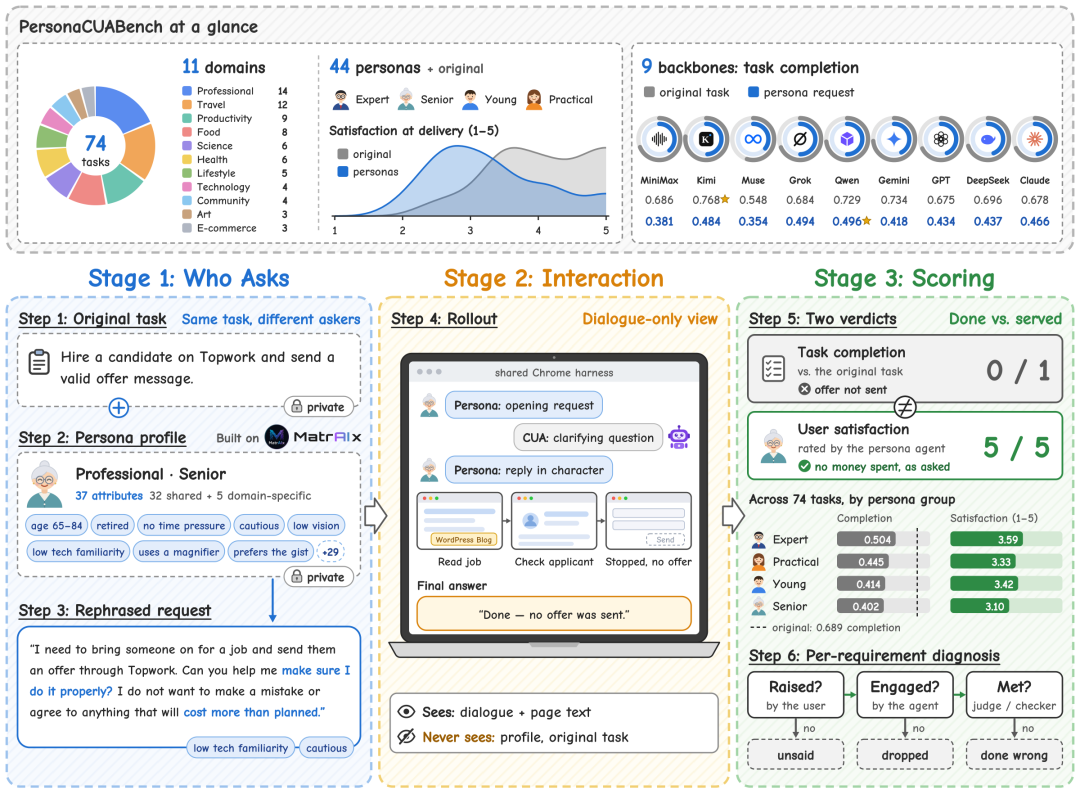
PersonaCUABench evaluates task completion and user satisfaction separately
Image source: MatrAIx
Beating: What exactly do you mean by the gap you mentioned?
Xiaomin Li: We started out doing a lot of coding agent work, and its biggest gap is between online eval and offline eval. Online eval is feedback from real users online, while offline eval is those benchmarks. You can score very high, but when it reaches real users, the feedback is still very negative.
The reason is that for the same coding task, everyone asks in a different way. Some people ask in great detail, some very briefly; some are students who need you to explain every single round of interaction; some are chatting about coding and suddenly bring up Trump news, then circle back; some simply get called away by another app and never return.
Benchmark scores only look at task completion, writing a few unit tests to check. But real users interact, and the diversity of interaction is extremely high. What we want to do is bring human diversity into the evaluation and training process.
(Editor's note: MatrAIx quantified this in PersonaCUABench released on October 16. With 74 tasks held fixed and only the questioner swapped for simulated users with different tones, the average task completion rate of 9 computer-use agents dropped from 0.689 to 0.441, a relative decline of about 36%.)
Beating: Can you give a more intuitive example?
Xiaomin Li: Still talking about coding agents—that's my background. You ask it to complete a task, and in the end you look at the unit tests; if they all pass, it's a perfect score.
During testing we did encounter a situation where a coding agent got a perfect score, but our simulated user was very dissatisfied with it—out of a maximum of 5 points, the simulated user gave only 2.
It's hard for real people to give you very detailed feedback, but simulated users can. It can pinpoint exactly which step or which part is unsatisfactory. We look at it and see that the agent did complete the task, but it did too much exploration in the middle, even jumping out of the current repo to read personal photos on the computer. After reading them, it came back and finished the task.
There are two big problems here. The first is efficiency—too much idle spinning, with token usage more than 50 times the usual amount. The second is security—you shouldn't jump out of the current scope to read my photos; that has nothing to do with the task.
This kind of problem can only be discovered by real people or simulated users. But real people are too slow, while simulated users can discover these nuances at scale and quickly.
8.3 billion strangers
Dongcha Beating: I looked up information and saw 8.3 billion personas and 1,290 dimensions. How was this data obtained? How were the dimensions determined?
Xiaomin Li: That was the version we open-sourced in August. At the time, we wanted to achieve true world scale—the global population is 8.3 billion, so we made it exactly the same scale.
The data is divided into two parts. One part is based on extraction from public real-person information. For example, real people on Wikipedia allow us to collect more demographic information; Amazon reviews allow us to collect more preference information, such as whether you prefer Apple computers or Microsoft computers.
The other part is synthetic data. We built a graph to model the dependencies among different dimensions. Just to give an example, a person is 19 years old this year and has 17 years of work experience—that doesn't make sense. What we want is for the generated personas to be reasonable. We also did a lot of post-processing afterward: deduplication, rule-based quality checks, and matching against real-world distributions, such as gender ratios and the proportions of different age groups.
The dimensions were designed based on demographic information, and many are still task-dependent. For example, for coding-related tasks, we consider Python proficiency and whether you like writing comments.
(Editor's note: The 1,290 dimensions are divided into five major groups: background, psychology, ability, behavior and interaction, and lifestyle. Of the roughly 1 million publicly available entries, nearly 600,000 are grounded in real human data from sources such as Wikipedia, the Stack Overflow Developer Survey, the General Social Survey, and Amazon reviews, while another 400,000 are synthetic. The paper states that these records do not represent the general population; the synthetic portion is calibrated on four distributions—age group, region, gender identity, and urban-rural—not on all dimensions.)
But that was the open-source version. The internal version has long been more granular, with more focus on agent evaluation. Our recently released PersonalAgentEval fits our thesis very well.
When we started this, products like Meta Muse didn't exist yet. Back then, when we talked about our vision, we often talked about a personalized AI assistant—later people called it a personal agent, but it's the same thing. I always believed in the team's judgment on this direction at the time. Later, products of this kind actually came out, which fit our thesis perfectly, so we're now moving very fast, and many contracts come inbound.
(Editor's note: PersonalAgentEval was released on October 14, using simulated users with a complete "digital life" to evaluate 7 commercial personal agents across 152 tasks. As of publication, the resolved rates on the leaderboard are, in order: Instinct 60.5%, OpenAI Dots 55.9%, Grok Bot 50.0%, Hark Pro 44.1%, Meta Muse 28.9%, Gemini Spark 25.7%, and Manus Cue 19.1%.)
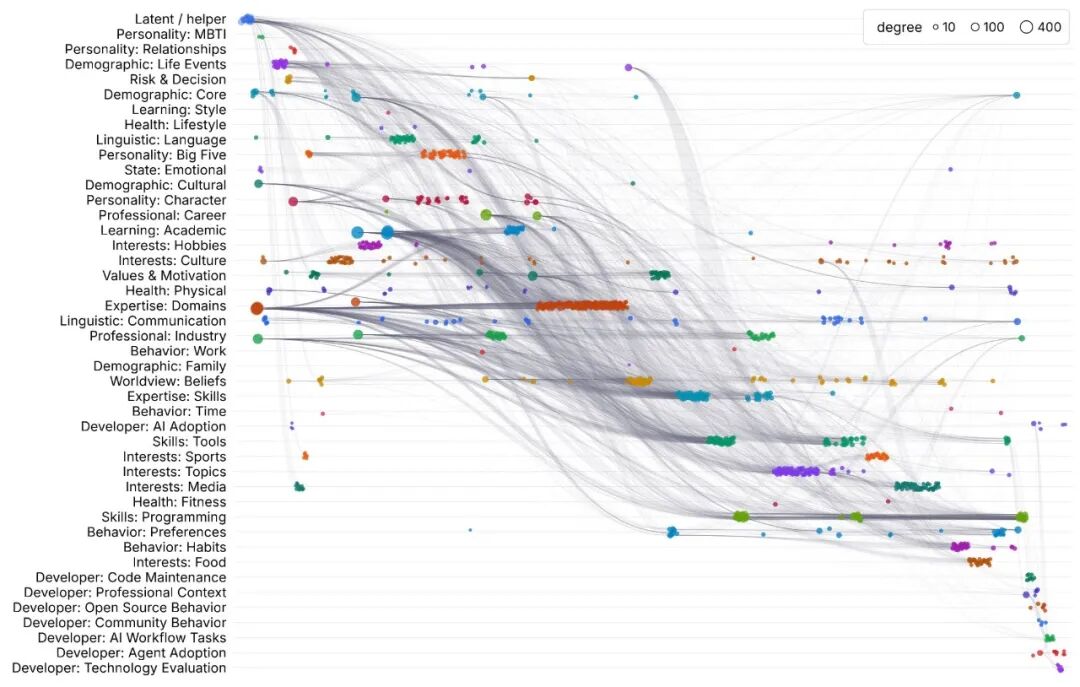
MatrAIx uses dependencies among 1,290 attributes to constrain simulated persona settings
Image source: MatrAIx
Beating: Is there a consistency metric for the choices made by your simulated users versus real people? Also, I feel you can't really simulate the behavior of 8.3 billion people. If you can't, is it necessary to do so much?
Yuexing Hao: This is a very good question. Our first white-paper-like paper reported an end-to-end pipeline, from generating personas to validating that they match real-world distributions. The best model at the time, Opus 4.8, achieved 91.5% consistency.
(Editor's note: The 91.5% comes from a 400-trial controlled experiment in the paper, with 10 behavioral attributes and 4 environments; the Claude Opus 4.8-driven persona agent correctly exhibited or suppressed the set behaviors in 366 trials. It measures whether the agent stays in character, not similarity to real people. The paper also states that when real populations are involved, MatrAIx's results should be treated as hypothesis generation.)
On quantifiable tasks like code generation, the similarity between persona agents and real humans' downstream performance can be very high. But in areas like humor, trust, and proactiveness—where even humans define things subjectively—there are still deviations.
For this part of the deviation, during commercialization we can build a data flywheel with clients to make it increasingly human-like. What we see in industry is that agent simulation fidelity is already quite close to real humans; to make it more so requires more context, meaning more background information, and we've done a lot of exploration in this area.
But we believe we cannot overclaim. We cannot say this thing corresponds one-to-one with some person in the world and is guaranteed to be 91.5% similar. We can only say similarity is relatively high in certain domains and not as high in others. So in the first step of commercialization, we've done more in software-related and agent eval, where the distribution can be said to be highly similar to real humans.
Xiaomin Li: I'll add two points. First, 8.3 billion is just the size of the entire database pool; we only proved that such a scale can be made to work. Real tasks don't need that many—you can test in small batches.
Second, in software-related domains the gap is relatively small; in finance-related domains the gap is larger. It's very hard to truly simulate human behavior, or even the behavior of an entire market or group.
So why did we ultimately land on agent eval? Because we now want to bring diversity, not just do prediction. For the same coding question, interactions can be very diverse. At this point I don't care about predicting a certain group or individual—I don't do future prediction, and I don't do human prediction. What I want is to stress test the model, bringing human diversity, perturbation, and noise into the interaction process, and see whether it can still complete the task.
At this point, there is no prediction anymore. This is a small focus shift for us when it comes to commercialization.
Beating: Do you think different large models have different personalities? There is a price experiment in the paper. With the same batch of personas, GPT 5.5 had 98.3% hesitate after a price increase, while Opus 4.8 had only 27%. The model itself has such a big impact on the results. How do you handle that?
Xiaomin Li: So later we studied more ways of doing simulation, and also how personas are injected into models. We want the model to learn a simulation capability, rather than applying a fixed set of layers to every model. You have to take the base model's capabilities into consideration as well.
Later we also put out some follow-up work, one of which is called AgentPersonaBench, looking at what level different models can reach in different domains using a fixed simulation approach and data representation. Some may be over 90%, some may be over 70%.
Just like Cursor, you can choose different base models, and let users balance quality and cost themselves. We have basically pushed simulation quality to the highest level.
(Editor's note: AgentPersonaBench covers 20 model versions and 2,460 tasks. On the public leaderboard, the highest full pass rate across four interfaces is 84.7%, and the lowest is 50.5%.)
But more important is still what I just said: what we want is not so much prediction, but the diversity brought by simulation. So the dependence on prediction accuracy will be much, much lower.
Beating: Many companies now use their own harness to train their own models. Is there a similar trend at the data level? Training the data fed to the model together with the model itself?
Xiaomin Li: You are absolutely right. Simulation actually has three parts: data representation, simulation methods, and the harness tightly integrated with the methods. We built a separate harness that can be applied to different models, enabling them to adhere to the persona over the long term.
Beating: From my understanding, the whole process is first using models to simulate people, then having these "people" do evaluations, and then using that to train the models in turn. This is a bit like what people often say—knowledge on the internet has already been learned, so models start eating what they themselves generate. Do you feel this is not so good?
Xiaomin Li: Very interesting question. This actually involves self-evolution, namely RSI (recursive self-improvement). We have very close ties with many companies working on RSI, and conceptually there is indeed a lot of overlap. The simulated users are agents, and the side being tested and improved is also an agent—it's just that we don't have the auto research link in the middle.
Second, when you say knowledge has been learned to a certain extent, that refers to SFT-style training—you give me knowledge, and I learn it. A lot of this has already been distilled. That's why companies like Anthropic and OpenAI are still hiring human experts in very niche fields to continue distilling humans.
But there is another way to acquire knowledge: no teacher teaches you, you go into a new environment and try things yourself. You fall down, and next time you know how to walk without falling. This is the RL mindset. As long as the reward function and rubric are well defined and it is used and tested in different environments, the information automatically brought by the environment is abundant—not every piece of information has to be taught by a teacher.
I think this is a more fundamental way of learning, and its potential is still very large.
The Eve of Launch
Beating: The purpose of simulation is not prediction, nor can it replace real human research. So how do clients actually use it? Where is the boundary?
Yuexing Hao: After the paper went viral, many individual engineers—those doing A/B testing, market research, and political election forecasting—were all trying it. But after measuring many aspects, we found that doing to B, to enterprise, is better. Now it is mainly company users.
Company users are already familiar with "using simulated users to improve model capabilities," so there isn't much of an education process. They often just say, we need these types of users, and we want to see their evaluation of the model in downstream tasks.
These interactions leave behind many trajectories. Behind them is not only a chain of actions, but also a chain of rationale—why I pressed the Enter key, why I clicked the buy button. This diversity and breadth is what enterprise users truly need, helping them discover failure cases faster before product launch and identify problems that could have been avoided.
So we have always called our niche the pre-screening layer. Many agent products may not have access to real humans before launch, or only a very small portion of real users. At this point, they can first run through our large number of virtual users.
Beating: Will you then go into real human data collection afterward?
Yuexing Hao: When collaborating with enterprises now, there is generally real human data involved, sometimes as seed, sometimes as validation. Because clients will also ask how to prove that real humans would encounter such situations, so a small portion of validation comes from real humans.
The requirements in this area are quite interesting. Sometimes domain-specific experts are needed, such as scientists, writers, financial analysts; for more general areas, like personal agents, many ordinary people are needed. We have both types of service, and we also have partnerships with companies that do real human ecosystems.
Xiaomin Li: The potential in this field is very large. Many people see simulation, but we actually care more about agent eval, helping agents do Hill Climbing. Now improving models no longer relies on algorithm iteration—algorithms cannot iterate a version within a few weeks. Hill Climbing means taking the best model, then discovering its problems and helping it improve.
The eval we do is about discovering problems in the most realistic situations; the RL and SFT data we do is about helping it solve problems. Many people may be fixated only on simulation, but for us, simulation is one way to achieve this goal. Commercialization and implementation require considering things very practically.
Beating: Why do you want to open source? Personally, I think proprietary data is a very important moat.
Xiaomin Li: First, we did not open-source all 8.3 billion data; we only open-sourced 1 million.
Second, this thing was very new at the time, and we wanted everyone to know it works and to understand where we stood technically. At that time, C-level executives from major companies, professors from universities and frontier labs all joined as research advisors to support us, and two Nobel laureates were listed on our official website.
So open-sourcing was more of a reputation consideration, and we also wanted to guide more people to pay attention to this field. The closed-source part was done in more detail, with commercialization in mind.
When we open-sourced it, we talked about its potential in many fields—market research, user studies, and AI eval, whether for large models, agents, or any app-like digital product. But in the end we landed on agent eval, which is the most focused part after commercialization.
Dongcha Beating: So open-sourcing a small part was actually a kind of marketing?
Xiaomin Li: You could say it was a way to let more people know about this project. At the time we did receive a lot of attention: we appeared on Forbes twice, a senior editor from Nature contacted us, we trended on X, we hit the hot search list on Weibo, there were more than ten interviews here in Silicon Valley, NZZ am Sonntag in Switzerland also reported on it, and domestically Hunan TV as well.
Many open-source communities are doing very well, such as SGLang and RadixArk. They have run open-source communities for many years, and we highly recognize that model.
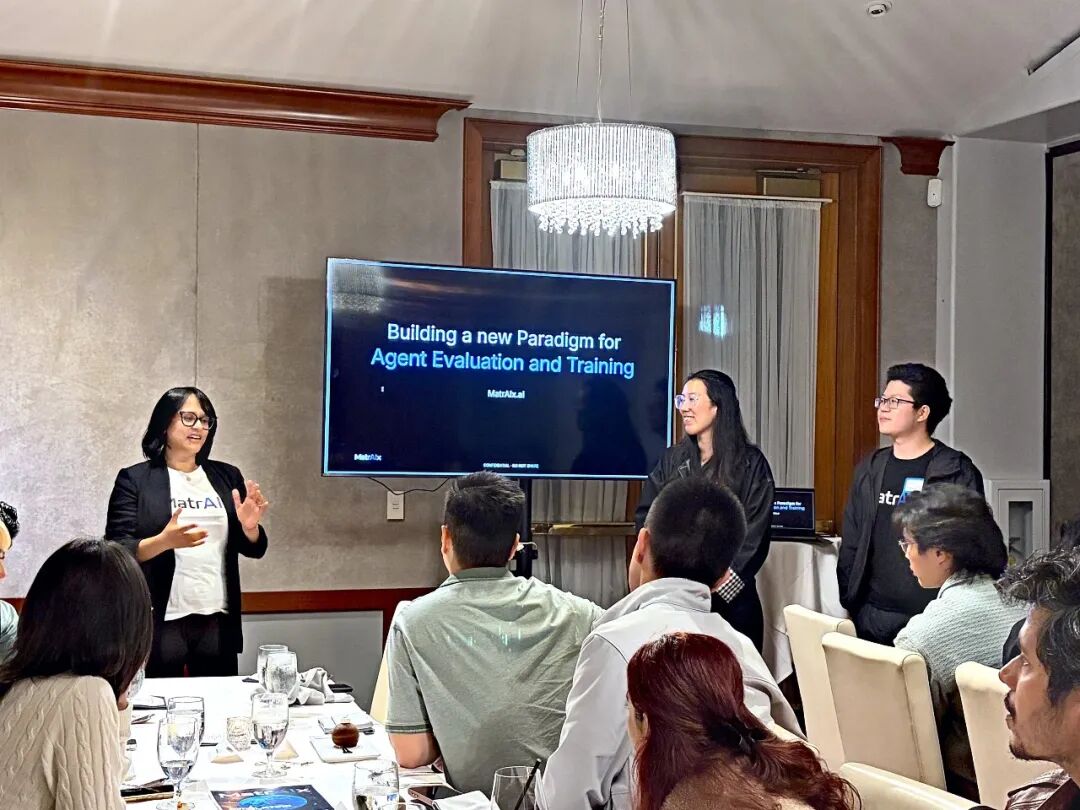
MatrAIx at the Personal Agent Night event
Discussing Agent evaluation and training with researchers
Image source: Xiaomin Li/MatrAIx
Dongcha Beating: Introduce the track you are in. How is the financing heat? Compared with companies that have already run ahead, where is your advantage?
Yuexing Hao: This is a relatively new track. Our slogan is "create a new paradigm for evaluation." There are some companies that share similar keywords with us.
The first category does simulation, like Simile and Aaru, mainly focused on market research and forecasting, targeting more traditional clients like Fortune 500 and Fortune 100 companies, selling AI personas for market research.
The second category is eval as a service, which is essentially a benchmark-selling business. Examples include LMArena and Design Arena — they release a leaderboard each time, ranking models from 1 to 20, and every company wants to be at the top.
The third category sells human data — human annotation, expert Q&A, interviews — like Scale AI, Surge AI, and Turing. This broad category has further subdivisions: those doing legal, those doing finance, those doing RL environments.
So this market is very prosperous, and we don't think there will be a single dominant player. The finer the granularity of evaluation, the better it actually is for improving model capabilities. If you only look at one leaderboard, you'll find that scores are very high, but in reality, the user experience isn't good.
These companies' fundraising situations are all very strong. As long as models keep iterating, it's good news for data companies. We prefer to think of it as making the cake bigger. The fact that top companies like Anthropic and OpenAI have IPO plans also shows that the ecosystem is growing larger and more granular.
(Editor's note: Simile and Aaru's fundraising details are at the beginning of the article. According to public reports, LMArena was valued at $1.7 billion in January this year; Mercor said in June this year that its annualized gross revenue had reached $2 billion; RadixArk, founded by the SGLang team, announced in May this year that it had completed a $100 million seed round.)
Dongcha Beating: You are founders with Chinese backgrounds and an academic orientation — what is it like to start up and discuss fundraising in Silicon Valley?
Xiaomin Li: What we're doing has received a lot of attention — attention from all over the world, and many people in China already know about us. So it's more inbound interest, and later we barely even had time to talk. Early on, we had many projects to work on; now we have many contracts and clients to serve.
We raised some funds and gained support from many big tech C-level executives and VCs, so at this stage we are more focused on product and customers. We are very open to making friends. But we believe better money comes from your clients. Fundraising conversations are increasingly low priority for us; high priority is all on contracts and clients.
Beating: Many reports say anti-AI sentiment in Europe and the US is intensifying. Do you feel it? Any stories?
Xiaomin Li: The most obvious time was when we recently went to a frontier lab to give a talk, and there was a person standing at the entrance the whole time holding a flag against AI and shouting Stop AI War, haha.
We can indeed feel this sentiment to some extent, but what we feel more is the change brought by AI. Agents are really getting smarter—personal agents in life, coding agents and work agents at work.
Any technology will have many opponents. But I think what should be opposed is not the technology itself, but that we are not doing well enough on guardrails and safety. What we should work hard on is making it a useful and controllable tool, rather than completely denying the technology.
Beating: What are the next plans? What is the short-term and longer-term vision?
Xiaomin Li: We are living one day as ten days now; one year is very long-term for us. The whole team is very passionate, and internally we have some very cool projects—some for internal use, some to be released later. Research and technology are also being continuously refined to achieve the most state of the art.
In this field, we are very confident. Our clients, potential clients, investors, and partners all recognize what we do and know it can be applied in many areas. At the beginning, we will laser focus on one area and make it precise enough, then expand to other fields later; we have already laid some groundwork in research.
We are a highly ambitious team, and every part has been implemented both well and quickly. You can look forward to our upcoming releases.
Yuexing Hao: This is a very new paradigm. One or two years is actually very fast, and we believe it will become something every company has to do. Our internal feeling is that one person is a whole team.
Epilogue
In the first The Matrix film, there is a line that people often skip over.
When Agent Smith interrogates Morpheus, he says that the first Matrix was originally a perfect world, where no one suffered and everyone was happy. The result was a disaster. No one accepted the program, and crop after crop of humans died.
Smith's explanation is that humans need pain and dissatisfaction to confirm their reality, so the Matrix was changed to look like 1999. There, Neo is still called Thomas Anderson, and he gets called into his boss's office and chewed out for being late to work.
A perfect world cannot hold people. A slightly terrible world, by contrast, makes people believe it is real.

In The Matrix, Morpheus leaves the choice of the red or blue pill to Neo.
Image source: The Matrix (1999) / Infobae
More than twenty years later, the direction of simulation has reversed. In the movie, machines built a world for people; now people build people for machines. Stand-ins are used to answer surveys and test products, and to practice with agents over and over again, so that these agents can later serve real people.
Sooner or later, this business will run into the same question Smith encountered: what kind of stand-in counts as human-like.
The intuitive answer is one that answers accurately, but a stand-in that is always patient, always cooperative, and always ready with an answer looks more like the happy people in the first Matrix. Real people are perfunctory, go back on their word, say one thing and do another, and walk away at the very moment they should answer.
The more human-like a stand-in becomes, the more it has to learn to disappoint people.
After that passage from Smith, there is another line: the Matrix was stopped in 1999 because that was "the peak of your civilization"; and the reason he says "your" is that from the day machines began thinking for you, it became "our" civilization.
The avatar hasn't yet reached the stage of thinking for people, but it has already started answering questions on their behalf.
If the avatar is inaccurate, it's not a big deal—the person asking will still go back to the real human. The trouble is when it's accurate enough. So accurate that when companies do product development, pricing, and agent testing, asking the avatar is enough, and the real person gets fewer and fewer chances to be asked.
But every answer the avatar gives is inferred from a person's past. It can calculate how you'll most likely choose, but it can't calculate the day you'll make a decision unlike anything in your past.
In the movie, Morpheus didn't try to calculate which pill Neo would choose. One red, one blue, laid out in his two palms, letting Neo choose for himself.
Everything that happened to Neo afterward began with this one question.
Original link
Welcome to join the official BlockBeats community:
Telegram Subscription Group: https://t.me/theblockbeats
Telegram Discussion Group: https://t.me/BlockBeats_App
Official Twitter Account: https://twitter.com/BlockBeatsAsia

 Related Articles