From on-chain gacha to collectibles infrastructure, the infinite possibilities of Renaiss's verifiable fairness mechanism.

One of the tracks BlockBeats has been following is the on-chain TCG card market. Earlier this year we wrote an in-depth article on this, one of the most profitable businesses currently on-chain. But what does an on-chain TCG card-drawing platform still need to reach a larger market? We believe that more important than channel distribution is returning to this question—the fun of opening packs comes from unknown results, but whether the card pool is real and whether the rules are enforced should not become another unexplainable uncertainty. Especially when platforms procure cards themselves and rearrange prize pools, the richer the product experience, the more specific the trust responsibility the operator must bear.
Not just proving that a certain random number is valid, but connecting how the prize pool is constructed, when the list is sealed, and why the random result corresponds to this card. Open-source algorithms and public verification tools mean fairness does not have to remain only in the platform's explanations—it can also become evidence that users and third parties can check.
The significance of this path is that it will no longer limit the on-chain TCG card market to the on-chain card-drawing business itself, but enable the same set of verification processes to be used for other collectible assets and use cases. Before understanding these possibilities, we must first return to the TCG market: why people continue to buy, collect, and trade these cards is precisely the demand foundation the platform needs to serve.
The business behind a card: competition, collecting, and cross-generational demand
We have all more or less played TCG cards, especially childhood "card battle" games, but we may not have researched why TCG cards are so popular today or the current size of the TCG market.
A TCG card can enter a competitive deck, or be placed in a protective sleeve and become part of a collection someone wants to complete. These two uses together support the TCG market. Grand View Research estimates that the global TCG market will be approximately $18.537 billion in 2025 and is expected to reach $32.141 billion by 2033; the Pokémon TCG in the same study is estimated at $6.681 billion in 2025, accounting for about 36%.
The physical TCG card market continues to expand. A Bandai survey shows that the Japanese multi-brand TCG market, calculated at suggested retail price, expanded from ¥111.2 billion in the fiscal year ended March 2022 to ¥319.7 billion in the fiscal year ended March 2025, with the latter growing about 11.7% year over year.
The secondary market is equally active, and sky-high sales of rare cards make people truly feel that this is no longer the realm of toys, but of collectibles. On February 16, 2026, the only Japanese Pikachu Illustrator rated PSA GEM MT 10, held by YouTuber and WWE star Logan Paul, sold at Goldin for $16,492,000 including the buyer's premium, with a hammer price of $13,300,000.
The first layer of demand for this business can be seen at the competition tables. Pokemon official tournament results show that the TCG player count at the North America International Championships was 2,274 in 2023, 3,119 in 2024, and rose to 4,562 in 2025, an increase of about 100.6% over two years. Among them, the Masters Division grew from 1,897 to 3,812. For these players, cards are first and foremost competition tools; they need to test decks, find key cards, and then bring their decks to events. Therefore, beyond opening packs, buying specific single cards to build the required combinations is a continuous demand.
Competition has also attracted viewers who do not sit at the tables themselves. Esports Charts recorded that the peak concurrent viewership for the Pokemon TCG World Championships Masters Division livestream was 77,088 in 2024 and 82,507 in 2025. This division alone already has a foundation of tens of thousands of people watching the finals simultaneously. In 2026, the organization recorded a peak of 173,698 for the TCG category.
Tournament prize money is also rising. The prize for the Pokemon Official World Championships TCG champion was $25,000 in 2023; the 2026 rules list a prize of $50,000 for champions in each age division, and when summed according to the prize table, the nominal prize amount for the three TCG age divisions is $1,020,000. As for top players specifically, Chilean player Fernando Cifuentes won the 2024 World Championships Masters Division with an Iron Thorns ex deck, and the tournament database records a champion prize of $50,000. In an oral account published by The Guardian in January 2025, he also described being invited to the Chilean presidential palace after winning and meeting President Gabriel Boric. Just like in the esports market, prize money, public decklists, and champion stories allow competitive events both to motivate participants and to attract more attention to cards and players.
Beyond competition, collecting is the larger consumer intention. People who put cards into protective sleeves do not necessarily want to become champions. For many adult collectors, buying cards again means reconnecting with characters they loved as children. Reuters interviewed Kenneth Ho, a 36-year-old commercial pilot living in Hong Kong, in March 2026. He grew up in Toronto, began collecting Pokemon cards in the 1990s, paused during high school and university, and returned to the hobby during Covid lockdowns. His collection includes Mario Pikachu promotional cards and a Pikachu card wearing a Charizard-themed poncho. In the report, he linked childhood memories with the collecting potential he sees today; character memories and adult purchasing power meet in the same person.
This affection will also carry into the next generation's life. When Japan's BSS reported on a newly established card section at a store in Yonago City, Tottori Prefecture in 2024, it interviewed a father playing Pokémon cards with his child. He said, "I had Pokémon cards when I was a kid. I felt nostalgic looking at these cards, and my child said they wanted to play too, so we play together as father and son."
Children may simply hope for their favorite Pokémon to appear, players want to pull the cards they need to complete their decks, and collectors wait for special illustrations or high-rarity versions. The long-standing influence of classic IPs has made related TCG cards appeal to both young and old, keeping consumer willingness flowing endlessly—this is why the TCG card market thrives.
From the Joy of Opening Packs to Platform Trust: Why Fairness Needs Verifiability
One of the greatest pleasures of TCG cards is the uncertainty when opening card packs. When buying single cards, users already know what they will get, but opening packs is like opening blind boxes—the result is only revealed once the pack is opened. Tearing open an ordinary pack and occasionally encountering a favorite character or special card face is precisely the appeal that distinguishes pack opening from direct purchase. For example, Charizard ex 199/165 from Scarlet & Violet—151 is a Special Illustration Rare; its card face, character, and rarity make it different from ordinary cards bought merely to complete a deck. Another example is One Piece English OP-05 "AWAKENING OF THE NEW ERA," which placed Super Parallel special versions of the three captains Luffy, Law, and Kid into the series lineup, and also included a one-year anniversary special Luffy card using new illustrations by Eiichiro Oda.
Reasons such as limited offline store coverage constrain people from enjoying this pleasure, and at the same time, with highly developed online social interaction today, people have higher demands for enjoying this pleasure, which has given rise to online pack-opening platforms.
DOPA! and Clove both cover Pokémon and One Piece cards; what they sell is not factory-sealed booster packs, but original draw products in which operators purchase cards and then rearrange the prize pool. Users buy points, select a card pool, and participate in draws. DOPA! officially states that as of August 2026, cumulative users exceeded 1,500,000, with more than 500 types of card packs on constant sale.
Whatnot, by contrast, preserves the fun of live pack opening and livestream viewing. Its Card Break sells physical card products according to pre-announced slot rules; buyers watch the host operate, ask questions on the spot, and then wait for the physical items to be delivered. The platform officially states that in September 2026, Pokémon card sales on the platform exceeded 10 million cards.
Compared to purchasing card packs at physical locations, online pack opening offers better convenience, more diverse pack options (custom-built prize pools), richer social experiences, and other advantages. However, unlike buying card packs at physical locations, consumers do not have the same natural trust in pack issuers when opening packs online. This is especially true in cases where the platform self-sources cards and self-builds prize pools—the experience is indeed richer, but the fairness and trust the platform itself needs to establish are correspondingly greater.
The fun brought by the uncertainty of opening card packs is built on a foundation of fairness and transparency. Disputes over fairness and transparency will affect whether consumers are still willing to accept uncertainty as an entertainment experience, challenging one of the largest underlying consumer demands in this industry. In March 2026, The Athletic and Sports Collectors Daily reported that consumers filed a private arbitration against Whatnot over random card pack opening and repacking. Whatnot explicitly denied the relevant descriptions, emphasizing that the platform does not allow gambling and stating that live pack openings are conducted on camera and that violating sellers will be penalized.
As the TCG card market develops rapidly, disputes will inevitably increase, because evidence of fairness often remains only in the hands of operators. Disputed cases cannot prove that Whatnot has engaged in unfair behavior, but they do provide a point of differentiated competitive advantage for on-chain TCG card platforms—can verifiable rights to fairness and transparency be placed in the hands of consumers?
Pool-building algorithms and input requirements can be made public, prize pool lists can form an on-chain commitment before drawing, and random proofs and card selection rules can be used to review specific results. After obtaining the corresponding complete inputs and after prize pool details and historical draw records are made open, external parties can recalculate on their own rather than merely waiting for the platform's explanation. It is not only about publishing "the probability of drawing a certain type of card"; publishing the inputs, algorithms, and results connected to the commitment, and further allowing users to check how the specific distribution is generated—that is the expectation for fairness in the on-chain TCG card market.
Fairness goes beyond randomness: discovering Renaiss's advantages through fairness and transparency
Let us start with the fairness and transparency of TCG cards, with several specific questions: Does the platform form prize pools according to public rules? Is the card drawn the same one that was placed into the prize pool in advance? Has the platform altered card or valuation records after the draw? According to the established drawing rules, should I have received this card?
Overall, among the 5 mainstream on-chain TCG card platforms at present, the one that impressed us in terms of fairness and transparency is Renaiss—this platform does an excellent job.
The first question is to check whether the prize pool is formed according to public conditions. Renaiss has made public the pool-building algorithm and the required data. After obtaining the corresponding candidate cards, recording valuations and configurations, external parties can rerun the same set of rules to check whether the same prize pool can be obtained and whether it satisfies the prescribed quantity of each tier and the average valuation range. For example, if a configuration requires the prize pool to contain a certain number of high-grade cards, recalculation can check whether the final list satisfies this condition, rather than merely trusting a picture of a grand prize displayed on the page.
Verifying the prize pool list answers the question of "whether this list changed afterward," while being able to recompute the list further answers "given these candidate cards and conditions, was this list originally generated according to the rules," making whether the pool-building rules were executed a checkable question.
On this point, here is a horizontal comparison of other platforms:
· They can verify the list after the prize pool is formed and have also disclosed the card selection rules, but how the complete candidate inventory forms the final prize pool according to all pool-building conditions—no detailed explanation was found
· Public recomputation mainly targets the random results of opening card packs and partial candidate card selection, and does not include the complete pool-building process—no detailed explanation
The second question: checking whether the drawn card belongs to the prize pool sealed before the draw, and whether the recorded valuation has been altered. Before the draw, Renaiss stores the verification record of the entire prize pool list on-chain; this process is called Seal. The unique identifier of each card and the USD valuation recorded at that time are both included in this record. After the draw, users can verify the credential corresponding to the winning card and confirm whether it is the same item in the originally sealed list. Suppose a card was recorded as $100 at sealing time, and later the same item is changed to $200—when verifying again, it will not match the original sealed record. Even if the platform secretly changes the price on the webpage or database side, the modified data cannot impersonate the original record and pass verification. Likewise, swapping in another card or adding or removing constituent cards in the prize pool will also cause the entire pool verification to be inconsistent.
On this point, Renaiss associates the sealed record with the on-chain timestamp before the draw, so that the check not only answers "whether the data changed" but also answers "whether this commitment predates the draw result." Here is a horizontal comparison of other platforms:
· They have similar capabilities, but whether the prize pool records used were publicly put on-chain before the random draw results were generated—no detailed explanation.
· They can check the relationship between some candidate cards and the winning card, but cannot confirm that the complete prize pool and its valuation were jointly fixed before the draw
Third, check why, according to the draw rules, this card should have been obtained. Proving that the winning card was originally in the prize pool is not enough; the platform also needs to explain why it was assigned to this user. Renaiss allows external verification of that random result, and then, combined with the cards previously drawn, recomputes the one that should have been selected from the remaining prize pool at that time. If the card given by the platform differs from the recomputed result, it cannot pass this verification step.
This is a crucial point and the one users feel most strongly about, so basically every platform has implemented it, just in different ways—for example, publishing historical VRF integration materials or verifying the relationship between the random index and the prize through contracts. But Renaiss's advantage is not that it has a unique and far-leading effect on all three questions above, but that it connects them completely: first check how the given data forms the prize pool, then verify the cards and valuations committed before the draw, and finally verify the random output and how it maps to this card. VRF handles the randomness proof, Merkle Root handles the data commitment, and the pool-building and card-selection rules connect the two into a reviewable process.
Hands-On with Renaiss Fair: How to Verify the Prize Pool and Draw Results
Renaiss achieves the above because it has a complete open-source fair and transparent verification system called Renaiss Fair. Even without opening card packs on the Renaiss platform, you can directly experience the effects of this system through the Renaiss Fair page, and we have tested it out.
First, how is the prize pool composed? We used the Verify a Gacha feature of Renaiss Fair to check the PANDORA 88 prize pool:
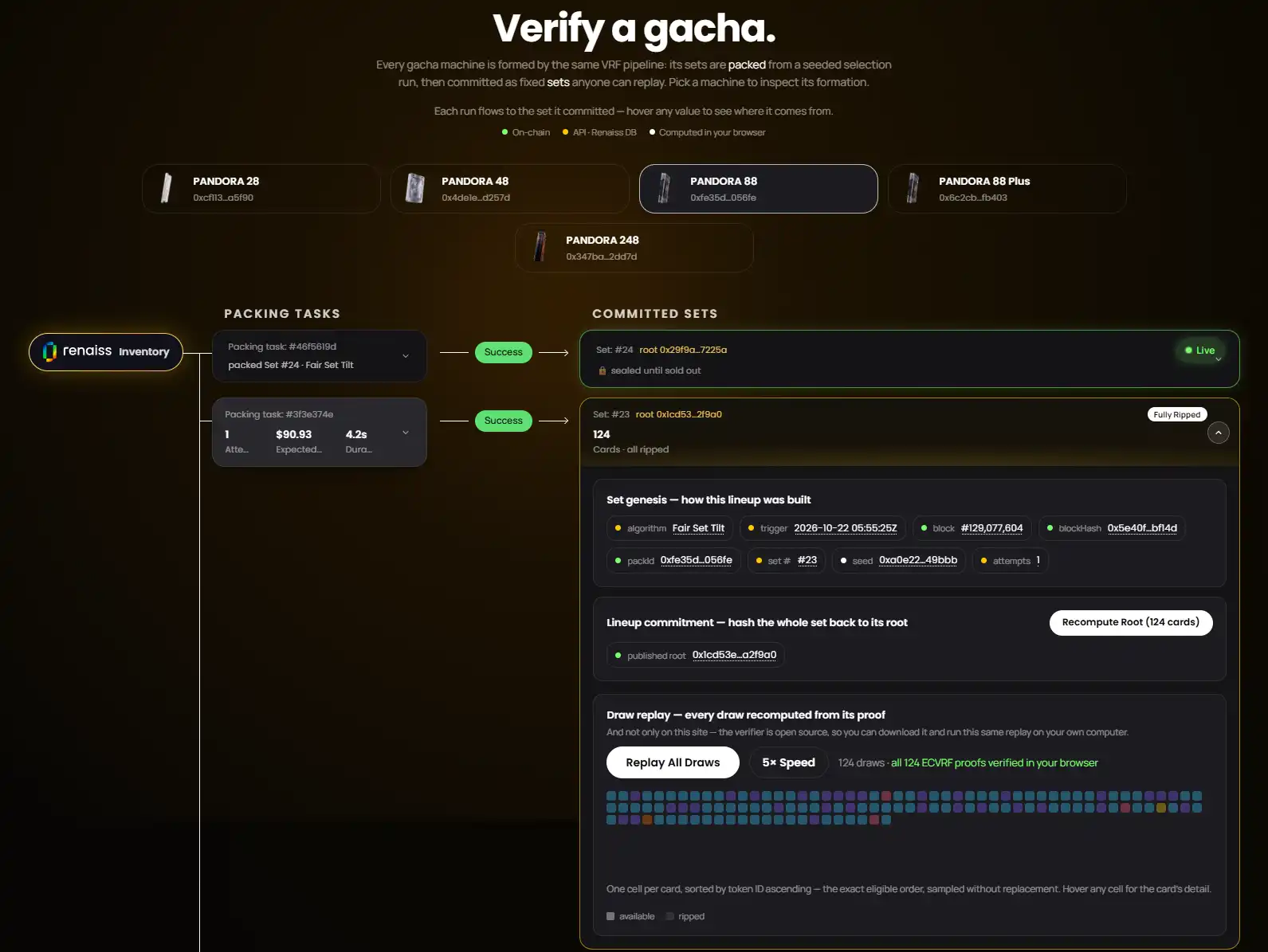
When checking PANDORA 88 this time, the completed Pool 23 showed 124 cards, with the construction algorithm as Fair Set Tilt, and listed the trigger time, block, seed, and number of attempts. The page also marked the currently selling Pool 24 as sealed. The algorithm for prize pool composition, trigger time, block, seed, number of attempts, and the number of cards in the pool are all very complete.
Renaiss's Fair Set Algorithm uses candidate inventory, card valuations, configuration, and a reproducible random stream to build the prize pool, then checks conditions such as the expected value (EV, i.e., the average card value calculated by draw probability) range and the number of cards in each value tier. Candidate pools that fail the hard conditions will not be directly published. At the same time, open source allows the same inputs, algorithm version, and configuration to match the same construction results. External parties can verify why the prize pool list was accepted, rather than just trusting the platform's claim that it meets the requirements.
Next, can the prize pool be changed after the draw starts? We clicked the Recompute Root button in the image above, and the page recalculated the root value from the 124 cards, prompting "Derived root equals the published root," indicating that the recomputed value of the public list of these 124 cards matches the published root value, and is the same as the published root value read on-chain:
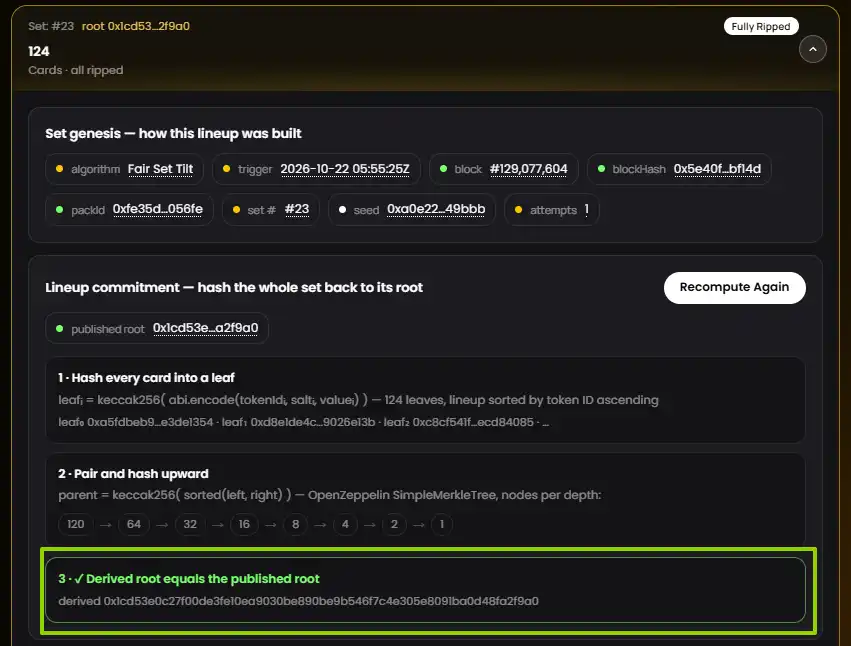
Renaiss's design is to organize the prize pool card data into a Merkle Tree before the draw starts, and record the Merkle root on-chain. The Merkle root can be understood as the "digital fingerprint" of the prize pool list, used to check whether the list is consistent with when it was sealed. The leaves here contain the card token ID, salt, and valuation at the time of construction. If cards are later added, removed, replaced, or the committed valuations are changed, recomputation will usually yield a different root value, and such deviation will be detected.
Finally, why did the user ultimately receive this card? Renaiss Fair's Use Demo Rip feature provided a bundled transaction and completed a six-step verification. The transaction can also be queried on BscScan, and the public API shows it came from PANDORA 88 Pool 1 with checkoutId 1. The expanded verification results are as follows:

The verification results show that the pool has 287 cards, and there are no earlier draws to deduct. After the ECVRF proof passed, the recalculated index was 46, mapping to PSA 9 Mint's 1999 Pokémon Base Set "#85 Pokémon Center." Finally, the root value recalculated along the Merkle path composed of 9 hashes matches the published root value.
The official front-end tool lowers the operational threshold, and the open-source implementation allows third parties to independently re-verify without relying on the same webpage.
Extension of Business Boundaries: What Else Can a Complete Open-Source Verifiable Fairness Mechanism Do?
Renaiss Fair is indeed a good open-source fair and transparent system, but on what basis can it be said to have the potential to trigger a value revaluation?
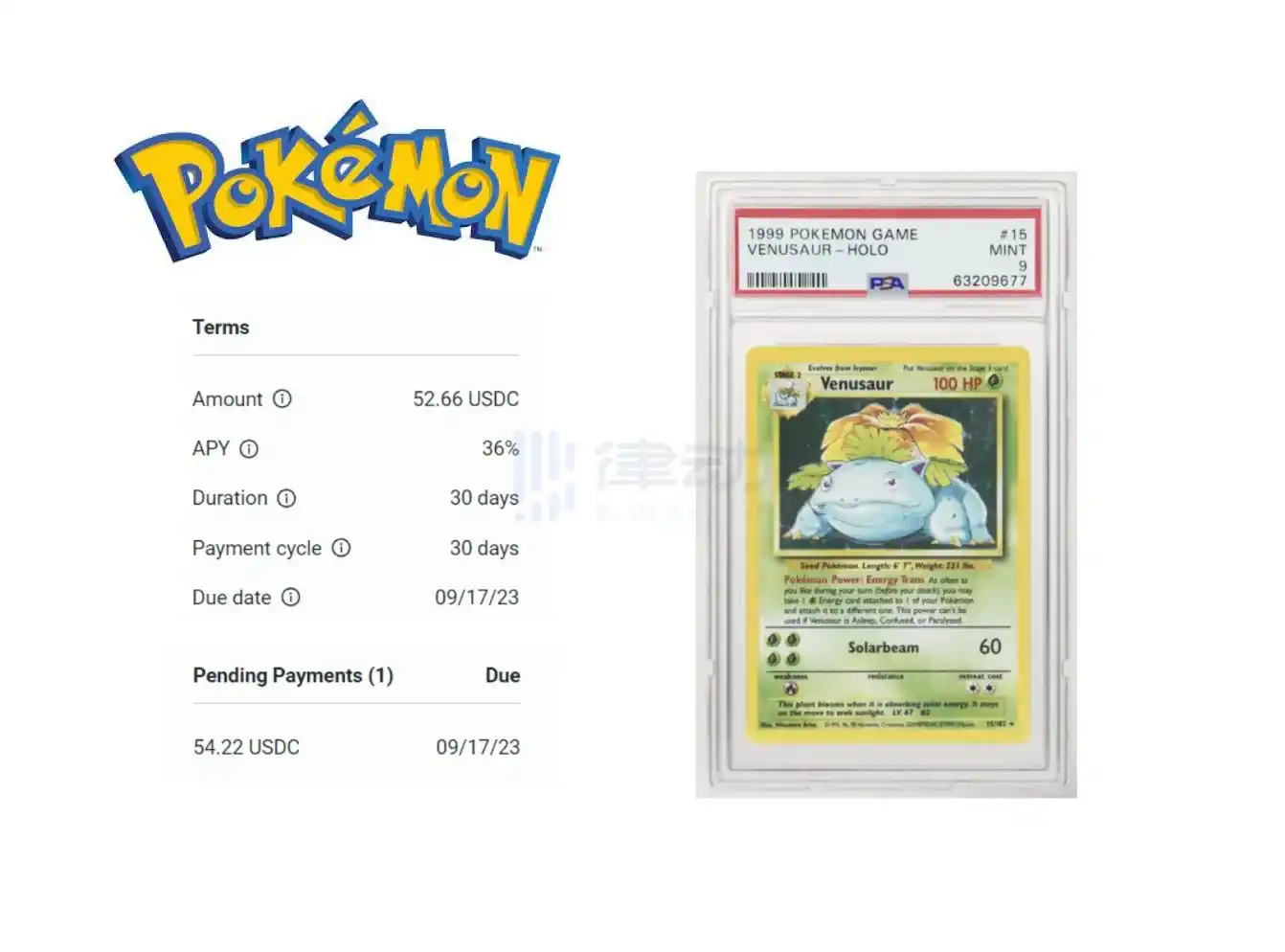
First, the financialization utility of on-chain TCG cards is far from being unlocked. As early as 2023, we saw @S4mmyEth use one of his Pokémon cards to obtain a loan with an APY of 36%, but for years, the potential of TCG cards in lending and even more DeFi scenarios has not been unlocked by a large and stable platform.
Since last year, some platforms have also offered perpetual contracts for TCG cards and new collectible assets such as CS2 and Dota 2 game skins, such as Trove on HyperEVM. These platforms often use oracle price feeds, and the final outcome is often a Rug Pull. The cost of building a complete open-source fair and transparent system is inherently there, and it very much demonstrates the project team's determination.
Most on-chain TCG card platforms are still positioned at the vertical application layer of "card pack distribution." This positioning is good and very profitable, but homogeneous competition is already fierce. Distribution is about channels, but Renaiss's complete open-source verifiable fairness system not only demonstrates its determination for long-term development but also enables it to break away from pure channel competition and have more possibilities at the verification layer.
During the Hong Kong Consensus conference in February this year, Renaiss held a special exhibition focused on high-end physical collectibles. Renaiss partnered with card shops such as LOGOMAN and YAMACARDO to display cards with QR codes that allow visitors to view ownership and custody information. What is presented here is no longer just related to the online card-pack-opening business, but rather how the physical items provided by partner card shops are linked to queryable digital records—an extension of external scenarios built on its own capabilities.
This is a standardized physical-to-on-chain process. Authentication and verification are completed by third-party professional institutions, including LegitApp and partner card shop staff, together with on-chain signature confirmation; the physical assets are then received, scanned, and minted with signatures through Renaiss Network Vault OS by approved distributed third-party custodians or vaults. From the outset, Renaiss did not follow the generic "physical NFT" approach, but instead chose to build a dedicated smart contract standard for physical collectibles.
This external collaboration case shows that fair mechanisms can be integrated into asset collections with clear provenance and custody relationships. If partner card shops or issuers wish to conduct limited sales with randomly assigned editions, the next step is to seal the asset list, saleable quantity, and allocation rules in advance, and then let buyers verify whether the assets they receive match what was promised. The physical side is responsible for providing trustworthy asset records, while Fair's verification process can be used to check the subsequent allocation.
In limited-edition collectible sales, consumers often first face not the question of how low the odds are, but whether they can know why their eligibility disappeared. Kotaku reported on September 8, 2026, that a wave of cancellations occurred in Pokémon Center's 30th Celebration card preorders, with multiple buyers saying they queued on their phones for hours, placed only one order, and were still canceled. Some players speculated that the platform accidentally harmed real people while cleaning up bots, while others suspected overselling.
This preorder was not a verifiable random lottery. If limited sales were changed to eligibility allocation using a Renaiss Fair-style process, the business side could, after review, seal the anonymous applicant list, the publicly available quantity, and reserved quotas, while fixing purchase limits, cancellation, and waitlist replacement rules, and then use VRF and a public allocation algorithm to generate the purchase order. Users could verify whether people were added temporarily after sealing, whether public quotas were reduced, or whether waitlist replacements were skipped.
Another issue is whether, after obtaining purchase eligibility, the specific rights received match what was promised. The 2026 World Cup Random Selection Draw randomly allocates ticket purchase eligibility when demand exceeds inventory, but disputes remain. The Athletic reported on April 8 that a fan who purchased Category 1 tickets had seats for two matches located in areas marked as Category 2 on the map at the time of purchase. FIFA responded that the map was only a category-range guide, not a precise seat map, and that later maps reflected the final zoning; the New York and New Jersey attorneys general issued subpoenas in May to investigate issues including seats not matching promotions.
If a verifiable mechanism is adopted, it is not enough to merely seal the applicant list; commitments must also be made to the public inventory of each category, as well as the mapping rules between categories and specific seat pools, and then random proofs and deterministic algorithms must be used to complete non-repeating allocation. In this way, external parties can check whether the actual allocation comes from the originally committed set, whether inventory has been reused, or whether a certain entitlement has been reclassified after the results are produced. Of course, the definition of categories, exception adjustments, and refund conditions still need to be clearly stated in advance. Cryptography cannot replace judgment about seat quality, but it can add a verifiable evidence chain between "random winning" and "actual delivery." This is exactly in line with Renaiss Fair's approach of not only checking the random number but also checking whether the cards obtained belong to the pre-sealed list.
In addition to making lotteries for existing goods verifiable, the issuance experience of NFTs and tokens can be further changed: issuers provide the complete asset set in advance, participants subscribe according to public conditions, and then a verifiable random result determines the specific allocation. This design brings the sense of participation of revealing results into the sales process, but allocation power is no longer held only in the issuer's backend.
Taking NFTs as an example, creators can first deposit the series to be sold into a contract, fixing the quantity of each edition, allocation weights, and sales conditions. Participating funds are first held in escrow, and after the predetermined launch conditions are met, specific NFTs are randomly allocated; a portion of the works may also be allocated directly to supporters according to a pre-announced ratio, while the rest enters an asset pool for continuous sale. Which work subsequent participants receive is determined jointly by public rules and random proofs, rather than designated transaction by transaction by operations staff. When funds for supporters and creators are settled, and how an unfinished issuance exits, also need to be agreed in advance and executed by the corresponding contracts.
For token sales, NFTs can be replaced with claim credentials corresponding to predetermined token shares, or subscription eligibility can be randomly allocated in the event of oversubscription. The issuer first fixes the total quota, the shares of each tier, and the corresponding probabilities, and then seals the list of eligible participants; after allocation, users check whether the credentials they receive, the number of tokens, and the claim conditions comply with the original rules. In this way, sales do not have to revolve only around rushing to place orders and waiting for backend quotas, and can also add the fun of result revelation. Randomness does not change the total issuance amount. The return of unallocated funds, token locking, and claim times are still handled according to publicly announced terms.
"Fairer" here does not mean that different tiers must all have the same probability, but that probabilities and quotas cannot be unilaterally rewritten after subscription. If different weights are used, the weights themselves and their correspondence to assets should also be committed before allocation; participation requests should be bound to the corresponding asset set, and added assets, retries, or failure handling must not become an entry point for selectively changing results. Renaiss Fair's build records, pre-sealing, and random result verification provide a process worth learning from for these checks.
According to a third-party data dashboard on Dune, the cumulative gacha sales volume of five major on-chain TCG card platforms, including Renaiss, over the past three months was approximately $638 million. If we step outside the on-chain scope, the annual trading scale of the trading card niche market is about $8 billion. Going further, into the full asset class of collectibles, the global collectibles market size is projected to be $551.63 billion in 2026 and is expected to reach $915.61 billion by 2035.
TCG gacha can serve as an early entry point for asset distribution and user acquisition, but the collectibles market is still vast, and opportunities cannot always come from competition in channel distribution. The extensive efforts Renaiss has poured into fairness and transparency give it unlimited potential to connect with the much larger collectibles market in the future.
Conclusion
What Renaiss is doing is not confining business and channel competition to the chain. On the business side, Renaiss Fair's open-source verification process can become a shared technical foundation for different applications: from card draws to limited releases, purchase qualification allocation, and NFT and token issuance—specific products may change, but the relationship between the rules that need to be verified, prior commitments, and outcomes can persist.
Beyond envisioning possibilities on the business side, on the channel side, they are doing something overlooked but important—bringing real players together. In real-world card sales-related stores, what you often see is a group of players who genuinely enjoy TCG cards, staying in a store for extended periods, battling or exchanging collecting tips.
Although we are on-chain and on the internet, we are all human. Platforms will compete for users with incentives such as airdrops, rebates, and low fees and low prices, but the true moat, beyond fairness and transparency, is network effects. Especially given that although the on-chain gacha business scale has developed rapidly over the past two years, the data on daily active users is actually still very small. According to Blockworks data, over the past 30 days, Collector Crypt's daily active addresses have consistently remained in the range of 1,000–1,500. The world is so big, and so many people love TCG cards—many of them are not on-chain.
To make them see, it is necessary to truly enter player communities and win their hearts. In June of this year, Renaiss held a highly successful offline event at KCCF, South Korea's largest card culture expo, featuring multiple segments including mini-games, Vinci Gacha, lucky draws, and collector interactions.
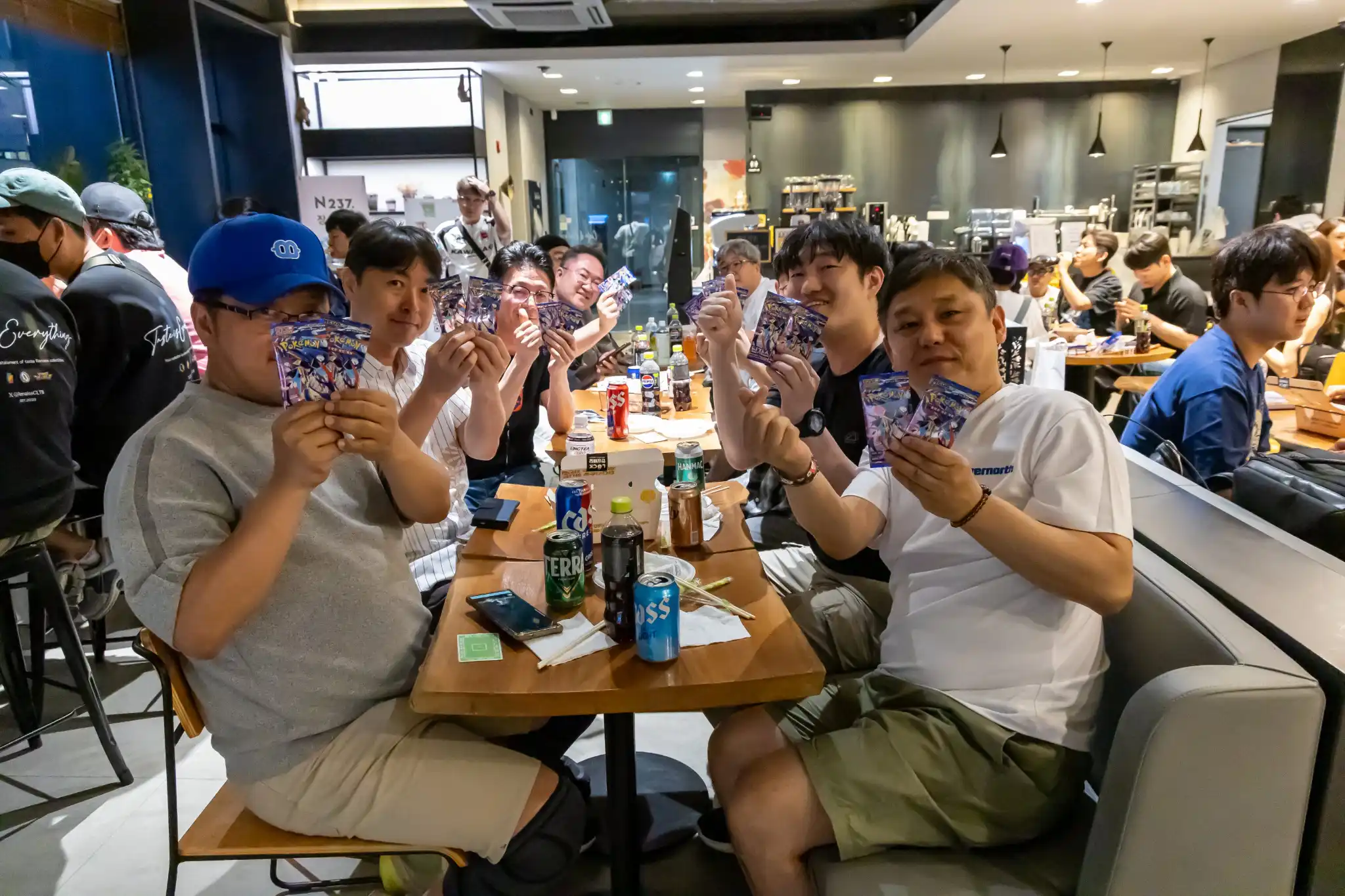
This is also where Renaiss's business and channels can mutually support each other: a reusable fairness mechanism gives the platform the opportunity to serve scenarios beyond card packs; reaching a broader player base allows the technology to serve not just existing on-chain players. Fairness and transparency are the foundation of trust, and the continuous communication and community connections formed around cards bring that trust into everyday use. The key to long-term competition is not just keeping more transactions on-chain, but enabling the business to land in more and larger external scenarios, so that more real players are willing to participate.
But whether in business or channel expansion, everything ultimately comes back to a verifiable fairness mechanism. Renaiss Fair breaks a single pack opening into three independently checkable steps: pack assembly, sealing, and drawing. Packs are assembled from graded card inventory according to a public algorithm, and the Merkle root of the pack lineup is sealed on-chain—any addition, deletion, or replacement will cause the root value to mismatch. After payment is completed, the system uses on-chain data as a seed to generate a random number through a verifiable random drawing mechanism (ECVRF), which is then mapped to specific cards according to public rules. When users verify a pack opening, they only need to open the verification link corresponding to that transaction hash in the pack opening record, or copy the hash to the "Verify a Rip" page of Renaiss Fair to query; the page will locally replay the drawing process card by card in the browser, verify the ECVRF proof, and directly display the specific cards drawn, not just the rarity.
This fully open-source verifiable fairness mechanism not only reflects Renaiss's long-termism, but will also demonstrate increasing value in Renaiss's future development. Feel free to visit the official Renaiss Fair page and experience it yourself.
Welcome to join the official BlockBeats community:
Telegram Subscription Group: https://t.me/theblockbeats
Telegram Discussion Group: https://t.me/BlockBeats_App
Official Twitter Account: https://twitter.com/BlockBeatsAsia
 Related Articles