Goldman Sachs cuts target prices for Samsung and SK Hynix: Memory chips still in shortage in 2027, prices may turn to decline in 2028
TL;DR
· Shortages persist through 2027. Goldman Sachs expects the conventional DRAM supply gap to reach 5.1% in 2027, narrowing to 1.2% by 2028. Over the same period, the NAND supply gap will narrow from 2.2% to 0.3%.
· Prices turn negative in 2028. Taking SK Hynix as an example, Goldman Sachs expects its conventional DRAM and NAND average prices to rise 32% and 20% respectively in 2027, then fall 19% and 21% respectively in 2028.
· HBM still has room to grow. Goldman Sachs raised its 2027 global high-bandwidth memory (HBM) market size forecast by 72% to $200 billion, and expects it to further increase to $237 billion in 2028.
· Target prices cut for two stocks. Goldman Sachs lowered its target prices for Samsung Electronics and SK Hynix to KRW 350,000 and KRW 2 million respectively, maintaining Buy ratings. According to its model, the stock prices at the time of the report's publication had largely reflected a scenario of zero AI capex growth in 2028 and memory average prices 40% below the base-case forecast.
In a research report published on November 22, Goldman Sachs raised its 2027 high-bandwidth memory market size forecast while cutting target prices for Samsung Electronics and SK Hynix by 30% and approximately 43% respectively.
The target price cuts mainly stem from Goldman Sachs' revisions to 2028 earnings expectations. In 2027, servers and AI accelerators continue to drive memory demand. Entering 2028, new capacity gradually comes online, while the smartphone and PC markets struggle to absorb additional supply, putting pressure on conventional memory chip prices. Goldman Sachs further modeled the impact of three risks on manufacturers' performance: cloud providers cutting spending, customers exiting long-term procurement agreements, and memory chip prices repeating the deep decline of the previous cycle.
AI servers sustain 2027, capacity expansion depresses 2028 prices
Goldman Sachs expects the conventional DRAM supply gap to reach 5.1% in 2027, potentially the tightest supply-demand balance in more than 15 years. Servers are the primary source of demand growth. Goldman Sachs expects server DRAM demand excluding HBM to grow 32% and 21% in 2027 and 2028 respectively, after growing 63% in 2026.
Smartphone and PC demand is relatively weak. After memory chip price increases, device manufacturers face higher costs for increasing memory configurations, and shipments may also be affected. Goldman Sachs expects PC DRAM demand to decline 2% year-over-year in 2027, while smartphone demand will grow 8%.
Meanwhile, Chinese manufacturers are still expanding production. Goldman Sachs expects CXMT's DRAM supply, measured by storage capacity, to grow 36% and 32% in 2027 and 2028, respectively. By 2028, the supply gap for conventional DRAM is expected to narrow to 1.2%, significantly lower than Goldman Sachs' previous forecast of 3.9%.
The narrowing gap has also changed price expectations. Goldman Sachs still expects SK Hynix's average conventional DRAM price to rise 32% in 2027, but has widened its forecast decline for 2028 from 5% to 19%. Samsung's average conventional DRAM price is expected to fall 20% in 2028.
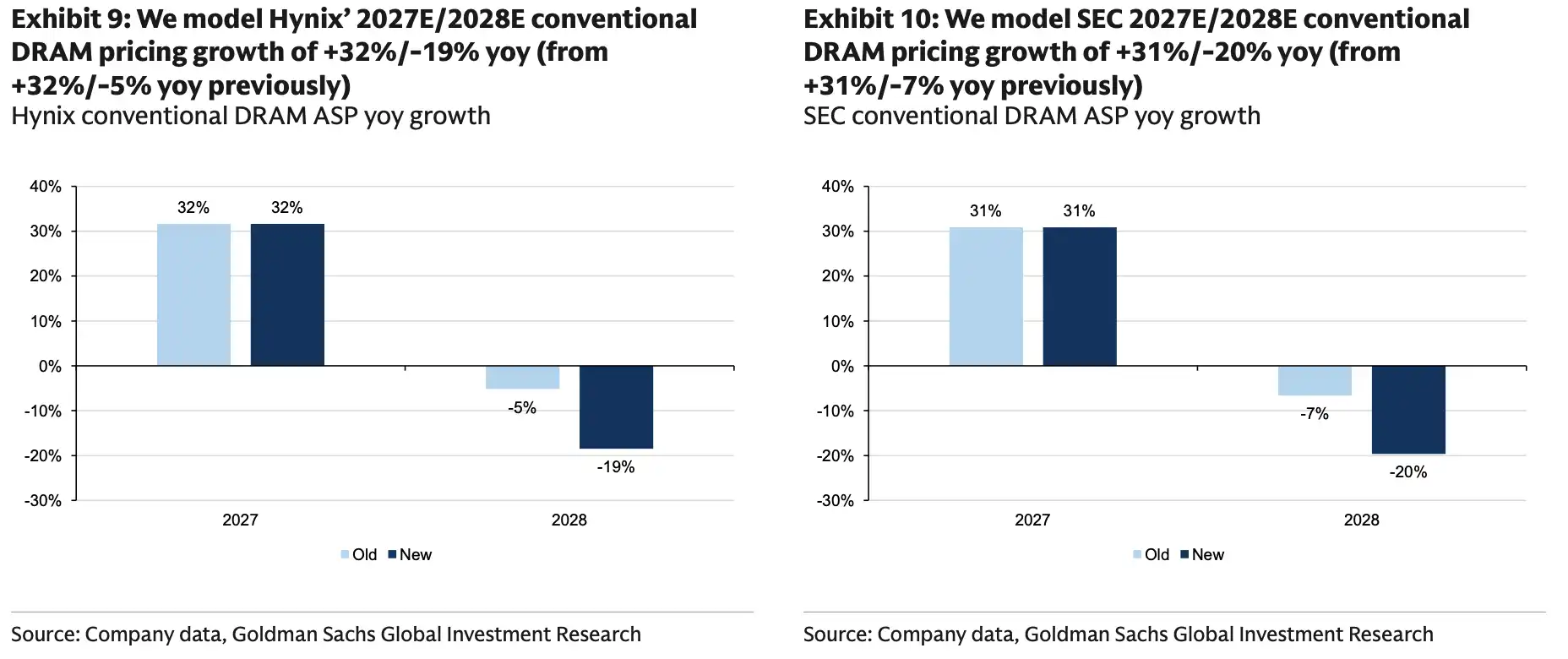
Goldman Sachs expects SK Hynix's and Samsung's average conventional DRAM prices to fall 19% and 20% year-on-year, respectively, in 2028.
NAND flash supply and demand are closer to balance. Enterprise SSDs are expected to account for more than half of global NAND demand in 2027, but demand from phones and PCs is relatively weak, and supply expectations from Samsung, Micron and Chinese manufacturers have been revised upward. Goldman Sachs expects the NAND supply gap to be only 0.3% by 2028. Taking SK Hynix as an example, Goldman Sachs cut its 2027 NAND average price increase forecast from 30% to 20% and widened its 2028 decline forecast from 14% to 21%.
HBM market size revised upward, with growth slowing markedly in 2028
High-bandwidth memory (HBM) used in AI accelerators remains one of the fastest-growing segments of the memory market. Goldman Sachs raised its 2027 global HBM market size forecast from $116 billion to $200 billion. The upward revision mainly comes from two aspects: higher-than-expected demand from custom AI chips and rising HBM prices. Goldman Sachs expects HBM demand by capacity to grow 66% in 2027, with average prices doubling year-on-year to $24.7 per GB.
Goldman Sachs expects custom AI chips such as Google TPUs to account for 44% of global HBM demand in 2028, up from 39% in 2026. Samsung already has certain advantages among such customers, and Goldman Sachs also expects it to expand supplies to Nvidia. By sales value, Goldman Sachs expects Samsung to account for 43% of the global HBM market in 2027, with SK Hynix at 32%. By product mix, HBM4 is expected to contribute more than half of global HBM market revenue in 2027.
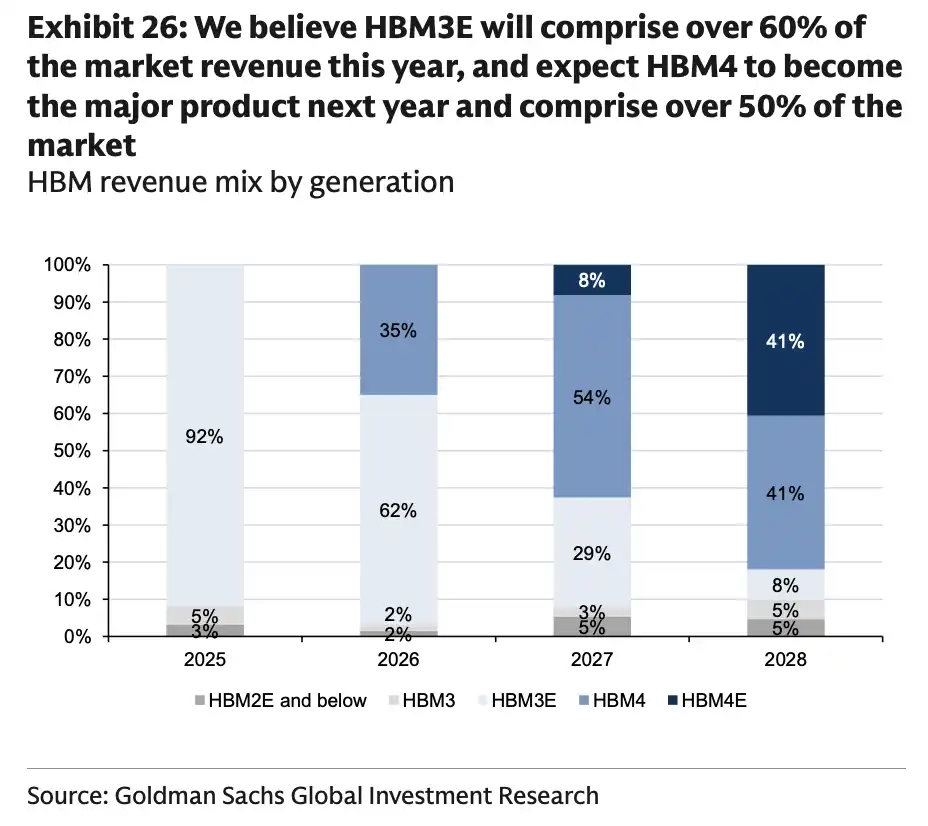
Goldman Sachs expects HBM4 to contribute more than half of global HBM market revenue in 2027.
Entering 2028, Goldman Sachs expects HBM demand growth to slow to 25%, with industry-wide average prices falling about 6%, and market size growth slowing from 236% to 18%. Goldman Sachs believes prices for products of the same specification may fall more than 20%, but a rising share of higher-priced HBM4E and HBM5 will cushion the decline in overall average prices. If customers reduce memory usage to control costs, or data center projects are delayed, actual demand could also fall short of forecasts.
Once AI Investment Cools, Memory Makers Will Face Dual Pressure on Volume and Price
Goldman Sachs expects capital expenditure by major cloud providers to rise from about $1.1 trillion in 2027 to $1.2 trillion to $1.3 trillion in 2028, with about 40% going to memory procurement. If 2028 capex is flat year over year, memory spending would be about $55 billion less than the baseline forecast. If capex falls 20% year over year, that gap would widen to about $144 billion.
Reduced purchases by cloud providers will first affect memory chip shipments. If manufacturers resell chips originally earmarked for these customers into the market, they could further depress transaction prices. Goldman Sachs estimates that if 2028 AI capex is flat and average memory prices are 20% below the baseline forecast, Samsung's and SK Hynix's operating profit will be 23% and 26% below the baseline forecast, respectively. If capex falls 20% year over year and average memory prices are 40% below the baseline forecast, the declines in the two companies' operating profit will widen to 45% and 48%, respectively.
Backing out from the valuation multiples used by Goldman Sachs, the two companies' share prices at the time the report was published roughly corresponded to a scenario in which 2028 AI capex is flat and average memory prices are another 40% below the baseline forecast. The calculation treats orders cut by cloud providers as shipment losses. If manufacturers can find other buyers, the hit to shipments may be smaller than the estimate.
Long-Term Agreements Can Soften the Blow, but Sharp Price Declines Will Still Compress Profit
Long-term procurement agreements between memory makers and customers are usually bound by price terms and prepayments. In Goldman Sachs' estimate, if customers prepay 30% of the contract amount, conventional DRAM market prices for Samsung and SK Hynix would need to be 32% to 51% and 38% to 54% below Goldman Sachs' forecasts for the corresponding quarters, respectively, for it to be worthwhile for customers to forfeit prepayments and turn to market purchases.
Goldman Sachs further assumes conventional DRAM prices are 60% below the baseline forecast and half of customers facing a default choice exit their agreements. In this scenario, manufacturers can retain prepayments and resell chips corresponding to canceled orders. Compared with full performance of the agreements, Samsung's and SK Hynix's 2028 conventional DRAM revenue will fall by about 10% and 8%, respectively. Compared with a scenario with no long-term agreements at all, the two companies' revenue will still be 55% and 49% higher, respectively.
Goldman Sachs also separately modeled scenarios similar to the downturns in 2019 and 2023. If average DRAM and NAND prices both fall 50% year over year in 2028, Samsung's and SK Hynix's operating profit will drop to KRW 234 trillion and KRW 172 trillion, respectively, 54% and 55% below the baseline forecast. In this scenario, Samsung's operating margin will still be about 35%, corresponding to about 4.7x price-to-earnings and 1x price-to-book for 2028 based on the share price at the time the report was published.
As price and earnings expectations for 2028 were revised downward, Goldman Sachs cut its target price for Samsung from KRW 500,000 to KRW 350,000 and its target price for SK Hynix from KRW 3.5 million to KRW 2 million. Goldman Sachs maintained its Buy ratings on both companies, citing still-tight supply and demand in 2027, dividends and buybacks expected to support shareholder returns, and the fact that share prices at the time had already reflected a considerable degree of downside risk.
Welcome to join the official BlockBeats community:
Telegram Subscription Group: https://t.me/theblockbeats
Telegram Discussion Group: https://t.me/BlockBeats_App
Official Twitter Account: https://twitter.com/BlockBeatsAsia

 Related Articles