Nvidia Earnings and Anthropic IPO Lead the Way: This Week's Hot Assets Preview | WEEX VIP Weekly Report (November 16–22)
Summary:
Market Environment
Last week, U.S. stocks recorded their best weekly performance since August despite hotter-than-expected October CPI/PPI and the shock of NVIDIA (NVDA) CEO Jensen Huang's resignation. All three major U.S. indices closed higher, but the 10-year Treasury yield surged a cumulative 30 basis points, closing at 5.145% on Friday and lingering near a three-week high. Sticky inflation and rate-hike expectations continue to weigh on risk asset valuations. The crypto market fell in strong correlation amid shrinking risk appetite and sustained net outflows from ETFs, with Bitcoin dropping 12.69% for the week.
Crypto Market
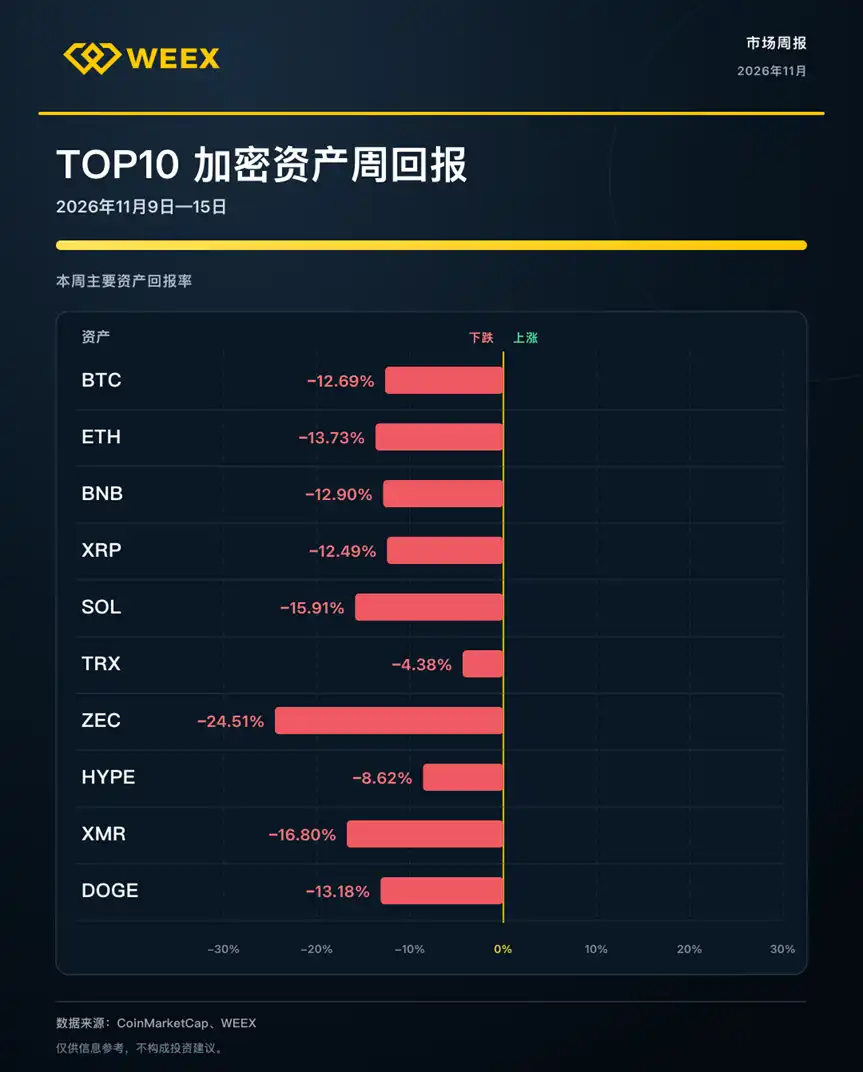
Last week, BTC and ETH posted weekly declines of 12.69% and 13.73% respectively, with prices approaching the $65,000 and $1,800 levels. The broader market is in an orderly deleveraging and extreme fear phase. The Fear & Greed Index remained in fear territory throughout the week and plunged to "extreme fear" levels of 10–13 over the weekend (near the lows seen in February and June this year). Spot ETFs continued to see significant outflows throughout the week, with institutional capital continuing to retreat.
This Week's TradFi Focus
The core focus this week is NVIDIA's (NVDA) earnings report on Tuesday (its first results since Jensen Huang's resignation) and Anthropic (Claude's parent company), which is expected to officially list on Nasdaq on Thursday (ticker: ANT). With sticky inflation and AI capex concerns continuing to simmer, the market remains highly sensitive to the Fed's subsequent rate-hike path. Caught between tightening expectations that have yet to fully ease and valuation pressure on risk assets, U.S. stocks and crypto are likely to maintain high-level volatility in the near term, accompanied by defensive cross-asset repositioning.
This Week's Watchlist
Spot: BTC ETH SOL HYPE GOLD(PAXG) QQQ SPY NVDA AMD AVGO
Perpetual Contracts: BTC ETH SOL HYPE XAUT QQQ SPY NVDA AMD AVGO ANTHROPIC
I. Overall Market Performance Last Week
This period's data covers the previous week. Crypto market and commodity prices use WEEX's UTC daily close (including weekend information); other markets are based on closing prices from November 9 to November 13, and will not be further noted below.
Last week, hotter-than-expected U.S. inflation data combined with leadership changes at Nvidia (NVDA) triggered uncertainty around policy and the AI narrative. The market first saw a brief rebound, followed by partial selling in risk assets, but still ended the week higher overall, with risk appetite somewhat restored.
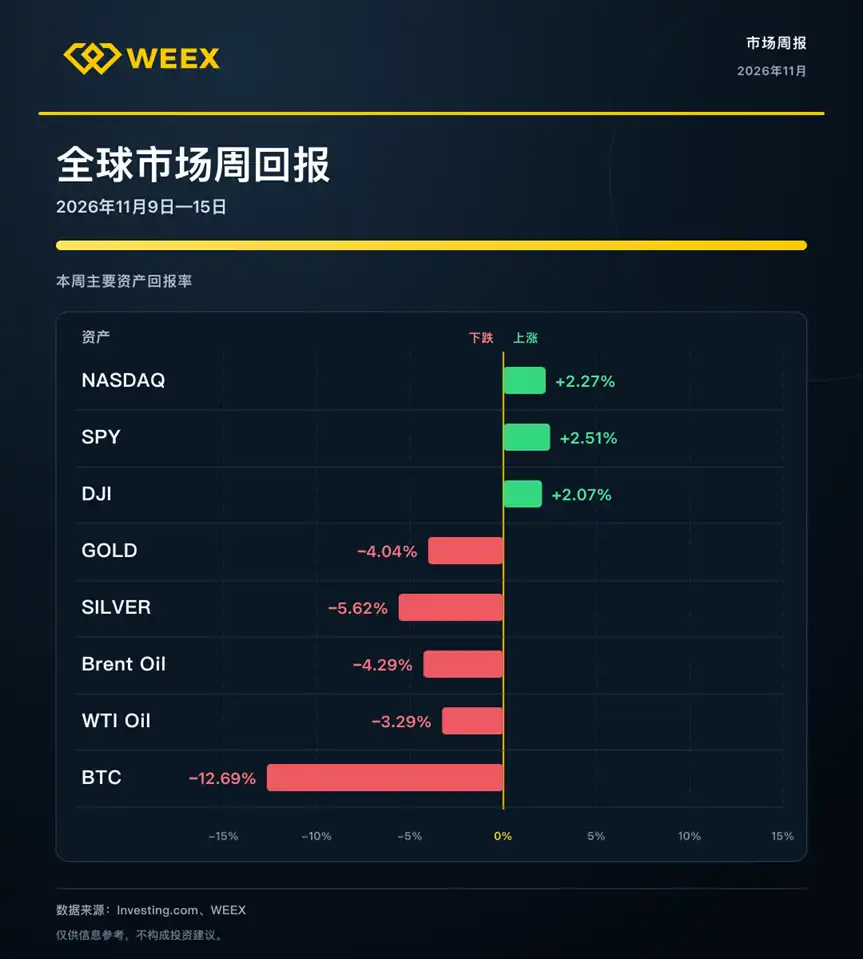
U.S. Treasuries continued to weigh on markets: The 10-year Treasury yield surged a cumulative 30 basis points last week, climbing sharply from around 4.867% during the week and closing at 5.145% on Friday, lingering at a three-week high, as sticky inflation and rate-hike bets continued to suppress risk asset valuations.
Gold and crude oil fell in tandem: Safe-haven sentiment failed to withstand rising yields and real interest rate pressure, with gold down 4.04% for the week and silver down 5.62%; Brent crude fell 4.29% for the week and WTI crude fell 3.29%.
U.S. stocks showed rebound and divergence: The three major U.S. stock indices rose more than 2% for the week, ending a four-week losing streak and marking their best weekly performance since August. However, before the weekend, Nvidia CEO Jensen Huang's resignation weighed on chip stocks, accelerating rotation into cash-flow-steady platform giants such as AMD and AVGO.
Crypto market's correlation with U.S. tech stocks deepened but diverged in direction: Dragged down by high interest rates draining liquidity and massive net outflows from spot ETFs, BTC and ETH plunged 12.69% and 13.73% respectively, underperforming the broader U.S. stock market, indicating that the current market remains dominated by defensive capital rotation and de-risking behavior.
For investors, with tightening expectations rising and volatility among AI leaders intensifying, high-leverage risk exposure should be strictly controlled, and allocations to cash and stable wealth management products should be increased as a defensive base. VIP users in particular should first build a defensive base position, then opportunistically increase allocations to risk assets.
II. Crypto Market Performance Last Week
The crypto market came under overall pressure and declined last week, extending losses early in the week and continuing the downtrend over the weekend amid low liquidity. U.S. tech volatility and rising Fed rate-hike expectations suppressed risk appetite, BTC spot ETFs saw continued net outflows, and BTC fell 12.69% for the week; ETH spot ETFs saw net outflows of approximately $399 million during the week (marking seven consecutive weeks of net outflows), with institutional capital remaining cautious.
Total crypto market capitalization fell from approximately $2.54 trillion during the week to around $2.12 trillion (a new low since January this year), shrinking nearly 20% in a single week, and has now recovered to $2.19 trillion. The Fear & Greed Index remained in fear territory throughout the week and plunged over the weekend to "extreme fear" levels of 10–13 (close to the lows seen in February and June this year). Total stablecoin market capitalization also contracted about 1.41% to around $284.97 billion, down 5.15% cumulatively over the past 30 days, reflecting continued ebbing of incremental on-chain liquidity. Capital and sentiment broadly converged, with the market dominated by wait-and-see and defensive positioning, showing no clear signs of recovery.
Looking ahead to this week, the market may continue to experience high-volatility choppy trading. Focus on retail sales, the FOMC minutes, and Nvidia (NVDA) earnings for their impact on rate expectations and AI sentiment. If risk appetite does not recover, BTC may continue to test the $60,000–$62,000 support level; if sentiment and capital flows stabilize, there is room for a rebound, but overall defensive trading remains dominant, and a trend breakout is likely difficult in the near term.
Major Asset Performance Last Week
• BTC
BTC has fallen for 6 consecutive weeks, showing relative resilience but still under pressure. Last week, spot ETFs saw net outflows of approximately $1.07 billion during the week, with cumulative net outflows reaching $2.552 billion over 3 consecutive weeks. The price first declined, then rebounded, and then fell back again, briefly breaking below $62,000 before a modest rebound. The Fear & Greed Index remains in the "Extreme Fear" zone, indicating cautious market sentiment, overall institutional capital withdrawal, and a market dominated by choppy bottom-finding.
• ETH
ETH's performance is noticeably weaker than BTC. Last week, spot ETFs saw net outflows of approximately $399 million, with 7 consecutive weeks of net outflows totaling over $2.4168 billion. Main force capital continued to redeem, lacking independent incremental support, and prices came under pressure as broader market risk appetite declined.
• SOL
SOL continued to underperform BTC and ETH. Spot ETFs recorded net outflows, with price pressure mainly stemming from correlated selling in risk assets and insufficient relative momentum.
• HYPE
HYPE's weekly decline was smaller than BTC's. Although spot ETF fund flows remained cautious, active on-chain derivatives trading supported its relatively strong resilience against the downturn.
• ZEC
ZEC plunged 24.51% for the week, among the steepest declines in mainstream coins and significantly underperforming the broader market. Dragged down by continued spot ETF net outflows and broad risk-asset selloffs, capital fled the privacy sector at an accelerated pace, and its earlier defensive logic gradually lost validity.
• TRX
TRX edged down 4.38% last week, one of the smaller declines among mainstream crypto assets and a relatively resilient performer, demonstrating notable defensive attributes underpinned by rigid demand for stablecoin settlement.
III. TradFi Market Performance Last Week
Last week, U.S. stocks were shaped by hotter-than-expected inflation data, the resignation of NVIDIA (NVDA)'s CEO, and the Federal Reserve's maintained restrictive stance. Midweek volatility subsided somewhat, with all three major indices posting their best weekly gains since August, as capital rotated from high-valuation growth into select defensive and value sectors.
Sharp divergence emerged within leading tech and AI sectors: last week, NVIDIA CEO Jensen Huang's resignation rattled the market, sending NVIDIA down 12.75% for the week and briefly pushing it below the $4 trillion market cap threshold, sparking concerns over AI infrastructure debt financing and capital expenditure returns. Meanwhile, capital accelerated its shift toward platform tech giants with robust cash flows and non-pure-compute hardware exposure — Tesla rose 8.97% for the week, Meta gained 5.17%, while Apple, Google, and Amazon also posted modest gains.
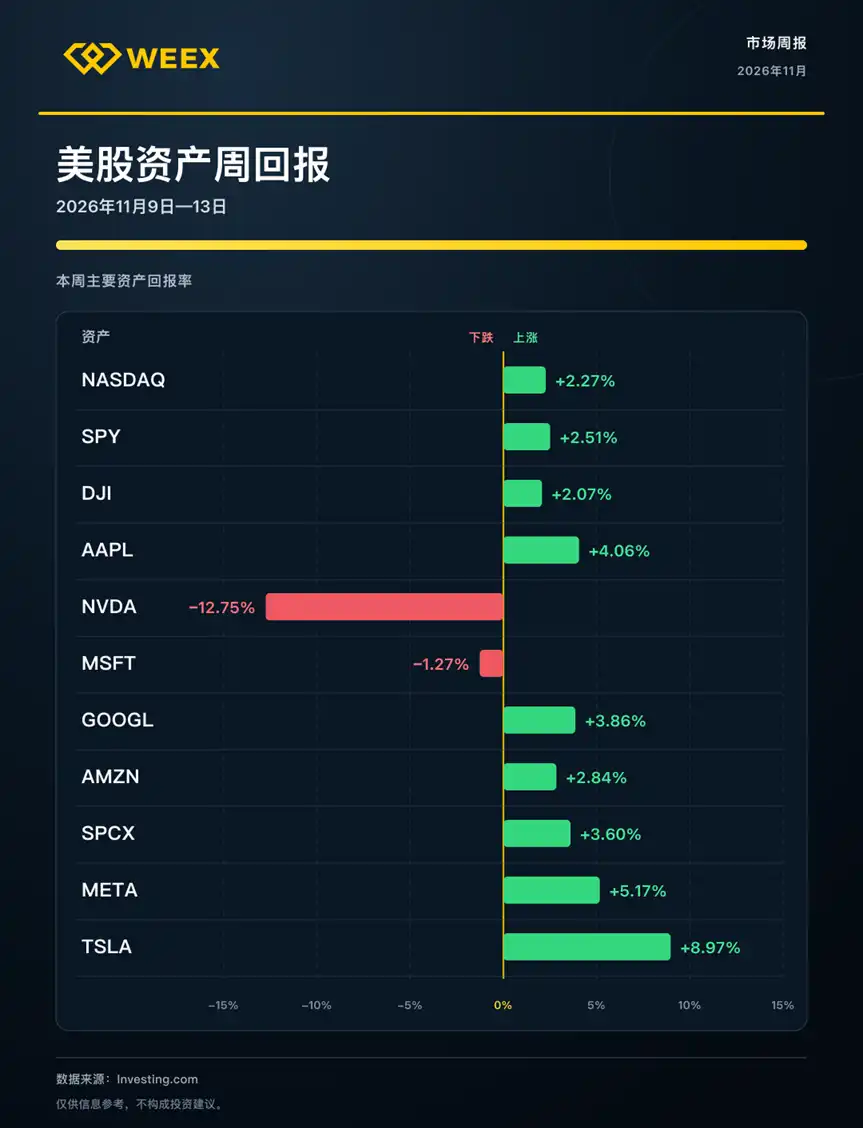
This week, focus on NVIDIA (NVDA)'s earnings report and progress on former CEO Jensen Huang's return to company management, as well as Anthropic (Claude's parent company)'s expected formal listing on Nasdaq (ticker: ANT). Market sentiment may shift from AI fervor toward earnings and balance sheet discipline; users should consider allocating toward defensive, high-quality names with positive cash flows and dividends, and build positions in leading tech names on pullbacks in tranches.
Major Asset Weekly Performance
Nasdaq, S&P 500, and Dow
The three major U.S. indices rose 2.27%, 2.51%, and 2.07% last week, respectively, ending a four-week losing streak. Early in the week, falling oil prices triggered broad gains; midweek, hotter inflation and surging Treasury yields weighed on sentiment; Friday saw divergence amid a chip stock pullback. Overall, this shows that under macro rate-hike pressure, capital favors heavyweight stocks with high earnings certainty.
• NVIDIA (NVDA)
NVIDIA (NVDA) swung sharply last week due to CEO Jensen Huang's resignation, falling 12.75% for the week. The AI chip sector became the focal point, with sentiment cooling sharply before a rebound, dragging on the broader tech growth narrative. Tuesday's after-hours earnings report will be the first core test of the "post-Jensen Huang era," and management guidance will directly determine the trajectory of the global AI compute narrative.
• Advanced Micro Devices (AMD)
AMD surged 18.93% last week, significantly outperforming the semiconductor and broader tech market. As NVIDIA's most direct competitor in the AI GPU market, AMD received analyst upgrades and benefited from expectations of compute share redistribution following NVIDIA's management turmoil. Although it pulled back Friday amid profit-taking in chip stocks, its high-growth data center business logic has gained capital recognition, injecting a strong boost into the general-purpose compute alternative sector.
• Broadcom (AVGO)
Broadcom (AVGO) surged 18.16% last week, trailing only AMD in gains. The market is betting that leadership turmoil at Nvidia will accelerate cloud providers' push toward supply chain diversification, positioning Broadcom as a core beneficiary given its leading edge in custom AI chips (ASIC) and high-speed networking equipment.
• Google (GOOGL)
Google (GOOGL) rose 3.86% last week, with steady search and cloud businesses and growing attention to AI model progress, providing relative defensive support for the internet advertising and cloud computing sectors. Additionally, as a key strategic shareholder in Anthropic, Google is expected to benefit this week from an AI ecosystem valuation re-rating catalyst tied to Anthropic (Claude's parent company) anticipated to officially list and begin trading on the Nasdaq.
• SpaceX (SPCX) and Tesla (TSLA)
SpaceX (SPCX) and Tesla (TSLA) rose 3.60% and 8.97% respectively last week, significantly outperforming the broader market. Merger rumors between SpaceX and Tesla (TSLA) heated up last week, with reports suggesting an announcement could come as early as this December or early next year. Specifically, SpaceX benefited from breakthroughs in commercial space recovery technology that lifted sector sentiment, with Morgan Stanley and Deutsche Bank successively reiterating bullish ratings; Tesla led tech giants on gains driven by Cybercab commercialization progress. This week, watch how delivery expectations under a high interest rate environment affect growth stock volatility.
• Meta (META)
Meta rose 5.17% last week, significantly outperforming the broader tech market. AI-driven precision ad targeting and improved monetization efficiency have gained institutional recognition, demonstrating strong platform defensive attributes during chip hardware turbulence and providing solid support for the digital advertising sector.
• Apple (AAPL)
Apple rose 4.06% last week with a steady trend. Its first smart home hub HomeView officially went on sale last Friday, further completing its on-device AI hardware ecosystem loop; with its massive cash flow and hardware ecosystem moat, Apple has become a safe haven for capital seeking to avoid computing capital expenditure volatility, serving as an anchor for the consumer electronics sector.
IV. Asset Allocation
Last week, U.S. stocks staged a technical rebound but the AI chip sector suffered heavy losses, while the crypto market pulled back sharply amid continued ETF outflows and rate hike expectations. This week's core focus: Nvidia (NVDA) earnings and Anthropic (Claude's parent company) anticipated to officially list and begin trading on the Nasdaq (ticker: ANT) will serve as important observation windows for the AI supply chain and tech stocks; U.S. retail sales, industrial production, and employment data will further reflect economic resilience; Fed meeting minutes and multiple officials' speeches may provide new signals on the future interest rate policy path.
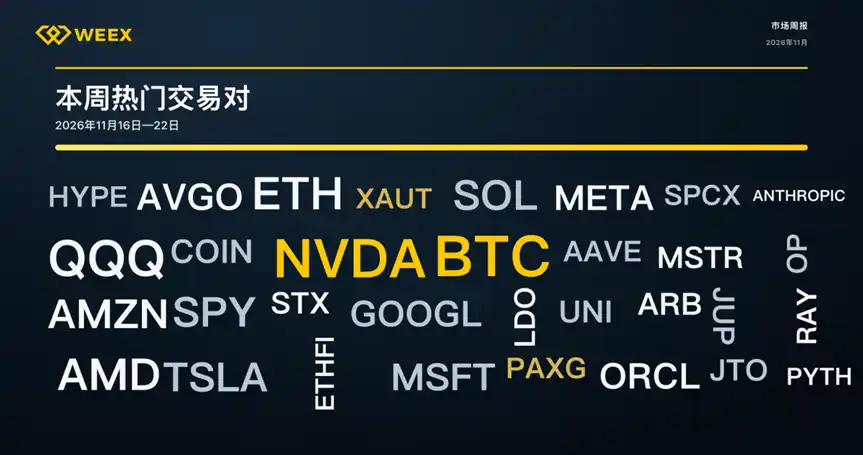
Against this backdrop, Nasdaq 100 ETF (QQQ), BTC, ETH, as well as NVIDIA (NVDA), Advanced Micro Devices (AMD), Broadcom (AVGO), Amazon (AMZN), Tesla (TSLA), and Palo Alto Networks (PANW) and other targets will usher in more active trading windows, with the main thread revolving around "earnings validation after AI leadership transition and macro rate repricing."
Among them, the compute share redistribution triggered by NVIDIA's leadership turmoil has made Advanced Micro Devices (AMD) and Broadcom (AVGO) the core beneficiaries of market speculation on supply chain diversification; NVIDIA's earnings report and new management guidance on Tuesday will directly test the sustainability of this substitution logic—if NVIDIA's delivery pace or governance stability sends uncertain signals, the trend of capital rotating toward the two competitors is expected to continue, but short-term profit-taking volatility after prior sharp gains still warrants caution.
It is recommended to balance liquidity and defensiveness in allocation, moderately control risk asset positions, and avoid excessive concentration in a single sector. If NVIDIA's results beat expectations and Anthropic's IPO ignites enthusiasm for AI applications, tech stocks and BTC may see recovery trades; conversely, if inflation signals run hot or AI capital expenditure pressures continue to surface, QQQ, BTC, ETH, and AI supply chain targets still need to guard against a second decline, and it is advisable to wait for market sentiment and liquidity conditions to stabilize before adjusting positions. Overall, maintain caution and prioritize defensive base positions.
V. Week Ahead
5.1 Key Financial Events
This week, US equities face tests from retail sales, industrial production, and employment data. On Monday, the New York Fed Manufacturing Index will reflect regional activity; on Tuesday, retail sales and import prices will validate consumption and inflation; on Wednesday, the FOMC meeting minutes will provide clues on the policy path; on Thursday, initial jobless claims and the Philadelphia Fed Index will assess labor market resilience. Speeches by multiple Fed officials will also provide signals on the rate path.
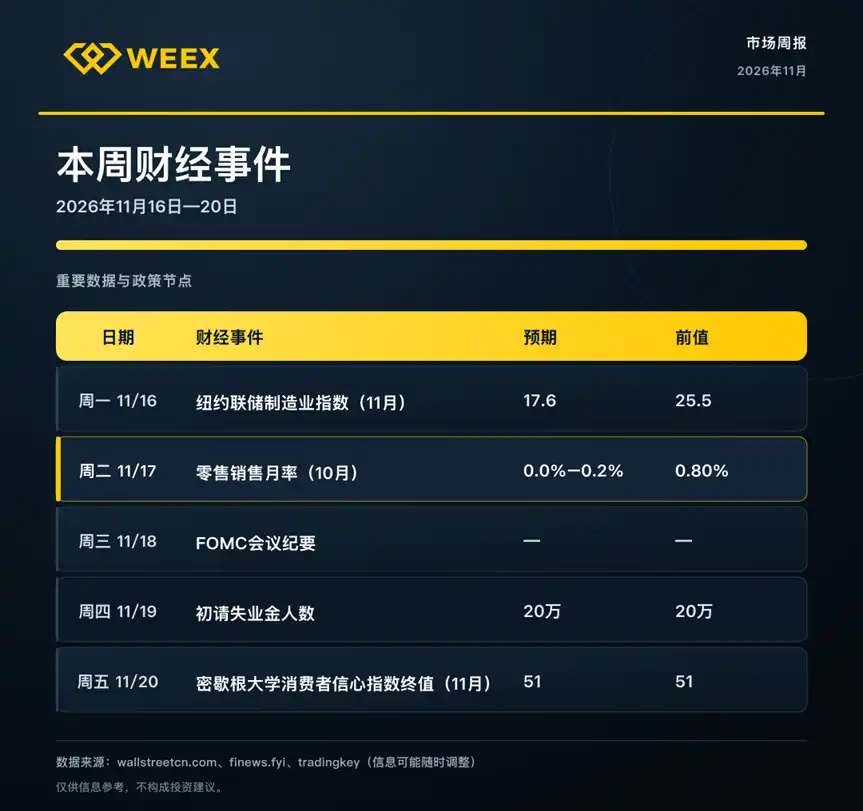
The highlights are Tuesday's October retail sales and NVIDIA (NVDA) earnings, as well as Thursday's Anthropic IPO. Retail sales are expected to show moderate growth; if they beat expectations, it will reinforce consumption resilience and rate hike expectations; NVIDIA (NVDA) results and guidance will directly test the sustainability of AI capital expenditure. Anthropic (parent company of Claude) is expected to officially list on Nasdaq under the ticker ANT, with a pricing range of $70-$78, which will become an important observation window for the AI supply chain.
We will focus on core consumption within the retail sales sub-components and the inflation discussion in the FOMC minutes as key线索. By assessing the tug-of-war between "consumption resilience" and the "policy path," we use this as a reference for subsequent asset allocation and risk hedging investment decisions.
5.2 Individual Stock Earnings
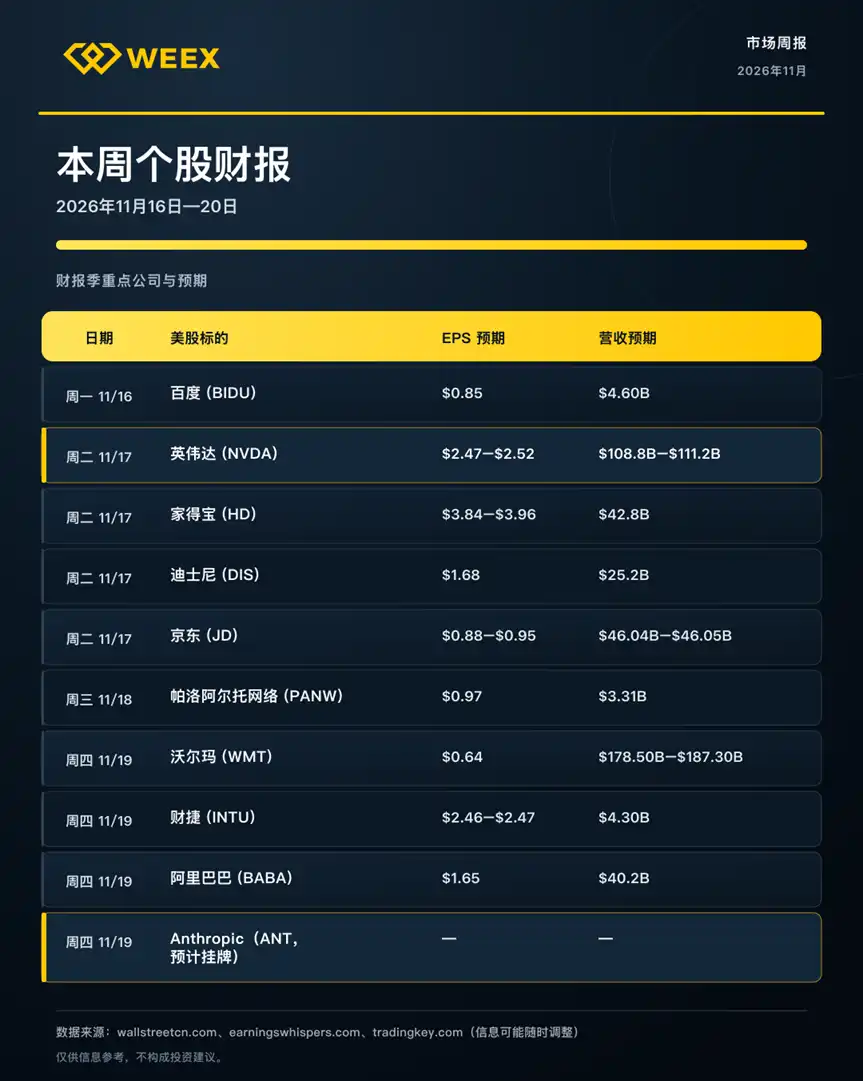
This week's U.S. stock earnings focus on AI and retail themes. Tuesday features Nvidia (NVDA) as the headline event, alongside Home Depot (HD) and Disney (DIS); Thursday brings Walmart (WMT) and Alibaba (BABA), while Anthropic is expected to list on Thursday. Overall expectations are strong, with many revenue growth highlights, but guidance and gross margins still require observation of execution capability.
Key focus on Nvidia (NVDA), Walmart (WMT), and Anthropic. Nvidia (NVDA) is expected to report EPS of approximately $2.47-$2.52 and revenue of approximately $108.8B-$111.2B, with AI equipment demand expected to drive record highs; Walmart (WMT) is expected to be steady, with e-commerce and membership businesses as key; Anthropic's listing will test the market's pricing of the commercialization of Claude-related AI models. The guidance and performance of these three will serve as market bellwethers.
We focus on whether individual stock revenues beat expectations, the magnitude of guidance upgrades, gross margin trends, and AI-related order visibility, as the basis for subsequent position adjustments.
5.3 Token Unlocks
This week the crypto market needs to watch multiple token unlocks exceeding $10 million, among which Cronos (CRO) releases approximately $51.4 million, the most prominent, while LayerZero (ZRO) and Arbitrum (ARB) correspond to approximately $34.7 million and $12.5 million respectively.
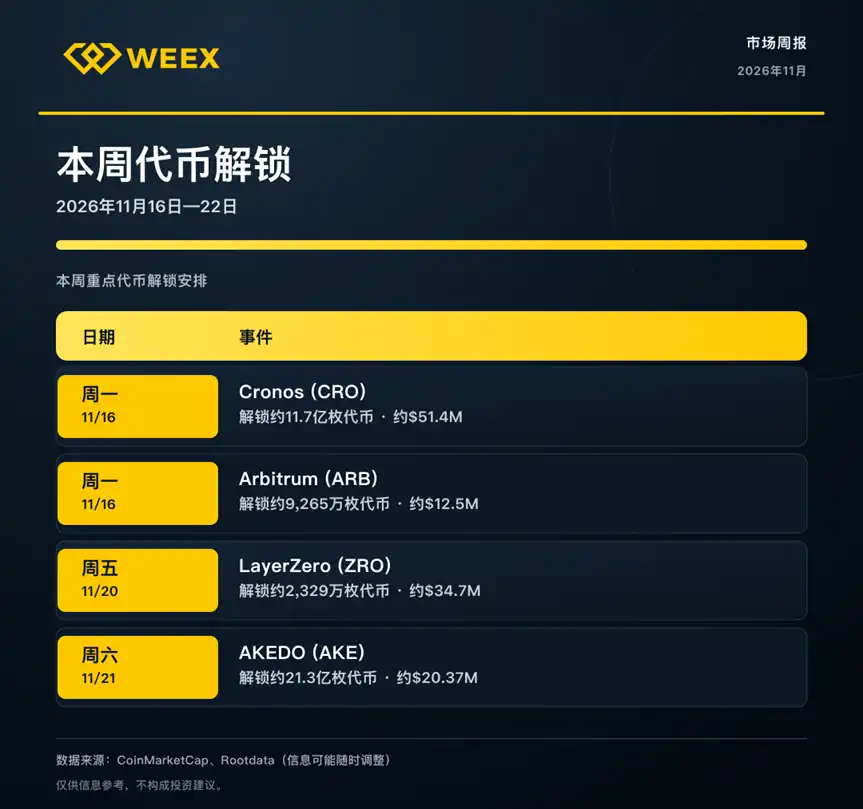
Current market sentiment is cautious with increased volatility. Large unlocks can easily trigger short-term selling pressure and liquidity shocks. Investors should closely track price and volume changes after unlocks.
Disclaimer
This report is provided by the WEEX research team for informational reference only and does not constitute any investment, legal, or tax advice, nor does it promise returns. Digital assets and stocks are highly volatile and illiquid, which may result in loss of principal; forecasts do not represent future results. Investing involves risk; please conduct independent research and make your own decisions. The platform assumes no liability for any losses. Unauthorized copying and distribution will be pursued in accordance with the law.
This article is contributed and does not represent the views of BlockBeats.
Welcome to join the official BlockBeats community:
Telegram Subscription Group: https://t.me/theblockbeats
Telegram Discussion Group: https://t.me/BlockBeats_App
Official Twitter Account: https://twitter.com/BlockBeatsAsia

 Related Articles