Who pays for the delays in AI data centers?
TL;DR
· On November 5, the Nasdaq fell 5.5%, and chip stocks suffered their second-largest single-day decline in history. Post-election selling reflects market concerns about a slowdown in data center expansion.
· Estimates from Goldman Sachs and Cleanview show that states that may tighten rules or support pausing approvals account for about 45% and 41% of planned U.S. capacity, respectively. The two estimates use different methodologies, and both point to policy exposure for new projects.
· Data centers already powered up are more likely to benefit from tighter supply. Several H100 rental price indicators have risen, reflecting that available compute still has takers, but this cannot be used to infer end customers' return on investment.
· Google is advancing a $17 billion project in Wyoming and incorporating power supply costs into the project design. Regulation raises the equipment investment for individual projects and may also delay suppliers' revenue recognition.
· Reuters said that after the selloff, interest rate traders pushed back the expected timing of the next rate hike to March of the following year. Oil prices and inflation trends remain key variables in this valuation logic.
Policy pressure first falls on projects still awaiting approval
On November 5, the Nasdaq Composite fell 5.5%. Democrats won both chambers of Congress in the midterm elections and won governorships in key data center construction states such as Texas and Georgia. The market began lowering expectations for a new round of construction, and smaller developers already squeezed by high rates in financing faced even greater pressure.
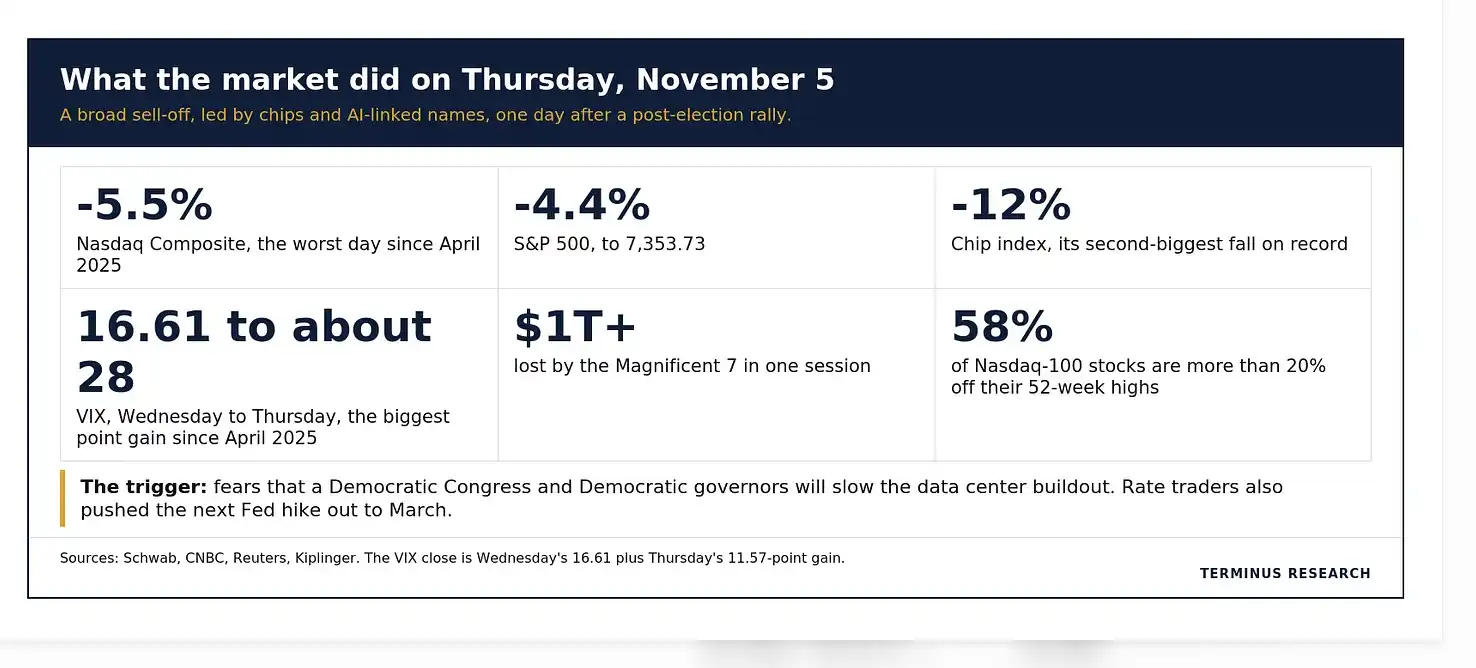
In the November 5 U.S. stock selloff, the Nasdaq fell 5.5%, and the chip index fell 12%.
Terminus Research judges that a nationwide moratorium faces resistance from a presidential veto, and the more direct impact comes from state and local governments. Residential electricity bills are a bipartisan issue, and the actual constraints may fall on how electricity and water costs are shared, whether tax incentives are retained, and when new projects are approved.
Goldman Sachs estimates that states that may tighten rules account for about 45% of planned U.S. data center capacity, with Texas alone accounting for nearly one quarter. Cleanview, counting by whether governors support pausing construction, arrived at a result of about 159 gigawatts, or 41% of planned capacity, and believes that about 56.7 gigawatts of capacity under construction faces relatively little direct impact. Specifically for Texas, Terminus Research, citing third-party tracking data, said Jefferies estimates that about 13.1 gigawatts of announced projects are at risk. The two national data sets measure the scope that policy may cover, while Texas's 13.1 gigawatts is an estimate of risk to announced projects, and how much capacity is ultimately delayed still depends on approvals, financing, and customer demand.
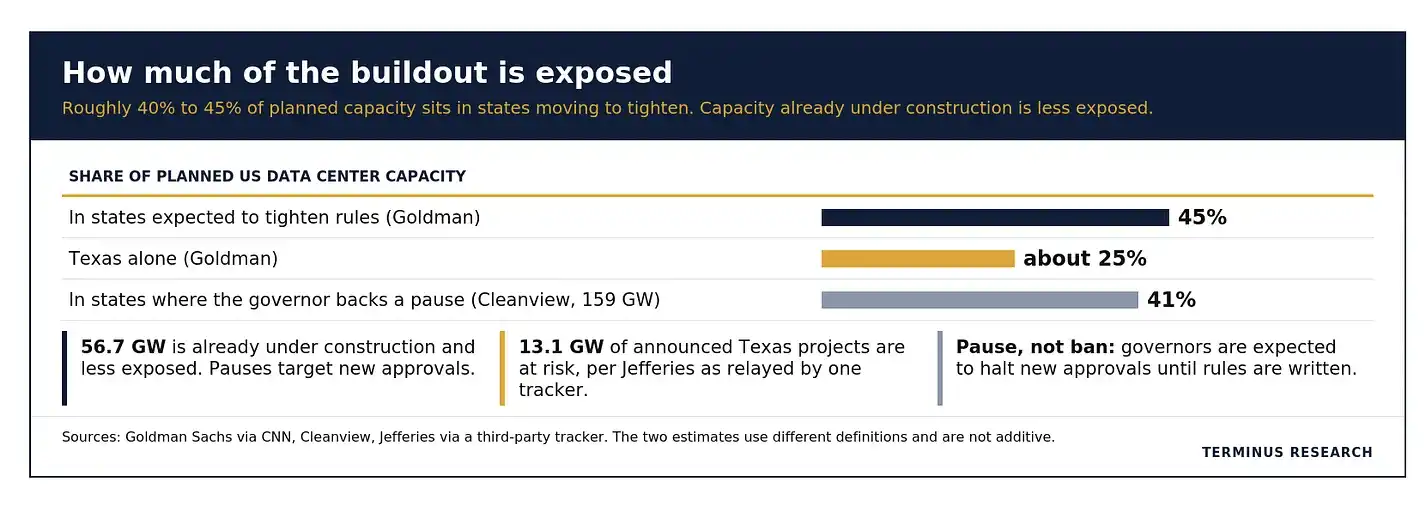
Goldman Sachs and Cleanview separately estimate that about 45% and 41% of planned U.S. data center capacity is located in states that may tighten rules or support pausing approvals.
Powered data centers are scarcer, and cloud providers' cash flow depends on how spending changes
Once delivery of new data centers is delayed, facilities already connected to the grid and capable of deploying GPUs gain more bargaining power. According to Silicon Data cited in the research report, the H100 rental price index for neoclouds rose from $2 per GPU hour to $2.88, an increase of about 44%. SemiAnalysis's one-year contract index also rose about 38% between October 2025 and March 2026. These indicators cover different rental markets and all point to support for existing computing power prices, but rental prices remain below the level of more than $7 per hour in early 2024.
For developers, interest, equipment procurement commitments and utility-related costs may still accumulate during the delay. For large cloud providers, deferred spending may temporarily improve free cash flow. Terminus Research, citing third-party tracking data, said that because delivery of third-party data center capacity was delayed to the first half of 2027, Microsoft's 2026 capital expenditure estimate was cut from about $175 billion to $170 billion. The difference of about $5 billion reflects the impact of delivery timing on spending for the year. At the same time, Amazon's 2027 capital expenditure guidance is higher, and whether overall cloud provider spending has peaked still depends on when deferred projects are delivered and whether new projects continue to move forward.
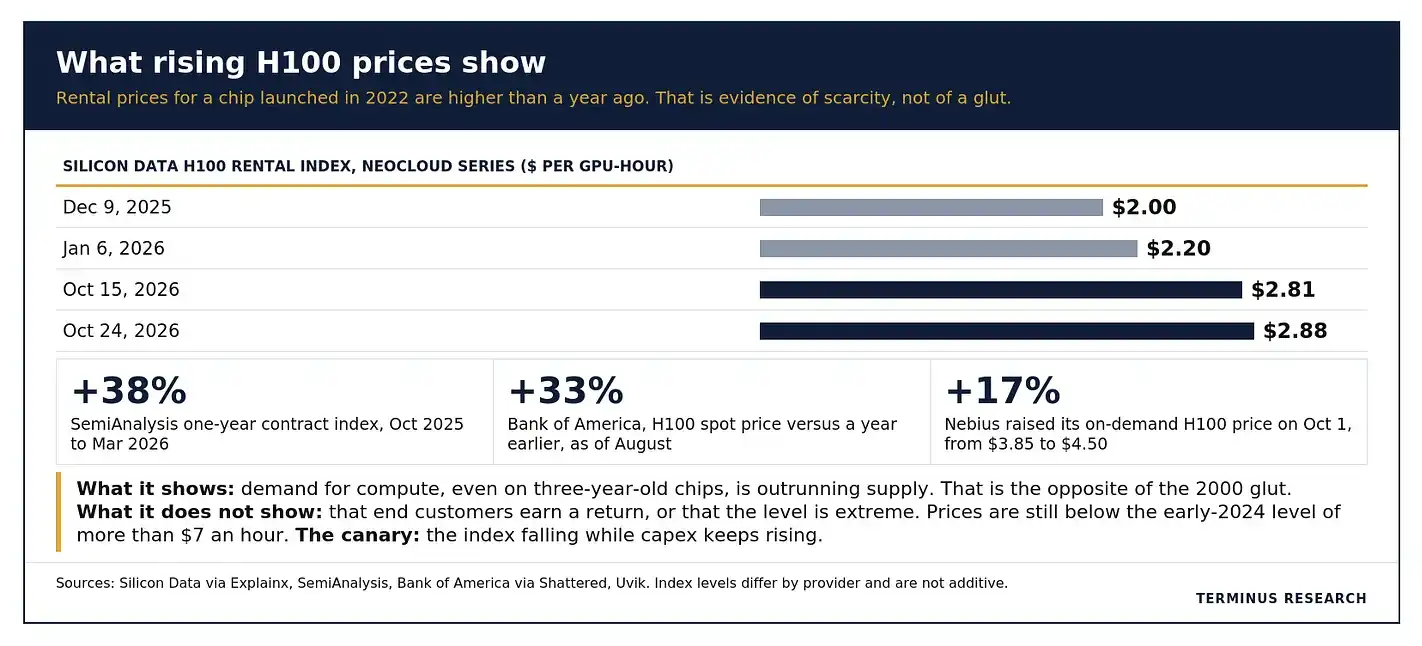
Silicon Data's H100 rental price index rose from $2 per GPU hour in December 2025 to $2.88 in October 2026.
Google incorporates power supply costs into the project, while equipment makers still have to wait for delivery
Google announced on November 5 that it will invest $17 billion to build a data center in Laramie County, Wyoming, with the goal of beginning commercial operations in early 2030. Google pledged to bear all electricity costs as well as infrastructure expenses directly brought about by project expansion.
The project uses air cooling to reduce water use and plans two power supply facilities: a 702 MW fuel cell project supplied by Bloom Energy and equipped with carbon capture and storage systems, and 564 MW of new gas-fired generation capacity built by Black Hills as supporting infrastructure for the project. The two planned capacities total about 1.27 GW. The time span from planning of power supply facilities to commissioning of the data center also shows that after equipment makers receive orders, revenue recognition still depends on delivery progress.
This case shows how new projects respond to local government concerns. Developers bearing more power supply and infrastructure costs may increase investment in power, cooling, and supporting equipment per megawatt. Terminus therefore believes that power and data center equipment suppliers are more likely to win orders from design changes, especially manufacturers with multi-year backlogs. Chip suppliers, by contrast, are more dependent on on-time data center delivery, and additional power and cooling spending cannot directly offset delays in chip shipments. Even if equipment orders are ultimately retained, deferred delivery will still delay revenue recognition, making high-valuation suppliers particularly sensitive.
Cooling rate hike expectations: how much earnings pressure can they offset?
Reuters reported that after the November 5 selloff, rates traders pushed back the expected timing of the next rate hike to March of the following year. Terminus believes that tighter financial conditions and weakening growth expectations may ease pressure for further rate hikes. A data center slowdown may also gradually ease power demand in some regions, but near-term inflation is more affected by oil prices.
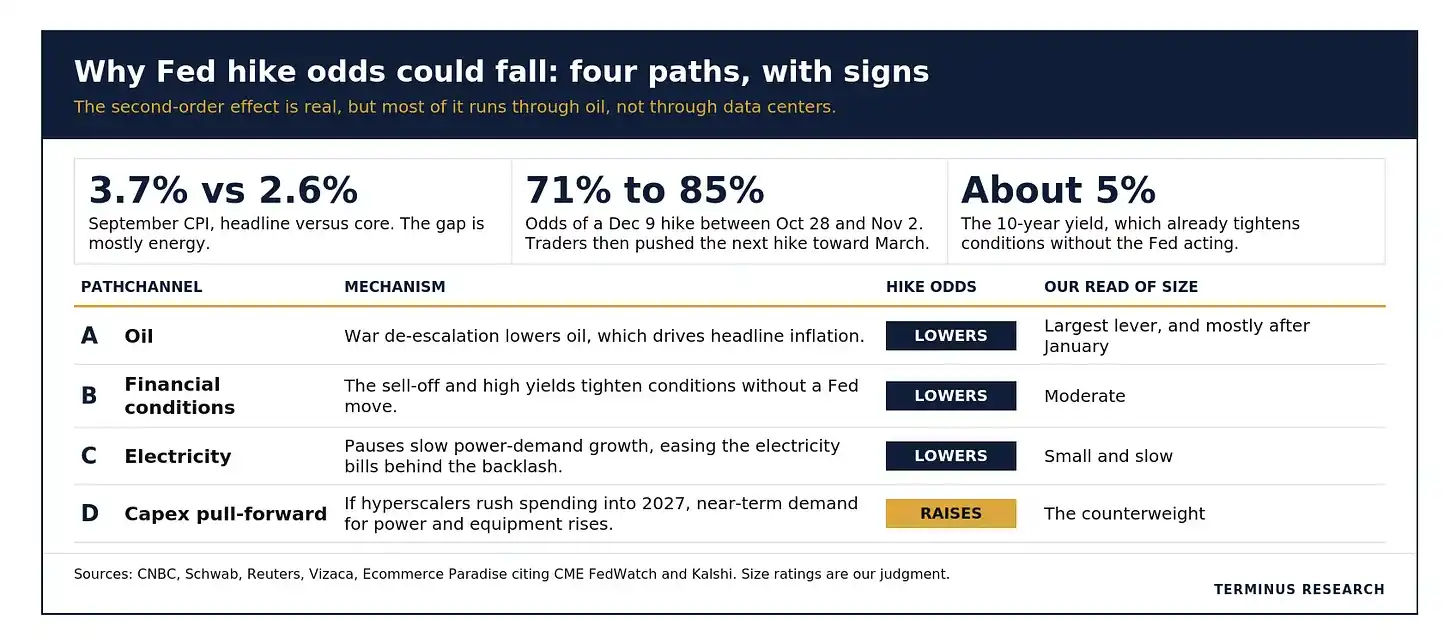
Terminus Research's assessment of how oil prices, financial conditions, power demand, and capital expenditure affect rate hike expectations.
If bond yields fall, lower discount rates can support valuations. At the same time, slower construction will drag on earnings growth for some AI suppliers, and which of these two forces is stronger depends on how inflation and orders evolve. Next, three signals need to be distinguished: whether local pauses evolve into multi-year bans, whether cloud providers cut budgets due to weak demand, and whether project cancellations begin to reflect financing difficulties. If H100 rental prices weaken while cloud providers are still expanding capital expenditure, the scarcity logic of existing compute capacity also needs to be re-examined.
Welcome to join the official BlockBeats community:
Telegram Subscription Group: https://t.me/theblockbeats
Telegram Discussion Group: https://t.me/BlockBeats_App
Official Twitter Account: https://twitter.com/BlockBeatsAsia
 Related Articles