Will U.S. stocks and Bitcoin rise after the U.S. midterm elections?

Original Title: "IOSG Weekly Brief | Bitcoin's 'Election Effect': Political Catalyst, or Just Hitting the Halving Cycle? #353"
Original Author: IOSG Ventures
Since 1950, the United States has held 19 midterm elections. According to our statistics, in the year following each election, the S&P 500 index was higher than on voting day. Bitcoin has experienced 3 complete midterm election cycles, and its price was also higher one year later each time, but it first fell for a period in the weeks after each vote.
At the time of the vote on November 3 this year, the two markets were in different positions. U.S. stocks were near historical highs, while Bitcoin was still recovering from a previous sharp selloff. Historically, one can be somewhat optimistic about the performance of both one year later, but the path in between may differ greatly.
However, how much reference value these historical data have for 2026 remains questionable. In the year before past midterm elections, the median maximum drawdown for U.S. stocks was 16%, while this year it was only about 9%, so there was not much decline to recover in the first place. Bitcoin has only 3 samples, and each midterm election fell between two to two and a half years after a halving, with the two cycles overlapping, making it difficult to determine how much of the rise is related to the election itself.
Key Views
· U.S. stocks: Historically, performance after midterm elections has been quite strong, but this year's pre-election market performance was also stronger than in previous years. Therefore, directly assuming that the historical average gain will repeat is not prudent.
· Bitcoin: The one-year returns across three complete cycles were all positive, but each time it first experienced further declines. With only three samples, it is still impossible to confirm a reliable "election effect."
· Policy: Congressional control will affect legislation and regulation in the crypto industry. But the core factors determining market direction remain corporate earnings, interest rates, and capital flows.
U.S. Stocks: Strong Historical Performance, but This Year's Starting Point Is Different
From 1950 to 2022, there were 19 midterm elections. In the 12 months after each election, the S&P 500 index recorded gains, with an average increase of 15.1% and a median of 14.5%. Even the weakest performance rose 1.1%.
By comparison, in non-midterm election years, using early November as the same starting point, the average return over the following year was 7.2%, with about 70% of samples recording gains.

▲ Source: IOSG, calculated based on daily closing prices
Historically, most declines occurred before elections. In the year before midterm elections, the median maximum drawdown of the market was 16%. Within the six-month observation window around voting day set in the study, market lows occurred before voting day in 17 of 19 elections.
Rallies also often do not need to wait until voting ends to begin. BlackRock's analysis shows that as election results gradually become clear, U.S. stocks historically typically began rising about one month before midterm elections. In late October this year, prediction markets gave about a 93% probability that Democrats would control the House and about a 68% probability that they would control the Senate. This means that a situation in which the president and Congress belong to different parties was already widely expected by the market and may not necessarily become an Election Day surprise.
This does not mean that all policy effects have already been reflected in prices, but a result in line with expectations may trigger a smaller immediate market reaction than an unexpected result. Therefore, voting day can serve as a time reference for observing market trends, but it is not necessarily the turning point for the market.
This year's market starting point is also different. In late October, the S&P 500 was only about 3% below its record closing high set on October 6, while the maximum drawdown over the previous year was about 9%. In other words, the market does not need to recover much lost ground.
Historically, five midterm elections met both conditions at the same time: a pre-election gain of more than 10% and a drawdown of less than 10%. They occurred in 1954, 1958, 1986, 2006, and 2014. Returns in the following year ranged from 1.1% to 33.2%, with a median of 6.7%.
Compared with the seemingly precise median figure, this wide range deserves more attention. These cases show that strong markets can continue to rise after elections, but that is not enough to set a reliable return target for 2027 based on them.
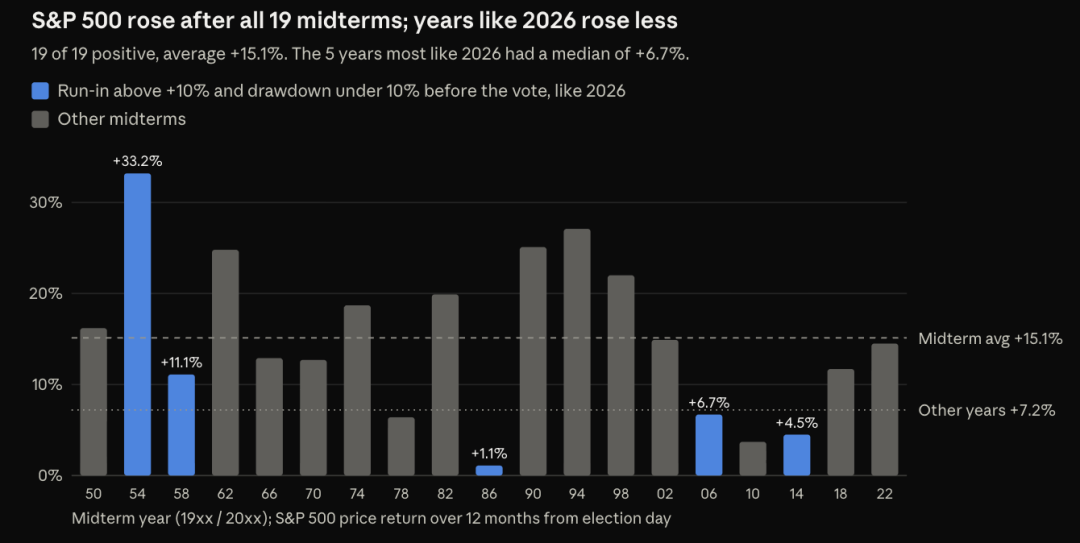
▲ Figure 1. S&P 500 returns 12 months after past midterm elections. The blue bars mark five historical cases that met the conditions of "larger pre-election gains and shallower drawdowns," for comparison with 2026.
Historical experience leans optimistic, but the next leg of gains still needs support from corporate earnings and the interest rate environment.
Bitcoin: Gains a Year Later Don't Mean the Recovery Was Easy
Bitcoin's history is shorter, and holding through it is harder to endure.
In the three full midterm election cycles of 2014, 2018, and 2022, BTC fell in the weeks after voting day each time, but a year later its price was higher than on election day in all three. The 2022 decline was shorter-lived, and by three months after the election, BTC had already posted gains. Short-term performance varied widely across the three cycles.
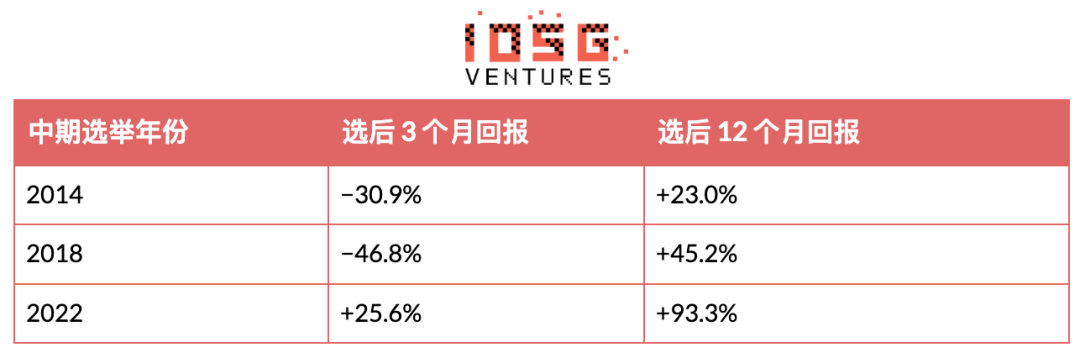
▲ IOSG, calculated using CoinMetrics BTC PriceUSD data
Binance Research notes that Bitcoin's average gain in the year after midterm elections is about 54%, broadly consistent with the 53.8% average gain in our sample. But the path of the rally matters just as much: the median return three months after the election is about −31%, and about +45% after twelve months. Even if investors ultimately get the direction of the recovery right, they may still endure substantial losses before the rally arrives.
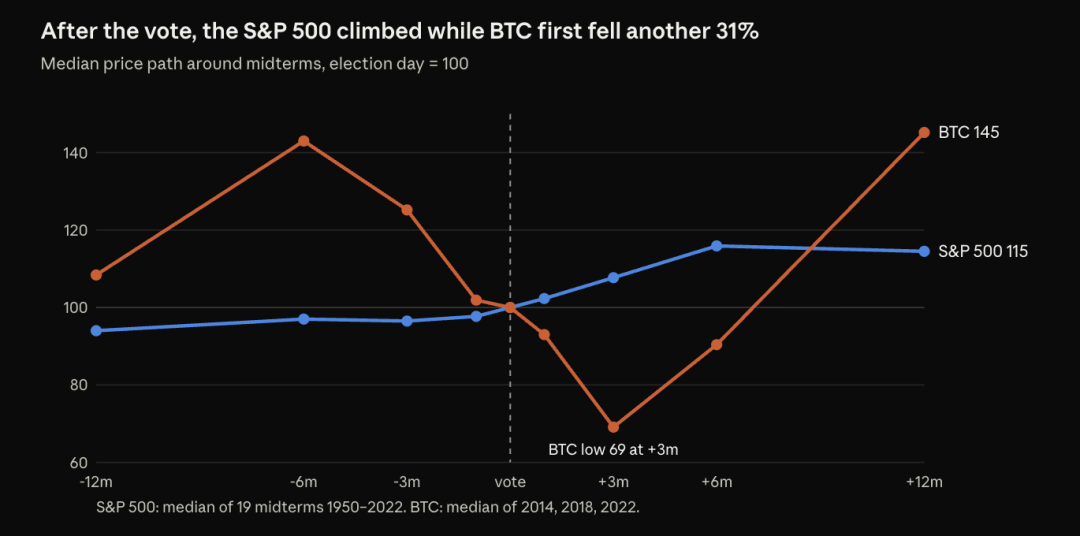
▲ Figure 2. Median performance around midterm elections, indexed to 100 on voting day. The S&P 500 sample covers 19 elections from 1950–2022; the Bitcoin sample covers three elections from 2014–2022. The lines in the chart connect only selected observation points and do not represent forecasts.
However, these samples cannot isolate the effect of the election itself. Each midterm election also happened to occur roughly two to two and a half years after a Bitcoin halving, and all were in bear market phases. The November 2026 election will also be about two and a half years after the April 2024 halving.
With only three samples and two overlapping cycles, it is impossible to determine whether the election had a material effect on this pattern.
Likewise, the median curve should not be treated as a price forecast. This curve aggregates outcomes from different years; it is not the full market journey that investors actually experienced in any single cycle. Mechanically applying it to today's price only creates a false sense of precision that the data itself cannot support.
With the entry of spot ETFs and corporate treasury funds, Bitcoin's investor base has also changed. These channels can bring demand, but they can also transmit redemption pressure, financing pressure, and shifts in risk appetite into the market.
What truly deserves remembering is this: being bullish on the performance over the coming year is not contradictory to the fact that there is still room for a short-term decline. As for when the decline will end, historical samples cannot provide an answer.
What changes will the election bring to the crypto industry?
For the crypto industry, the most direct impact of the election comes from policy. Given the widespread market expectation that the presidency and Congress will be controlled by different parties, what is more noteworthy is how the new Congress will adjust legislation, regulatory oversight, and personnel appointments at regulatory agencies.
The progress of the CLARITY Act reflects this uncertainty. On September 15, the Senate failed to pass a procedural motion to end debate and advance the bill, with 49 votes in favor and 50 against. Subsequently, the Senate filed a motion to reconsider, so the bill is currently stalled and has not completely lost the chance to be revived. However, before the election recess, the Senate did not hold a second vote, and the only remaining window for this Congress is the "lame-duck session" after the election and before the new Congress takes office.
The next Congress will determine the leadership of each committee, legislative priorities, and the specific conditions for renegotiation.

▲ The above is a scenario analysis, not a prediction of legislative outcomes
If Republicans retain the Senate, it may be more conducive to advancing policy proposals favored by the industry, but it does not guarantee passage of the bill. Likewise, Democratic control of Congress does not mean that bipartisan cooperative legislation is impossible.
At the same time, regulators can still take action within their existing authority. Rulemaking and issuing staff guidance may be able to resolve some specific issues, but their scope of application and durability may not be comparable to formal legislation.
The same election result may affect U.S. stocks and the crypto industry through different channels. If the presidency and Congress are controlled by different parties, new fiscal spending plans may be constrained, thereby easing some upward pressure on bond yields and supporting equity valuations. But for crypto companies, legislative gridlock may also prolong the period of uncertainty over market structure rules.
This may lead to divergence: financial markets welcome constraints on fiscal spending, while the crypto industry is disappointed because a stable legal framework remains elusive. Of course, neither outcome is inevitable; even if Congress is deadlocked, the executive branch and regulators may still push for policy changes.
What factors can support the market in continuing to rise through 2027?
My baseline judgment is: the outlook for US stocks is generally optimistic, but the upward path will have twists and turns; Bitcoin's short-term trajectory is harder to judge. This is a judgment made with reference to history, not a prediction derived directly from historical data.
For US stocks, continued growth in corporate earnings and easing pressure from bond yields will help the market rise further. If the rally can broaden from large tech companies to more companies, the recovery will be more convincing. Conversely, regardless of which party controls Congress, persistently high inflation or earnings falling short of expectations would weaken the bullish case.
For Bitcoin, I will watch whether spot ETFs can continue to attract capital, whether liquidity improves, and whether Bitcoin can hold onto prior gains when the broader market weakens. If capital continues to flow out, or financing pressure rises again, it would be unwise to readily conclude that the bear market low has passed.
Three developments deserve particular attention:
· The Fed's policy meeting on December 8–9: The Fed kept rates at 3.75%–4.00% on October 28, with two committee members dissenting, and the market has begun pricing in the possibility of a December rate hike. New economic projections will help determine whether pressure from bond yields is easing.
· Earnings and rally breadth: Whether earnings growth and stock price gains can broaden from the companies currently leading the index to more businesses.
· Bitcoin capital flows: Whether institutional demand can be sustained for consecutive weeks, rather than concentrated in just a few trading days.
Election results should be observed alongside these indicators, not as a substitute for them.
Conclusion
The most powerful finding in the historical data is the high consistency of US stocks rising after midterm elections. But it should also be noted that stocks were already quite strong before the 2026 vote.
Bitcoin offers a different lesson: across three full cycles, prices were higher one year later, but investors also experienced further declines along the way. This helps in understanding holding risk, but is not sufficient to support a clear prediction for the next cycle.
The November 3 election will shape the future policy environment. Whether the market can sustain a recovery into 2027 will ultimately depend on subsequent corporate earnings, liquidity, and capital flows.
Original link
Welcome to join the official BlockBeats community:
Telegram Subscription Group: https://t.me/theblockbeats
Telegram Discussion Group: https://t.me/BlockBeats_App
Official Twitter Account: https://twitter.com/BlockBeatsAsia

 Related Articles