Goldman Sachs interprets MSFT: Azure growth at 48%, cloud gross margin rebound—has Microsoft's AI investment return reached a turning point?
TL;DR
·Azure revenue grew 48% year-over-year at constant currency, exceeding the 44% to 45% guidance and further accelerating from the previous quarter.
·Cloud gross margin rebounded from 65% to 66%, with growth and profitability improving in tandem.
·Capital expenditures including finance leases were $45.2 billion, up 30% year-over-year, below market expectations of a 48% increase.
·M365 commercial cloud growth was driven by premium product upgrades and GitHub Copilot consumption-based revenue, with AI commercialization contributing revenue through multiple paths.
·Commercial bookings and remaining performance obligations growth moderated, requiring observation going forward in light of high base effects and delivery cadence.
Goldman Sachs maintains a Buy rating and $640 price target, with new capacity, compute allocation, and return on invested capital remaining key variables.
Microsoft delivered a quarterly report featuring accelerating cloud business growth, recovering margins, and capital expenditures below expectations.
According to Goldman Sachs' preliminary assessment for fiscal year 2027 first quarter released on October 28, Microsoft's Azure revenue grew 48% year-over-year at constant currency in the quarter, above the prior guidance of 44% to 45% and exceeding market expectations of 45%; compared to the previous quarter's 42% growth rate, growth further accelerated. At the time of the Goldman Sachs report's release, Microsoft shares rose approximately 4% in after-hours trading.
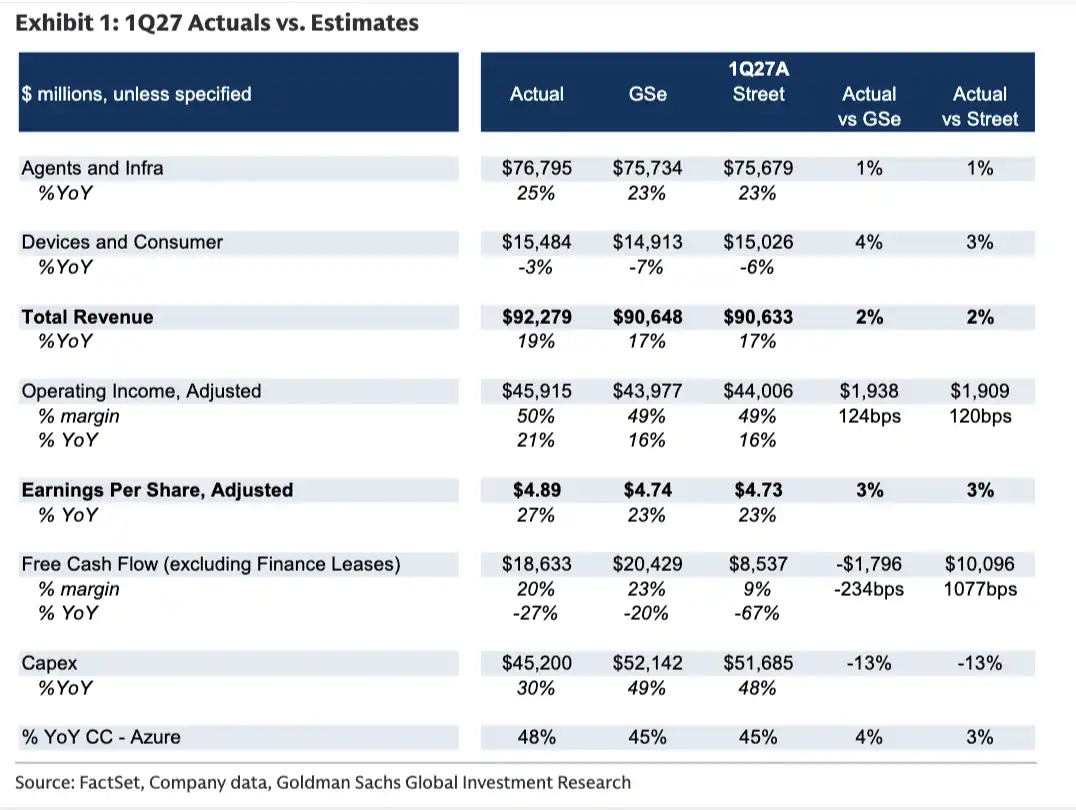
Total revenue for the quarter was approximately $92.279 billion, up 19% year-over-year, beating market expectations by about 2%. Adjusted earnings per share were $4.89, above market expectations of $4.73, a beat of approximately 3%.
This set of data provides more revenue-side support for Microsoft's AI investments. However, the core question after the earnings report remains: as new compute capacity gradually comes online, can the cloud business sustain growth, and how long can margin improvement last?
Azure accelerates growth, cloud gross margin rebounds
Azure was the most prominent growth driver in this quarter's results. The 48% constant-currency revenue growth rate was both above guidance and continued the acceleration trend from the previous quarter.
Meanwhile, Microsoft's cloud gross margin rebounded from 65% in the previous quarter to 66%. For Microsoft, which continues to expand AI infrastructure, gross margin changes are an important indicator for observing whether revenue growth can translate into profitability. The single-quarter rebound provides a positive signal, but whether it can form sustained improvement still requires observation of utilization of new capacity and cost changes going forward.
Goldman Sachs identified the pace and magnitude of Azure growth in fiscal year 2027 as a key focus of the earnings call, with particular attention to how Microsoft allocates compute capacity between its own products and third-party customers, as well as the visibility into new data center capacity additions in 2027.
Compute allocation affects the growth cadence of Microsoft's different businesses: its own AI products require infrastructure support, while external customers' cloud demand also needs capacity to be served. When new supply comes online and which businesses it is allocated to will affect the speed at which demand converts into revenue.
Copilot Drives Upgrades, Capital Expenditure Structure Still Needs Monitoring
Beyond Azure, Microsoft 365 Commercial Cloud also showed signs of accelerating growth.
On a reported basis, M365 Commercial Cloud revenue grew 18% year-over-year at constant currency, up from 15% in the prior quarter. Adjusting for the comparable base impact from revenue recognition in the year-ago period, growth was 19%, compared with 16% in the prior quarter.
Growth was primarily driven by customers upgrading to premium offerings such as Copilot, E5 and E7, which lifted average revenue per user (ARPU); increased consumption-based revenue from GitHub Copilot's usage-based billing was also a contributing factor. This means AI monetization can be achieved both through enterprise customers upgrading subscriptions and through revenue contribution as actual usage grows.
By contrast, M365 Consumer Cloud growth slowed to 16% from 22% in the prior quarter, reflecting a divergence between enterprise and consumer performance.
Goldman Sachs seeks further insight into early feedback on E7 upgrades and how this upgrade cycle differs from previous ones. It is also focused on how enterprise customers use products such as Foundry to access and manage different models, and how forward-deployed engineers assist customers in implementing AI projects.
On capital expenditure, Microsoft invested $45.2 billion in the quarter, including finance leases, up 30% year-over-year, below market expectations of approximately $51.7 billion and 48% year-over-year growth.
However, a single quarter's investment below expectations is not sufficient to indicate a change in the full-year investment trajectory. Goldman Sachs is still awaiting management's updated outlook on capital expenditure and return on invested capital.
The spending mix also warrants attention: the share of short-lived assets in capital expenditure rose to approximately three-quarters from about two-thirds previously. As the asset mix shifts, subsequent depreciation, utilization rates and investment payback will become important variables for assessing the economics of AI infrastructure.
Behind the $640 price target, supply and returns still need validation
Order metrics are not accelerating across the board. Microsoft's commercial orders fell 11% year-over-year at constant currency, which Goldman Sachs mainly attributed to the high base formed by 111% growth in the same period last year. Commercial remaining performance obligation (RPO, the contracted amount not yet recognized as revenue) rose 73% year-over-year, below the 84% growth in the previous quarter.
Remaining performance obligation still maintains a relatively high growth rate, but the speed at which it converts into revenue needs to be observed in conjunction with contract terms, delivery arrangements and computing power supply. The year-over-year decline in commercial orders also needs to be understood against the backdrop of last year's high base.
Goldman Sachs maintains its "Buy" rating on Microsoft and a 12-month price target of $640, based on a valuation of 28 times price-to-earnings on adjusted net profit for the next 12 months. Relative to the October 27 closing price of $531.33 used in the report, this implies about 20.5% upside.
This judgment still faces several risks: slower-than-expected ramp-up of in-house chips may limit market share gains and gross margin expansion; unexpected increases in investment in non-Azure projects may affect capital allocation; key management changes, and a broader shift by customers to customized software, may also put pressure on the business.
For this quarter, Azure growth, cloud gross margin and capital expenditure together constitute positive signals. What needs to be validated next is whether new data centers can be delivered as planned, whether in-house chips can ramp up smoothly, and whether products such as Copilot can continue to drive customers to pay for upgrades. These variables will determine whether Microsoft can further convert AI demand into revenue, profit and cash flow.
Welcome to join the official BlockBeats community:
Telegram Subscription Group: https://t.me/theblockbeats
Telegram Discussion Group: https://t.me/BlockBeats_App
Official Twitter Account: https://twitter.com/BlockBeatsAsia
 Related Articles