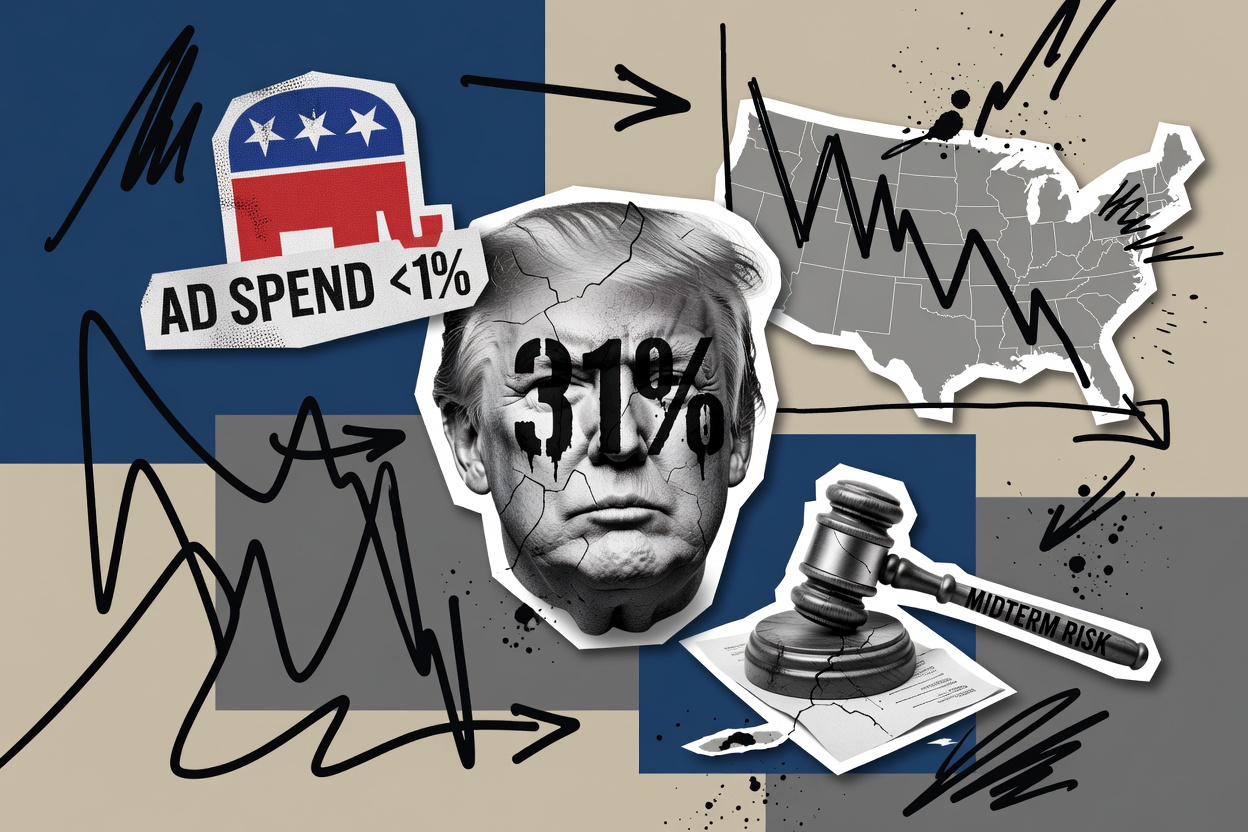
Trump's approval rating drops to 31%, Republicans remove him from campaign ads first.

TL;DR
· A Reuters/Ipsos poll on October 19 shows Trump's approval rating falling to 31%, the lowest in the agency's two terms. Among registered voters, Democrats lead the generic ballot 47% to 35%, with Fox, NBC, and the Washington Post reading between 33% and 36% in the same period.
· Fox's breakdown shows that Republicans who do not identify with the Trump movement went from a net approval of +7 in September to -5. From September 9 to October 17, Republican congressional ads mentioned Trump less than $1 per $100 spent, while Democrats spent about $20.
A national poll released by Reuters and Ipsos on October 19 shows Trump's approval rating falling to 31%, the lowest reading in the agency's two terms.
Among registered voters, Democrats lead the generic ballot (which only asks which party they would vote for, not a specific candidate) by 12 points, 47% to 35%.
The White House's message is completely opposite. A White House spokesperson called Trump the Republican Party's core leader and most effective campaign surrogate, while Trump himself is asking voters to treat this election as a vote about him.
Republican strategists see a different battlefield. Brittany Martinez of the conservative group Principles First said candidates are systematically distancing themselves from this "heavyweight" president. Carrie Dann of the Cook Political Report summed it up as a balancing act: energize the base without letting disillusioned Republicans slip away.
Ad data confirms the direction. According to AdImpact, from September 9 to October 17, Republican congressional ads mentioned Trump less than $1 for every $100 spent, while Democrats spent about $20.
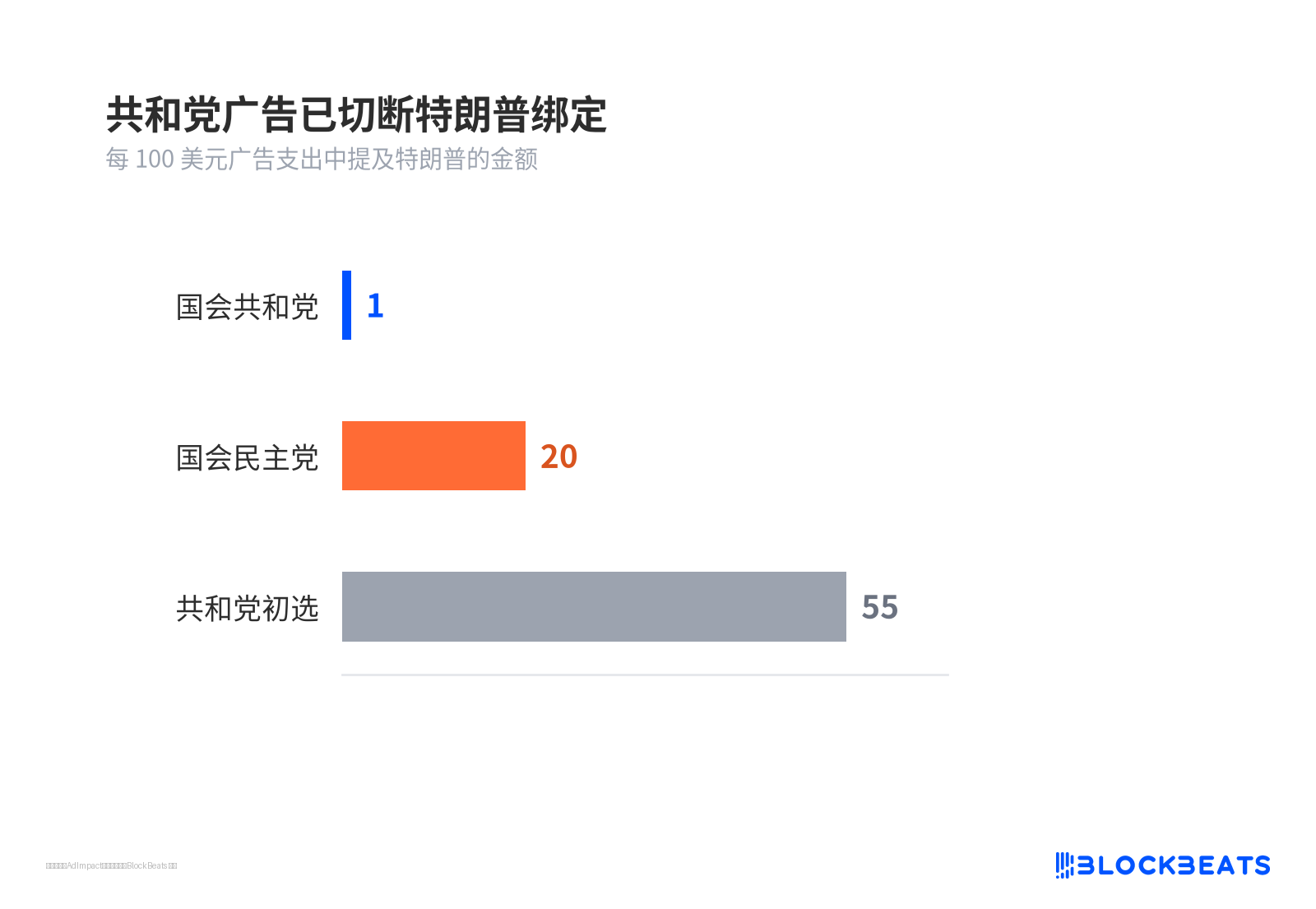
Republican ads have cut the Trump tie
The national vote is a thermometer, not a scoreboard. All 435 House districts are settled separately, and the Senate map is calculated differently.
31% is a single reading, but the new low falls in the same month
31% comes from an online survey and does not equal the "true approval rating." Putting the various readings together, Trump is roughly between 33% and 36%, with the RealClearPolitics average at about 38.9%. The gap is not small, but the direction is consistent.
A Washington Post/ABC News-Ipsos survey conducted October 9-13 gave 33% approval and 66% disapproval. NBC's reading was about 34%. Fox interviewed 1,202 registered voters from October 9-12 and got 36% to 64%.
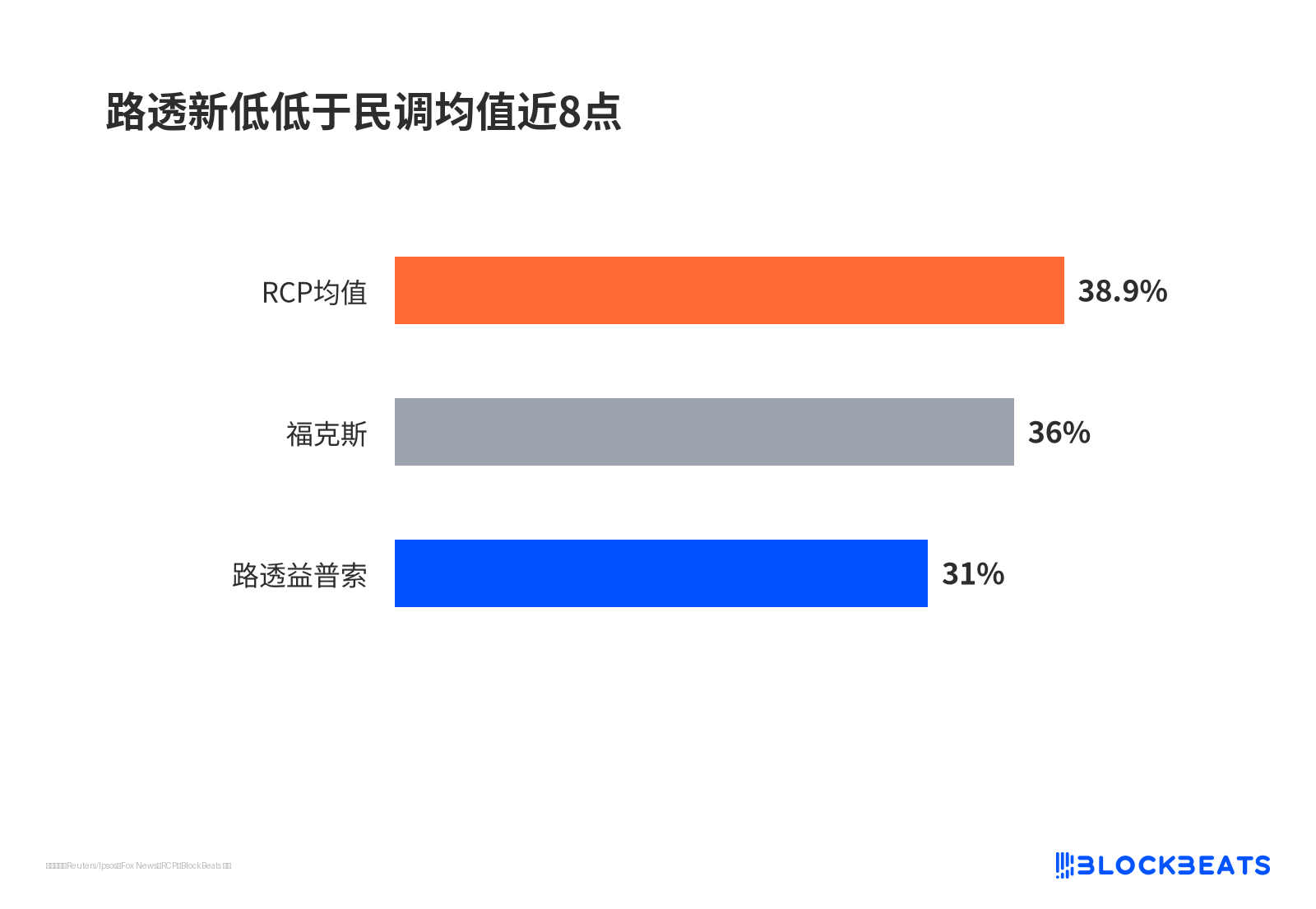
Reuters low nearly 8 points below polling average
All three "record lows" clustered in the same month.
What's holding the numbers down is economic approval. In the Reuters/Ipsos sample, 68% disapprove of Trump's handling of the economy, including 37% who identify as Republicans. After U.S.-Israeli military action against Iran in late February, rising gasoline and diesel prices were widely seen as the proximate cause of deteriorating economic assessments. This can only be treated as a consensus explanation, not an identified single cause. But the direction is clear: what's dragging down approval is the cost of living, not abstract image problems.
Non-MAGA net approval flips negative, pressure falls within the base
Midterms are traditionally a referendum on the incumbent president, and a referendum must translate into seats, with turnout standing in between. The breakdown here is more worth watching than the topline.
Fox's breakdown shows that Republicans who identify as part of the core Trump movement give Trump 95% support. Republicans who don't identify with that label show only 47% support and 52% opposition, with net approval flipping from +7 in September to -5. All Republicans combined stand at about 76%.
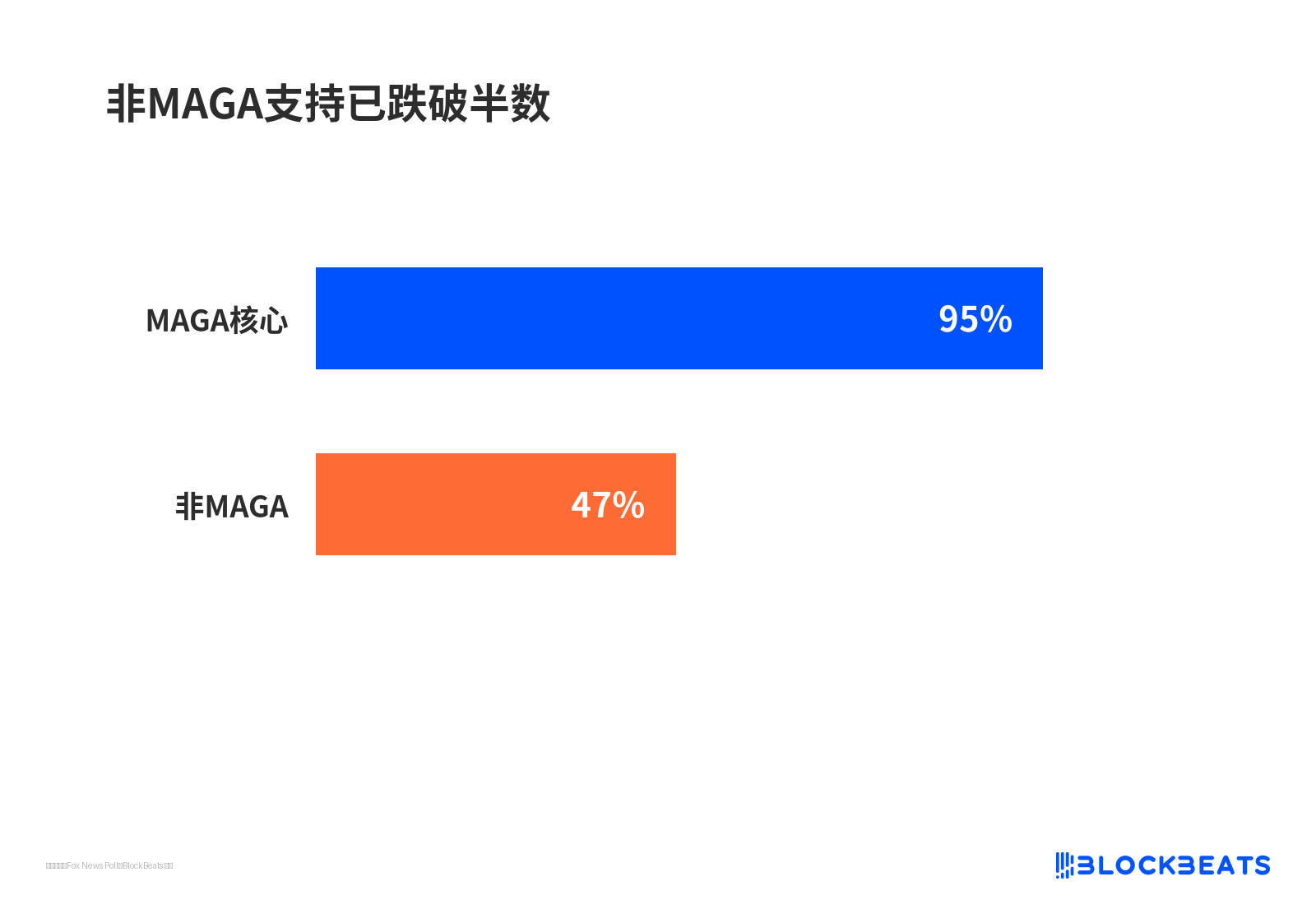
Non-MAGA support has fallen below half
The pressure therefore isn't just about swing voters leaving. Martinez's argument is that candidates have to do two things at once: turn out the 95% core voters, and get those disillusioned Republicans to hold their noses and vote. The more Trump is emphasized, the more energized the former and the more hesitant the latter.
For every $100 in ads, less than $1 mentions Trump
Ad asymmetry is the most直观 behavioral evidence this cycle. Dane summarizes the Republican approach as letting candidates "become their own brand" rather than an extension of the president. Democrats do the opposite, trying to tie district opponents to the president.
Spending structure can only prove strategy, not effect. There's no conversion data showing whether omitting the name actually costs candidates a few points, nor data ruling out another possibility: that Democrats' $20 tying effort exactly offsets Republicans'切割.
The only thing that can be confirmed is this: Republicans are behaviorally treating this election as carrying referendum risk, not as a confidence vote on the president.
The Senate map is harder than the House
National headwinds are unfavorable, but two buffers remain before it reaches the seat count. The Senate currently stands at 53 Republicans and 47 Democrats (including independents who caucus with them), and Democrats need a net gain of 4 seats to reach 51. That requires multiple seats currently held by Republicans to flip simultaneously. The president's party commonly loses seats in midterms, but the Senate flipping along with it is not common.
The House stands at roughly 218 Republicans and 214 Democrats, with 2 seats vacant. Whether Democrats need a net gain of 3 or 4 seats therefore depends on how the vacancies are counted; the safe formulation is 3 to 4 seats.
Morgan Stanley Research's scenario work in mid-October was that even if Congress changes hands, the tariff and deregulation path led by the executive branch may not necessarily reverse, and what increases is mostly noise from oversight investigations and debt ceiling negotiations. This is an institutional policy scenario assumption, not a path that has already materialized. What it signals is that the direction and speed of policy change are not the same thing as the seat numbers.
The early-voting structure is the final gate
There are three conclusions that can currently be supported: the new low fell in the same month, net support among non-MAGA voters turned from positive to negative, and Republicans are actively distancing themselves in ads. All three have primary sources, and none of the three equals an outcome.
What is missing is turnout. Early voting has already begun, and there is not yet an authoritative public breakdown of partisan composition. Polls in the 2016, 2020, and 2024 elections all underestimated Trump's actual vote. "Mentioned by less than 1%" is spending, not persuasiveness; 31% is a single reading, not an average.
The reasonable standard of judgment is therefore that national headwinds are unfavorable to Republicans and that House risk is significantly higher than Senate risk, but both "blue wave locked in" and "policy reverses immediately" go beyond the evidence.
What will change pricing over the next two weeks is not another 31% reading, but the structure of early voting and turnout data. They determine whether this round of low approval can pass through the gate of the districts, and they also determine how much discount the market should assign to policy uncertainty.
Welcome to join the official BlockBeats community:
Telegram Subscription Group: https://t.me/theblockbeats
Telegram Discussion Group: https://t.me/BlockBeats_App
Official Twitter Account: https://twitter.com/BlockBeatsAsia