Silicon Valley's 'Next PayPal Mafia' – Why Has It Become Chinese Fighting Chinese?
Original title: "Silicon Valley's 'Next PayPal Mafia,' Why Has It Become Chinese Fighting Chinese"
Original author: Sleepy
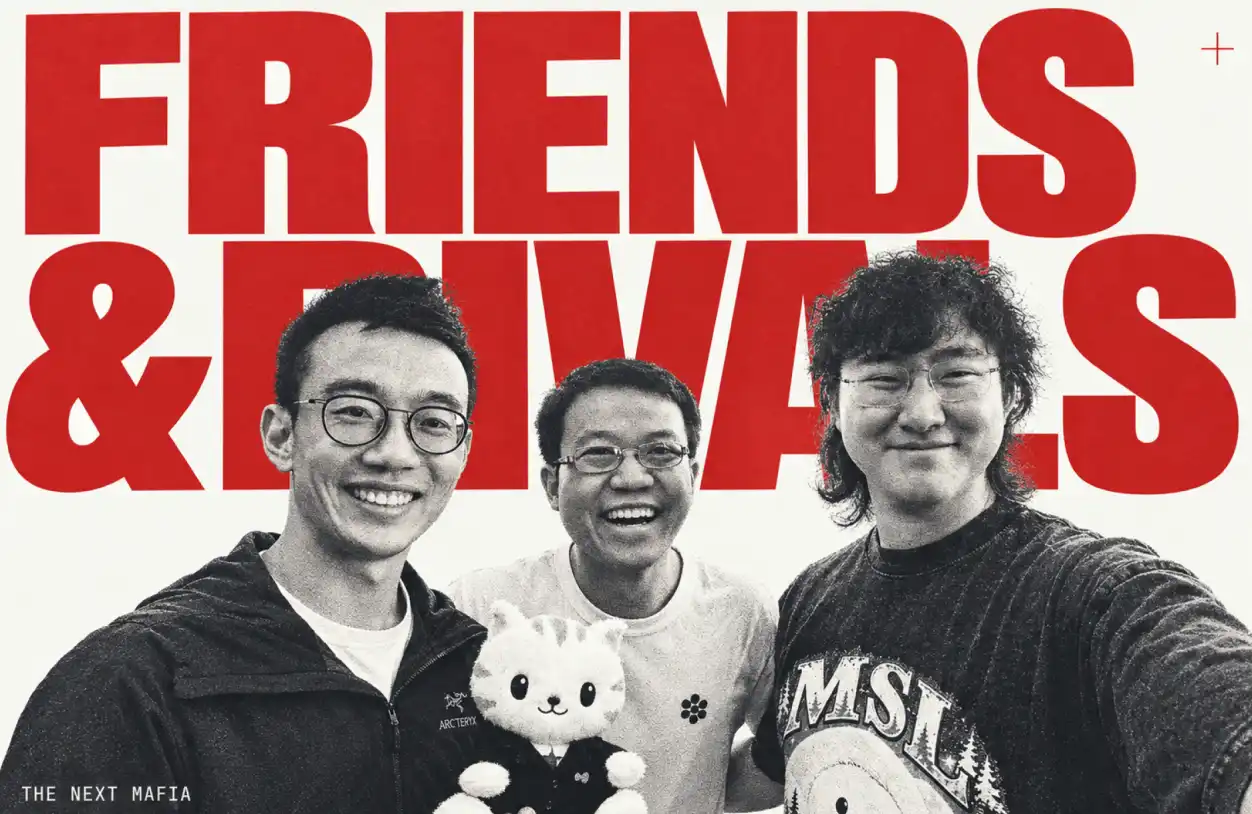
On October 19, 2026, Alexandr Wang posted a photo on X with Jeff Yan and Scott Wu, captioned: "got the HRT gang back together!"
The three people in the photo are all descendants of Chinese immigrants, raised in the same olympiad circle. Ten years ago, they and several other peers of the same age did the first internship program at quantitative trading firm HRT. Alexandr Wang's 19th birthday was celebrated during that internship.
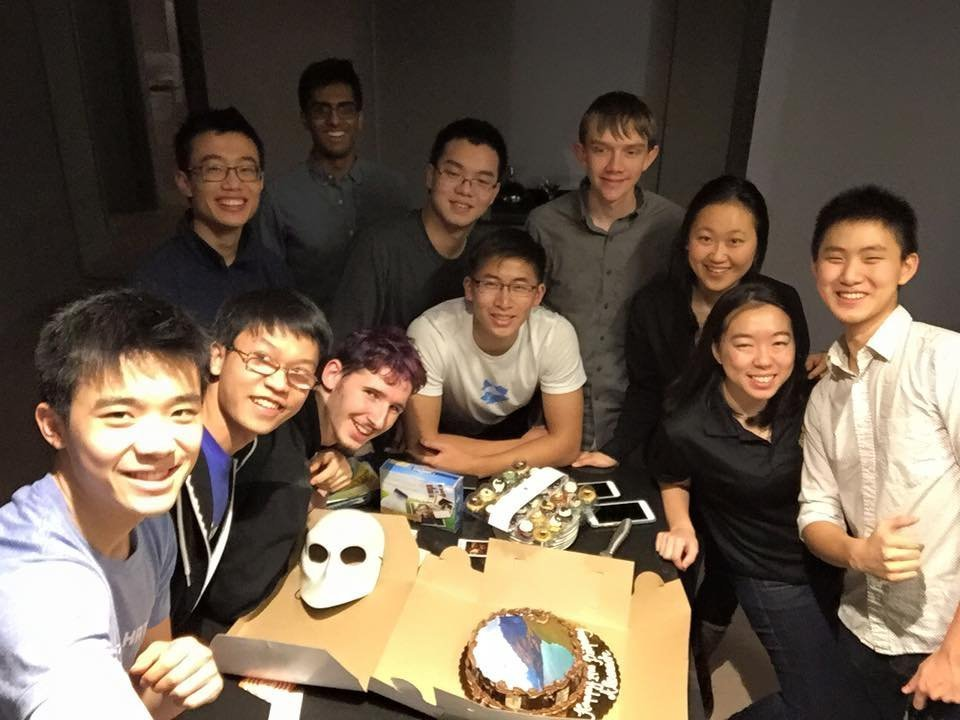
Image source: X
In April this year, Colossus magazine's Jeff Yan profile resurfaced this internship experience, and the phrase "PayPal Mafia of the AI era" quickly spread.
But behind the warm reunion photo of old friends on October 19 lies a somewhat cold time gap.
Just six days before posting the photo, Meta Superintelligence Labs, led by Alexandr Wang, had just released the new model Muse Wonder. The most powerful version of this model, Muse Wonder Full, is not for sale at all and is only installed in Meta's own coding Agent product Muse Code.
And the competitor Muse Code is set to collide head-on with in the market is precisely Cognition, founded by Scott Wu, who stands to his right in the photo.
If you dig further down from this photo, from coding applications, customer service Agents, data labeling, all the way to top-level model labs and bottom-level computing power chips, at the card table of every core track in Silicon Valley AI today, sitting across from a Chinese person is almost always another Chinese person.
Unable to Be Switzerland
Among Cognition's three co-founders, two were formerly under Alexandr Wang.
CTO Steven Hao joined Scale, the data labeling company founded by Alexandr Wang, in 2018 and was among its earliest engineers, not leaving until May 2022; CEO Scott Wu, after dropping out of Harvard, also served as a founding engineer at Scale.
Fast forward to this year, on the Forbes 400 list of richest Americans, former subordinate Steven Hao became the youngest listee with a net worth of $5.8 billion. His former boss, Alexandr Wang, did not appear on the list.
The reunion of the two groups ultimately landed in the most crowded AI coding arena.
Scott Wu's business was originally built on the premise that "any model can be purchased." In June this year, he used an analogy on David Senra's podcast, saying that Cognition aims to be the Switzerland of the coding world, with its Devin backed by a sophisticated orchestration system that switches between Anthropic, OpenAI, Google, open-source models, and in-house models based on the task, helping clients spend every token where it counts.
The host asked him how he handles the delicate relationship of being both a customer of model companies and their competitor.
Scott Wu's answer was focus. He said: "If you do everything, you will lose to Microsoft or Google. They do everything, with trillions more dollars in resources and a hundred thousand more people than you."
The logic is sound, but being Switzerland requires that the great powers are willing to sell you their best weapons and have no intention of personally marching in to occupy Zurich.
Reality quickly provided a counterexample. The former boss became an upstream model supplier, and the sharpest weapon, Muse Wonder Full, was never intended to be sold to the former subordinate from day one.
Fortunately, Cognition ran fast enough this year. Its client list includes Citi, Goldman Sachs, Mercedes-Benz, Dell, Santander Bank, plus the U.S. Army and Navy. In June this year, the acquired Windsurf was renamed Devin Desktop and merged with the cloud-based Devin; on September 8, Scott Wu announced the completion of over $2 billion in Series E funding at a post-money valuation of $48 billion, with ARR climbing from $492 million in May to nearly $900 million.
The host pressed on how many acquisition offers Cognition had received. Scott Wu declined to answer, saying only that if selling the company were the most ambitious choice, they would sell. Just on August 14, Cognition's biggest rival Cursor had just merged into SpaceX at a valuation of $60 billion.
Interestingly, even if you take apart Cursor's shell, the people standing inside are still Chinese.
Composer 2, the in-house model Cursor released in March this year, is built on Kimi K2.5, trained by Yang Zhilin's Moonshot AI; and Cursor's access to this model runs through the licensing channel of Fireworks AI, founded by Lin Qiao, with both training and inference hosted on Fireworks' platform.
Lin Qiao led the PyTorch team during her time at Meta, overseeing more than 300 engineers. In July this year, Fireworks reached a valuation of $17.5 billion, and its client list includes both Cursor and Perplexity, another company dragged into the war by Meta.
The Same Cap Table
Before inviting Alexandr Wang in, the first door Mark Zuckerberg knocked on was actually Perplexity's.
According to Bloomberg's disclosure in June 2025, Meta held a round of acquisition talks with Perplexity before taking a stake in Scale, and also sought to recruit CEO Aravind Srinivas himself. Perplexity's co-founder and chief strategy officer Johnny Ho was the perfect-score first place winner at the 2012 International Olympiad in Informatics, coming from the same olympiad circle as Scott Wu. The two companies had prior ties: Sonar, the in-house model Perplexity released in February 2025, was built directly on Meta's open-source Llama 3.3 70B.
But the deal didn't go through.
Meta turned around and dropped $14.3 billion to buy a 49% stake in Scale, bringing Alexandr Wang in to take the helm. A year later, on September 8, 2026, Meta's personal assistant Muse launched in the United States, sending emails, booking trips, and shopping online for users; it surpassed 2.5 million downloads in two weeks and shot straight to the top of the U.S. App Store free chart.
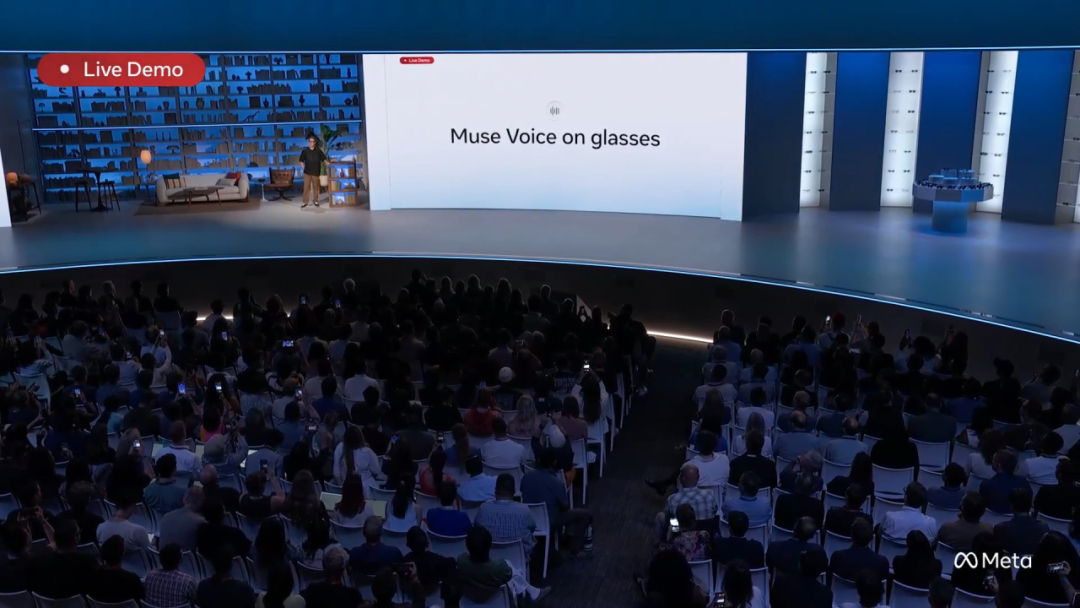
Image source: Meta Connect 2026
Placing orders online on users' behalf is exactly the path Perplexity first blazed with its browser Comet. In November 2025, Amazon sued Perplexity, alleging that Comet disguised itself as Chrome to place orders for users; by September this year, Amazon had also shut Meta's Muse out.
Perplexity on the other side hasn't slowed down either. Its ARR has grown from under $250 million at the start of the year to over $750 million, and in August word spread that Nvidia was in talks for an investment valuing it at over $30 billion.
Also dragged into the battlefield by Meta during the same period was Jesse Zhang, of the same generation, and his Decagon.
Decagon focuses on enterprise customer service agents, serving Chime, Duolingo, Hertz, and Block. It was valued at $4.5 billion in January this year, and in August its ARR crossed the $100 million threshold.
Its original main rival was Sierra, founded by OpenAI chairman Bret Taylor and valued at over $15 billion.
Unexpectedly, Meta came charging in from the flank. In June 2026, Meta launched Business Agent in London, letting merchants use AI for free on WhatsApp, Messenger, and Instagram to receive customers, recommend products, and book services. Meta said its earlier beta had already been used by over 1 million merchants.
Meta originally had another card to play. At the end of last year, it splashed over $2 billion to buy Manus, founded by Xiao Hong in 2022. In April this year, the National Development and Reform Commission, citing foreign investment security review, ordered the deal to be unwound entirely, and Meta subsequently cut off data exchanges with Manus. On October 8, Butterfly Effect, Manus's parent company, announced it had completed over $500 million in new financing, led by Boyu Capital and IDG Capital.
If you raise your perspective from products to the capital level, you'll see a more subtle picture: these young people are fighting tooth and nail in business, but the money in their pockets comes from the same batch of funds.
The lead investors in Cognition's over $2 billion Series E were a16z and Accel.
a16z co-founder Marc Andreessen has sat on Facebook's board since 2008 and was just re-elected on May 27 this year; at the same time, a16z was also the lead investor in Cursor's Series A. The other lead investor, Accel, was both an early backer of Facebook in 2005 and the lead investor in Scale's Series A. Decagon's seed round was led by a16z, its Series A was led by Accel, and its Series C was jointly led by Accel and a16z.
So it is with Peter Thiel's Founders Fund. It led Scale's 2019 Series C, led Cognition's rounds three times, and was also one of SpaceX's earliest outside investors, investing about $600 million in total. Its roughly 3% stake, calculated at SpaceX's June IPO price this year, is worth more than $50 billion.
After the referee stepped onto the field
Everything comes at a price.
Alexandr Wang left Scale to join Meta, directly placing another Chinese entrepreneur on the throne in the data track.
This person is Edwin Chen.
He previously worked as an engineer at Google, Facebook, and Twitter, and in 2020 independently founded the data labeling company Surge AI. In Silicon Valley, where hot money floods everywhere, Edwin Chen is an outlier. He deliberately took not a single cent from VCs, on the grounds that venture capital would make the company bloated and distort the team's incentive mechanisms.
According to Forbes statistics, Surge has been profitable almost from day one, with revenue of about $1.2 billion in 2024, while Scale's revenue that same year was $870 million. Even more striking is the revenue per employee ratio: Surge has only about 110 full-time employees, while Scale has more than 1,000.
The moment Meta announced its stake in Scale, the balance tipped completely. When the referee steps onto the field and becomes a player, former customers naturally no longer dare to hand over their cards. Scale's largest customers, Google and OpenAI, have moved their data orders elsewhere one after another; no one wants Meta to infer from labeling demand what models they are training.
The truly embarrassing thing for Scale happened inside Meta. In August 2025, reports emerged that researchers at TBD Lab under MSL, which Alexandr Wang himself heads, actually preferred to purchase data from Surge and Mercor, complaining that the data quality of Scale, in which their own company had invested $14.3 billion for a stake, was not good enough. Although Meta officially denied it, its actions were quite honest: after taking the stake, it was still paying to buy competitors' data.
After losing major customers, Scale turned to litigation and government contracts, and in September 2025 sued a former employee who had jumped ship to Mercor, accusing the person of taking away more than 100 confidential documents.
On the other side, Edwin Chen, with roughly 75% of Surge shares in hand, made his debut on the Forbes 400 list of richest Americans last year with a net worth of $18 billion, becoming the wealthiest newcomer that year, and he remains on the list this year.
But compared to the scramble for data orders, the talent war in model labs is even more cutthroat.
On July 19, 2025, Silicon Valley investor Deedy Das posted on X a list allegedly leaked from Meta's internal MSL, showing that of the 44 people, half were from China, 40% were poached from OpenAI, 15% from Scale, and three-quarters were first-generation immigrants. Of the earliest exposed 11-person core team, 7 were of Chinese descent.
The poaching war kicked off as soon as Alexandr Wang stepped through Meta's doors in June 2025. Mark Zuckerberg personally led the charge, first poaching Lucas Beyer, Alexander Kolesnikov, and Xiaohua Zhai from OpenAI's Zurich office, then days later signing four core researchers in one go: Shengjia Zhao, Jiahui Yu, Hongyu Ren, and Shuchao Bi.
The most dramatic case was Shengjia Zhao, one of ChatGPT's core authors. According to reports, just days after joining Meta, he threatened to resign and return to OpenAI, and was swiftly promoted to chief scientist of MSL. By July, Meta offered a compensation package reportedly exceeding $200 million to poach Ruoming Pang, Apple's foundation models lead; the same month, Jason Wei, the proposer of chain-of-thought, also jumped from OpenAI to Meta; in October, Ke Yang, who led AI search at Apple, was likewise brought on board.
On the other side of the table, defending OpenAI's turf, is also a Chinese American: Chief Research Officer Mark Chen.
Before joining OpenAI, Mark Chen had also worked as a quantitative trader at proprietary trading firms like Jane Street, making him and Alexandr Wang cut from the same cloth. According to The Wall Street Journal, Mark Zuckerberg once privately extended an olive branch, asking whether he would be willing to come to Meta; Mark Chen declined.
Another table beneath the card table
The more fiercely these twenty- and thirty-something young people battle at the model and application layers, the more astonishing the money burned at the底层.
Compensation packages running into hundreds of millions of dollars and billions in financing ultimately all turn into compute procurement orders flowing to data centers. And when Alexandr Wang, who heads Meta AI, and Mark Chen, who leads R&D at OpenAI, bow their heads to go buy "munitions," they will discover an even more intriguing fact.
The four chip giants supplying compute to all of Silicon Valley—Nvidia, AMD, Broadcom, and Intel—have four Chinese predecessors sitting in the chief executive seats.
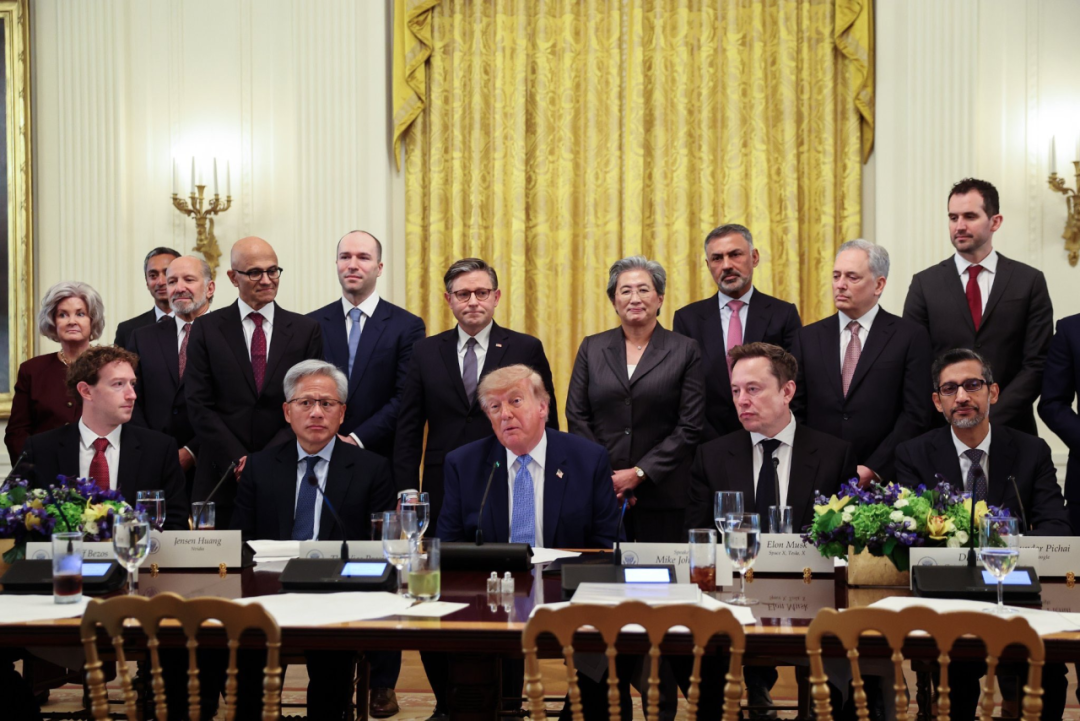
Image source: Doug Mills / NYT
The younger generation of Chinese is fighting the model war on the front stage, while the older generation of Chinese is fighting the munitions war behind the scenes.
Jensen Huang and Lisa Su were both born in Tainan. According to genealogical research by scholars in Taiwan, China, Jensen Huang's mother and Lisa Su's grandfather are biological siblings, and by seniority, Lisa Su would have to call Jensen Huang "cousin-uncle." Lisa Su later recalled that the two did not know each other as children and only met for the first time after many years of working. At that time, no one could have imagined that these two would later respectively helm Nvidia and AMD.
To avoid being strangled by a single supplier, the young people on the front stage have begun using extremely similar financial structures to place simultaneous bets among several Chinese predecessors.
In the fall of 2025, OpenAI signed with three chip giants in the span of a single month. In September, it signed a letter of intent with Nvidia for at least 10GW of compute, accompanied by an investment commitment of up to $100 billion; on October 6, it turned around and signed a 6GW order with AMD, casually taking warrants for up to 160 million AMD shares, about 10% of total share capital; just one week later, on October 13, it announced joint development of 10GW of custom chips with Broadcom.
A few months later, Meta, where Alexandr Wang works, copied the homework almost exactly from the same blueprint.
On February 17, 2026, Meta announced the purchase of millions of Blackwell and Rubin GPUs from Nvidia, plus Grace and Vera CPUs; just one week later, on February 24, it signed a massive 6GW order with AMD, with warrant terms identical to OpenAI's—also up to 160 million shares; and at the table for its in-house MTIA chips, the partner Meta brought in was still Broadcom.
Hock Tan, who helms Broadcom, was born in Penang, Malaysia, and sat on Meta's board for more than two years starting in February 2024, only stepping down in May of this year. This veteran, known for iron-fisted acquisitions, also believed in his early years that Nvidia's general-purpose GPUs would dominate the market, but later changed course and went all-in on custom chips for major customers.
Jensen Huang responded without mincing words. In June 2025, he publicly pushed back in Paris, saying that many companies initially try to build custom chips, but after running the numbers, almost all of them cancel the effort.
Broadcom's AI chip revenue surged to $16.7 billion in the third quarter of fiscal 2026, a year-on-year jump of 221%. Google's TPU, Meta's MTIA, and OpenAI's in-house chips all have Broadcom behind them. For large-model giants, every custom chip Broadcom helps them build is a bargaining chip at the negotiating table to buy fewer Nvidia GPUs.
His cousin Lisa Su has also caught up. On September 21 this year, AMD's market capitalization officially broke through $1 trillion, with a year-to-date gain of 187%. Although it still lags far behind Nvidia's $5.45 trillion market value over the same period, the table is no longer a one-voice affair.
The fourth entrant is Malaysian Chinese Lip-Bu Tan. In March 2025, he was called in at a critical moment to serve as Intel CEO. Then on August 7, Trump suddenly attacked him on social media, accusing him of a "serious conflict of interest" due to early investments in a batch of Chinese semiconductor companies and saying he "must resign immediately."
Venture capital veteran Lip-Bu Tan went straight to the White House. Two weeks later, the plot reversed: the U.S. government announced it would buy a 9.9% stake in Intel for $8.9 billion; a few weeks later, even rival Jensen Huang put $5 billion into Intel.
From Hock Tan in his 70s, Jensen Huang and Lip-Bu Tan in their 60s, to Lisa Su in her 50s, and then Alexandr Wang and Scott Wu in their 20s, two generations of Chinese separated by three decades ultimately filled the entire AI industry chain's table as rivals to one another.
The Same Pipeline
Why has this kind of high-density, head-on collision among Chinese rarely appeared in Silicon Valley in the past?
Silicon Valley has never lacked Chinese engineers.
UC Berkeley scholar AnnaLee Saxenian conducted a study in 1999 showing that between 1980 and 1998, 24% of newly founded tech companies in Silicon Valley were led by Chinese and Indian entrepreneurs, with Chinese accounting for 17% of that. Jensen Huang founded Nvidia in 1993, precisely a product of that golden age of hardware entrepreneurship.
But when Silicon Valley entered the internet platform era, the top of the pyramid rarely went to Chinese anymore.
In 2015, the Ascend Foundation analyzed the workforce demographics of five major Silicon Valley companies—Google, HP, Intel, LinkedIn, and Yahoo—finding that Asian Americans made up 27.2% of professional technical staff but only 13.9% of executive roles. During the same period, Satya Nadella and Sundar Pichai successively took the helm at Microsoft and Google, rising through the internal product and management ladders of large corporations. Yet within the "PayPal Mafia" that defined Silicon Valley power at the time, aside from YouTube co-founder Steve Chen, Chinese faces were almost nowhere to be seen.
Until AI completely rewrote these promotion rules.
In this wave of technological revolution, power has returned to a handful of hardcore technical geniuses. Alexandr Wang said on a podcast that his top priority is recruiting the best people, with teams that are small, flat, and have extremely high talent density.
In September of this year, The Economist dedicated an article declaring that "Olympians" have replaced "Davos Man" as the new power elite of the AI era. The article named everyone from Anthropic and OpenAI to Cognition and Perplexity, and casually mentioned that Meta's highest-paid executive is very likely the 29-year-old Alexandr Wang.
And the talent pipeline that produces these "Olympians" is one that Chinese people know best.
The entrance to this pipeline is math and informatics olympiads, the middle section is Wall Street and Silicon Valley's quantitative giants, and the exit is today's AI labs.
Over the past decade, quant firms like Jane Street have regularly appeared at olympiad events. Citadel says it has twenty to thirty interns each year who have participated in olympiads, and ten years ago HRT's first internship program was the earliest sample pool.
In January of this year, recruiting firm Selby Jennings predicted in its annual outlook that quant funds would increasingly collide with OpenAI and Anthropic in the talent war. On the academic side, according to the latest edition of MacroPolo's Global AI Talent Tracker, among researchers at the three top conferences NeurIPS 2024, ICML 2024, and ICLR 2025, 38% did their undergraduate studies at Chinese universities, and of those, 72% work at U.S. institutions.
When the same highly selective pipeline delivers a large batch of the most elite young Chinese talent to the top of Silicon Valley power in just three to five years, and there are only so many seats at the table, the opponent you look up and see can only be the deskmate who sat next to you grinding through problem sets back in the day.
There Can Only Be One Winner
Back in the day, the "PayPal Mafia" had their internal fallouts too.
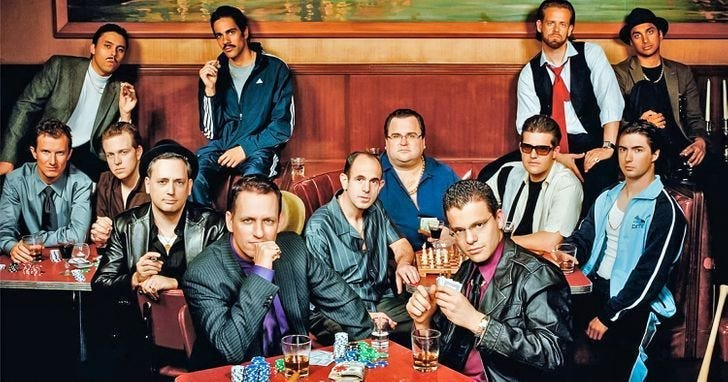
Image source: Medium
In September 2000, newlywed Elon Musk flew to Australia for his honeymoon. While he was still on the plane, the board staged a coup and replaced him as CEO with Peter Thiel.
But eight years later, when SpaceX's Falcon 1 failed three launches in a row and cash was running dangerously low, it was Peter Thiel's Founders Fund that wrote a $20 million check to save Musk. In the same circle, Roelof Botha led Sequoia's investment in Steve Chen's YouTube, Max Levchin incubated Yelp, and Reid Hoffman personally introduced Peter Thiel to Mark Zuckerberg, who had just moved to Silicon Valley.
The reason that generation could turn grudges into mutual success was largely because the internet in the early 2000s was still uncharted territory—social, video, e-commerce, reviews, payments. The wilderness was vast enough that everyone could turn around and claim a plot without colliding with anyone else.
But the cruelty of the AI era is that there are only so many highways that can grow into $10 billion businesses: foundation models, coding agents, search gateways, enterprise customer service, data infrastructure.
The lanes are too narrow, the people too smart, and the money too concentrated. When everyone sees the same direction at the same second, the only place old friends can reunite is the dead center of a single-log bridge.
On October 11 this year, Alexandr Wang shared an amusing anecdote on a podcast. Recently he ran into the founder of his former employer HRT, who mentioned that HRT had started doing private equity investments.
Alexandr Wang joked on the spot:
"Just invest into the interns! All the interns get seed checks!"
(Just invest in the interns—hand every intern a seed-round check.)
Except a decade later, those former interns no longer lack that seed check. What they're shortest on now, more than money, is a lane where they won't run into an old friend.
In the three-person photo shared by Alexandr Wang, the only one who didn't jump onto the AI table was Jeff Yan on the left. He stayed in the trading world he knew best and built the decentralized contract trading platform Hyperliquid.
Many years ago, Jeff Yan failed a math selection competition. When someone later asked about that failure, the former Olympiad youth calmly said one sentence:
Losing is very common. Most people are losers, and usually only one wins.
Original link
Welcome to join the official BlockBeats community:
Telegram Subscription Group: https://t.me/theblockbeats
Telegram Discussion Group: https://t.me/BlockBeats_App
Official Twitter Account: https://twitter.com/BlockBeatsAsia