SemiAnalysis's China Data Center Survey: ByteDance Rented 20% of the Nation's Available Land
Editor's note: While global investors focus on Nvidia GPUs, AI model performance, and the capital expenditures of American tech giants, China is undergoing another massive AI infrastructure expansion. On September 25, semiconductor and AI research firm SemiAnalysis released a China data center research report. Based on tracking more than 60 operators and over 1,000 data center facilities, it estimates that China's data center capacity will exceed 24GW by the end of 2026, second only to the United States in scale. At the same time, the combined capital expenditures of Alibaba, Tencent, and Baidu in the second quarter reached about $20 billion, more than doubling year over year.
But behind this expansion is a seemingly contradictory phenomenon: on the one hand, China's data center industry has long been plagued by high vacancy rates, price competition, and overcapacity; on the other hand, AI data centers are rapidly securing orders, with some hyperscale projects even requiring delivery within six months. Is the market truly experiencing overcapacity, or is compute supply falling short of demand?
SemiAnalysis argues in the report that the key issue is not the total amount of data centers, but the structure of supply. China's early data centers were mainly built around telecom operators, small racks, and traditional cloud computing demand, and many old facilities cannot be economically retrofitted into high-density AI computer rooms. Today, companies such as ByteDance, Alibaba, and Tencent are driving the construction of new wholesale-type data centers, with power costs, chip supply, and construction speed becoming more important competitive variables.
This also means that understanding China's AI infrastructure cannot rely solely on listed companies' capital expenditures or the industry's average rack utilization rate. Who is buying compute, who is providing computer rooms, where capacity is being built, and how much capital is actually converted into usable AI computing power are the important clues for judging the industry's prosperity. What the report depicts is not simply a construction boom, but the process of China's data center market transforming from traditional telecom infrastructure to AI compute infrastructure.
The following is a translation of the original text:
The scale of China's data center market may be larger than many overseas investors previously estimated.
SemiAnalysis's newly released China Datacenter Model shows that, based on its facility capacity measure, China is expected to have more than 24GW of data center capacity by the end of 2026, exceeding the approximately 14GW in Europe, the Middle East, and Africa, and also exceeding the approximately 15GW in Asia-Pacific excluding China, second only to the estimated 56GW in the United States.
Note: GW stands for gigawatt, and 1GW equals 1,000MW. What is measured here is the power capacity of data center facilities, which is not equivalent to the compute power of AI chips already installed and in operation.
This statistic does not yet include approximately 20GW of follow-on projects with clear timelines, nor approximately 30GW of announced projects with relatively low delivery certainty. These two categories of reserve capacity cannot simply be regarded as already built or fully certain to be put into use.
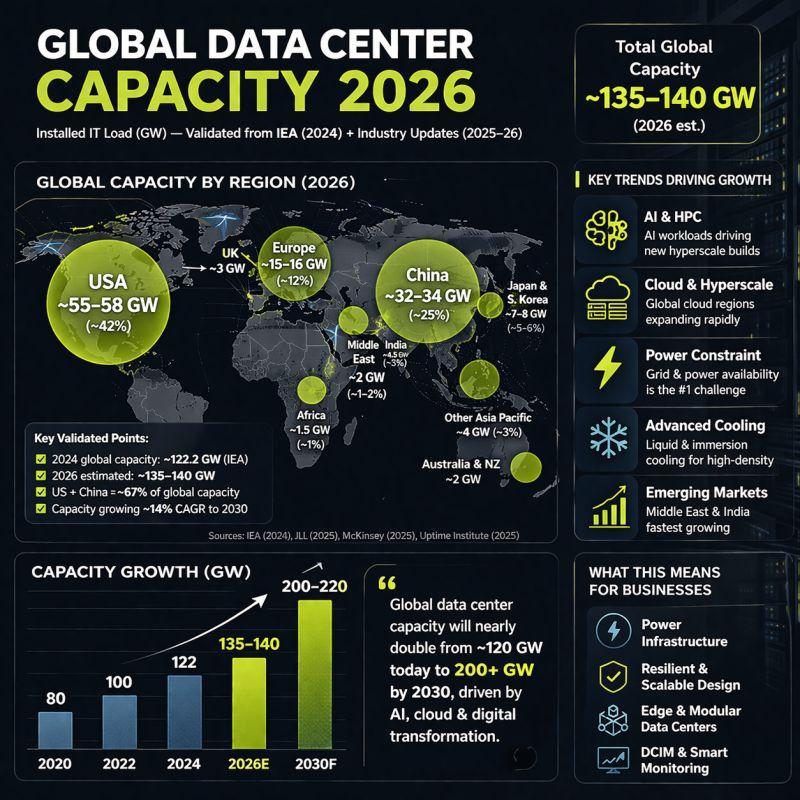
Figure: Comparison of data center capacity in major global regions in 2026. Source: SemiAnalysis
What underpins this round of expansion is the reaccelerated capital expenditure of China's internet giants.
According to SemiAnalysis, in the second quarter of 2026, the combined capital expenditure of Alibaba, Tencent, and Baidu was approximately $20 billion, more than doubling year-over-year. The report also noted that all three companies recorded negative free cash flow in the quarter, reflecting a marked increase in their investment intensity.
But this does not yet include China's largest single data center tenant — ByteDance.
SemiAnalysis's building-level tracking model estimates that ByteDance accounts for approximately one-fifth of China's delivered data center capacity, the vast majority of which comes from leasing. For the entire third-party wholesale data center industry, ByteDance has become the most important source of demand.
It is precisely for this reason that traditional statistical methods may underestimate the true scale of China's AI infrastructure investment: one of the most important computing power buyers is not yet publicly listed, and some of the largest operators are also not publicly listed, making it difficult for investors to reconstruct the entire market based solely on public financial reports.
China's data centers do not lack demand — it is that old capacity cannot accommodate AI
SemiAnalysis believes that to understand the current supply-demand contradiction in China's data center industry, one must first return to the industry's construction history.
The U.S. data center industry developed earlier around large cloud vendors, with hundreds-of-megawatts-scale campuses often customized for a small number of large customers. China's market, by contrast, was initially dominated by telecom operators such as China Mobile, China Telecom, and China Unicom, mainly serving websites, online games, content delivery networks (CDNs), and government and enterprise customers.
At that time, data centers were closer to a telecom infrastructure leasing business: operators provided racks, networks, and bandwidth, and customers leased on demand. Facilities were typically smaller in scale, and rack power density was also lower.
Around 2015, Alibaba Cloud, Tencent Cloud, and others began to expand rapidly, and data center construction entered a cloud computing-driven phase. Large cloud vendors continuously increased capital expenditure, third-party operators followed with expansion, and a large number of developers bet that cloud computing demand would grow over the long term.
However, from 2022 to 2023, growth among internet companies slowed, competition in cloud services intensified, and capacity built in earlier phases began to be released in concentrated fashion, pushing the industry into a digestion period. Data center rental prices came under pressure, and utilization rates at some older facilities continued to decline.
According to VNET data cited in the report, its overall data center utilization rate once fell from about 70% to the 50%-plus level. But after 2023, the market began to show clear divergence: driven by AI demand, wholesale data center utilization rates rose back above 70%, while traditional retail racks still hovered around 60%.
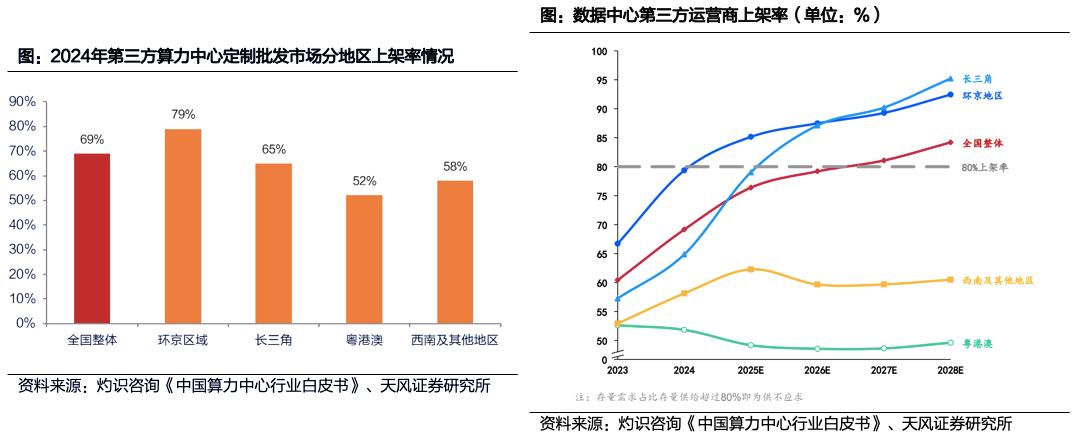
Chart: VNET's overall and segment-level data center utilization trends, with wholesale and retail businesses gradually diverging. Source: VNET disclosures, SemiAnalysis
The reason is that traditional computer rooms and AI computer rooms have different infrastructure requirements.
Older server racks often required only lower power, while modern GPU clusters place higher demands on power supply, cooling, rack power density, and cluster interconnection. A traditional data center that is still operating and has some racks already leased may not be able to be economically converted into a large AI computing facility even if it has spare space.
For operators, retrofitting may involve upgrades to power distribution and cooling systems and may also affect existing customers, so the economics may not be better than building new. Therefore, the high vacancy rate of traditional facilities cannot directly prove that AI data centers are also oversupplied.
SemiAnalysis divides China's data center industry into four stages: the carrier colocation era before 2015, the cloud computing expansion period from 2015 to 2021, the capacity digestion period from 2022 to 2023, and a new AI-driven construction cycle since 2024.
The most important change is that AI demand is no longer just filling racks built in the past, but is creating a new data center supply system.
The report estimates that the combined capital expenditure of ByteDance, Alibaba, Tencent, and Baidu rose from about $35 billion in 2024 to more than $50 billion in 2025, and based on the spending trends observed in the report at the time, could approach $100 billion in 2026. But this figure is still a trend projection, not confirmed full-year spending.
The demand structure is also changing.
In the first half of 2026, GDS and VNET together signed about 1.3GW of wholesale data center orders, while new retail orders in the same period were less than 10MW.
So-called wholesale colocation typically involves providing large-scale data center space, power, and infrastructure capacity to customers such as large cloud providers; retail data centers are more focused on leasing racks and supporting services to dispersed customers.
This set of order data indicates that new demand is highly concentrated among large customers and high-density facilities, rather than traditional small-scale rack leasing business. However, SemiAnalysis also cautions that VNET and 21Vianet only captured about one-third of ByteDance and Alibaba orders within its tracking scope from 2024 through 2026 to date. Looking only at the performance of the two U.S.-listed data center operators would still miss a large amount of demand.
ByteDance becomes the largest buyer, five giants take different computing power routes
Another difference between this round of AI infrastructure expansion and the previous round of cloud computing competition is that demand is highly concentrated in the hands of a few large tech companies.
SemiAnalysis focused on five companies: ByteDance, Alibaba, Tencent, Baidu, and Huawei. Although all are increasing AI investment, there are clear differences in their respective business models, capital expenditure approaches, and data center strategies.
ByteDance: leasing about one-fifth of the country's delivered data center capacity
ByteDance is the most important source of demand in the report.
According to SemiAnalysis's model, its domestically leased delivered data center capacity exceeds 4GW, with partners including Qinhuai Data, Zhonglian Data, 21Vianet, and several other operators. Some suppliers rely on ByteDance for more than 80% of their revenue, with Qinhuai Data's related share still around 90% in early 2026.
This means that ByteDance's capital expenditure decisions not only affect its own AI business, but may also directly change orders and revenue across the entire third-party data center industry.
Its demand mainly comes from two ends: on one hand, Douyin and TikTok's existing recommendation, advertising, and global businesses; on the other hand, training and inference demand brought by AI products such as Doubao, Seedance, and Volcano Engine.
According to the report, as of March 2026, Doubao's monthly active users had reached 345 million, further increasing ByteDance's demand for AI inference infrastructure.
In terms of investment scale, budget information cited by SemiAnalysis shows that ByteDance's 2026 AI infrastructure budget was initially about $24 billion, and by May had been raised to more than $30 billion. Media have mentioned a potential spending scale of up to $70 billion, but the report clearly states that this is only an upper limit under discussion, not an already finalized annual budget.
For a long time, ByteDance relied on leasing for rapid expansion. But as demand continues to grow, it has also begun to add self-built campuses through Volcano Engine, deploying large-scale computing facilities in Shanxi, Anhui, and Inner Mongolia, with signs of new project preparations emerging in Ningxia.
In SemiAnalysis's view, this means ByteDance is gradually shifting from a model primarily dependent on leasing to a parallel approach of leasing and self-building, in order to reduce long-term costs and improve its control over core computing power.
Alibaba: Integrating Models, Cloud Services, and Data Centers into One Business
Compared with ByteDance, Alibaba's advantage lies in a more complete cloud computing business model.
SemiAnalysis views Alibaba as the cloud vendor in China closest to the AWS model: based on Infrastructure-as-a-Service (IaaS), it then provides enterprises with Model-as-a-Service (MaaS), converting large model capabilities into cloud revenue.
According to the report data, AI-related product revenue has already accounted for about 35% of Alibaba Cloud's external revenue.
Unlike simply purchasing GPUs or building data centers, Alibaba also expands its cloud ecosystem by investing in large model companies. SemiAnalysis mentions that Alibaba's investments in companies such as Moonshot AI, MiniMax, and Zhipu not only bring equity exposure, but may also generate sustained computing demand through cloud resource procurement.
Another advantage of Alibaba is software-hardware synergy.
The report mentions that T-Head's self-developed chips have begun serving actual Alibaba Cloud workloads. In April 2026, China Telecom and Alibaba Cloud deployed a 10,000-card cluster using T-Head Zhenwu chips in Shaoguan, and plan to further expand capacity.
In data center construction, Alibaba does not insist on fully self-building, but instead uses a mix of self-building, third-party leasing, and cooperative development models, shifting part of its infrastructure capital expenditure to partners.
Tencent, Baidu, and Huawei: Increased Capital Expenditure Does Not Mean the Same Expansion Approach
Tencent's strategy is relatively cautious.
SemiAnalysis points out that Tencent actively consolidated data center resources from 2022 to 2023, shut down some small leasing facilities, and concentrated demand into large self-built campuses. Although capital expenditure in the first half of 2026 has exceeded the full year of 2025, the report observes that its data center capacity growth has not shown a jump of the same magnitude.
Analysts speculate based on this that a significant portion of the new spending may be allocated to chip and storage equipment procurement, rather than simply building more data centers. Compared with ByteDance and Alibaba, Tencent's data center layout is also more skewed toward the eastern region, consistent with the network latency requirements of WeChat, gaming, and video businesses.
Baidu, meanwhile, faces different challenges.
The report argues that Baidu started early in AI research and development, but its infrastructure investment scale lags behind other major internet giants. Its differentiation direction is gradually shifting toward self-developed chips such as Kunlun, as well as GPU cloud services for enterprise and government clients.
According to the report, Baidu's GPU cloud revenue grew 283% year-over-year in the second quarter of 2026. SemiAnalysis interprets this as Baidu strengthening its chip and computing power services business, rather than merely participating in large model training scale competition.
Huawei's role is even more distinctive.
It not only operates Huawei Cloud, but is also an important supplier of China's AI chips and computing systems. The report estimates that Huawei's self-built data center ratio exceeds 90%, higher than other large enterprises tracked.
SemiAnalysis believes Huawei Cloud can be understood as a commercialization channel for Ascend computing power: customers do not necessarily need to buy servers directly, but can rent related computing capacity through cloud services.
As a result, China's AI infrastructure market has formed a structure different from simple cloud vendor competition: ByteDance mainly drives external leasing demand, Alibaba promotes model and cloud service synergy, Tencent focuses more on integrating existing businesses, Baidu strengthens chips and GPU cloud, while Huawei simultaneously participates in computing power supply and infrastructure construction.
This also means that the same capex metric cannot be used to judge all companies' AI competitiveness.
China is building data centers faster and faster, but the real bottleneck is chips
If the demand side is driven by a small number of tech giants, then the most important change on the supply side is that data center construction is beginning to concentrate in regions rich in energy and with lower land costs.
In 2022, China officially launched the "East Data, West Computing" project, planning eight national computing hubs and ten data center clusters, hoping to guide large-scale computing facilities toward regions with energy and land advantages. This policy framework has also been confirmed by publicly available documents from the National Development and Reform Commission.
SemiAnalysis believes that where this policy truly takes effect is not only in planning where data centers should be built, but also in influencing developers' actual site selection through energy-saving reviews, project approvals, and resource allocation.
But policy is not the only determining factor.
In the past, cloud computing, gaming, and e-commerce businesses had high requirements for network latency, so data centers tended to be located closer to densely populated and commercially active areas such as Beijing, Shanghai, and Shenzhen.
AI training tasks are different. Large-scale model training typically cares more about power supply, operating costs, and cluster scale, and is relatively less sensitive to network latency to end users. This makes regions such as Inner Mongolia and Ningxia more attractive.
SemiAnalysis specifically highlighted the advantages of Inner Mongolia.
According to its estimates, electricity prices in some parts of Inner Mongolia are about half those in first-tier cities, and combined with relatively abundant land, energy, and approval conditions for large projects, this makes it an important destination for hyperscale AI data centers.
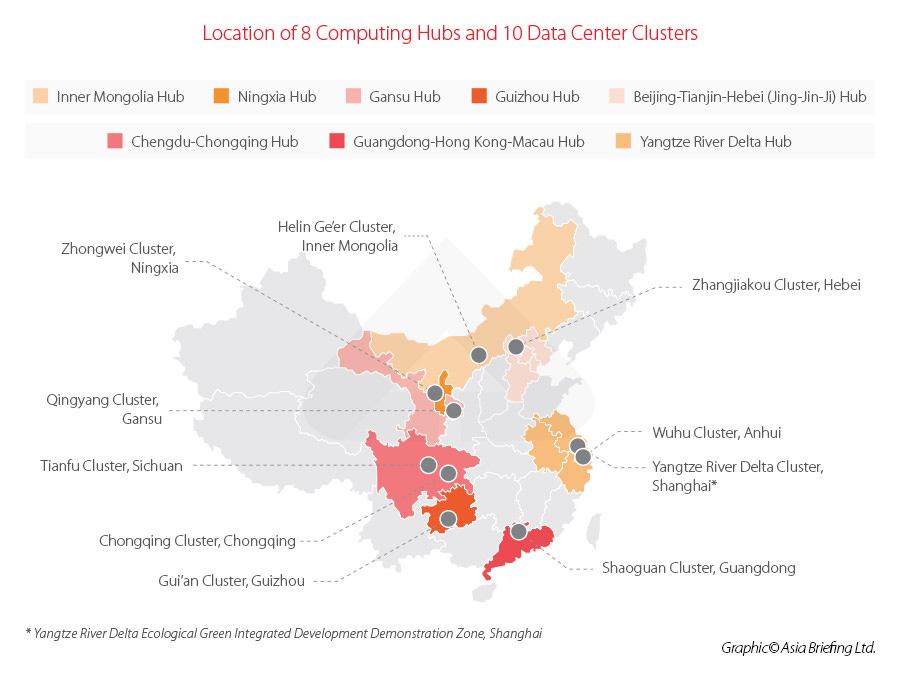
Figure: Layout of China's major computing hubs and data center clusters. Source: SemiAnalysis
However, data centers cannot be built just because electricity is cheap.
SemiAnalysis pointed out that although Shanxi is not one of the eight national hubs under the "East Data, West Computing" initiative, it has attracted commitments of nearly 2GW of self-built and leased capacity from companies such as ByteDance, Baidu, and JD.com, relying on cheap electricity, proximity to Beijing, and an earlier industrial layout.
This shows that policy determines the overall direction, but electricity prices, geographic location, and existing infrastructure still determine the competitiveness of specific projects.
Another advantage for China is construction speed.
According to SemiAnalysis research, the standard construction cycle for a 100MW data center in China has shortened from about 18 months in the cloud computing era to about 12 months in the AI era, with some projects even faster.
By comparison, the report estimates that for a relatively ideal fully modular data center project in the United States, construction itself usually still takes 12 to 18 months, and there may be additional lengthy approval periods. However, the specific timeline still depends on grid connection and local conditions.
One important reason China is able to shorten construction timelines is changes in building structure and construction processes.
In the past, data centers often used traditional multi-story concrete structures. Today, large AI data centers increasingly use low-rise, long-span steel structures and prefabricate some electrical, mechanical, and cooling equipment in factories in advance.
Building construction and equipment manufacturing can proceed in parallel, rather than waiting for the building to be completed before installing items one by one.
Alibaba's CUBE 5.0 modular solution is an example. According to the report, its so-called "100-day data center" includes 30 days of factory production and on-site preparation, 50 days of on-site installation, and 20 days of commissioning.
It should be noted that the 100 days here are not the entire process of a complete project from land acquisition to commissioning, but rather a specific phase from when the building shell is ready to when servers are brought in. The report estimates that such solutions can shorten the overall time from groundbreaking to commissioning to about 7 to 9 months.
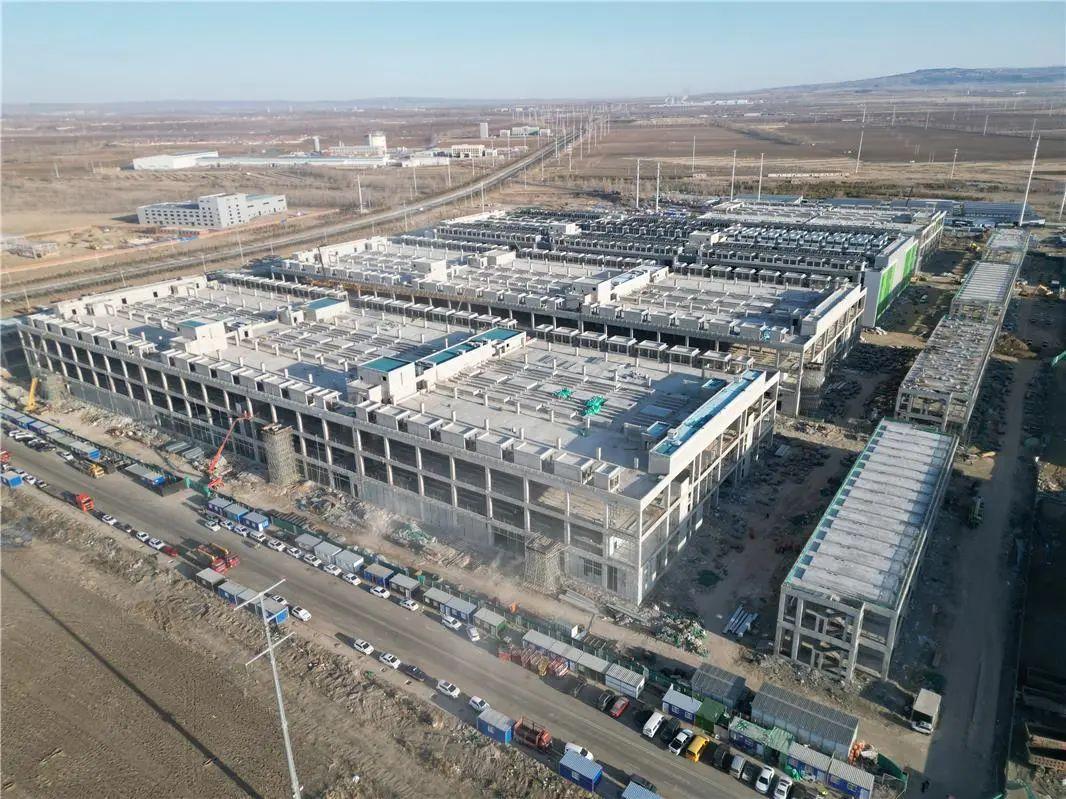
Figure: The construction process of VNET's Ulanqab data center, demonstrating the efficiency of low-rise steel structures and prefabricated construction
But faster construction speed does not mean China will fully adopt containerized data centers. SemiAnalysis proposed two reasons.
First, China has a relatively abundant construction labor force. Adopting steel structures and partial prefabricated modules is already enough to achieve shorter construction cycles, and the marginal benefits of further shifting to full modularization are limited.
Second, data centers themselves are also financing assets.
For third-party operators that rely on bank loans, a permanent building with a longer design life is more likely to obtain asset valuation and mortgage financing support. Movable containerized facilities, by contrast, may face lower residual values and different financing conditions.
As a result, China's data center industry has formed its own construction model: more factory prefabrication, less on-site construction, but still retaining permanent buildings with financing value.
This has also led to a seemingly counterintuitive result: while AI data center construction accelerates, the per-unit construction cost of facilities may still decline.
The report attributes this change to local supply chains, large-scale procurement, and prefabrication processes.
However, the speed of computer room construction is not the only constraint on China's AI infrastructure.
SemiAnalysis distinguishes the bottlenecks between China and the United States: the United States is more susceptible to constraints from grid interconnection, transformer delivery, and power supply conditions; in China, the supply of advanced AI chips may be a more important limiting factor.
In other words, China's ability to build data centers quickly does not mean it can deploy advanced GPU clusters at the same speed.
Data center capacity, power access, chip supply, and actually operational compute remain four distinct metrics.
Compute is beginning to move overseas, and the next step is to see whether capacity can be converted into revenue
The expansion of China's AI infrastructure has not stopped at home.
SemiAnalysis estimates that the overseas leased data center capacity of China's large tech companies will roughly double from 2026 to 2029, approaching 4GW by 2029.
This figure does not include GPUs leased remotely through overseas cloud providers, so it cannot be regarded as the entirety of Chinese tech companies' overseas computing resources.
ByteDance is the most important player among them.
The report notes that TikTok, due to its global business and local data processing needs, has leased a large amount of data center capacity in the United States, Europe, and Southeast Asia. In recent years, its overseas infrastructure expansion has been especially concentrated in Singapore, Johor, Malaysia, and around Batam, Indonesia.
Compared with the United States and Europe, some parts of Southeast Asia have certain advantages in land, energy, and construction costs. A group of data center developers with Chinese supply chain backgrounds are also bringing domestic prefabricated construction experience overseas.
Alibaba and Tencent are likewise advancing their global cloud infrastructure layouts.
Alibaba's goal is more oriented toward expanding its AI cloud business through overseas data centers while increasing service coverage for global customers. Tencent is more focused on expanding cloud services in Southeast Asia and other international markets around the overseas expansion of gaming, internet, and AI applications.
SemiAnalysis believes that overseas expansion includes both considerations of business growth and the motivation to obtain advanced computing resources.
But it is necessary to distinguish that overseas data center leasing, remote GPU access, and the actual acquisition of advanced chips involve different commercial contracts, technical architectures, and regulatory requirements, and cannot simply be regarded as an already unobstructed supply channel.
From an investment perspective, what truly deserves attention is not only the growth of overseas capacity, but whether sustained customer demand and stable revenue can be formed behind this capacity.
The report ultimately returns to one question: since China still has a large amount of idle data center space, why is data center construction still accelerating?
SemiAnalysis's explanation is that traditional retail data centers and next-generation AI data centers have already formed two different markets. The former faces inventory digestion and pricing pressure, while the latter is driven by a small number of large AI customers and requires higher power density, larger campus scale, and faster delivery speed.
However, new projects securing orders does not mean the entire industry chain will reap equal benefits.
Three variables will be particularly important going forward.
The first is the gap between orders and actual delivery. Whether signed lease contracts can be converted into operational capacity on schedule will directly affect data center operators' revenue realization.
The second is the relationship between capital expenditure and actual computing power deployment. If tech giants' capex continues to rise, but facility capacity, chip deployment, and cloud business revenue fail to grow in tandem, the market will need to reassess investment returns.
The last is advanced chip supply and facility utilization rates. If new data center buildings continue to be delivered faster than servers can be deployed, today's tight supply-demand dynamics for AI data centers could also shift in the future.
From this perspective, what is most worth watching in China's AI infrastructure expansion is not how many gigawatts of data centers are ultimately built, but how much capacity is truly filled with chips, used by customers, and converted into sustainable commercial revenue.
Data center buildings can be built ahead of schedule, but computing power requires chips to be realized. What will truly determine the returns on this round of investment is whether the two can stay in sync.
Welcome to join the official BlockBeats community:
Telegram Subscription Group: https://t.me/theblockbeats
Telegram Discussion Group: https://t.me/BlockBeats_App
Official Twitter Account: https://twitter.com/BlockBeatsAsia