Listed and quickly surged to a $50 million market cap, (3,3) reappears on Robinhood.

Today, the hottest project on Robinhood is none other than The Standard Reserve.
Within hours of launch, STANDARD's market cap briefly surged to approximately $49 million; the first 100 licenses to open new branches sold out in four minutes, and about 1.19 million STANDARD tokens were permanently burned. Capital is flooding in, not just because a new coin is rising fast, but because the project has turned "who gets the new coins" into a continuous auction.
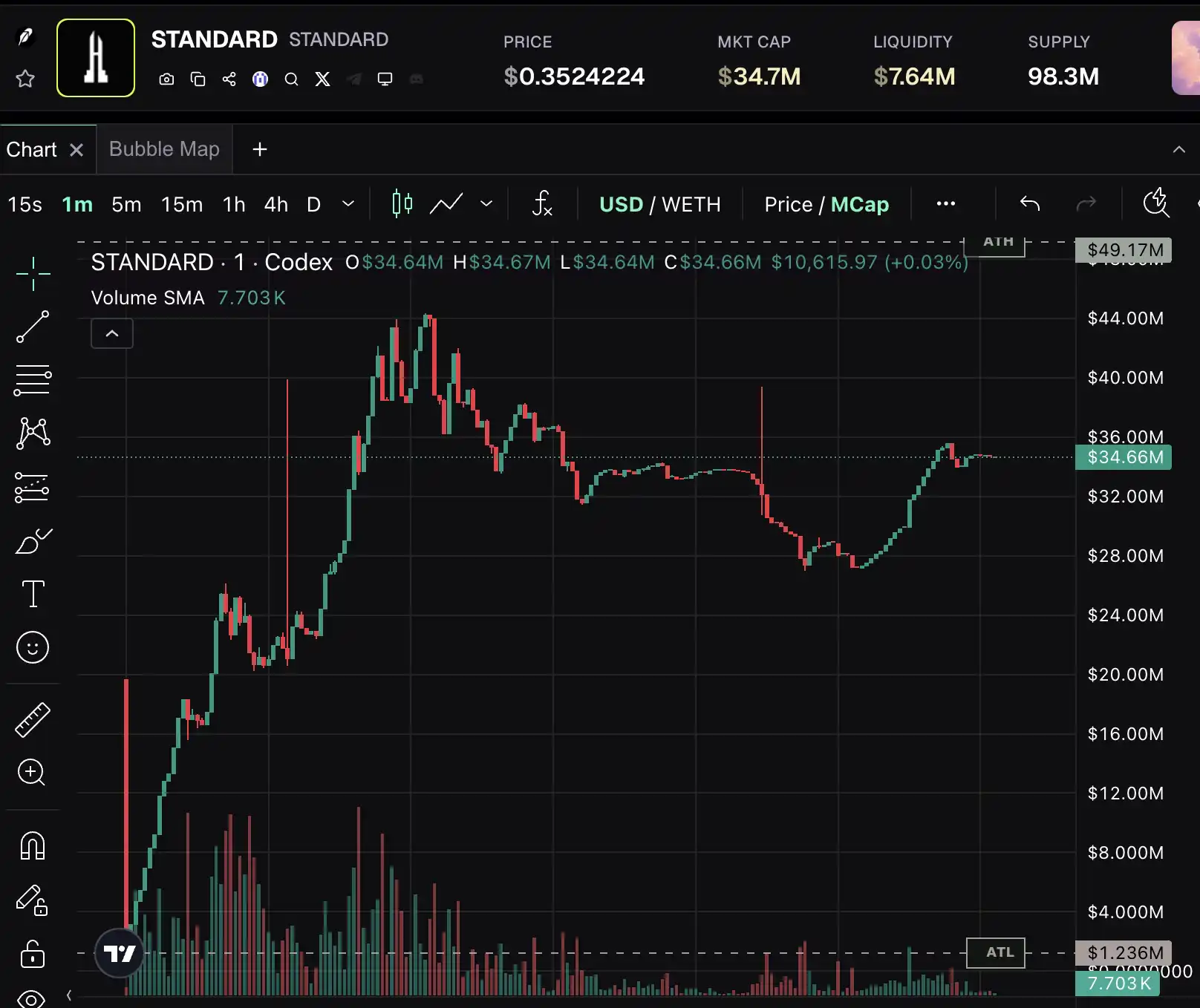
What the market is chasing is an on-chain business simulation game packaged as a central bank. Players first buy bank seats, then compete for monetary issuance rights; the protocol adjusts issuance based on ETH inflows and outflows, directing transaction fees to buy gold, increase liquidity, or repurchase STANDARD.
Why does this game excite capital on Robinhood Chain so much, and why do some compare it to OHM before the market even opens? The answer lies in the protocol's operating mechanism.
Cosplaying Bankers
To understand this mechanism, imagine a country with a "central bank" and many banks. The "central bank" is responsible for distributing money to banks, and how much a bank receives depends on how many "branches" it has.
To open a bank, you first need a "bank charter." It is an NFT that comes with one "branch" when first acquired, and branches can be expanded up to ten. During the project's genesis phase, 1,000 "bank charters" were minted, equivalent to 1,000 whitelist spots.
For example, suppose the bank issues only 100 coins today, and there are 10 "branches" nationwide. Each branch gets 10 coins. If you have two branches, you get 20 coins. Tomorrow, if the nationwide branches expand to 20, and the central bank still issues only 100 coins, your original two branches would only get 10 coins. Opening more branches yourself means more money; but if others also open more, the amount each of your branches receives gets diluted.
According to the project whitepaper, the actual launch parameters are 700,000 STANDARD tokens issued daily, multiplied by a "policy coefficient" (currently 1). Current real-time data on the official website shows there are 1,099 "branches" network-wide, with each "branch" receiving approximately 637 tokens per day.
However, "allocated" does not mean "in hand." The coins are first recorded in the "bank charter's" ledger, not in the banker's wallet. Suppose your "bank charter" has four "branches," and the ledger accumulates 400 coins; to withdraw the coins, you must permanently close one of the "branches" to claim about a quarter, or 100 coins, and the actual amount received is subject to a "resolution fee." The remaining three "branches" continue operating. Closing the last "branch" also destroys the "bank charter."
So a "banking license" is like an operating right, not a passbook that lets you withdraw money anytime. Operators earn coins through "branches," and cashing out requires dismantling those "branches."
Bank Expansion
To open an additional "branch," those who already hold a "banking license" must participate in an "Expansion License" auction. 100 "Expansion Licenses" are released daily, and each "banking license" can win at most three licenses per day.
The auction price starts high and gradually decreases over time; whoever is willing to accept the current price makes the deal. On the first day, bidding started at 12,000 STANDARD, and all 100 licenses sold out in about four minutes, with the final one closing at 11,888.34 coins (at this price, a newly auctioned "branch" would take 17 days to break even). According to the rules, the minimum opening price for the next day rises to 23,776.68 coins.
Buying an "Expansion License" only accepts STANDARD tokens, and all coins received are permanently burned. The approximately 1.19 million coins burned on the first day equaled 1.2% of the initial circulating supply.
's projection of the break-even cycle
But new "branches" are not free money printers. If you spend 20 coins on a license, and the new branch only distributes 1 coin per day, then based on coin count alone it would take 20 days to recoup the cost, and when calculated in USD it would fall even more; if more branches open nationwide, your branch might only distribute half a coin per day, requiring 40 days to break even. So before auctioning "Expansion Licenses," you must first calculate the break-even cycle.
Monetary Policy
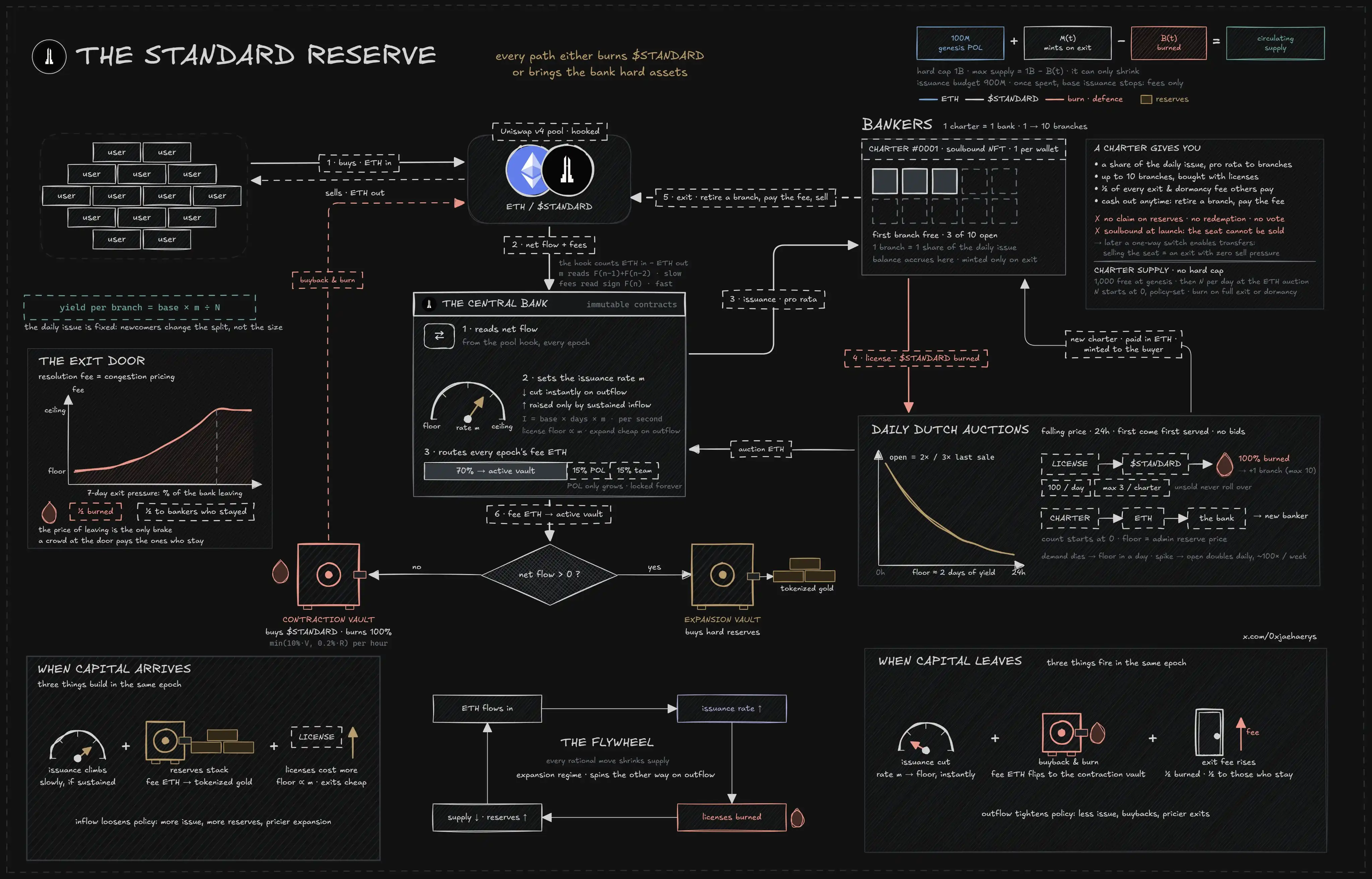
Standard Reserve's monetary policy mainly revolves around the ETH/STANDARD trading pool. In the liquidity pool, some people use ETH to buy STANDARD, resulting in net ETH inflow; others sell STANDARD for ETH, resulting in net ETH outflow. The protocol compares ETH inflows and outflows over a period of time, then decides whether to speed up or slow down the coin minting machine next, and where to send the buy/sell taxes collected.
When ETH has net inflow, the system is in an "Expansion" state. 70% of the buy/sell taxes collected are sent to the "Expansion Vault" to purchase reserve assets such as tokenized gold. If there is net inflow for two consecutive settlement cycles, the issuance coefficient of the next round of STANDARD tokens will gradually increase, creating a certain "inflationary" effect.
ETH sees net outflows, and the system is in a "Contraction" state. 70% of buy and sell taxes are sent to the "Contraction Vault," where STANDARD is bought back in batches and burned; at the same time, in the next settlement cycle, the issuance coefficient is lowered. Regardless of the state, another 15% of buy and sell taxes are used to increase liquidity, and 15% goes to the team.
Preventing "Bank Runs"
When "branch offices" are closed to claim coins in the account, the "exit fee" is at least 2%. The greater the network-wide exit pressure over the past seven days, the faster the "exit fee" rises, up to a maximum of 60%. There are ten people running a bank: if only one person leaves, exiting is relatively easy; if everyone suddenly closes their "branch offices" and runs away at once, those who leave must pay a higher price. Half of the "exit fee" is permanently burned, and the other half is distributed to the remaining "bankers."
There is also a rule that if a "banking license" holder has no on-chain activity for 30 consecutive days, they may be reported by others, forcibly revoked, and bear a 70% revocation fee.
How can people participate now?
Those who already hold a "banking license" can wait on the official website for the next "expansion license" auction and use STANDARD to bid to add new "branch offices" to their "banking license." The first day's licenses have already sold out.
For those who do not yet have a "banking license," the normal protocol entry is to wait for the official website to allow new "banking license" auctions; once enabled, bidders purchase with ETH according to the page, and a new license comes with its first "branch office."
At the same time, "banking licenses" can also be traded over the counter. The on-chain transfer switch for current "licenses" has not been turned on, so they cannot be traded on NFT marketplaces and can only be transferred directly via wallet.
People who do not operate "branch offices" can also choose to buy and hold STANDARD, but they must bear a 2% buy tax and a 3% sell tax.
The high热度 at launch has already ignited the flywheel. What to watch next is how many Licenses can still be sold after the price doubles, whether ETH net inflows can remain positive for consecutive periods, and whether Charter holders are willing to continue expanding after their shares are continuously diluted.
Welcome to join the official BlockBeats community:
Telegram Subscription Group: https://t.me/theblockbeats
Telegram Discussion Group: https://t.me/BlockBeats_App
Official Twitter Account: https://twitter.com/BlockBeatsAsia