Bridgewater Makes a Move as U.S. Bond Market Probes Treasury’s ‘Line in the Sand’
Original Title: Hot Take: Bessent Makes His Mark
Original Author: Stephen Innes
Translation: Peggy
Editor's Note: On August 19, the U.S. Treasury Department announced an expansion of long-term bond repurchases, increasing the size of the single-day liquidity support repurchase for some 10–30 year bonds from $20 billion to at least $40 billion. Previously, the 30-year Treasury yield had briefly risen to 5.337%, reaching a new high since 2007; after the news was released, the long-term yield swiftly retreated.
The market immediately began to wonder: Is the Treasury Department showing a more explicit policy sensitivity to the rapid rise in long-term rates?
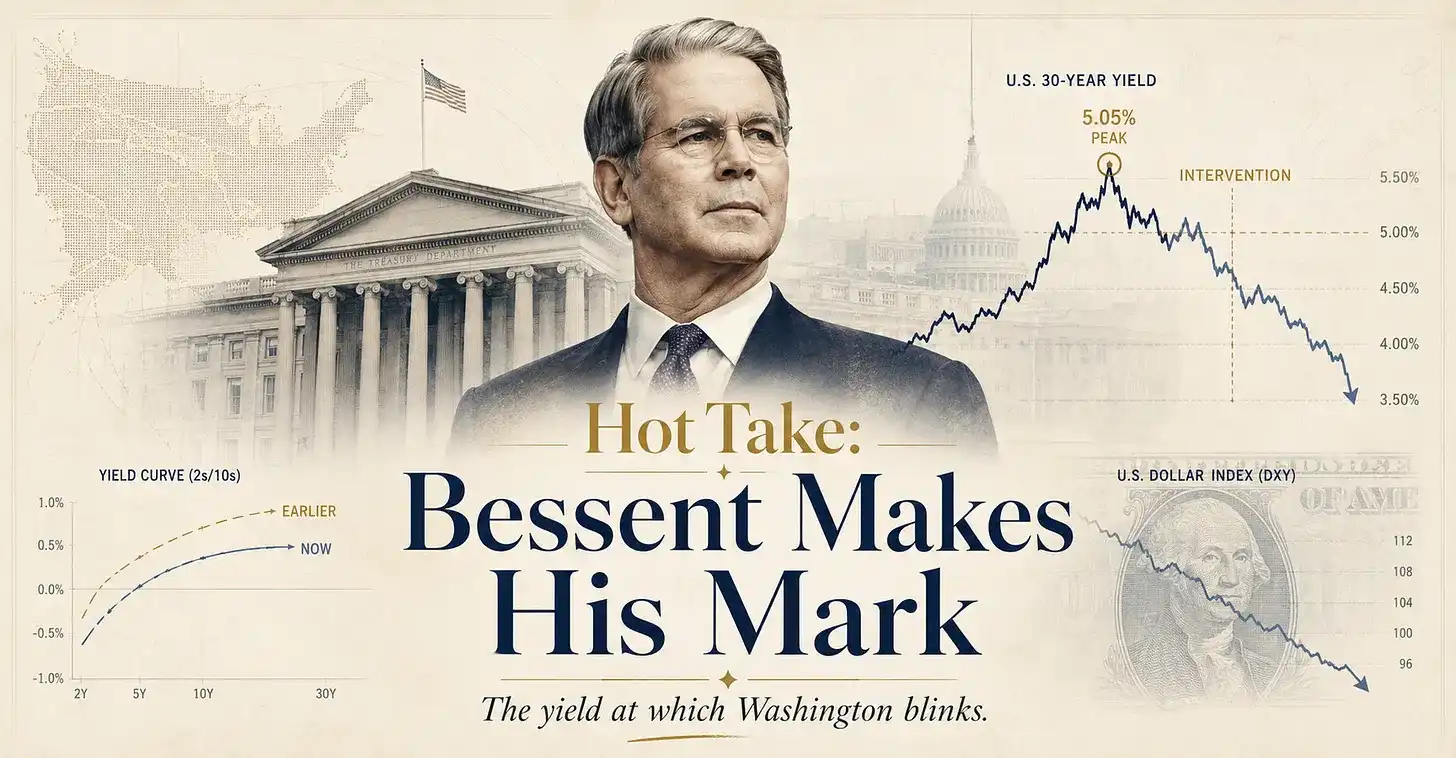
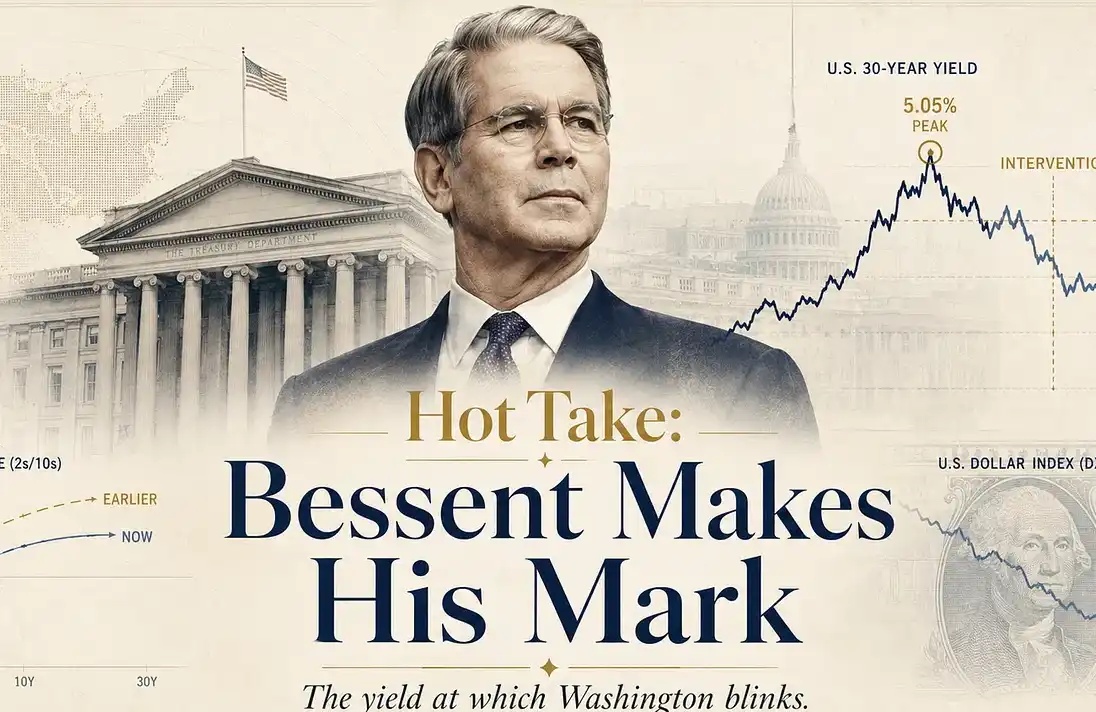
In his publication on August 20 titled "Hot Take: Bessent Makes His Mark," Stephen Innes discussed precisely this issue. He focused not on the $40 billion repurchase itself but on how this move could change the market's understanding of the U.S. policy "reaction function": when long-term yields rise high enough and fast enough, will the Treasury Department take action again and transition from a mere debt manager to another hand influencing financial conditions?
This development is significant because the policy constraints in the U.S. are increasingly concentrated at the long end. The Fed can directly determine short-term rates but cannot completely control term premia, fiscal supply, and the 30-year Treasury yield. If the Treasury Department starts more actively managing long-end market pressures, the framework of only focusing on the Fed to judge financial conditions will become incomplete.
Innes' key insight is not that the U.S. has entered yield curve control but that the market is starting to realize that Washington may have an undisclosed "policy pain threshold." Once traders believe that a certain yield level will trigger Treasury action, the pricing of future long-term rates will no longer depend solely on inflation, the Fed, and bond supply and demand but will also add a new variable: how high the Treasury Department can tolerate long-term yields rising.
Below is the translation of the original text:
U.S. Treasury Secretary Scott Bessent's latest move has added a new trading variable to the long-term U.S. bond market.
On August 19, the U.S. Treasury Department announced that it would at least double the size of the liquidity support repurchase for certain long-term nominal bonds. The single repurchase limit for 10–20-year and 20–30-year bond maturities will be increased from the current $20 billion to at least $40 billion. The new arrangement will take effect on September 9 and continue until the end of the current quarter's refinancing period on November 4. The Treasury Department's official explanation is to provide more liquidity support for long-term bond maturities.
In terms of scale, this is not a large enough operation to change the overall supply-demand dynamics of the U.S. Treasury market. The U.S. Treasury's bond repurchase mechanism itself is not QE: the Treasury mainly repurchases older, less liquid outstanding bonds to improve market liquidity, rather than injecting base money into the financial system through expanding the central bank's balance sheet as the Fed does with QE.
However, in the view of the author Stephen Innes, what the market is truly trading is not the $40 billion number, but the policy signal behind it.
Limited in Scale, Market Trades First and Foremost on "Why Now"
After the Treasury's announcement, long-term U.S. bond yields quickly fell.
On August 19, the 30-year U.S. bond yield briefly dropped by nearly 10 basis points to 5.187%. The day before, the yield had touched 5.337%, the highest level since 2007. At the same time, the long-end of the yield curve flattened, the U.S. dollar weakened significantly, gold broke $4,500 per ounce, Bitcoin rose, and the three major U.S. stock indexes all closed slightly higher.
These market changes coincided with the Treasury's announcement. However, a more accurate statement is: the market's expectations of the Treasury's policy response changed, rather than the Treasury directly lowering yields on that day by adding repurchase funds.
This is because the expanded repurchase size will not take effect until September 9. Therefore, what is most worthy of attention this time is the "signaling effect."
The author of this article points out that the Treasury could have announced this adjustment during the previous quarter's refunding arrangement, but did not do so at that time. Following that, there was a noticeable sell-off in long-term U.S. Treasury bonds over two weeks, pushing the 30-year yield to nearly a 19-year high before the Treasury separately announced the increase in the repurchase size.
The Treasury did not indicate that this adjustment was aimed at supporting a specific yield level; the official reason remains to enhance liquidity for long-term securities. However, in the author's view, traders will naturally wonder: if long-term yields rise rapidly again in the future, will the Treasury further adjust its policy?
This is precisely what he calls the "Bessent Makes His Mark" core.
From Yen Intervention to Expanded Repurchase, Market Begins to Test Treasury's "Threshold for Action"
This speculation arose quickly also because this was not the first recent event where the U.S. Treasury clearly intervened in market operations.
From late July to early August, the U.S. and Japan made a rare coordinated intervention in the foreign exchange market to support the yen. Less than a month later, the Treasury Department announced an expansion of long-term bond repurchases after long-term bond yields rose to multi-year highs. The two actions targeted different markets, and their policy objectives cannot be simply equated: the former directly addressed exchange rate volatility, while the latter was officially positioned as liquidity management in the government bond market.
However, Innes believes that they collectively influenced investors' assessment of the Treasury Department's reaction function — the market began to speculate on how much and how quickly the Treasury Department might act once asset prices experienced significant fluctuations.
This is also the essence of the so-called "Bessent Put." It is not a formal policy, nor does it mean that the Treasury Department has committed to buying bonds at a certain yield level, nor is it equivalent to Yield Curve Control (YCC).
More precisely, this is a market inference: if traders start to believe that the Treasury Department has an intolerable "pain threshold," whenever the 30-year yield approaches a high point in the future, the market may speculate on whether the policy will be adjusted again.
In other words, the market is looking for the Treasury Department's "intervention threshold": at what level will the long-term bond yield rise to prompt Washington to take action again?
The first intervention informed the market that the Treasury Department is monitoring pressure in the long end of the market. Only if similar actions are taken in the future, the market may further assess whether the Treasury Department truly has a relatively clear policy trigger range.
Whether the "Fed Put" is transitioning to the "Bessent Put" remains the author's judgment
Innes further discussed this change within the framework of the Federal Reserve under Kevin Warsh's leadership.
His assessment is that the Federal Reserve under Warsh aimed to reduce market reliance on central bank-induced suppression of volatility and allow more price discovery to return to the market itself. Therefore, if the Treasury Department becomes more willing to take action in case of sharp fluctuations in bonds or exchange rates, the familiar "Fed Put" from the past may not completely disappear but could show signs of shifting towards the Treasury Department.
It is important to make a clear distinction between facts and judgments.
The confirmed facts are: the Treasury Department recently participated in U.S.-Japan coordinated exchange rate intervention and announced an increase in the scale of long-term bond repurchases; the Federal Reserve still independently manages monetary policy. As for the idea that "policy support is shifting from the Federal Reserve to the Treasury Department," this is Innes' interpretation based on these two market operations and is not a new policy framework announced by the U.S. government.
Similarly, there is currently no evidence that the Treasury Department is implementing yield curve control. In fact, the scale of long-term Treasury bond buybacks remains small. A one-time $40 billion operation is limited compared to the over $30 trillion U.S. Treasury market, and buybacks have not addressed structural issues such as the fiscal deficit, inflation expectations, and long-term bond supply and demand that have led to rising yields.
Therefore, the "Bessent Put" is currently better suited as a concept to describe market expectations rather than an established policy tool.
Fed Still Discussing Rate Hike, Treasury Signals Adding Complexity to Trading Framework
Meanwhile, the signals from the Fed are not distinctly dovish.
The FOMC meeting minutes from July 28 to 29 showed that most members supported keeping the federal funds target rate at 3.50% to 3.75%, but "several" members were inclined to a 25-basis-point rate hike at the next meeting. The minutes also indicated that many members believed that further monetary policy tightening might be necessary if inflation did not continue to decline; ultimately, three members voted against keeping the rate unchanged and favored a 25-basis-point hike.
However, these minutes reflect the policy assessment at the end of July. Subsequently released inflation and employment data have been relatively moderate, leading the market to lower expectations of further rate hikes. This has made the current policy outlook more complex.
On the one hand, there are still voices within the Fed advocating for further monetary policy tightening; on the other hand, the Treasury Department's announcement of increasing long-term bond buybacks has prompted the market to reassess the upside potential of long-term yields, accompanied by a decline in yields and the U.S. dollar.
Innes therefore believes that simply trading U.S. financial conditions around "the next Fed rate hike or cut" may no longer be sufficient.
It is important to emphasize that the Treasury Department's announcement of expanding buybacks does not directly equate to monetary easing. A more accurate statement is that following the announcement, the decline in long-term yields and weakening of the U.S. dollar have had a certain marginal easing effect on financial conditions from a market pricing perspective; whether this effect can be sustained still depends on subsequent inflation, fiscal supply, and market demand.
This is the real issue to watch in the near future.
The Treasury Department has clearly stated that this increase in buybacks will only last until November 4 and will provide further information on future arrangements at the next quarterly refunding meeting. Therefore, for the long-term U.S. bond market, the key is no longer just the next set of inflation data or the next FOMC meeting.
The market is now also watching another variable that has not been so prominent before: if the 30-year Treasury bond yield approaches 5.3% again or even higher, will the Treasury Department adjust its tools again? In other words, what the market is currently testing is: how high does the long-term Treasury bond yield need to rise to trigger the Treasury Department's next move?
Currently, this is still a hypothesis that traders are testing, rather than a yield threshold that has received policy confirmation.
Welcome to join the official BlockBeats community:
Telegram Subscription Group: https://t.me/theblockbeats
Telegram Discussion Group: https://t.me/BlockBeats_App
Official Twitter Account: https://twitter.com/BlockBeatsAsia