Predicting Market Insider Trading Exposed, Can't Lose Once in This Position

According to PolyBeats News, on August 19th, Beijing time, an individual managed to achieve a 120% return in just 89 seconds by predicting "whether Russia would be able to occupy a certain area in the battlefield."
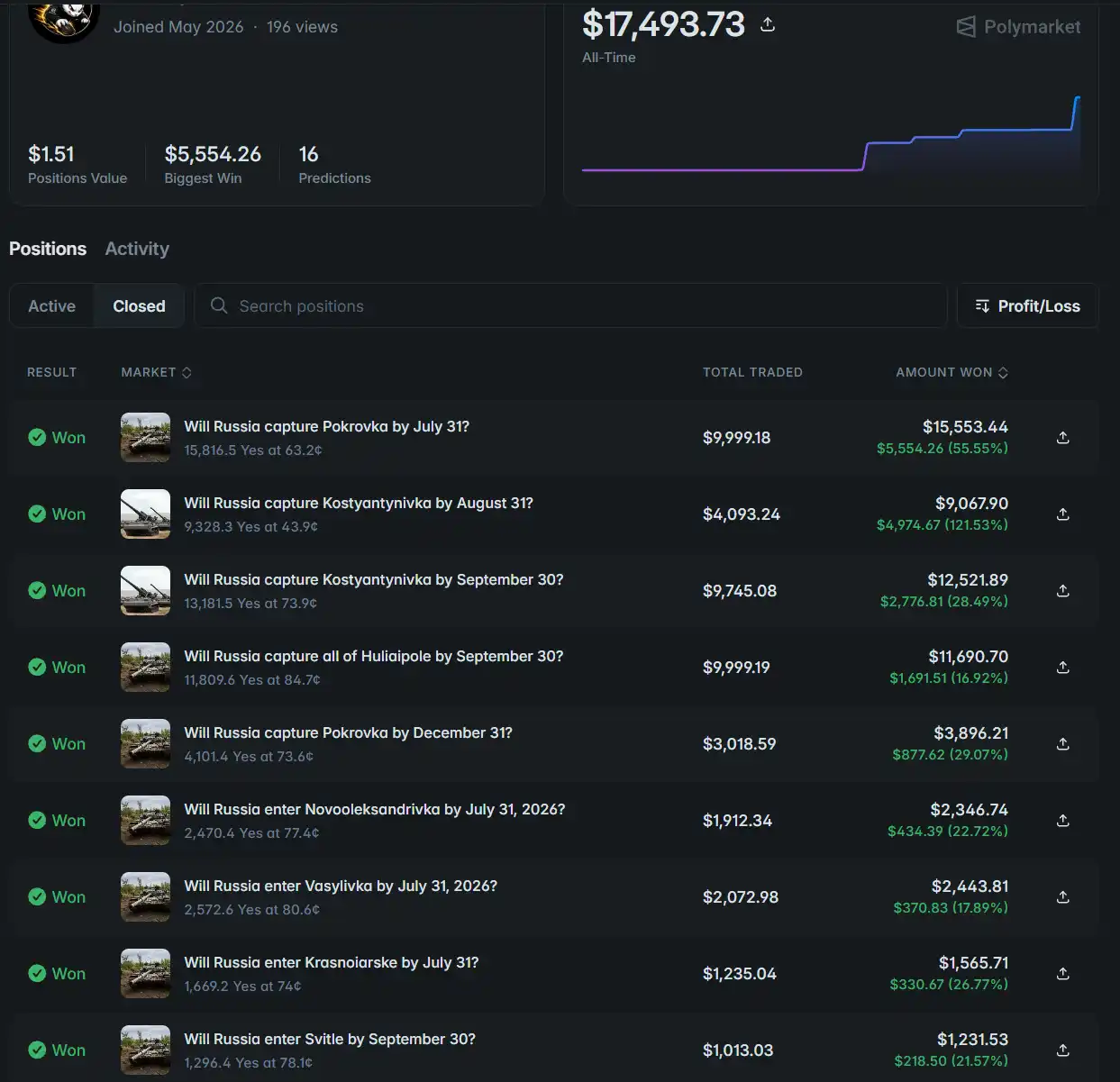
This individual invested $4,000 to purchase the prediction "Russia will capture Konstantinovka this month" on a platform called a prediction market. The probability of this event happening was only 43% at the time. 89 seconds later, this probability increased to 92%.
In this probability-price platform, if the event does occur, the probability will be locked at 100%, and the position value will increase accordingly. The mysterious individual placed the order, witnessed a sudden surge, and then exited at the take-profit in less than two minutes. In an era where various trading strategies abound, such stroke of luck in trading is not uncommon.
What makes this individual suspicious is that Konstantinovka was his 14th such operation.
14 Consecutive Successful Battlefield Predictions
Analysis of the account's transaction records by PolyBeats revealed that this individual's account had a total of 14 correct prediction trades related to the Russia-Ukraine conflict, realizing a total profit of approximately $17,500.
These predictions did not pertain to the same city or the same timeframe: from Maliyevka, Pokrovka, to Huliaipole, and Konstantinovka; some were about "whether Russia will capture," while others were about "whether Ukraine will re-enter." However, the operations were nearly identical as if copied from the same template.
Even more bizarrely, not only did this account accurately predict the outcome 14 times, but 11 of these trades saw the probability surge to nearly 100% within 5 minutes after the purchase.
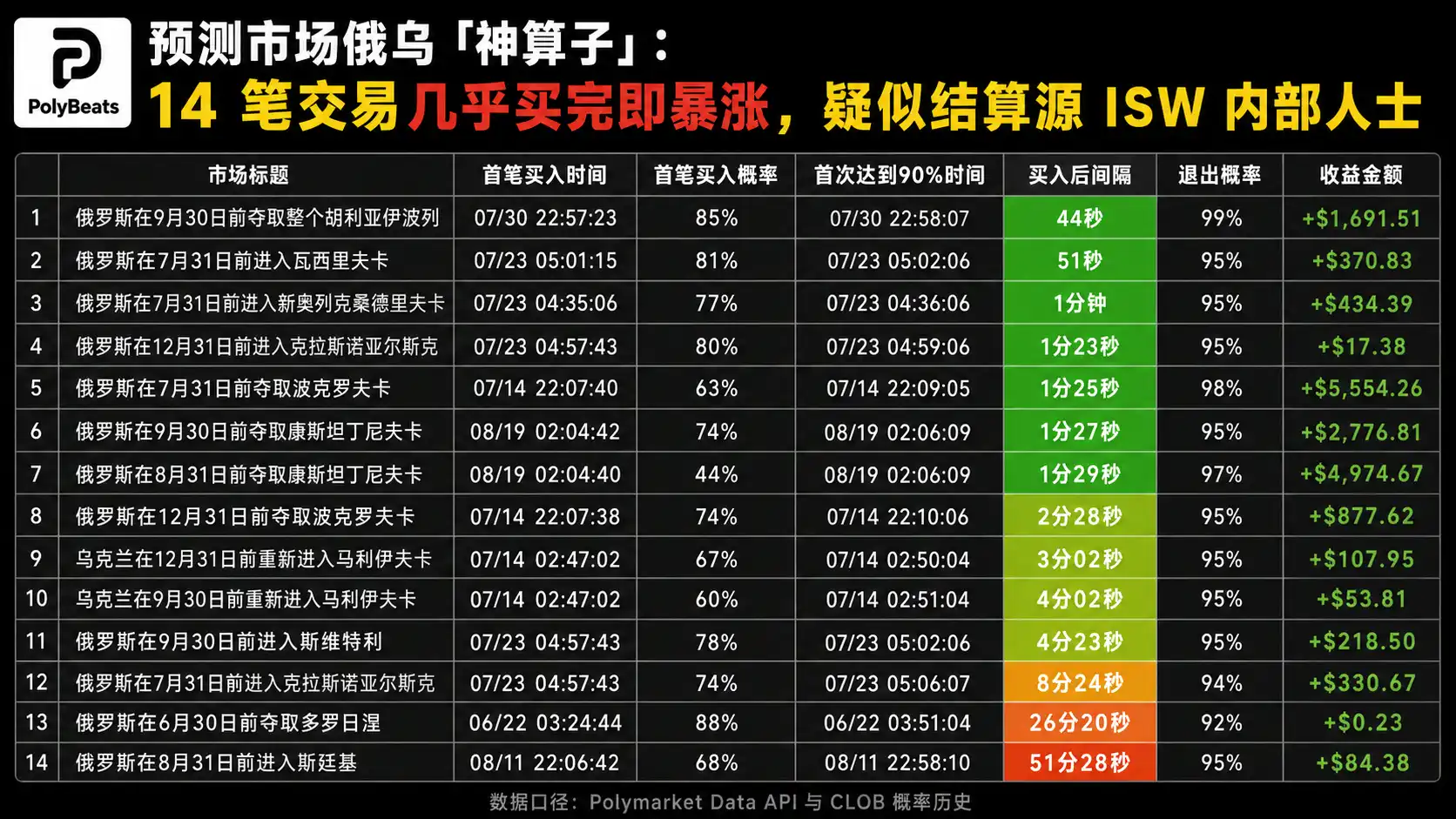
It is difficult to consecutively guess the battlefield developments correctly 14 times and buy in before the market probability escalates. However, if the advance knowledge was not of the battlefield but of the map update time, the scenario becomes much simpler.
Prediction Markets: Breeding Ground for Insiders
All of Polymarket's Russian-Ukraine occupation market titles are almost a template:
“Will Russia take over a certain region by ___?”
While the question may seem straightforward, what truly determines the answer is not when the gunfire starts.
According to Polymarket's rules, only when the Russia-Ukraine battleground map produced by ISW—the Institute for the Study of War—labels a specific region as Russian-controlled and meets the duration requirements set by the rules, will the market move to a "Yes" outcome—corresponding to a 100% settlement probability.
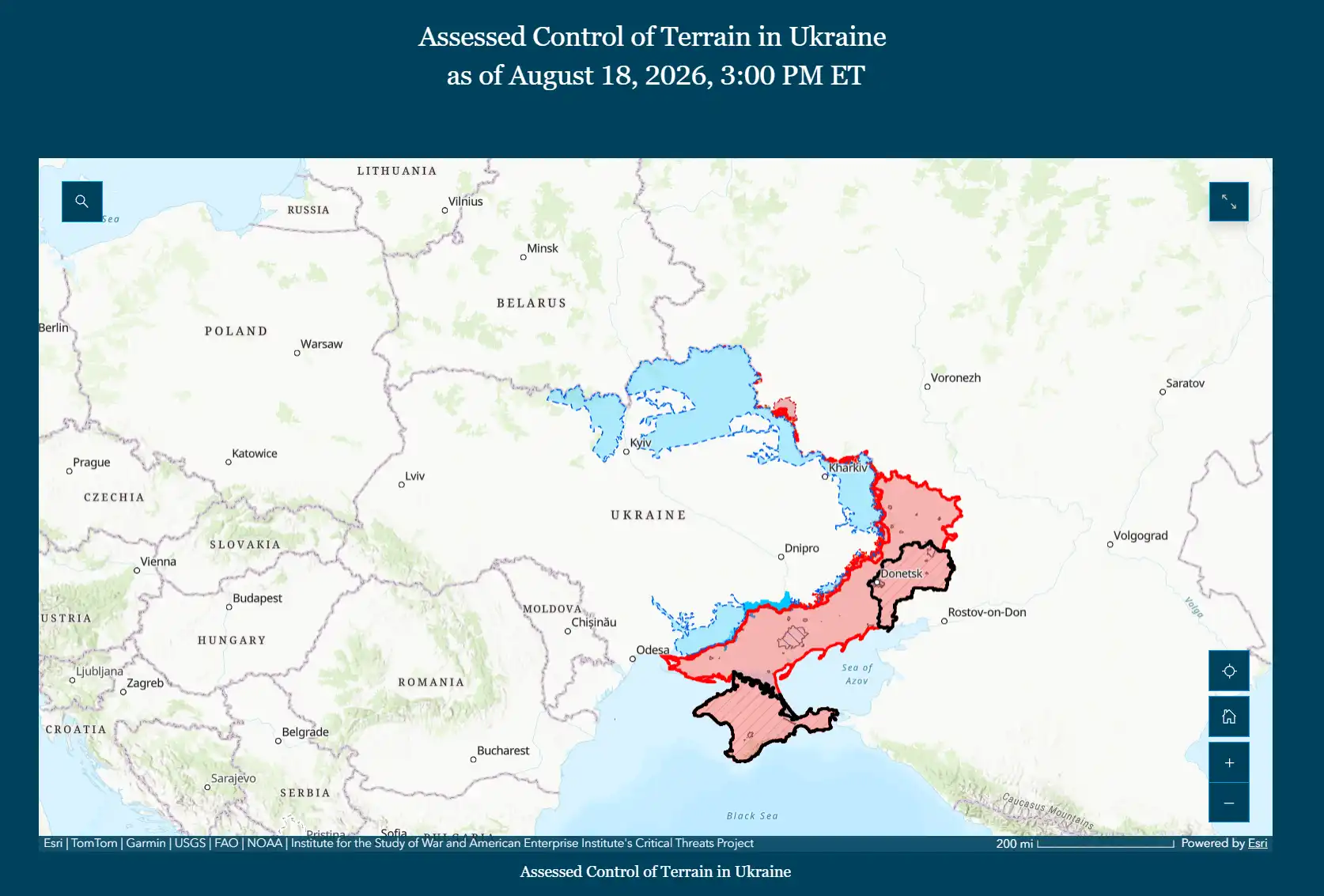
In other words, even a soldier standing in the occupied territory cannot insider trade to stable long-term gains in such a market: even if the occupation indeed happens, as long as ISW, the source of settlement, does not update the map, this market will settle as "No."
In such a market, only one type of person can achieve perfect profitability like the aforementioned account: he doesn't need to know the frontline situation, understand Russo-Ukrainian geopolitics and military strategy, or even follow any international current events. He only needs to know in advance which area ISW is ready to mark as Russian-controlled, and when that update will take effect.
This group of people is the technical staff responsible for updating the battlefield status at ISW. They only need to predict the corresponding market long positions to buy into right before clicking the mouse to confirm the ISW map update, enabling them to make a substantial profit within a minute.
Sound like a conspiracy theory? Last year, ISW had already experienced a similar farce.
Employee Manipulates Open-Source Intelligence Data for Massive Profits
In November 2025, the prediction market had already previewed how this mechanism would spiral out of control.
At that time, the market question was, “Will Russia take over Mironohrad before November 15?” The rules were almost identical to the above—only when the ISW map shows any part of the Russian military controlling a specified street intersection, the outcome could be determined as “Yes.”
The most significant difference from the current rules was that there was no "waiting period" back then: as soon as the map changed, the market settlement condition could be met.
On the evening of the 15th, the probability of "Yes" was less than 3% as there were only a few hours left until the deadline—without any geopolitical news reporting the occupation of Mironohrad, everyone had already assumed that this market would ultimately settle as "No."
However, at this moment, the ISW map suddenly showed the area as occupied; before most people could even react, the probability of "yes" was instantly pushed to 100%.
Over the next few days, as traders questioned the lack of concrete evidence for this map marking, ISW publicly admitted that there had been an "unauthorized, unapproved" edit on the interactive map during the night of November 15 to 16; this edit was removed before the start of the normal workflow on the 16th and did not represent its official battlefield assessment.
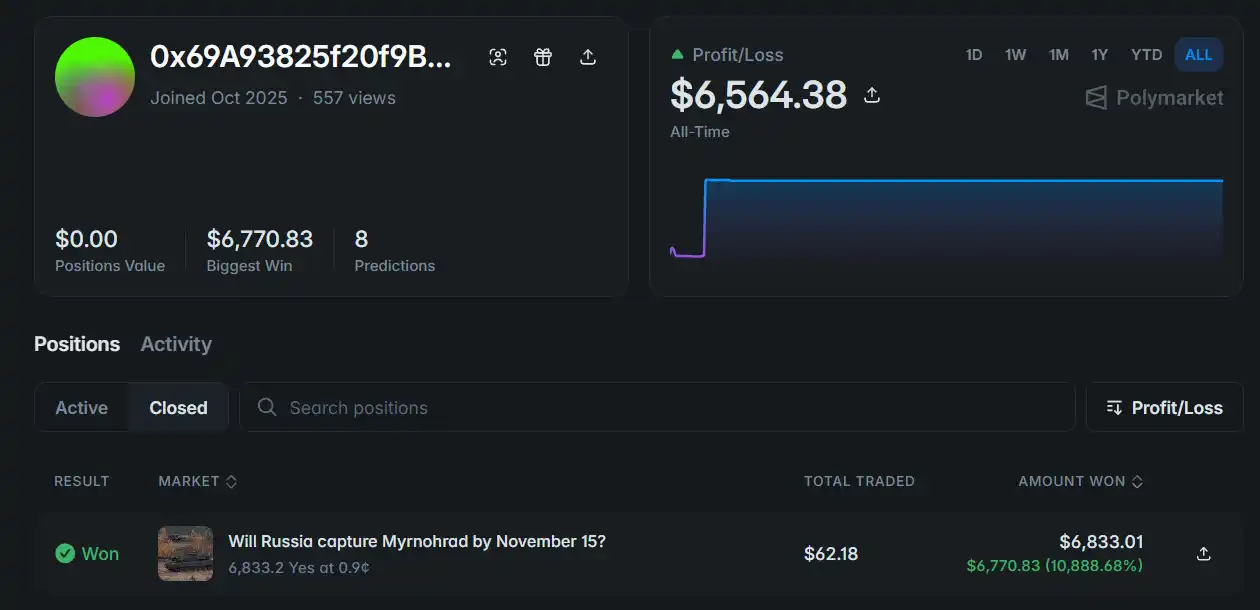
The map was retracted, but the market did not retract, and those accounts that predicted "yes" when the probability was approaching zero profited greatly from this "unauthorized edit." Among them, 0x69A9 bought in when the probability was only 0.9% and ultimately achieved a 10,888.68% excess return.
Following the Mironohrad incident, ISW stated that its map would continue to be modified during workdays and should not be understood as real-time battlefield conditions; it later added "being edited" and "finalized" status indicators. Prediction markets later also implemented stricter persistence requirements: the map status had to span the next full update cycle to be used as a settlement basis.
As of now, the mastermind behind these 14 consecutive victories has not publicly revealed their identity and has not been accused by any institution; ISW has also not acknowledged any employees benefiting from map update arbitrage.
But the timeline of the 14 victories is clear: almost every time, it placed bets on a city considered "undetermined" by the market; almost every time, it waited until the market was close to certainty before selling; almost every time, it pocketed the difference between "no one knows yet" and "everyone knows."
In the past, a regular ISW employee responsible for updating the map might have been just a nameless screw in a vast open-source intelligence system. What he held in his hands was just a mark about to change color, an update about to be released, and a few seconds before the click of confirmation.
These pieces of information were originally untradeable, and few would have cared.
But when a map can determine the final market settlement, those few seconds before clicking the mouse now have a price. A person doesn't need to disclose top-secret military intelligence, manipulate the battlefield, or even change any facts; all he needs is to know about a mark that is about to appear before everyone else, turning the authority assigned to his position into profits close to certainty.
Innovation has opened a market for everyone to predict the future, but it has also opened another door: when the settlement source can be seen in advance, modified in advance, or traded in advance, you and I can all become insiders.
Welcome to join the official BlockBeats community:
Telegram Subscription Group: https://t.me/theblockbeats
Telegram Discussion Group: https://t.me/BlockBeats_App
Official Twitter Account: https://twitter.com/BlockBeatsAsia