BofA Analysis: Micron's $100 Billion Cash Flow, Can It Navigate the NAND Cycle?
TL;DR
· BofA maintains Buy rating on SanDisk and $2500 price target, estimating approximately $100 billion in cumulative free cash flow from FY2028 to FY2030 based on the company's long-term guidance.
· NBM long-term contracts cover around half of FY2027 and about two-thirds of FY2028 NAND shipments, with contracts from 8 customers totaling $93.9 billion in value.
· An 80% gross margin and 50% adjusted free cash flow margin are still aggressive assumptions, depending ultimately on contract fulfillment, supply discipline, and AI inference demand.
SanDisk presented an aggressive long-term financial model on August 13th: average annual revenue growth in the mid to high teens from FY2028 to FY2030, non-GAAP gross margin of around 80%, non-GAAP operating margin of around 75%, and an adjusted free cash flow margin of around 50%.
Based on this, BofA estimates SanDisk's revenue in these three years to be approximately $61 billion, $70 billion, and $81 billion, with corresponding adjusted free cash flow of around $30 billion, $35 billion, and $40 billion, totaling around $105 billion. The report summarizes this as "approximately $100 billion in free cash flow over three years."
This model is also a key backdrop for BofA's maintained Buy rating and $2500 price target. The target price is based on around 10 times the estimated 2027 EPS of about $255, a valuation multiple roughly in line with the global storage peer average.
The real shift is that SanDisk is trying to prove it is no longer just a stock that moves with NAND price cycles. Long-term customer contracts have increased visibility into future shipments and prices, while AI inference provides a new demand source for Flash. If high-profit margins can be sustained, a significant amount of free cash flow could further be converted into share buybacks and shareholder returns.
But this is not cash flow already realized. An 80% gross margin, 50% adjusted free cash flow margin, and approximately $100 billion in cumulative cash flow still require continuous growth in AI demand, customer adherence to procurement commitments, and no significant industry supply re-expansion.
Approximately $100 Billion in Cash Flow over Three Years Supports $2500 Price Target
The long-term targets provided by SanDisk management for FY2028 to FY2030 include: average annual revenue growth in the mid to high teens, non-GAAP gross margin of around 80%, non-GAAP operating margin of around 75%, adjusted free cash flow margin of around 50%, with capital intensity maintained in the mid-single-digit percentage of revenue.
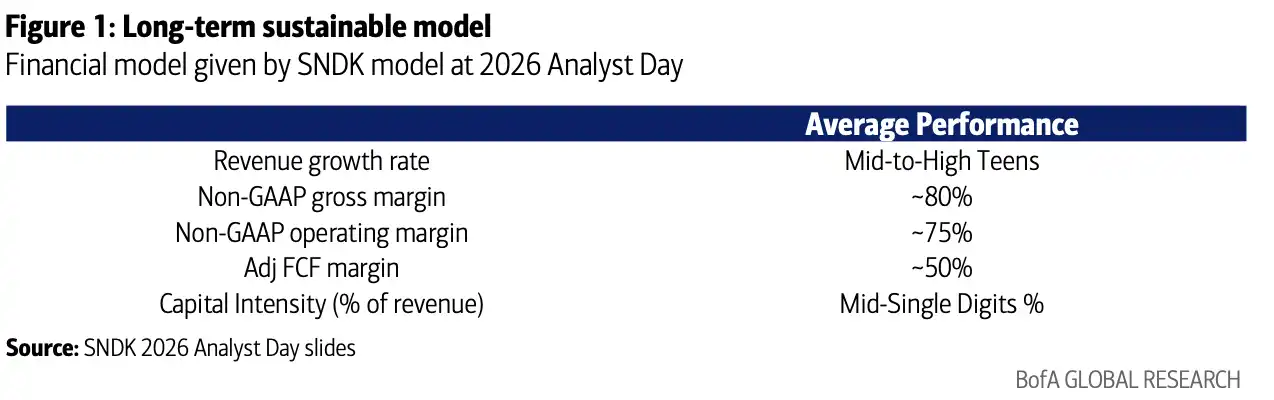
SanDisk has proposed long-term financial targets for FY2028 to FY2030, with a non-GAAP gross margin of around 80% and an adjusted free cash flow margin of about 50%.
Within this framework, Bank of America projects SanDisk's revenues for FY2028 to FY2030 to be approximately $610 billion, $700 billion, and $810 billion, respectively. Calculating based on the approximately 50% adjusted free cash flow margin, the three-year free cash flows are estimated to be around $300 billion, $350 billion, and $400 billion, totaling approximately $1.05 trillion.
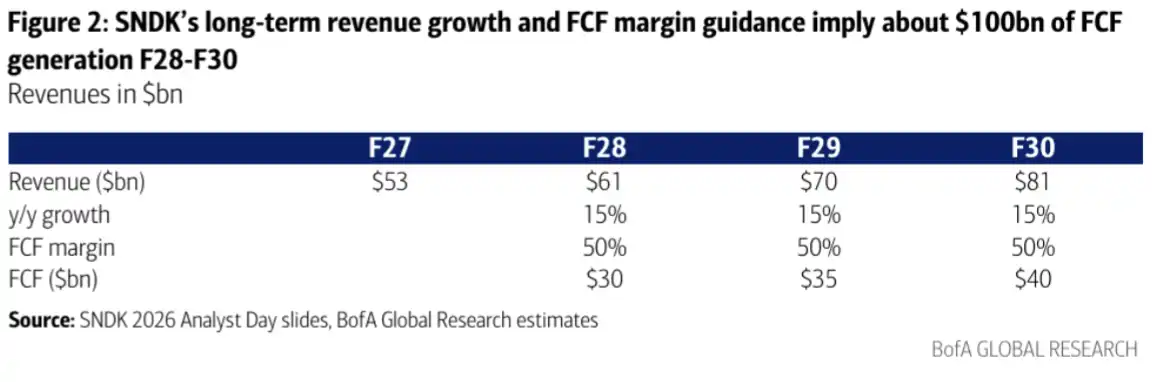
Based on SanDisk's long-term guidance, Bank of America estimates that the total free cash flow for FY2028 to FY2030 will be around $1 trillion.
It is important to note that the $1 trillion is not a direct cash flow commitment from the company but a calculation made by Bank of America based on management's revenue growth and free cash flow margin targets.
If a significant portion of this cash flow is used for stock buybacks, the impact will be significant. Bank of America estimates that around $1 trillion is equivalent to almost half of SanDisk's current market value. As of the investor day, the company has approximately $15.5 billion remaining in stock repurchase authorization.
Bank of America's $2,500 target price is based on approximately 10 times the 2027 calendar year expected EPS, which is around $255. The report indicates that based on SanDisk's fiscal year basis, the EPS forecasts for FY2027 and FY2028 are $233.85 and $248.16, respectively.
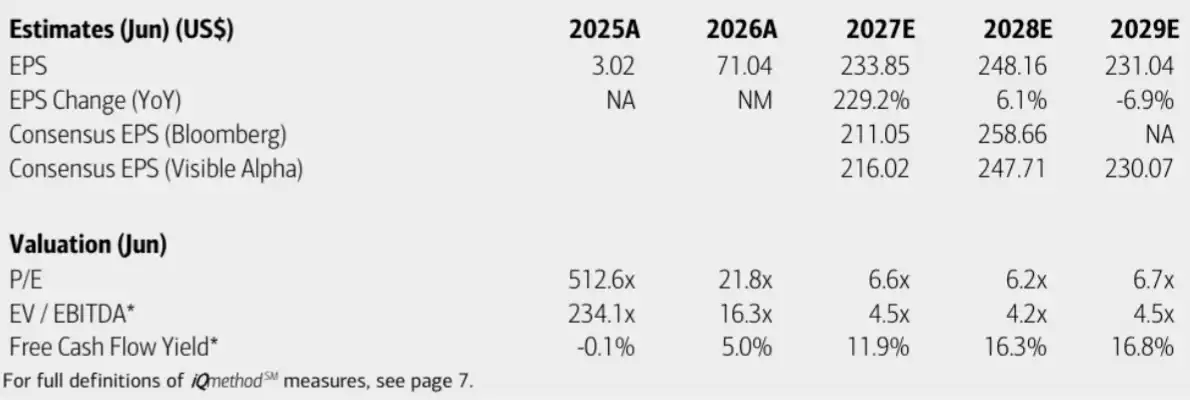
Bank of America projects SanDisk's FY2027 EPS to be $233.85, with a free cash flow yield of 11.9%.
This long-term model does not yet account for the potential contribution of HBF. In other words, Bank of America's current valuation is primarily betting on the existing NAND business forming a higher and more stable profit platform under AI demand, long-term contracts, and capital discipline support, rather than relying on yet-to-be mass-produced new products.
The issue lies in the fact that the NAND industry has always shown clear cyclicality. An 80% gross margin and 50% adjusted free cash flow margin are far above traditional cycle levels, requiring demand to remain strong relative to additional supply and customers to be willing to pay higher prices for long-term stable supply.
$93.9 Billion Long-term Contract Boosts Visibility, But Doesn't Eliminate Cycle
SanDisk's primary tool to mitigate NAND business volatility is a new business model contract called NBM.
As of Investor Day, the company has entered into multi-year NBM contracts with 8 customers, including 3 U.S. hyperscale cloud providers. These contracts already cover around half of SanDisk's NAND shipments in FY2027 and around two-thirds in FY2028.
The total value of the contracts with the 8 customers is $93.9 billion, with remaining obligations of $91.1 billion and financial assurances totaling $16.5 billion. Of this, around $2.5 billion is in cash, with the rest primarily held or provided by third-party financial institutions. Two customers have already added to their contracts, extending the duration of the collaboration or increasing purchase volumes.
NBM contracts consist of a fixed portion and a floating portion, with the floating price having upper and lower bounds. Management stated that the lower bound of the price was designed to support around an 80% gross margin even when executed at the floor price. The contracts have a weighted average term of over 4 years, with the longest extending to 5 years.
For SanDisk, this contract structure allows for early commitment to shipment volumes, price ranges, and customer commitments, reducing the impact of spot price fluctuations on the income statement. For AI data center customers, the long-term contracts increase the predictability of Flash supply.
However, NBM is not an insurance policy that immunizes SanDisk from cycles.
The company will still serve non-NBM customers, and the shipments and prices of these businesses will continue to fluctuate with the market. The $16.5 billion financial guarantee is also significantly lower than the $93.9 billion total contract value and should not be simply interpreted as all revenue being cash-secured.
If cloud providers' capital expenditures slow, customers adjust their purchasing pace, or Chinese manufacturers and other competitors expand supply, NAND prices and margins could still decline. While NBM has enhanced business visibility for the next two years, it does not prove that the NAND cycle has disappeared.
AI Inference is Bringing Flash to the Core of Infrastructure
Another premise of the BofA long-term model is that AI inference will significantly boost data center demand for Flash.
The report predicts that data centers will surpass consumer and edge devices in 2026, becoming the largest application area for Flash. As AI workloads shift from centralized training to large-scale inference, model serving, vector databases, caches, checkpoints, logs, and data pulls will all increase the demand for high-performance, high-capacity storage.
In this scenario, Flash is no longer just a regular storage component in servers, but will directly impact the data throughput, response speed, and deployment efficiency of AI infrastructure.
Sandisk's competitiveness first comes from vertical integration. The company covers NAND intellectual property, frontend manufacturing, system design, backend manufacturing, and sales channels, reducing profit loss between different parts of the industry chain. Its joint venture arrangement with Kioxia has been extended to 2034, with the two companies collectively holding about a third of the global NAND market.
Capital efficiency is also a key requirement for the long-term model's viability. Sandisk expects that from the fifth-generation product BiCS5 to BiCS11, the average bits per wafer will increase by 54% per generation, corresponding to approximately 27% annual production rate growth.
From 2021 to 2025, Sandisk and Kioxia's joint venture system will only use about 13% of the industry's capital expenditure but will contribute around 29% of NAND supply. By 2025, the industry will require approximately 2.6 times the capital investment of this joint venture system for each additional unit of storage capacity.
This means that if AI continues to drive demand for high-value NAND products and Sandisk can expand effective supply with lower capital intensity, the company's profit margin may remain above traditional cyclical levels in the long term.
Conversely, if the increase in supply outpaces demand, especially if Chinese manufacturers' production expansion leads to price pressure, around $100 billion in free cash flow could shift from a long-term plateau forecast back to a cyclical peak assumption.
HBF Provides Additional Upside, But Not Yet in Financial Models
HBF, or High-Bandwidth Flash, is another layer of potential in Sandisk's long-term story but is not currently the core support of the $2500 price target.
HBF aims to provide larger storage capacity while achieving faster data access, bringing Flash closer to the computation and memory layers of AI inference systems.
Sandisk has already taped out its first HBF storage chip, and the first batch of HBF products targeting AI inference is expected to be launched in 2027. According to a Bank of America report, the HBF technology alliance currently includes Sandisk, SK Hynix, Google, and Tenstorrent, with Meta recently joining as well.
If product performance, system integration, and customer validation progress smoothly, HBF may enable Flash to further penetrate AI inference architecture from traditional data storage, becoming an incremental revenue source beyond the existing NAND business.
However, samples do not equate to revenue at scale. The product still needs customer validation, system integration, cost reduction, and ramp-up to mass production to have a material impact on financial performance. SanDisk's current FY2028 to FY2030 long-range model does not yet include HBF contribution, so it is closer to an upside option rather than a business that can already support cash flow.
Whether SanDisk can transition from a NAND cycle stock to an AI storage cash cow ultimately depends on three things: whether AI inference demand can sustainably absorb the additional supply, whether NBM longs can be executed at existing pricing and procurement levels, and whether the company can continue to maintain capital expenditure discipline during a high-margin phase.
Any looseness in these three factors could lead the assessment of around $100 billion in free cash flow over three years to revert from a highly visible long-term model to a peak cycle assumption.
Welcome to join the official BlockBeats community:
Telegram Subscription Group: https://t.me/theblockbeats
Telegram Discussion Group: https://t.me/BlockBeats_App
Official Twitter Account: https://twitter.com/BlockBeatsAsia
 Related Articles