Revenue Hits Record High, Why Has AAOI's Profit Not Kept Up

On August 6, U.S.-based optical communication equipment provider Applied Optoelectronics, hereinafter referred to as AAOI, announced its second-quarter earnings. According to the company's earnings report, this marks the fifth consecutive quarter of record revenue for AAOI.
This could easily be seen as another piece of good news for AI optical module demand. However, when you put the income statement and cash flow statement together, the picture is no longer so straightforward. In the same quarter where revenue reached a new high, the GAAP gross margin hit a nearly six-quarter low, and the GAAP net loss did not disappear as non-GAAP profit turned positive, according to the company's quarterly performance announcements.
AAOI's financial report is more like a production line accelerating in a high-speed factory. Revenue has entered the report, the machinery has started to move, but materials, equipment, and receivables are still pulling cash and profit in the opposite direction. To understand this company, you first need to dissect three things: who is driving the revenue, how solid the profitability in the report is, and where the expansion money is coming from.
Who Is Driving the Revenue
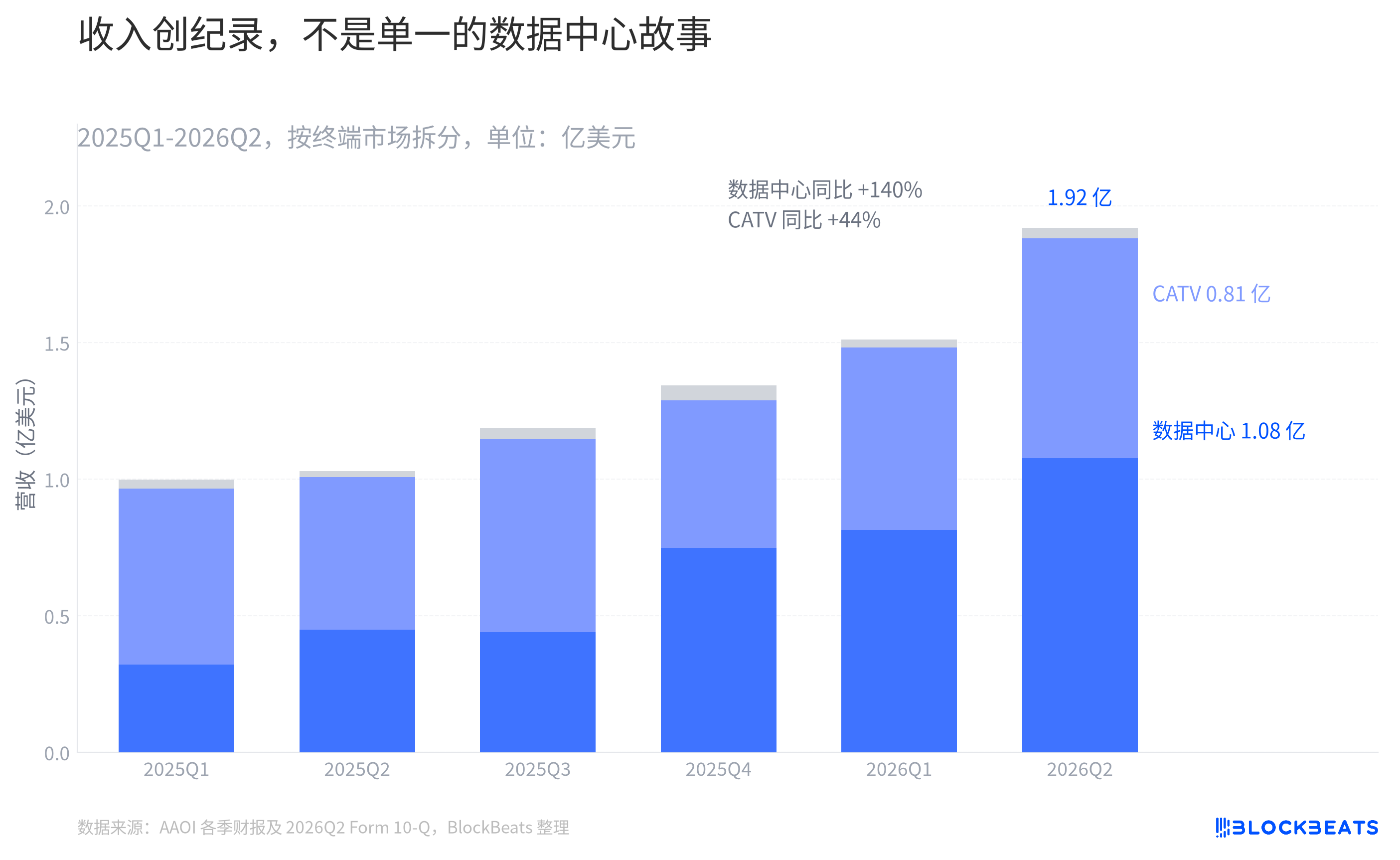
In the first chart, the most important thing to focus on is not the increasing bars, but the simultaneous thickening of two shades of blue. The data center business is the most eye-catching part of this growth cycle, increasing by 140% year-over-year in the second quarter. CATV, which is the cable television broadband business, still saw a 44% increase during the same period, as per the company's announcement.
This means that AAOI's revenue is not solely dependent on one AI thread. The data center modules drive the company towards higher-speed network demands, while CATV keeps the company in another, more mature broadband upgrade cycle. Both streams lifting revenue ensure that this growth is not entirely reliant on the purchasing pace of a single end market.
However, the end market is not the customer list. According to AAOI's quarterly report, CATV product customer Digicomm contributed 42.8% of the combined revenue in the first half of the year. In the same document, this customer represented approximately 67.2% of the year-end accounts receivable.
The company's quarterly report indicates that AAOI provided Digicomm with extended credit terms to allow for advanced stocking for network deployment. Credit terms themselves do not indicate asset quality but can create a time lag between revenue recognition and cash inflow. For a company purchasing equipment and expanding its facilities, book revenue and cash in hand cannot be treated as the same.
Why Did the Scale Increase While GAAP Gross Margin Decreased
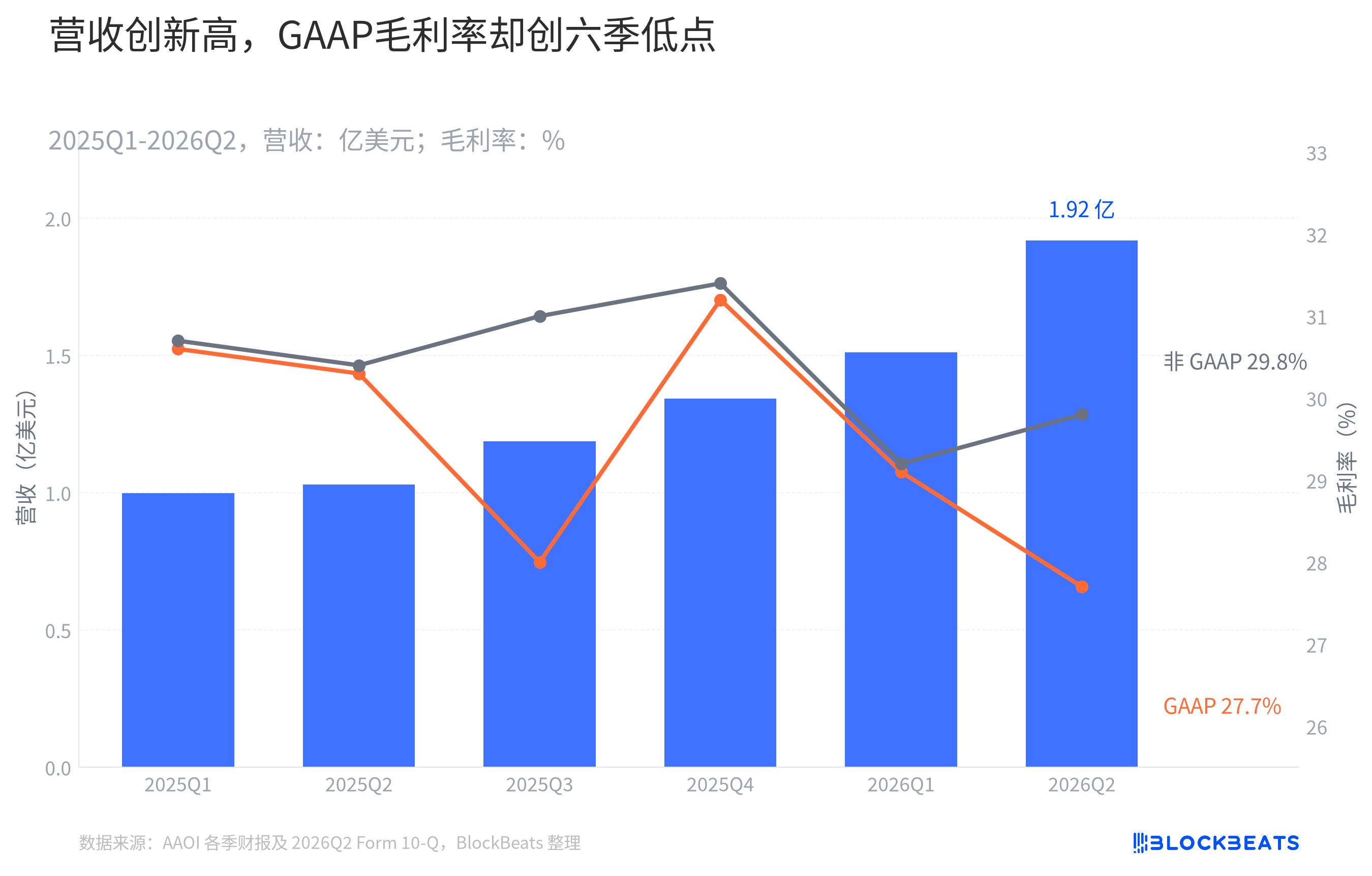
Typically, people would expect scale expansion to dilute unit costs. AAOI's GAAP gross margin in the second quarter was 27.7%, while the non-GAAP gross margin was 29.8%, as per the company's announcement. The distance between these two lines indicates that the current GAAP financial statements still include certain costs that the company has excluded in its non-GAAP calculations.
The company's reconciliation table shows that the non-GAAP gross margin excludes costs related to discontinued products. This measure helps observe the company's defined ongoing performance but cannot replace the GAAP measure.
Management stated that shipments of 800G products more than doubled sequentially this quarter and are advancing the next-generation module capacity. Mass production of high-speed modules is not about ramping up the old production lines but about taking equipment, processes, and yields across a new threshold together. Management anticipates that demand will continue to outpace its supply capacity, as per the company's announcement.
This is also the most easily overlooked part of the chart. Revenue growth first indicates products are shipping, while the gross margin records whether the expansion has already transformed into more efficient manufacturing. These two events occur on different timelines.
Non-GAAP Profitability, What Really Changed
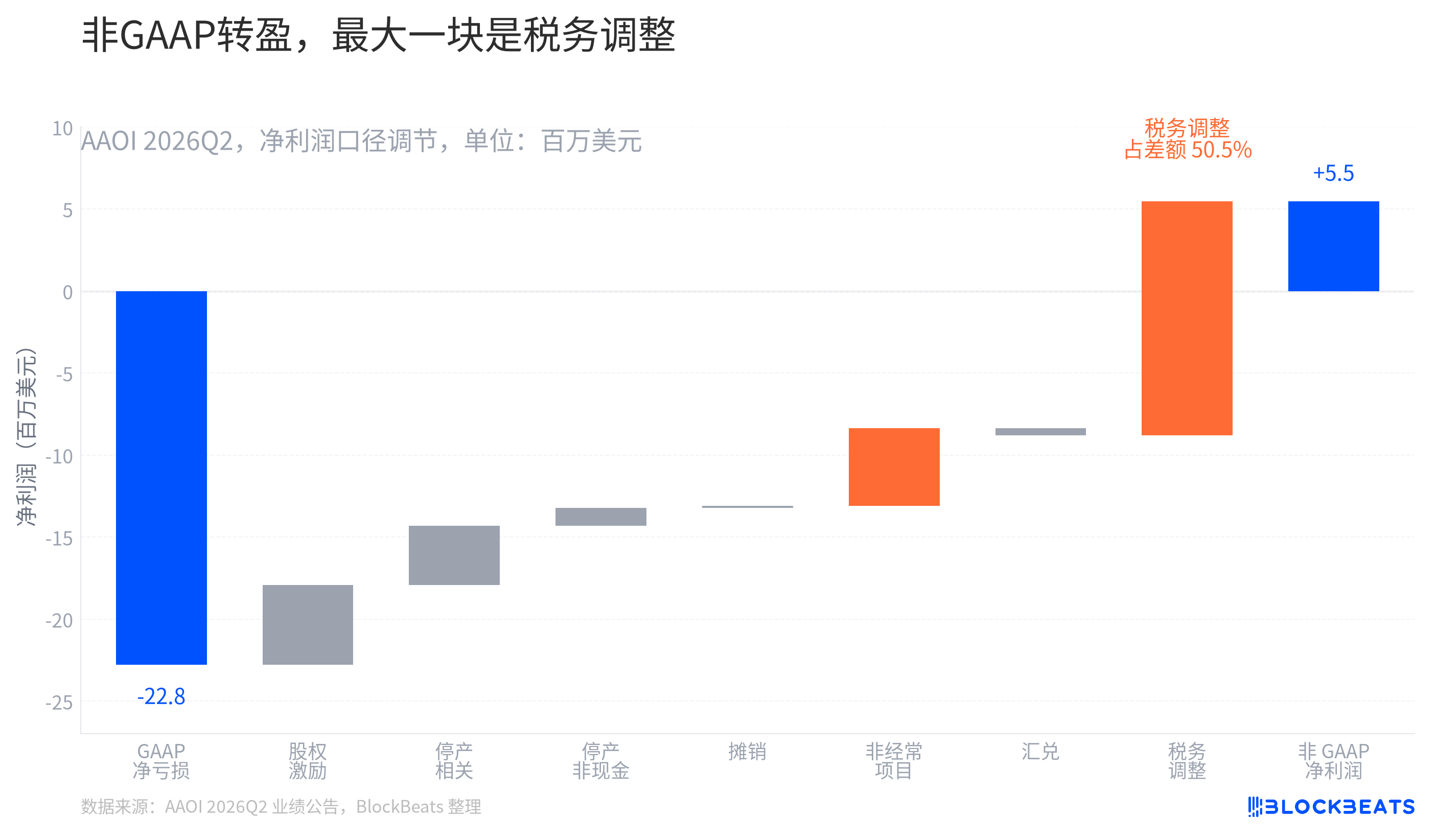
In the second quarter, AAOI shifted from a GAAP net loss to a non-GAAP net profit, with the largest difference being a tax adjustment related to the aforementioned restructuring projects, amounting to $14.26 million. According to the company's announcement, this item accounts for approximately 50.5% of the total bridging difference.
The chart also includes items such as stock-based compensation, costs related to discontinued products, amortization, non-recurring expenses, and foreign exchange, among others. These items do not disappear into thin air but are excluded from the non-GAAP measure defined by the company. This measure helps to view ongoing business but cannot replace the GAAP income statement.
A more cautious testament is that AAOI's EBITDA, adjusted for the quarter, remains negative at $543,000, as per the company's announcement. The shift to a non-GAAP net profit indicates that the company's adjusted measure is improving, but it cannot be directly equated to the expansion being self-sustaining.
Who is Footing the Bill for This Expansion Cycle
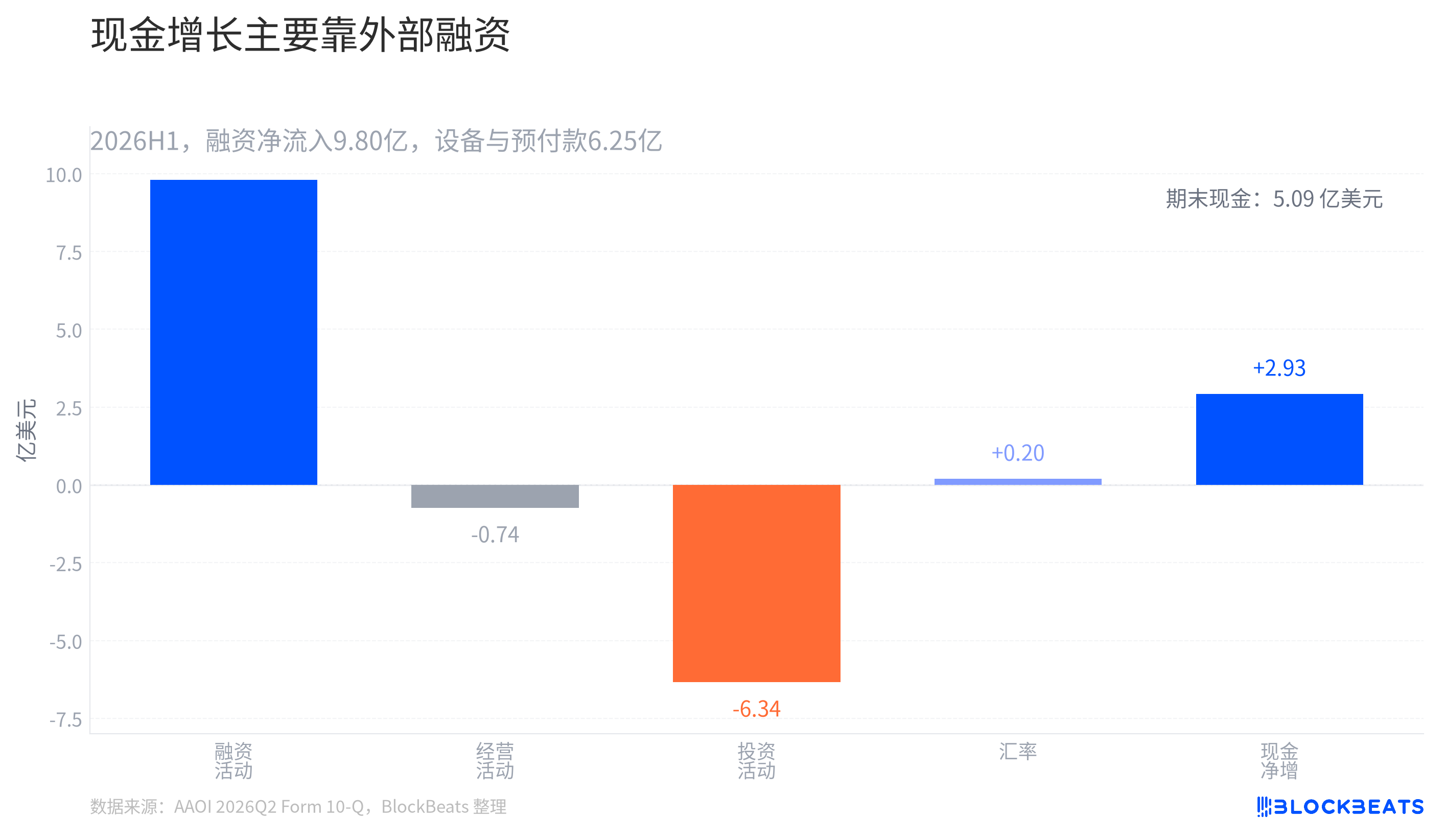
A more straightforward answer is provided in the company's quarterly cash flow statement. In the first half of the year, AAOI had a combined net outflow of $707 million from operating and investing activities, according to the company's quarterly report. Funds were absorbed by increases in accounts receivable and inventory, as well as plant, equipment, and prepayments.
On the other hand, there was a net inflow of $980 million from financing activities, with net proceeds of $1.028 billion from the issuance of common stock, as per the company's quarterly report.
The total of cash, cash equivalents, and restricted cash at the end of the period rose to $509 million. According to the company's quarterly report, the main source of this increase was equity financing and not a complete turnaround in operating cash flow.
The company's quarterly report shows that accounts receivable, inventory, and advance payments for equipment continue to tie up funds. While revenue growth has occurred, most of the funds for capacity expansion have come from financing.
Welcome to join the official BlockBeats community:
Telegram Subscription Group: https://t.me/theblockbeats
Telegram Discussion Group: https://t.me/BlockBeats_App
Official Twitter Account: https://twitter.com/BlockBeatsAsia