Shiba Inu Sells Over $3 Billion in Three Months, Price Speaks Louder Than Volume

In its latest quarterly report, SanDisk presented a top-line revenue of $8.965 billion for the quarter. According to the company's announcement, this is a 51% increase from the previous quarter.
This is not the company's "second quarter" of the fiscal year. It is referred to as FY2026 Q4 in SanDisk's records, with the reporting period ending on July 3, covering most of the calendar second quarter and serving as the most recent snapshot of the second quarter. The fiscal year nomenclature adds a layer of complexity, making it easier to overlook where the growth is actually coming from when reading the financial report.
In the 8-K attachment submitted to the U.S. Securities and Exchange Commission, the company indicated that the results are still pending the fiscal year-end close and audit processes, and the final 10-K may be adjusted. This article is based on the performance announcement and does not treat management's next quarter guidance as realized revenue.
How did revenue soar this quarter?
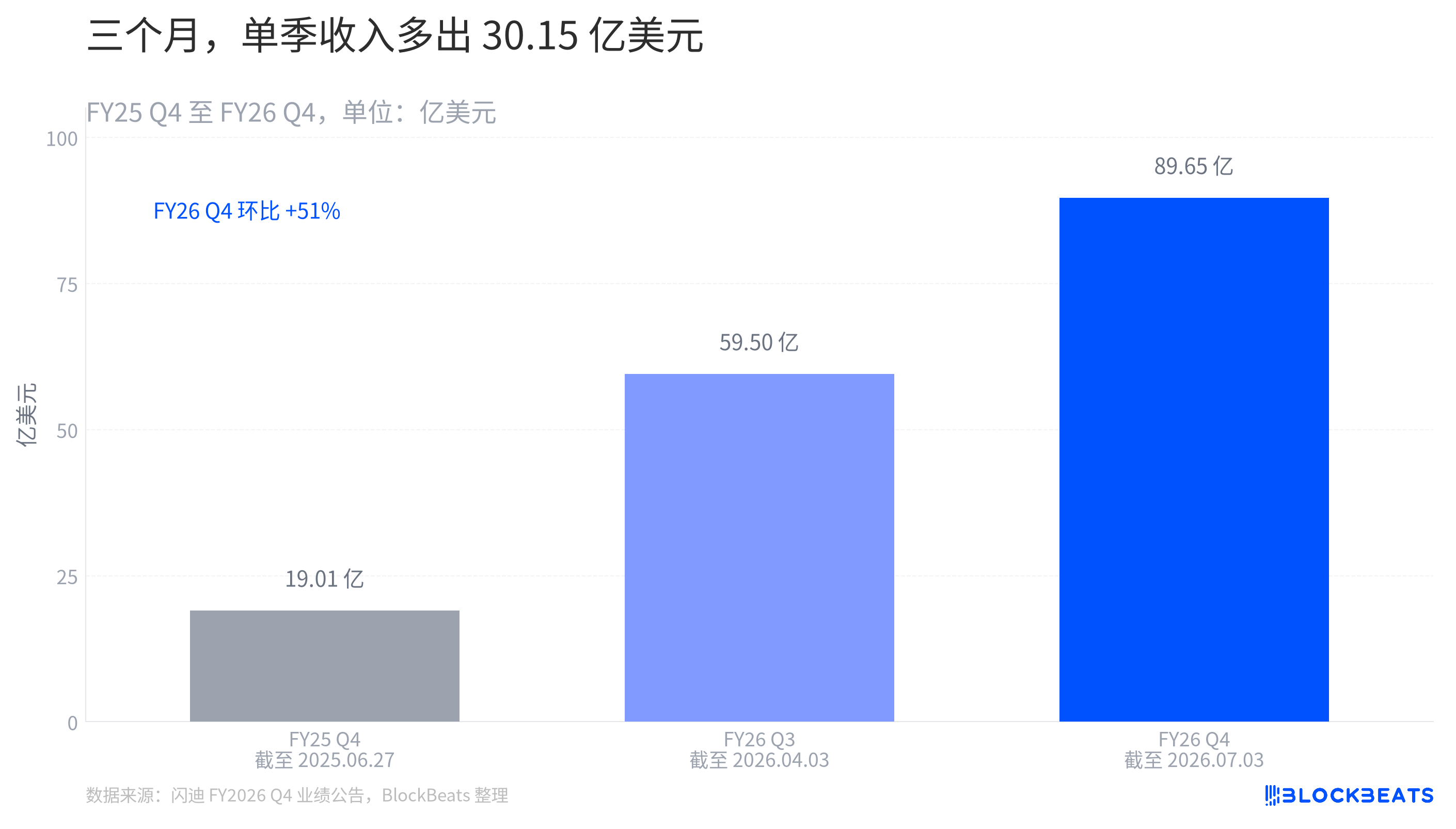
According to SanDisk's performance announcement, revenue in FY2025 Q4 was $1.901 billion, while the latest quarter has reached $8.965 billion. The staircase in the graph is steep, closer to this company's operational sense than just a "year-over-year growth."
The last bar is particularly intriguing. The additional revenue in the latest quarter compared to the previous quarter has exceeded the entire revenue for FY2025 Q4. It translates the 51% quarter-over-quarter growth into a more intuitive visualization. SanDisk did not just add a small segment to its existing scale; it virtually grew another previous quarter within three months.
The company's next quarter revenue guidance midpoint has already exceeded $10 billion. This is a dashed line representing management's current assessment and is not a fact confirmed in this article.
Why does almost all incremental revenue stay in gross profit?
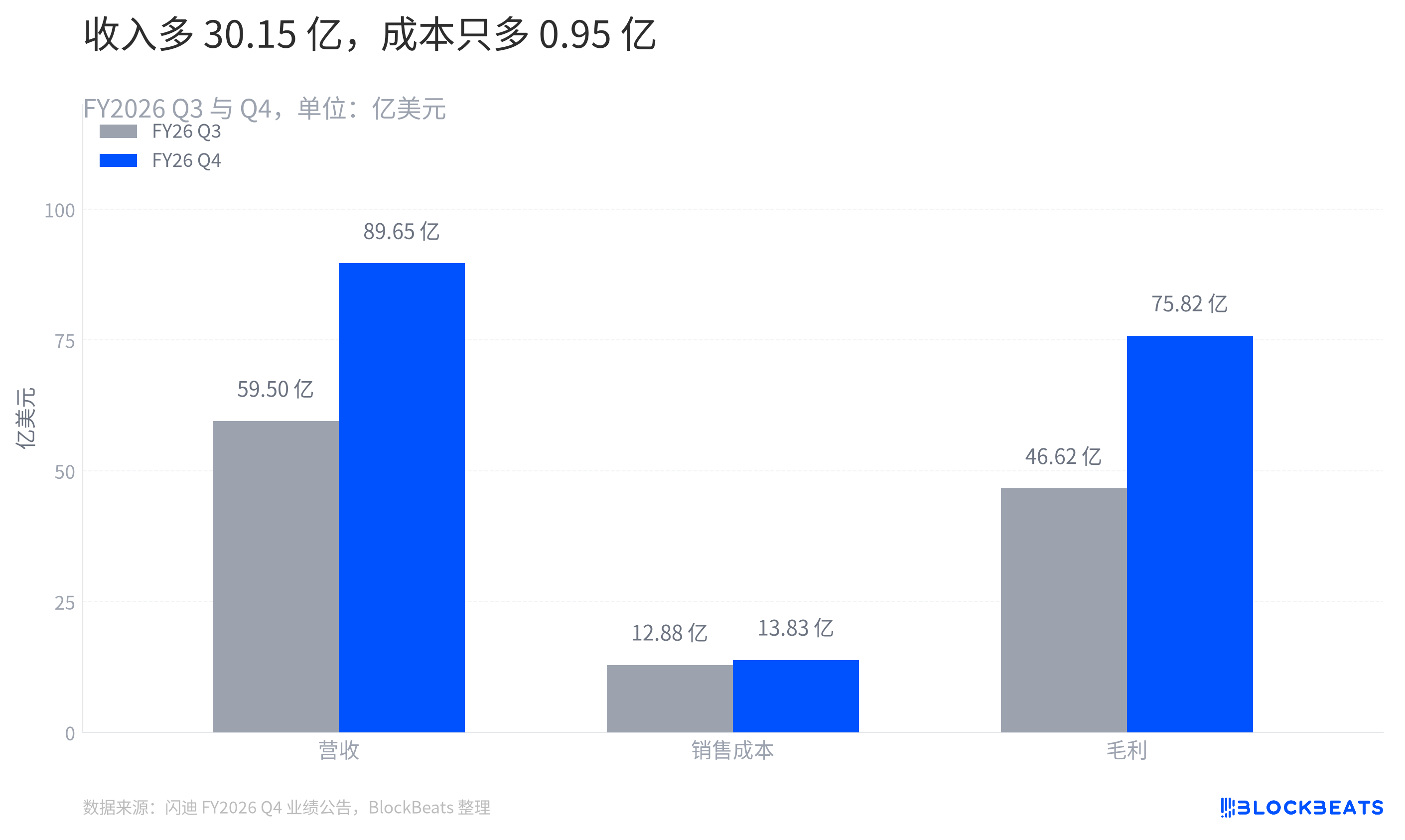
According to the company's announcement, FY2026 Q4 saw an additional $3.015 billion in sales compared to the previous quarter, with the cost of goods sold increasing by only about $0.95 billion. A clear dislocation is evident in the graph. While the blue revenue bar surged, the cost bar remained almost static.
This is a significant shift that a NAND manufacturer needs to be mindful of. The incremental revenue did not lead to a proportionate increase in manufacturing expenses, and the gross margin continued to climb above 80%. In simple terms, for every dollar of new revenue, the majority stayed in the gross profit.
The substantial profit still needs to be dissected. According to the company's reconciliation table, GAAP net income differs from Non-GAAP net income by approximately $741 million. The most striking variance is the $804 million equity securities gains excluded by the company from the Non-GAAP calculation. Such gains from valuation or disposal are not the same as the earnings from the increased flash memory sales during the quarter, and not all the brightness on the GAAP income statement can be attributed to the core business.
Is the Data Center the Sole Protagonist?
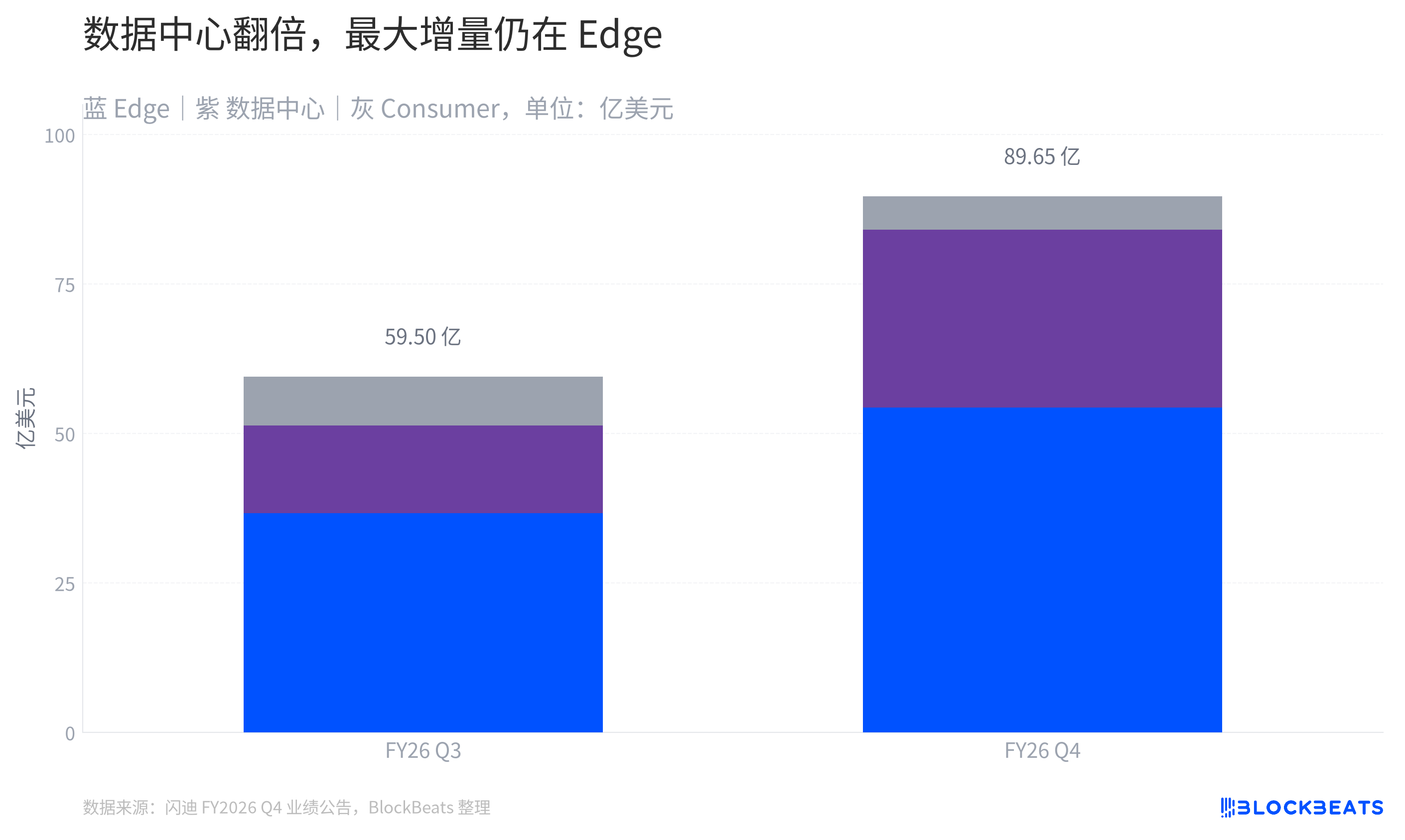
According to the company announcement, data center revenue doubled this quarter, making it the easiest candidate to be the protagonist in the AI narrative. However, when considering the three markets together, the blue Edge is still the largest base, and the quarterly increase in revenue was slightly higher than that of the data center.
This distinction is crucial. While the data center provides the fastest pace, the Edge provides a larger revenue increment. The top Consumer layer, on the other hand, has thinned out, indicating that this surge is not all demand surging upward simultaneously, but rather different endpoints reordering with varying degrees of intensity.
Summarizing it as "AI Driving Flash" is not entirely wrong but overlooks the revenue structure. The data center makes the growth more prominent, the Edge allows the scale to continue expanding, and the Consumer's decline reminds readers that SanDisk has not turned every product line into the same curve.
What Did Pricing Do?
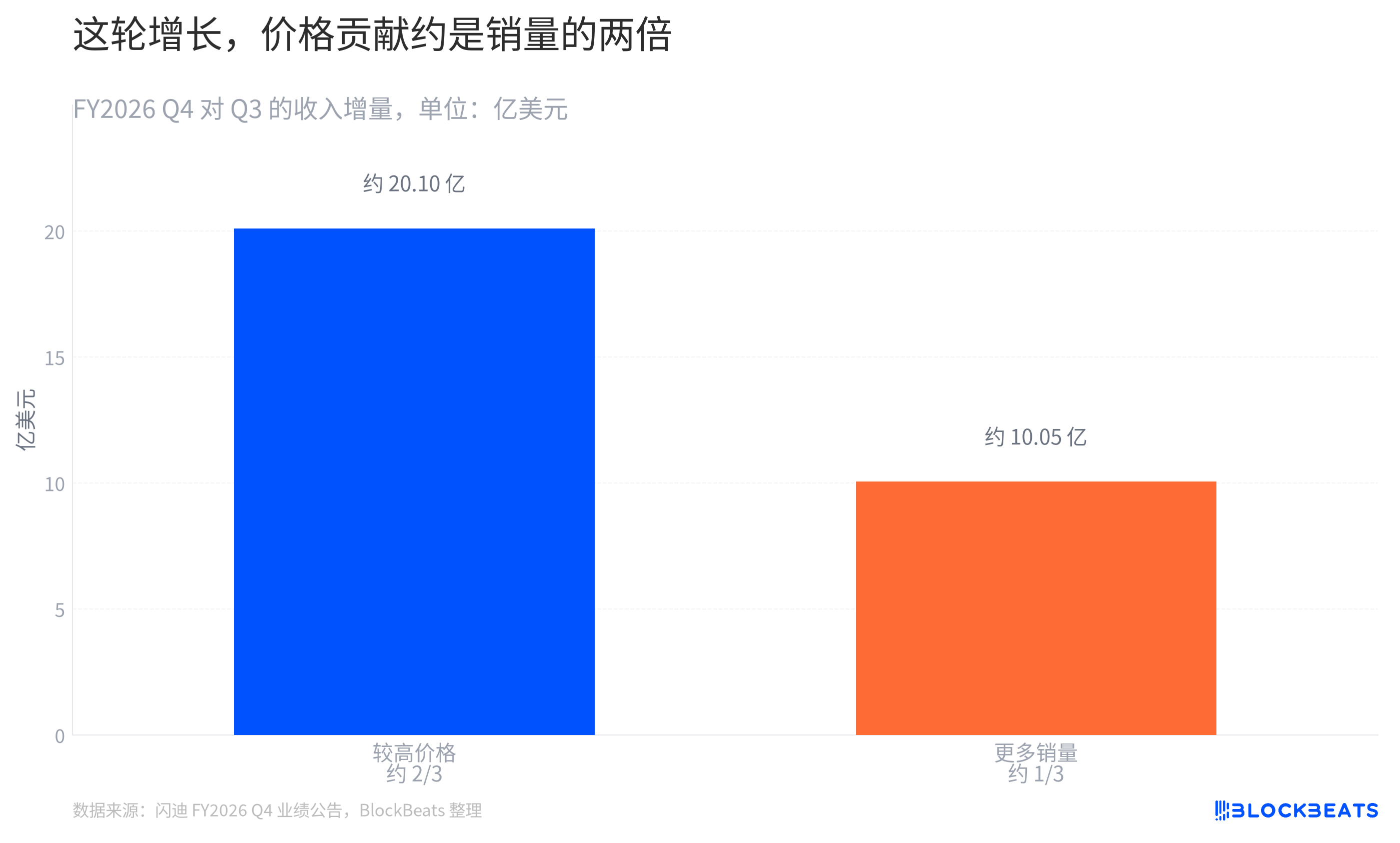
In its performance announcement, SanDisk provided a rare breakdown. The sequential revenue growth this quarter, about one-third came from increased unit sales, about two-thirds came from higher prices. Based on the ratio provided by the company, the contribution of pricing was approximately twice that of unit sales.
The two bars in the chart are not independently disclosed audit segments of the company but rather place "about two-thirds" and "about one-third" on the same scale. At the very least, it indicates that customers are not just buying more NAND, as SanDisk is also selling at a higher unit price. Once prices and product mix move upward together, manufacturing costs do not need to grow proportionally, and the income statement will show that kind of fold.
SanDisk's latest second-quarter financial report is not a single-line story driven solely by AI. The data center magnified the narrative, Edge retained the largest increment, and pricing propelled the new revenue into thicker profits.
Welcome to join the official BlockBeats community:
Telegram Subscription Group: https://t.me/theblockbeats
Telegram Discussion Group: https://t.me/BlockBeats_App
Official Twitter Account: https://twitter.com/BlockBeatsAsia

 Related Articles