CL, a Trading-Savvy Cat | Meet the Hyperliquid Trader

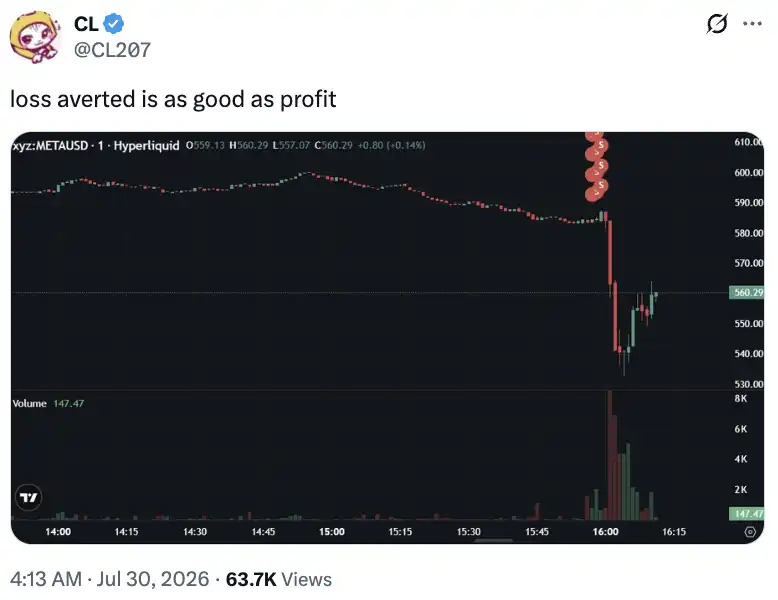
At the end of July, CL posted a chart of META on Twitter. The sell orders in the chart were concentrated around $584 to $586, and the price later dropped to $540. He captioned the chart with the phrase: "Avoiding losses is as valuable as profits."
On Hyperliquid, his address happened to have a long position in META that was liquidated at an average price of $584.41, resulting in a final loss of $93,449.20.
This phrase perfectly describes CL's trading style. He has made more wrong trades than right ones, with profits relying on only a few successful trades. For this trading style, considering closing a position must both prevent further losses and avoid prematurely killing a true winner.
The Cat's Trading Style
First, let's look at CL's profitability.
As of July 30, 2026, CL's perpetual contract trading volume on Hyperliquid was approximately $3.087 billion, with a total P&L of $697,185.44 and total assets of about $2.2617 million. The account had no open contract positions at that time and had incurred a loss of $368,056.91 in the past 30 days.
The visible 438 trades resulted in $1.06 million in realized profits. Out of these, 192 were profitable and 246 were losing trades, with a win rate of 43.84%. The average profit was $32,990.64, the average loss was $21,421.68, and the average winner was 1.54 times larger than the average loser. The total profit was $6.3342 million, and the total loss was $5.2697 million.
What truly determined the outcome were three trades.
The top three most profitable trades earned a total of $1,062,549.72, accounting for 99.82% of the net profit in the sample. Excluding these three trades, the remaining 435 trades only made $1,919.13. CL made numerous judgments and endured 246 losses throughout the year, with almost all net profits ultimately coming from seizing the market in three instances.
The direction was also highly concentrated. Out of the 438 trades, 353 were long positions, accounting for 80.59%, contributing $931,002.37 in profit; 85 short positions contributed $133,466.48. The top three highest profits and the top three largest losses all came from long positions. Being bullish itself did not provide an advantage; gains came from different holding paths and exit points in the same direction.
The position size further magnified this structure. The median nominal position size of the sample is about $1.2368 million, with a mean of about $1.6946 million. The median holding time is only 1 hour and 38 minutes, while the mean is stretched to 31 hours and 7 minutes by a few long-term positions.

The Past and Present Life of a Cat
CL's public persona is a cat in a yellow hazmat suit. He narrates the origin of the "cat" nickname as a family story: in his childhood, his mother, following an advice from a fortuneteller, gave him a cute nickname, thus starting to call him "cat." Years later, this name turned him into a KOL with around 279,000 followers.

His bio reads, "Left academia, left the trading desk, now enjoys watching Google Maps." In recent tweets, he humorously comments on market volatility with statements like "1 BTC still equals 1 BTC, 128GB still equals 128GB," and also engages in serious discussions about solar facilities in California and Xinjiang, interprovincial power supply, mentioning his long-term interest in bookmarking large-scale solar plants on Google Maps. He also commissions his longtime collaborator artist to create drawings of his cat persona. Trading, traveling, anime-style art, and cat-like language together form today's CL.

In 2018, he entered the crypto market through the university's blockchain club, initially investing around $2,000 in BTC. When the price dropped from around $6,000 to about $3,000, he continued to buy. Later, as BTC rose from the low point to around $12,000, the wealth change from simple holding remained limited, so he turned to leveraged trading.
CL never took a finance course. According to him, his early classroom was the BitMEX XBT perpetual contract interface, and his learning method was to continuously experiment in the market. He often appeared on BitMEX's weekly or monthly leaderboard, with most of his historical profits coming from BTC and ETH. Rather than how much money he could make in a single trade, he was more fascinated by why prices moved and viewed trading as a continuous problem-solving game.
Later, he was hired as a proprietary trader by an unnamed fund for a few months after posting trading views on Twitter, and after leaving in 2020, he traded independently. That experience led him to frequently observe liquidity, price impact, and arbitrage transmission between different trading venues, shaping his intuition about the market's microstructure.
In the second half of 2020, CL turned a joke into eGirl Capital. On the eGirl Capital website, he wrote in the first person, stating that the initial idea was to have a group of anime enthusiasts establish a fund to co-invest with mature venture capital firms. A group chat was subsequently formed, where members traded together, researched, developed products, and also invested in crypto startups.
The eGirl Capital website lists a portfolio that includes projects such as Arbitrum, zkSync, Blur, Lido, Celestia, Monad, and Stable.

eGirl Capital shed light on the other side of CL. He is not only an individual trader who frequently navigates the leveraged markets but also part of a loosely knit, anonymous, internet subculture-colored investment collective. A cat persona and a nonchalant linguistic style form the facade, concealing a savvy investor and trader underneath.
The Cat's Market Insight
CL's understanding of the market rarely comes from news and project narratives.
He pays more attention to what other participants have already done: whether spot and perpetual contracts show significant buy or sell orders, how open interest has changed, where leverage is concentrated, and if the funding rate is imbalanced. After observing this data for a long time, he mentally constructs a potential liquidation profile to assess where the price might move to trigger more forced liquidations or buys.
The core of this approach is feedback. CL does not engage in news-driven trading but primarily looks at charts, momentum, trends, and position structures. If the expected liquidation or "squeeze" event does not materialize, he revisits his initial assessment. Market behavior does not confirm assumptions; assumptions need to be abandoned.
His proudest market call, which also reflects this preference, came in the summer of 2020 when he foresaw in advance how position and liquidation structures could drive BTC to an extreme upward movement, potentially causing Binance to malfunction. Although the market later roughly followed this path, he admitted that his actual execution was not great.
CL considers refraining from retaliatory trading, controlling emotions, pre-defining risks, and acknowledging mistakes as basic abilities of a great trader. He can be aggressive on entry but relies more on momentum decay, time, and market feedback on exits, rarely setting a fixed-price mechanical stop-loss.
The subsequent BTC and NVDA trades illustrate that this approach can capture major trends while also oscillating between "just a bit longer" and "time to go" pressures.
The Cat's Live Trades
Four BTC longs in 2026 showcase the gains and costs of CL's trading strategy.
On February 5, CL entered a $4.158 million BTC long position at an average price of $69,299 and exited 6 hours and 54 minutes later at $66,260, resulting in a loss of $184,416.69. Over the five days leading up to this trade, BTC had dropped by 12.01%, with tech stocks and digital assets under pressure during the same period. This swift exit prevented the position from further exposure to the rapid decline path.
One month later, he made the most successful trade on the account in the same direction. The BTC long position established on March 4th was approximately $8.258 million, with an average entry at $68,816. Exiting 20 hours and 25 minutes later at $72,704, he made a profit of $461,853.47. During the holding period, BTC rose by 3.72%, ETH by 4.63%, and risk assets rebounded simultaneously. CL caught the trend and completed the exit before the subsequent retracement.
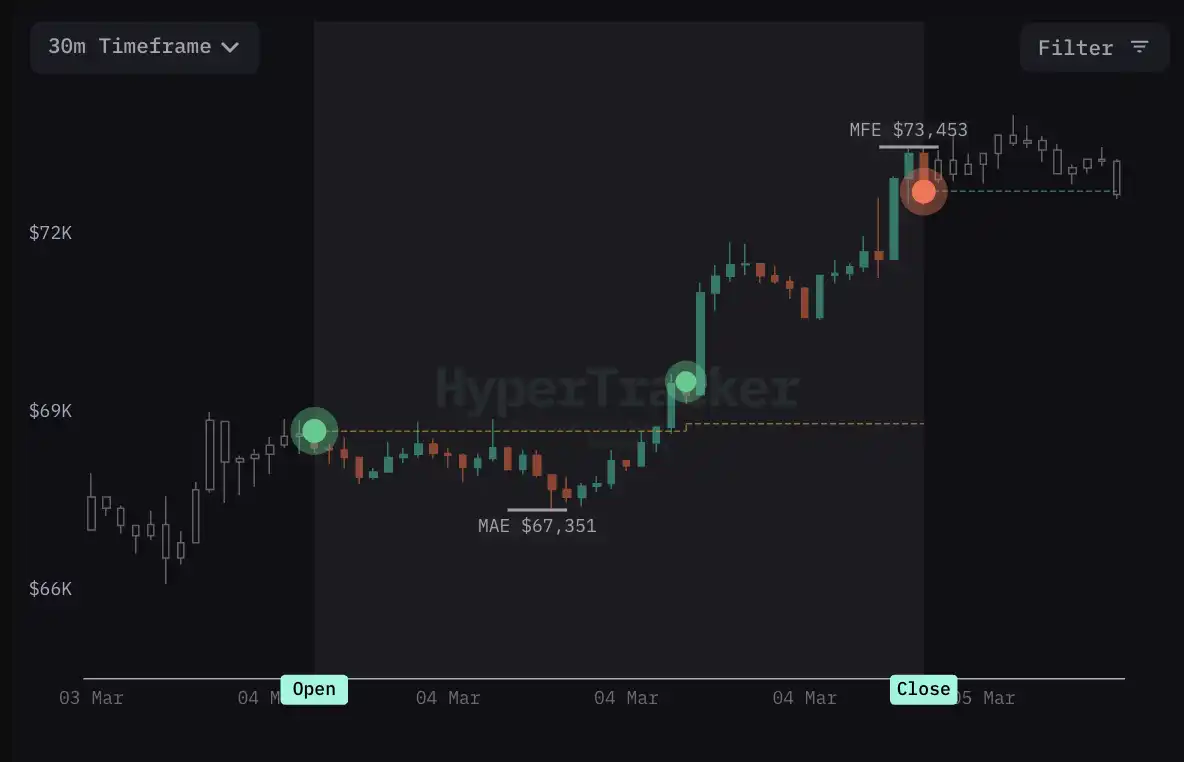
In April, the BTC long position was held for another 11 days and 13 hours, earning $298,607.26; another long position in May was only held for 1 day and 10 hours, resulting in a loss of $156,437.79.
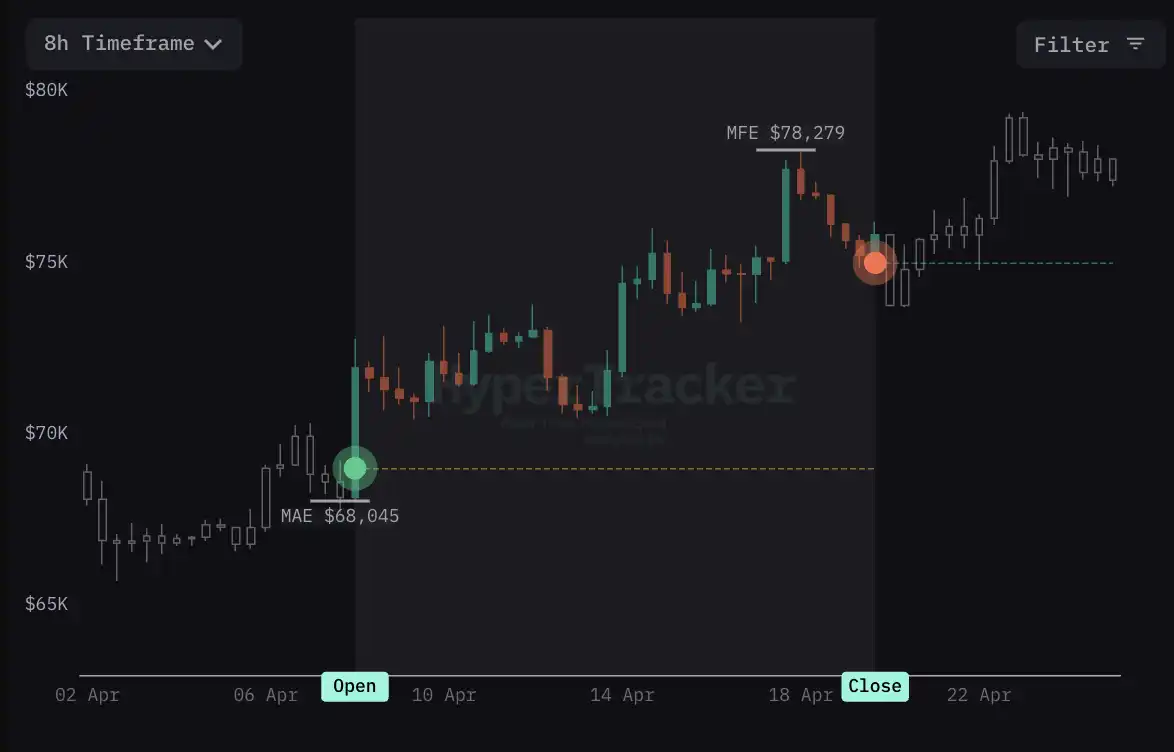
The four trades were all in the same direction, with holding periods ranging from 7 hours to nearly 12 days, resulting in two significant gains and two significant losses.
The Cat's Failure
If BTC demonstrated that the same direction could yield various results, then the two NVDA long positions constituted a more direct mirror image.
On May 6th, CL established a NVDA long position of approximately $2.3674 million at an average price of $205.86. Eight and a half days later, the average exit price reached $232.65, resulting in a profit of $302,088.99. This was the second-largest winner in the sample. During the holding period, NVDA rose by 12.74%, QQQ by 3.08%, and AI and the semiconductor sector strengthened simultaneously. To hold onto this trend, he paid a funding fee of $6,004.60.
On July 9th, he once again went long on NVDA. The nominal position expanded to approximately $4.0752 million, with an average entry price of $203.75. Subsequently, NVDA rose by around 5.22% relative to the entry, with the position holding a substantial unrealized profit, but CL did not end the trade here.
Over the next three weeks, positive infrastructure news alternated with AI funding concerns, and NVDA and QQQ eventually fell by 7.02% and 7.91%, respectively. On July 29th, CL exited at an average price of $194.43, after holding the position for nearly 21 days, resulting in a loss of $201,016.86, and an additional funding fee of $14,400.22.
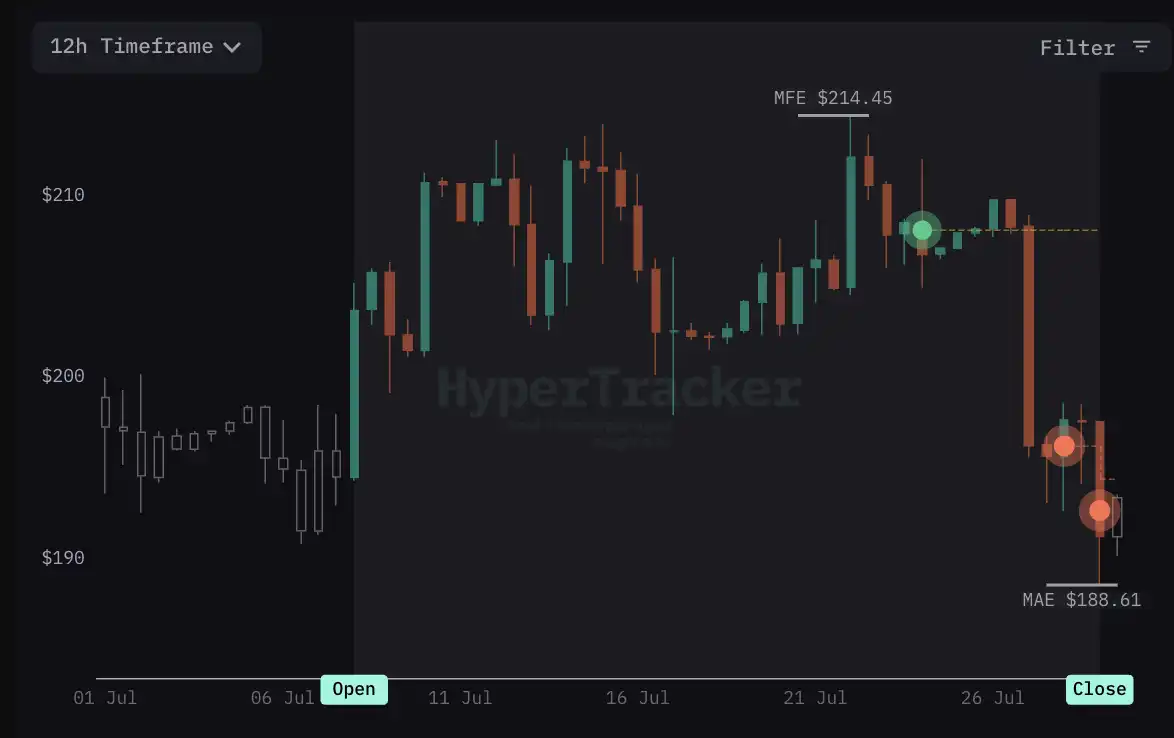
This marked the largest loss on the account.
The same underlying asset, the same bias. Patience in May resulted in a $300,000 profit, while patience in July turned a paper gain into a $200,000 loss.
Leaving the Screen Can Also Be Profitable
Of the 438 trades, only a portion showcase CL's tendencies: a sub-50% win rate, a strong bias towards long positions, and profits driven by three significant winners.
CL used to obsess over price and position all day long. It wasn't until the end of 2020, after taking a break from trading, that he realized the weight of constant pressure. Since then, while still forming directional views, he prefers to keep many trades in his mind, engaging in more "mental trading" and refraining from turning every idea into a real position. He refers to himself as a "life maximizer" and a "happiness maximizer," willing to earn less and not let high leverage positions dominate his life.
He travels frequently, stays in hotels for extended periods, sticks to a consistent diet, and prioritizes health habits. When asked what he would do with more money earned, he said he doesn't dream of becoming a super-rich person and is content with his current life. As his wealth continues to grow, he would probably still reside in hotels and use a portion of his money to support creators who are not in a rush to monetize their art.

Looking back at the opening statement, "Avoided losses are as valuable as gains," it's no longer just about a single trade. Exiting a losing position in time is a form of profit, and reducing endless screen-watching is also a form of profit. For CL, money measures trading outcomes but does not monopolize the value of life.
The cat in the yellow hazmat suit is still studying why prices move. The difference now is that he also knows when to turn off the screen.
Welcome to join the official BlockBeats community:
Telegram Subscription Group: https://t.me/theblockbeats
Telegram Discussion Group: https://t.me/BlockBeats_App
Official Twitter Account: https://twitter.com/BlockBeatsAsia