Bernstein Analyst Interprets Microsoft: Azure Accelerates to 45%, Copilot Exceeds 30 Million Seats, Microsoft's AI Commercialization Continues to Gain Momentum

TL;DR
· Microsoft's FY26 Q4 earnings report and FY27 Q1 guidance exceeded expectations, with the stock price surging around 9% in after-hours trading.
· Azure Q1 constant currency growth guidance is around 45%, with Copilot surpassing 30 million paid seats.
· Capital expenditure reduction was mainly driven by accounting changes, while AI demand and cash return remain the key focus.
Following Microsoft's better-than-expected FY26 fourth-quarter earnings report and next-quarter guidance, Bernstein has maintained an "Outperform" rating on Microsoft and slightly increased the target price from $646 to $647. The key reason is that Azure and Copilot, the two main AI narratives, are still accelerating.
The modest $1 increase in the target price is not the main point. More importantly, Microsoft has addressed the two most concerning questions in the market: whether AI demand is still genuine and whether AI infrastructure investment will weigh on cash flow.
Microsoft's official financial report shows that total revenue for FY26 Q4 was $90.07 billion, operating income was $40.603 billion, and GAAP diluted EPS was $4.81. According to the Associated Press, Microsoft's stock price surged about 9% in after-hours trading following the earnings release. The market's response primarily stemmed from the cloud business and the commercialization of AI both exceeding expectations.
Azure Has Not Reached a Saturation Point; Q1 Guidance Continues to Accelerate to 45%
Azure was the most direct hook in this earnings report.
In FY26 Q4, revenue from Azure and other cloud services grew 43% year-over-year at constant currency rates. More crucially, Microsoft's FY27 Q1 guidance for Azure constant currency growth is around 45%. Bernstein estimates that this guidance is approximately 400 basis points above the market's expectations.
At least from Microsoft's disclosed short-term orders and capacity status, the cloud business has not entered the feared "AI saturation period." Management stated on the earnings call that customer demand continues to outstrip available capacity, with capacity remaining the primary constraint at present.
For investors, the implication of this figure is straightforward: Microsoft's massive AI data center construction over the past few quarters has not immediately turned into idle risk. Instead, capacity is still insufficient, and Azure growth is still constrained by supply.
Microsoft Cloud revenue reached $59.3 billion in the fourth quarter, a 27% year-over-year increase, already stably contributing over half of total revenue. The ongoing cloud transformation, a long-standing narrative, has not concluded, with AI simply accelerating the growth trajectory.
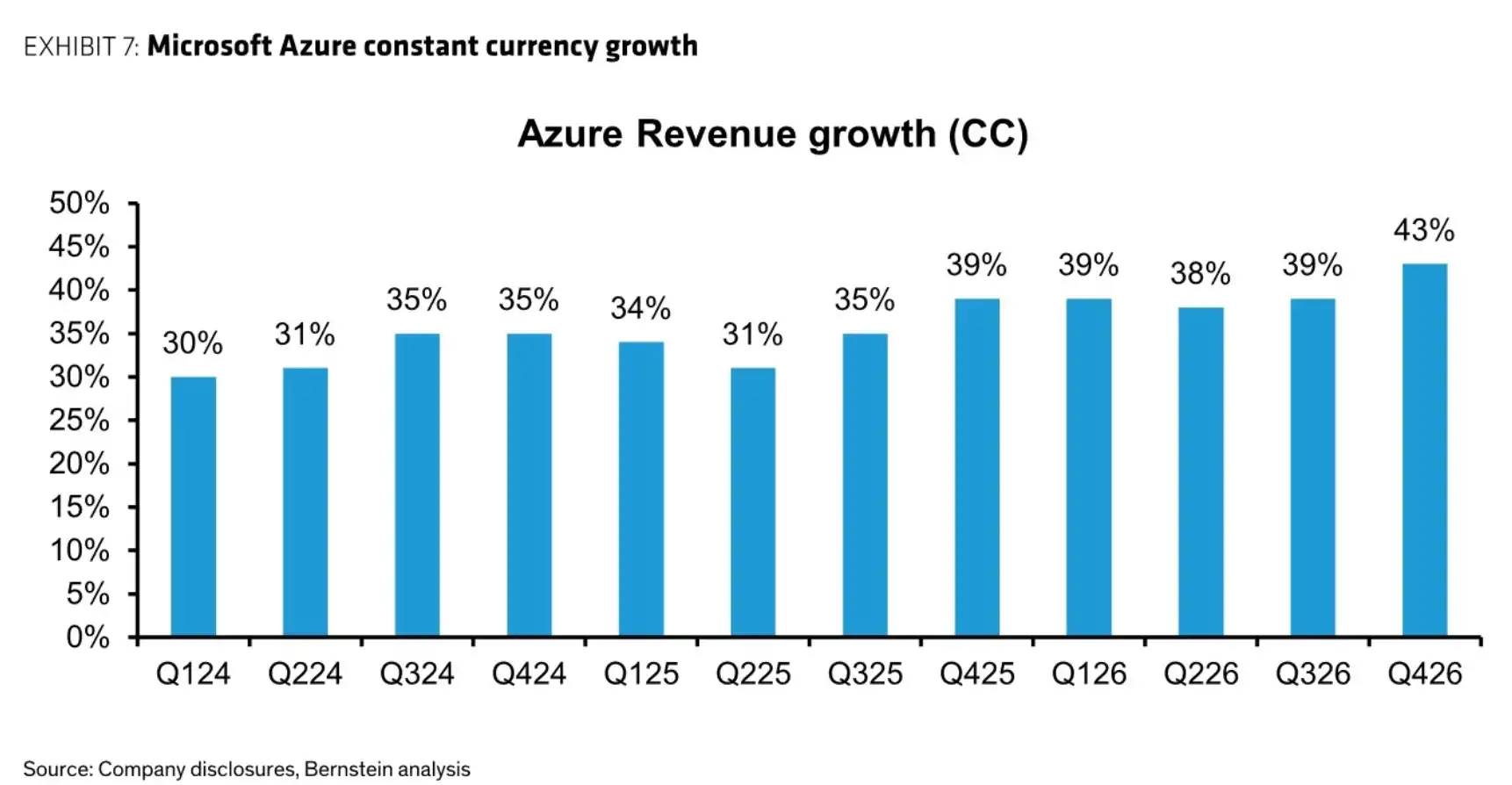
Azure's constant currency revenue growth increased from the 30%-35% range to 43% in Q4, with further guidance to around 45% in Q1.
Order metrics also support this. Commercial remaining performance obligation (RPO) grew by 84% year-over-year to $67.8 billion. Even excluding the impact of OpenAI and other advanced model companies, RPO still grew by 25% year-over-year, with a sequential increase in enterprise customer contributions.
This breakdown is crucial. The market has been concerned about Microsoft's AI cloud growth being overly reliant on a few key customers like OpenAI, fearing that if these customers change their investment pace, Azure's revenue could be under pressure. However, excluding this portion, enterprise customers are still growing, indicating that demand is not solely coming from a single major customer.
Copilot Surpasses 30 Million Seats, Easing Concerns of SaaS Disruption by AI
Another above-expectation figure comes from Microsoft 365 Copilot.
The Microsoft management confirmed that Microsoft 365 Copilot's paid seats have surpassed 30 million. Bernstein stated that this figure exceeds the market's previous expectation of "over 25 million," showing a significant improvement from the over 20 million level in the previous quarter.
The significance for Microsoft goes beyond just selling another AI tool. Over the past year, one of the market's concerns about software companies was whether AI would weaken the traditional SaaS seat model and if businesses would reduce software spend per capita. The continued growth of Copilot seats at least indicates that Microsoft can still embed AI capabilities into existing enterprise software systems and monetize through higher per-user revenue.
M365 Commercial cloud reported fourth-quarter growth of 14% on a reported basis and approximately 16% on an adjusted basis. Revenue improvement mainly came from E5 and E7 package upgrades and Copilot adoption. Microsoft is not selling a standalone AI plug-in but rather bundling AI features with existing enterprise software suites to increase customer spend per seat.
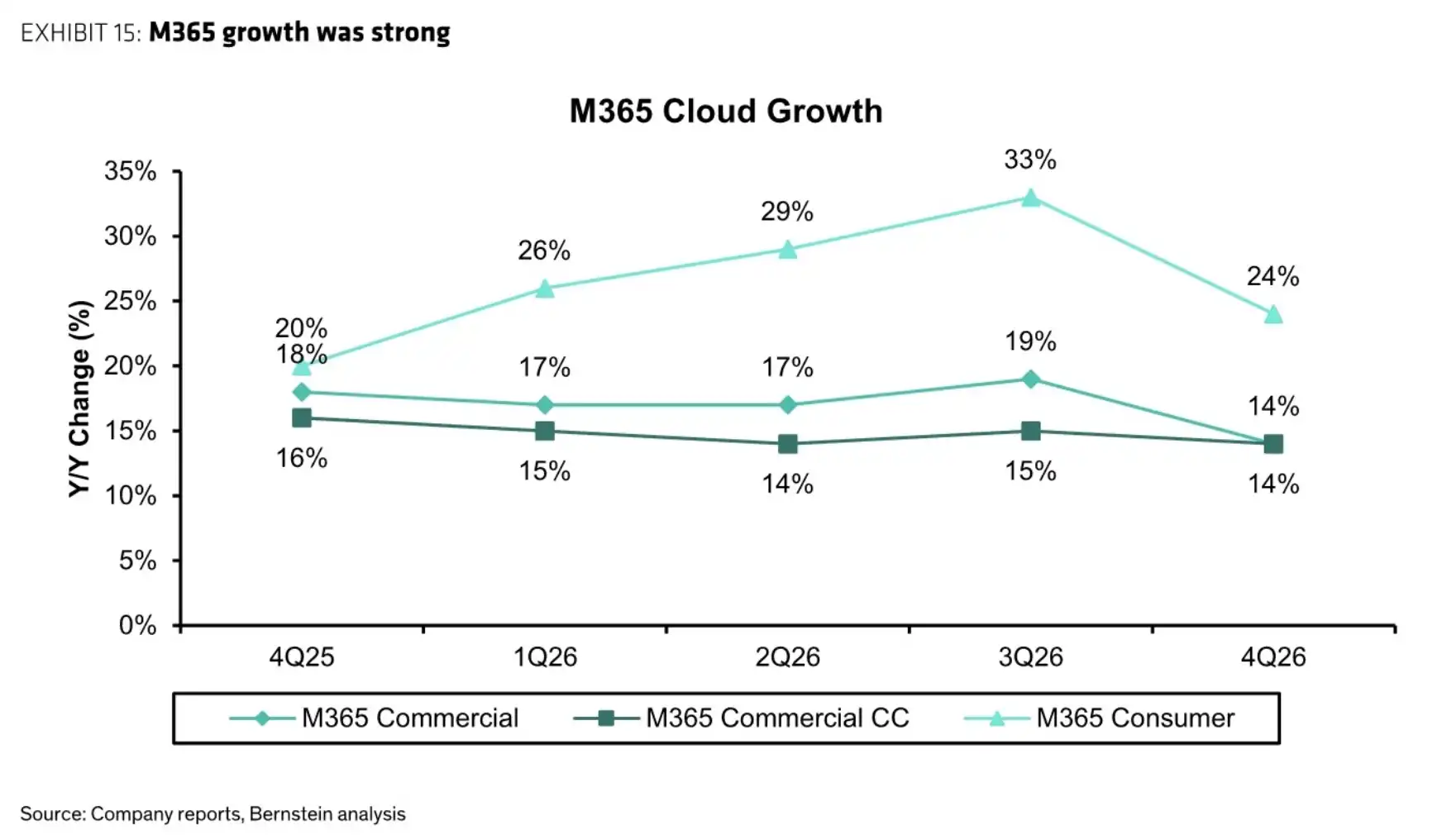
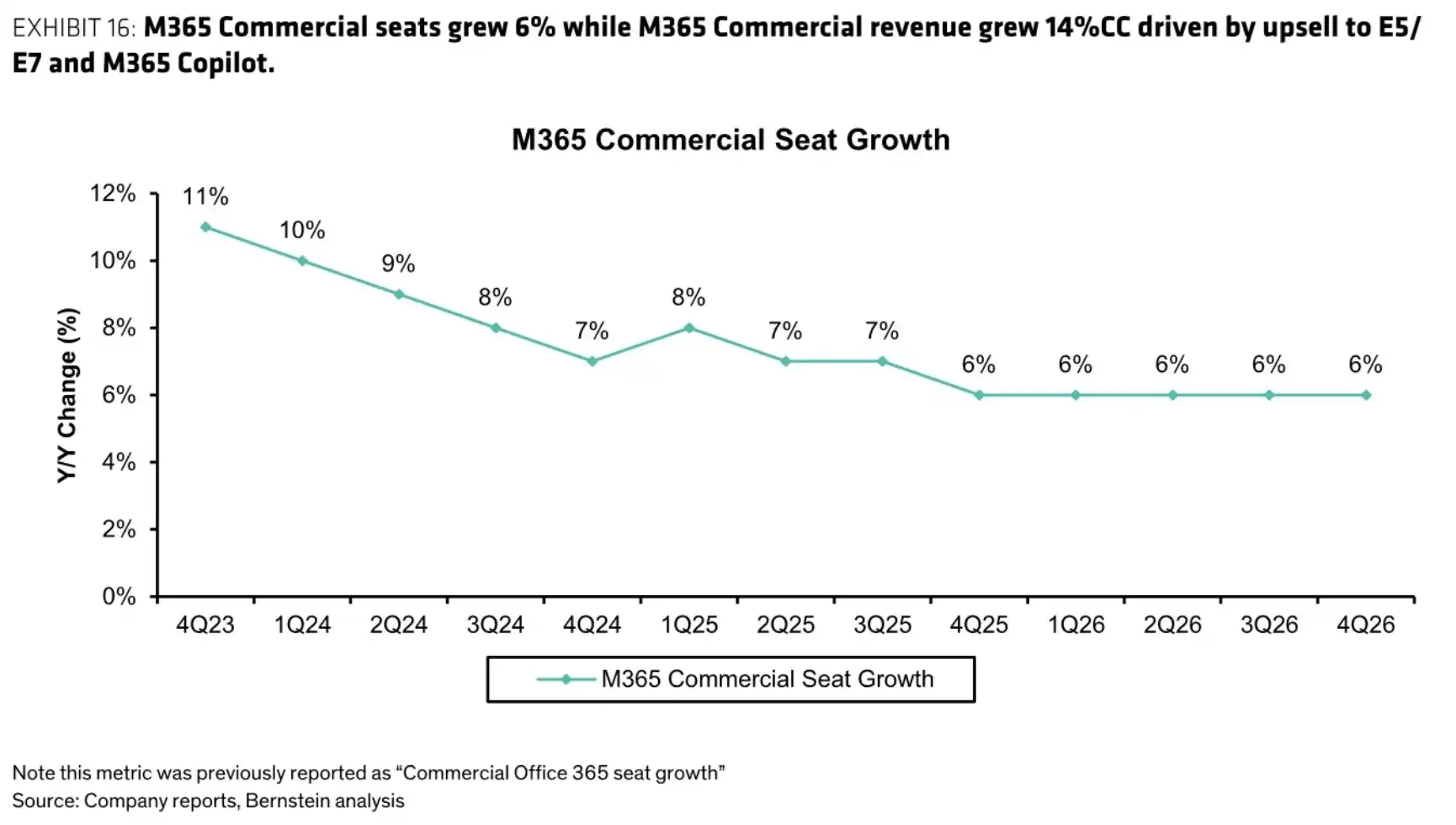
M365 Commercial cloud growth improvement, Copilot paid seats increased from 15M, 20M to over 30M.
GitHub Copilot is also expanding its user base, reaching 50 million users, and gradually transitioning to a "subscribe + consume" hybrid pricing model. The revenue of the developer AI tool now depends not only on fixed seats but also on usage volume.
However, Copilot's numbers still have boundaries. More than 30 million paid seats prove adoption is accelerating, but it still cannot directly prove that all enterprise customers will expand their AI software budgets in the long term. Whether it can continue to contribute revenue depends on renewal rates, usage frequency, and enterprise deployment scale.
Capital Expenditure Appears to Decrease, but Real AI Expansion Doesn't Slow Down
One of the most easily misread numbers in financial reports is capital expenditure.
Microsoft has adjusted its CY26 capital expenditure expectation to around $175 billion, lower than the previous estimate of around $190 billion. On the surface, this seems like a slowdown in AI investment. However, Microsoft explains that starting from FY27, the company will extend the estimated useful life of data centers and office buildings from 15 years to 25 years, leading to more data center leases shifting from finance leases to operating leases. Apart from the impact of the useful life extension, the capital expenditure investment expectation for CY26 remains unchanged.
In other words, the decrease is mainly due to accounting and leasing classification changes and does not mean that Microsoft is cutting back on AI data center construction.
A better indicator of the real investment intensity is the next quarter's guidance: the first-quarter capital expenditure for FY27 is still expected to exceed $50 billion. The total capital expenditure for the fourth quarter is about $41 billion, with cash purchases of property, plant, and equipment amounting to $35.8 billion, with about two-thirds used for short-lived assets like GPUs and CPUs.
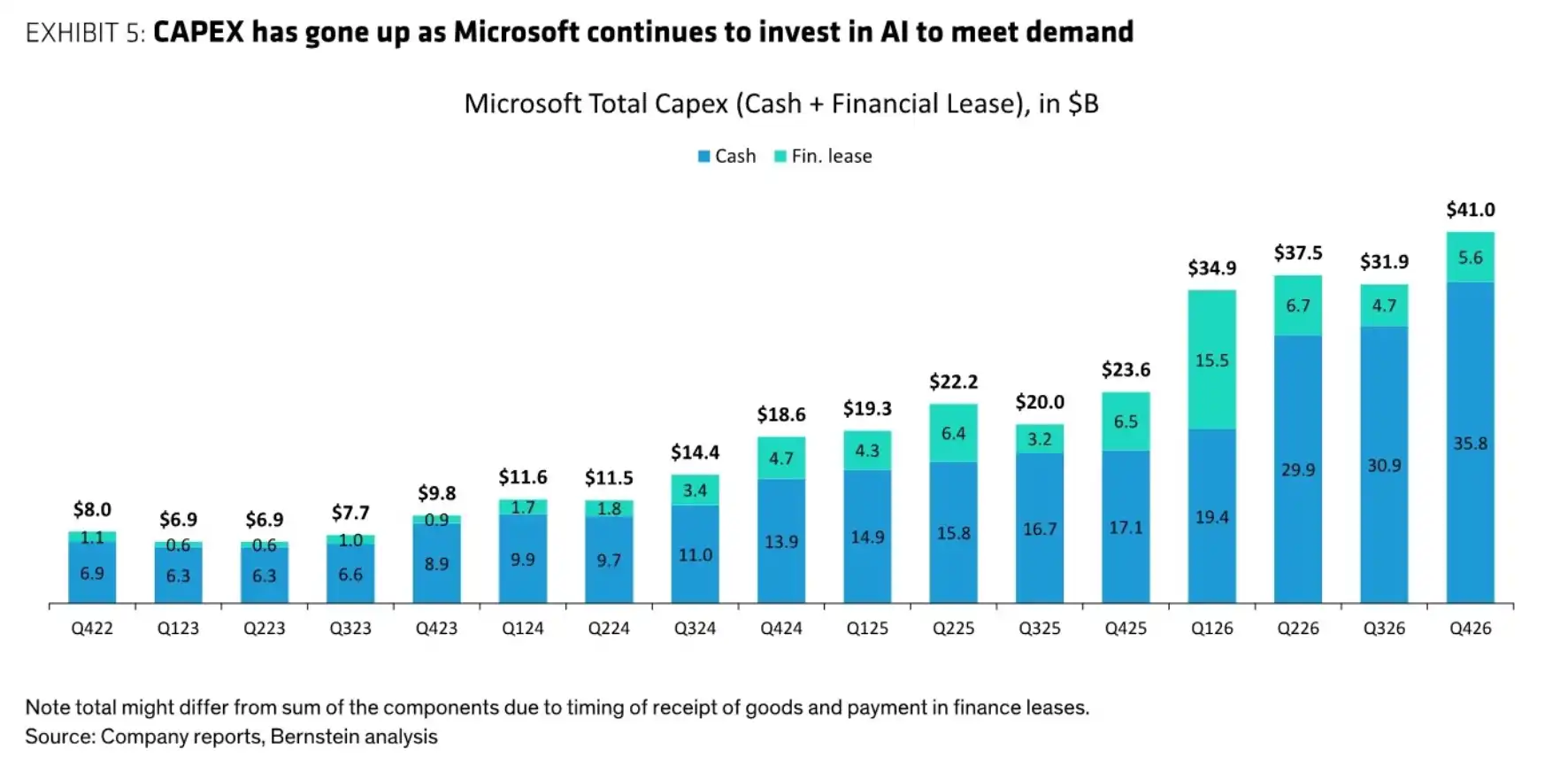
Q4 total capital expenditure is about $41 billion, with cash purchases of property, plant, and equipment around $35.8 billion, with about two-thirds going towards short-lived assets like GPUs and CPUs.
Capital expenditure hasn't slowed down, so naturally, the market will inquire about cash flow. The Microsoft management expects FY27 free cash flow to remain positive, contrasting with some hyperscale cloud providers turning to negative free cash flow during the peak of AI investment.
Microsoft Cloud's gross margin is 65%, down 3 percentage points year-over-year due to AI infrastructure investments, but Azure's efficiency is still improving. Copilot's workload throughput has quadrupled during the year, also helping to reduce unit delivery costs. As of the fourth quarter, the Microsoft platform has supported over 11,000 AI models, covering leading labs, open-source models, and proprietary models.
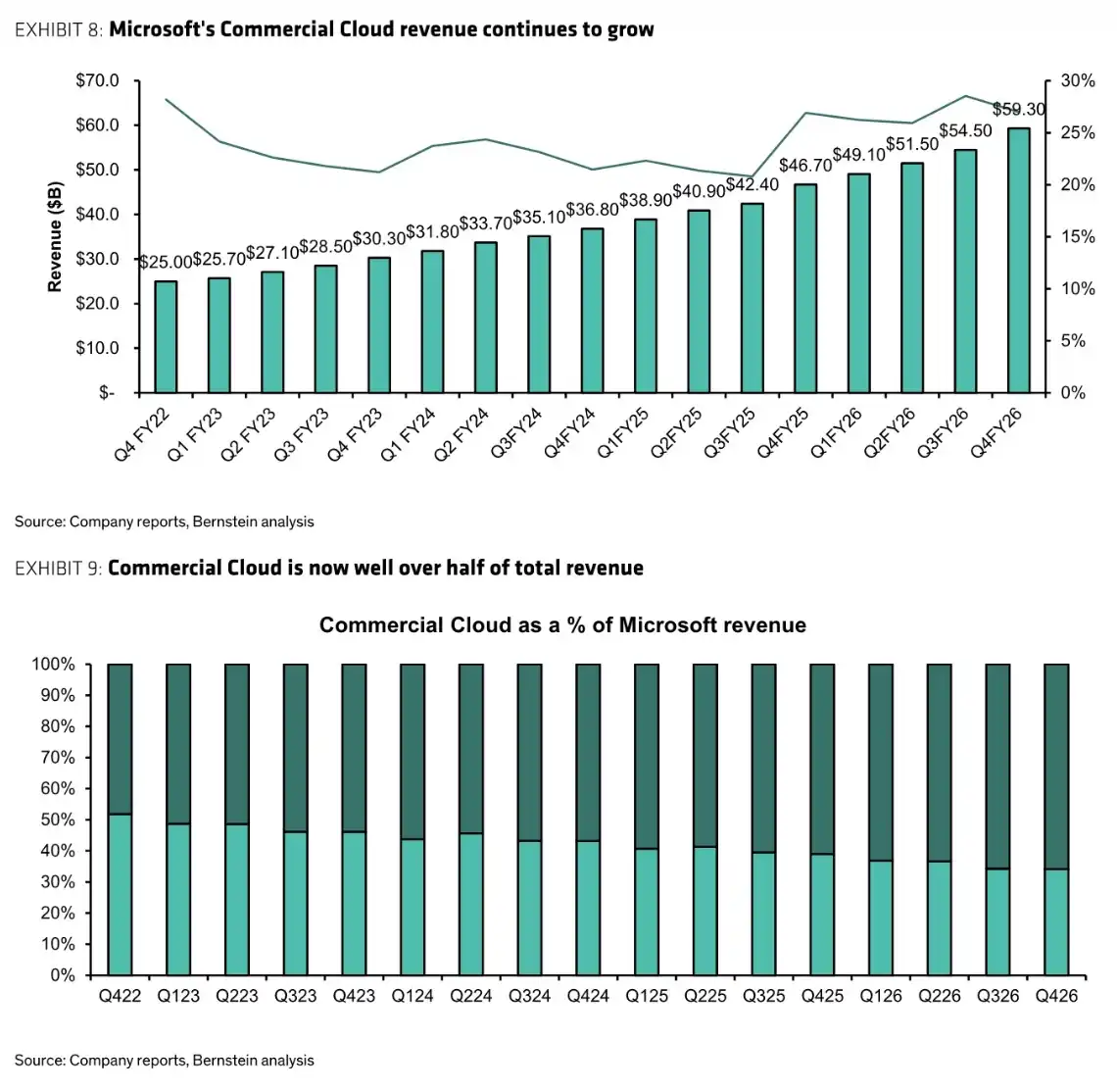
Microsoft Cloud Q4 Revenue of $59.3 billion, a 27% year-over-year growth, accounting for over half of total revenue.
This is also a key reason why Bernstein remains bullish on Microsoft: if AI revenue continues to perform well and free cash flow remains positive, Microsoft will be better positioned than most peers to withstand the fluctuations of the AI infrastructure cycle.
The Demand for AI Keeps Rising, While Capital Returns Face Scrutiny
This earnings report relieved market anxiety but did not eliminate all controversies.
The most immediate risk is still the possibility of AI demand falling below expectations. Microsoft's current signal is that demand far exceeds supply, with strong RPO growth and increasing Copilot seats. However, if enterprise adoption of AI applications lags behind expectations or spending by leading-edge model companies slows down, the payback period for data centers and hardware commitments will be extended.
Another risk comes from the true flexibility of capital expenditures. Microsoft emphasizes that there is some room for adjustment in data center and hardware commitments, but in the AI infrastructure construction cycle, GPUs, CPUs, power, and data center leases often need to be locked in advance. If demand falls short of expectations, the uncertainty remains about whether the flexibility is sufficient to protect capital returns.
Valuation is also not without pressure. Bernstein estimates that Microsoft's revenue for FY27 and FY28 is expected to be $392.63 billion and $466.335 billion, respectively, with adjusted P/E ratios of approximately 19.6x and 16.3x. This valuation is not excessive, but it is premised on Azure's continued high growth, ongoing Copilot penetration, and AI investments not significantly eroding cash flow.
The answers provided in this earnings report are more like this: Microsoft's AI story is still gaining momentum, and it has not yet been dragged down by capital expenditures. However, this is not yet the definitive evidence to debunk the "AI bubble." The real test is whether these computing power investments can continue to translate into enterprise payments, cloud revenue, and free cash flow.
Welcome to join the official BlockBeats community:
Telegram Subscription Group: https://t.me/theblockbeats
Telegram Discussion Group: https://t.me/BlockBeats_App
Official Twitter Account: https://twitter.com/BlockBeatsAsia
 Related Articles