Goldman Sachs Interpretation of the Minimax Founder's Meeting: MiniMax Valuation Correction, Target Price Upside Over 3x

TL;DR
· Goldman Sachs reiterates a Buy rating on MiniMax with a 12-month target price of HK$860, representing a 331.5% upside from the July 23 closing price.
· The thesis is based on M3 call volume, M3 Pro Inference Cost, H3 multimodal new products, and expectations around Stock Connect.
· MiniMax still needs to prove ARR growth and a path to profitability, with cash burn, model competition, and content risks as key boundaries.
Goldman Sachs reiterated a "Buy" rating on MiniMax Group (0100.HK) around July 24, with a 12-month target price of HK$860. Based on the July 23 closing price of HK$199.30, this target price implies approximately a 331.5% upside.
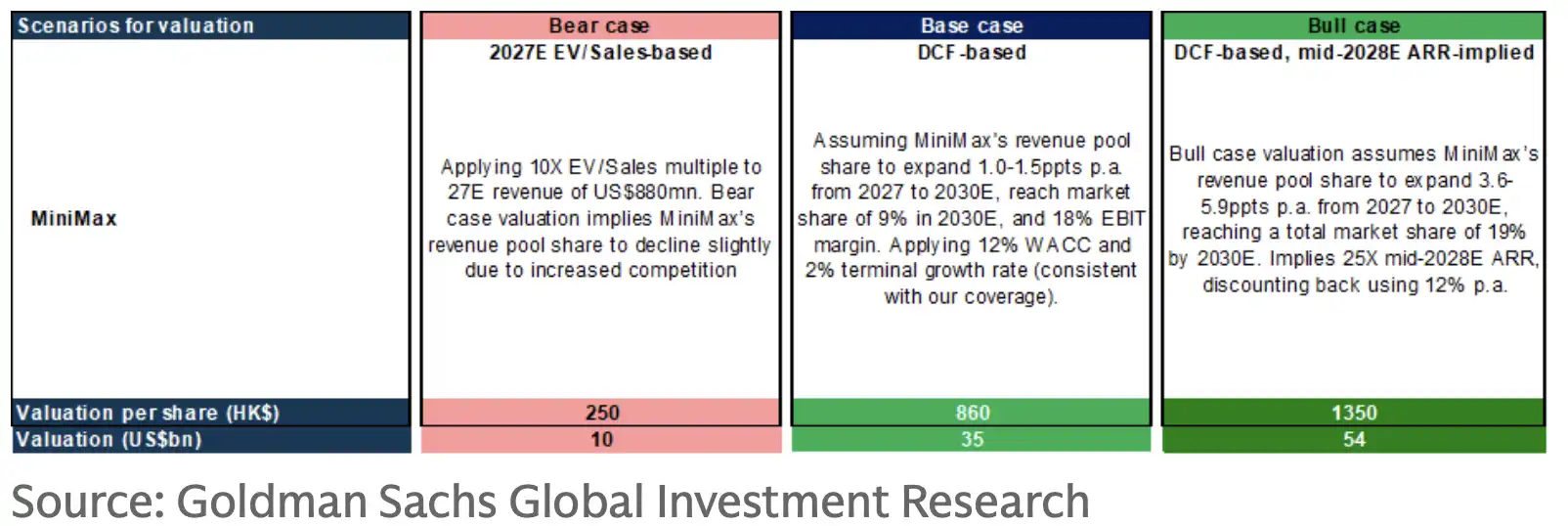
Valuation Upside/Downside/Base Case
MiniMax, a Chinese large-scale AI model company, debuted on the Hong Kong stock market in January this year, with the IPO ticker MINIMAX-WP and an IPO price of HK$165. On July 24, the stock closed at HK$196, still notably below Goldman's target price.
The most newsworthy aspect of this report is not just the aggressive target price but placing MiniMax in the context of China's AI model company valuation divergence. Goldman's optimism is not solely based on a single model release but on factors such as M3 call volume, API gross margin, M3 Pro cost efficiency, H3 multimodal new products, and a potential inclusion in Stock Connect in August, leading to valuation upside.
Target Price of HK$860, Betting on Valuation Discount Narrowing
Goldman's 12-month target price for MiniMax is HK$860, based on a DCF valuation approach. As certain DCF specifics and revenue forecasts are primarily from a sell-side report's perspective, they cannot be directly interpreted as the company's realized performance. However, the report's narrative is clear: MiniMax needs to demonstrate improvements in model call volume, commercial revenue, and inference costs simultaneously.
The valuation comparison is the report's strongest numerical hook. MiniMax's current market capitalization is around $8 billion to $8.5 billion. In comparison, according to the South China Morning Post's earlier report, Kling AI under Kuaishou is nearing the completion of a new round of financing with a post-investment valuation of around $18 billion. MiniMax is not lacking attention in the Chinese video generation and multimodal model race, but its secondary market valuation remains below the fundraising valuations of some similar assets.
The Goldman Sachs report also mentioned that SmartSight/Z.ai was recently valued at approximately $71 billion. This figure has limited publicly verifiable sources and is more suitable as a seller comparison metric rather than a market-recognized valuation. For investors, what really matters is not how high the industry valuation itself is, but whether MiniMax can use revenue and new products to narrow the discount.
After Trillion-Level Tokens, It's About Whether Each Call Can Make Money
Big model companies are now competing not only in model capabilities but also in the cost of each token.
MiniMax management stated at an analysts' meeting at the Shanghai headquarters on July 23 that the company's current primary goal is to ensure that each model strives for the best value for money. The M3 model currently has a daily throughput of trillions of tokens, and the open platform/API revenue has achieved a "healthy gross margin." At the current pricing, the company aims to achieve a high double-digit gross margin for this part of the business through inference efficiency improvements.
This is crucial for investors. The larger the AI model call volume, the more the inference cost determines the quality of revenue. Over the past two years, the big model industry has often seen model capability improvements and call volume growth, but price wars and inference cost have depressed profit quality. What MiniMax needs to prove is that while call volume is increasing, API prices remain competitive, and gross margins are not eroded.
M3 Pro is a more direct validation point for the second half of the year. Public reports and report calibers indicate that this model is expected to be launched between September and October 2026, with a parameter scale of around 2.7 trillion, close to the 3 trillion level. The technical directions mentioned by MiniMax include sparse attention mechanisms, activation parameter optimization, and KV cache optimization.
These technical terms translate into a business context where the key question is whether the model can reduce unnecessary computations, reduce GPU and cache pressure, make API services cheaper and faster, and still maintain profit margins with the same user request.
Self-Owned Computing Power Brings Cost Advantages but Also Cash Pressure
MiniMax's cost story is not only about model architecture but also about computing power infrastructure.
The management stated that the company has increased its self-owned computing power early on, expanded resources through domestic and international acquisitions and long-term leases, and believes that the acquisition of related resources occurred when GPU and AI server long-term leasing prices were significantly lower than current levels. This statement is mainly based on management communications and seller reports and still needs to be validated with subsequent financial data.
For AI model companies, computing power is not a one-time investment when training large models. After an increase in inference calls, the efficiency of computing power usage directly impacts the API gross margin. Experience with self-operated AI infrastructure can indeed help reduce the unit inference cost by improving cluster utilization.
However, this advantage also has a downside. Self-operated computing power implies heavier capital expenditure and cash consumption. If revenue growth falls short of expectations, or if model call volume cannot sustain significant enlargement, preemptively locking resources may shift from a cost advantage to a burden. To convince the market that its valuation is underestimated, MiniMax must not only emphasize "affordable computing power" but also demonstrate improvements in revenue, gross margin, and cash flow simultaneously.
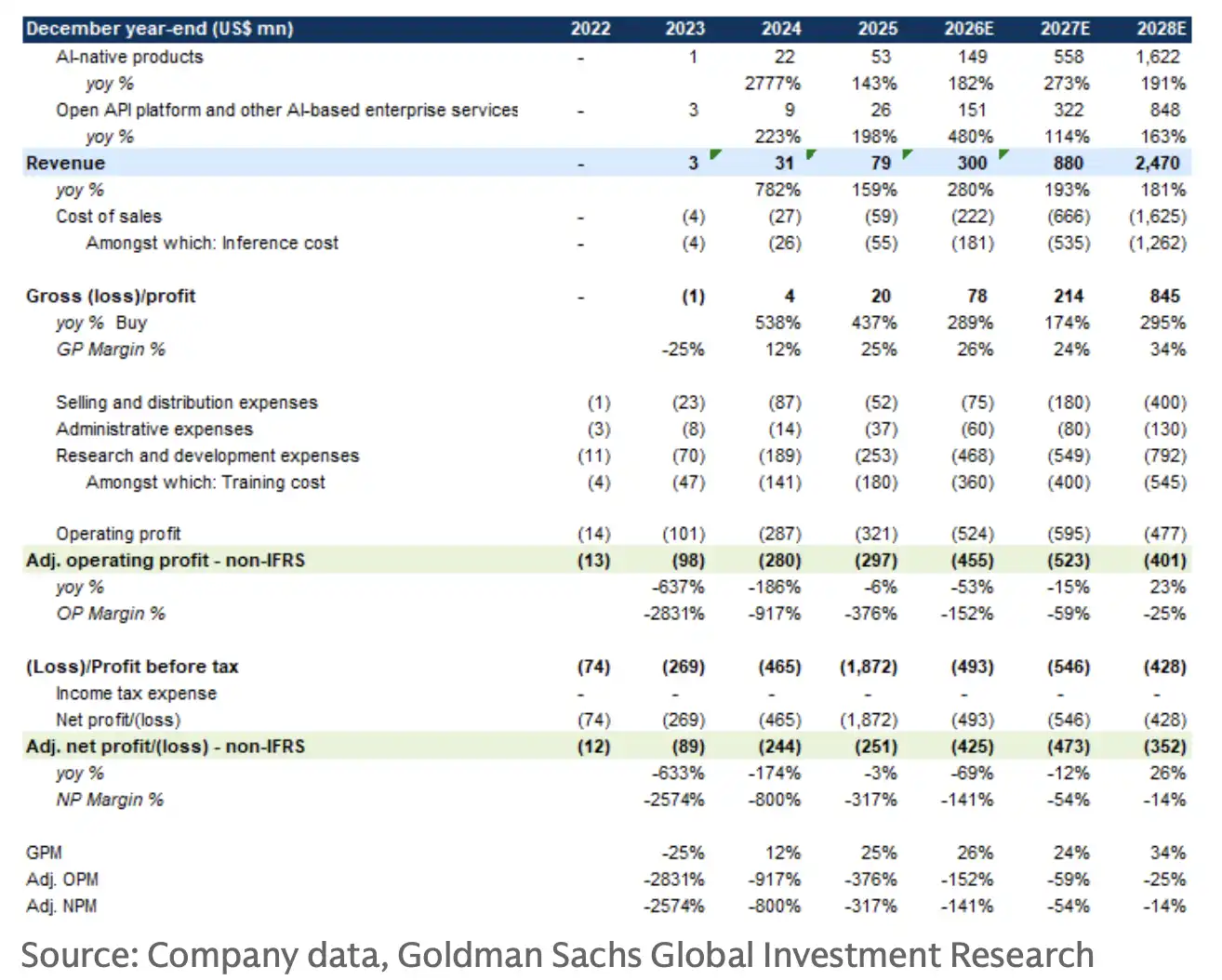
MiniMax Income Statement Summary: Goldman Sachs expects revenue to increase from $79 million in 2025 to $300 million in 2026, continuing to grow in 2027 and 2028.
H3 Beyond Video: Multimodality to Become a New Gateway
In addition to M3 Pro, another key second-half catalyst that Goldman Sachs values is the H3 model.
H3 is no longer just an extension of Conch AI's video generation model but is a multimodal model that can understand various inputs such as text, images, video, audio, music, etc., and produce video, image, and audio content based on user prompts. Several media sources report that this model is in the final stages of preparation for release.
The significance of this for MiniMax is that it may transition the company from a "video generation product" to a broader multimodal entry point. For users, the value of a multimodal model lies not only in generating a video but in enabling continuous understanding and transformation between text, images, sound, and video. In terms of commercialization, this signifies more paid scenarios and higher usage frequency.
H3 still faces two uncertainties. First, can it provide a sufficiently strong alternative experience beyond the existing video generation products? Second, can it drive sustainable ARR growth rather than just initial traffic at the time of release?
Multimodality is also an area where regulatory and content risks are more concentrated. The stronger the video, audio, and image generation capabilities, the greater the pressure regarding copyright, image rights, deepfakes, platform moderation, and content security. Goldman Sachs identifies IP and content generation risks as key risks, and this is the reason.
Stock Price Recovery Hinges on New Products and Revenue Realization
In the second half of the year, MiniMax has a capital market event. Goldman Sachs anticipates that in August 2026, the company may qualify for inclusion in the Stock Connect program. If eventually included in the southbound investment scope, the potential investor base will expand, and liquidity and market attention may increase.
However, Stock Connect eligibility itself cannot replace business realization. Ultimately, inclusion still needs to follow the lists from the Shanghai Stock Exchange, the Shenzhen Stock Exchange, and the Hong Kong Stock Exchange. For MiniMax's stock price to truly approach Goldman Sachs' target price, it still needs several supportive outcomes: continued growth in M3 call volume, maintenance of API gross margin improvement, the planned launch and cost efficiency of M3 Pro, additional demand from the H3 multimodal model, and continued growth in ARR.
The risks are equally direct. Global foundational model competition is still intensifying, and model performance may fall short of expectations. Earnings visibility may lag behind the market's expectations. Commercialization capability, cash burn, and self-funding ability all need continuous monitoring. The escalating U.S.-China tech competition could also affect computing power, customers, and overseas expansion.
Goldman Sachs' report does not propose a "MiniMax target price of 860 Hong Kong dollars," but rather a more realistic question: in a situation where the valuation gap among Chinese AI model companies is already significant, can MiniMax demonstrate that its current market capitalization of $8 billion to $8.5 billion is undervalued through lower inference costs, a faster pace of new product releases, and clearer ARR growth?
Welcome to join the official BlockBeats community:
Telegram Subscription Group: https://t.me/theblockbeats
Telegram Discussion Group: https://t.me/BlockBeats_App
Official Twitter Account: https://twitter.com/BlockBeatsAsia