Changxin Trust Emerges as the New A-Share King: How to Perform a Fair Valuation?
Original Title: "How to Value Changxin?"
Original Author: Long Yue, Wall Street News
Changxin Technology (688825) is scheduled to debut today, becoming the largest IPO on the Science and Technology Innovation Board. The IPO price is 8.66 RMB, with a post-issue total share capital of 66.881 billion shares (before the exercise of the over-allotment option), and a total market value of 579.188 billion RMB. However, the market clearly does not intend to stay at this price.
In an analyst report, Northeast Securities analyst Li Jiu valued Changxin from three independent perspectives, with the conclusion converging in the range of 3.2–5.7 trillion RMB. On the same day, Nomura Securities initiated coverage with a Buy rating, a target price of 116 RMB, implying a 1239% upside, corresponding to a market value of approximately 7.76 trillion—1.4 times the upper limit of Northeast Securities. The core of the disagreement between the two institutions lies in the judgment of Changxin's future share ceiling—Northeast Securities assumes a 17% base scenario, while Nomura is betting on a larger share space and a higher growth premium.
The above valuation may not be exaggerated. Changxin is a unique entity in the A-share market: a pure DRAM IDM leader with full design and manufacturing capabilities, currently in a period of performance explosion due to "cyclical reversal + share increase." The company's products cover DDR4/5 and LPDDR4X/5/5X, with products already in use by Alibaba, Tencent, ByteDance, and major mobile phone supply chains. According to Omdia data, by the fourth quarter of 2025, the company's global market share is 7.67%, ranking first in China and fourth globally. With the benefit of rising storage prices and increased shipments of high-end products, the company's performance resilience is accelerating.
The DRAM supply-demand gap persists, and Changxin enjoys the dual dividend of "rising volume and price + domestic substitution." The real issue is not whether it is valuable, but which yardstick to use to measure it.
Perspective One: Market Share Relative Valuation—Target Market Value of approximately 3.49 trillion RMB
Logic: Since DRAM is a globally unified market, the market value of overseas-listed storage companies already includes the market's pricing of "every percentage point of share." By using the market value of comparable U.S. companies, we can deduce "how much market value each 1% of future global share corresponds to," and then multiply it by Changxin's future share.
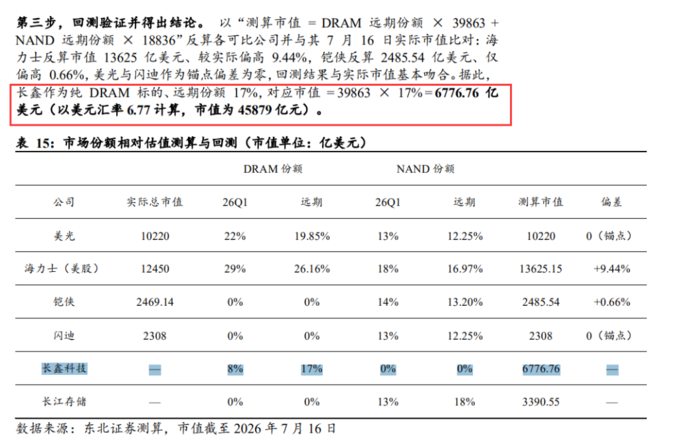
Operation: Micron and SanDisk's NAND shares happen to be equal (both at 13%), so the market value of Micron (a target company for both DRAM and NAND) minus the market value of SanDisk (a pure NAND target) equals the market value corresponding to Micron's DRAM business—$102.20 billion - $23.08 billion = $79.12 billion. Dividing this by Micron's 19.85% future DRAM share, we get that each 1% of future DRAM share is worth approximately $398.6 billion.
Conclusion: Changxin, as a pure DRAM target, has a forward share of 17% (currently around 8%), corresponding to a market value of approximately $6776.76 billion, equivalent to about RMB 45.8 trillion (calculated at an exchange rate of 6.77). After excluding the minority shareholder profit and loss ratio of about 24%, the attributable net value is approximately $3.49 trillion.
Backtesting Validation: Micron's calculated market value is overstated by 9.44%, while KnightX is only overstated by 0.66%. The results are broadly in line with the actual market values.
View Two: Earnings Split PE Valuation - Target Market Value of $2.85 trillion to $4.27 trillion
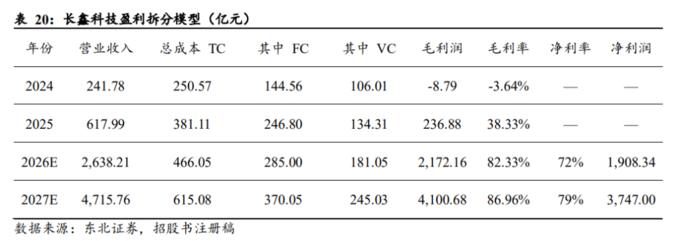
The second method is more fundamental: without relying on external anchors, directly predict Changxin's own profit. The cost structure of a storage factory is highly standardized, with fixed costs mainly in depreciation determined by the scale of capital expenditure; variable costs vary linearly with shipments. Since the prospectus does not disclose actual wafer capacity data, the calculation takes the original value of fixed assets as a proxy for capacity, multiplied by the utilization rate and production-to-sales ratio to derive sales volume, combined with ASP to obtain revenue.
Logic: Decompose revenue (capacity × utilization rate × production-to-sales ratio × ASP) and costs (fixed cost depreciation + variable cost), predict net profit, and apply a PE multiple.
Key Predictions:
· Revenue in 2027 is 471.6 billion yuan, gross margin is 86.96%, net profit is 374.7 billion yuan (overall basis)
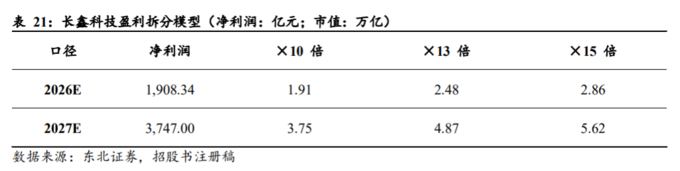
· After excluding minority shareholder profit and loss (assuming a constant 24% ratio), attributable net profit is about 284.8 billion yuan
Valuation: Northeast Securities believes that Micron and SK Hynix have a PE ratio of 7.51 times and 7.94 times in 2027, respectively, but Changxin is in a stage of rapid market share increase (the forward share is expected to reach around 30%). Given a growth premium, applying a PE of 10-15 times, excluding minority shareholder profit and loss, the corresponding market value based on attributable net profit is approximately $2.85 trillion to $4.27 trillion.
View Three: Per Unit Capacity Relative Valuation - Target Market Value of $3.22 trillion to $3.99 trillion
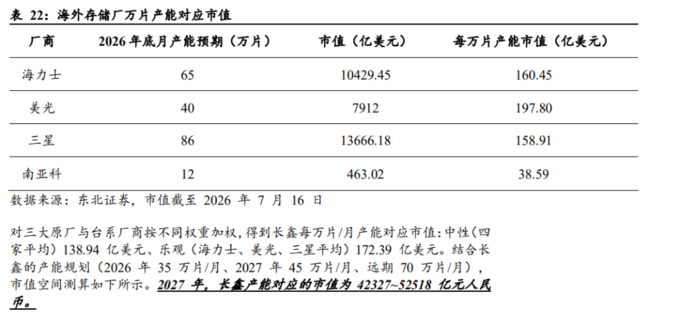
Logic: Divide the overseas memory factory's market value by monthly production capacity to obtain the "market value per 10K wafers per month," then multiply by Yangtze Memory's planned capacity.
Reference: The market value per 10K wafers per month for the three major memory manufacturers is concentrated in the $15.8-19.8 billion range—Hynix $16.045 billion, Micron $19.78 billion, Samsung $15.891 billion.
Conclusion: By 2027, Yangtze Memory's capacity will be 450K wafers per month, corresponding to a market value:
· Optimistic scenario (average of the three major manufacturers $17.2 billion/10K wafers): $5.2518 trillion
· Neutral scenario (including Taiwan manufacturers' average $13.9 billion/10K wafers): $4.2327 trillion
After excluding minority interest, this corresponds to approximately $32.2 trillion to $39.9 trillion.
Summary of Three Methods: Converging at $32 trillion to $57 trillion
Northeast Securities pointed out that by 2025, minority interest in Yangtze Memory will account for as much as 73.76%, significantly higher than Samsung, Hynix, and Micron (all less than 1%), requiring valuation adjustments.
Assuming minority interest remains at 24% in 2026 and 2027, the conclusions of the three methods are as follows: reasonable valuation after excluding minority interest impact is $32-$57 trillion.
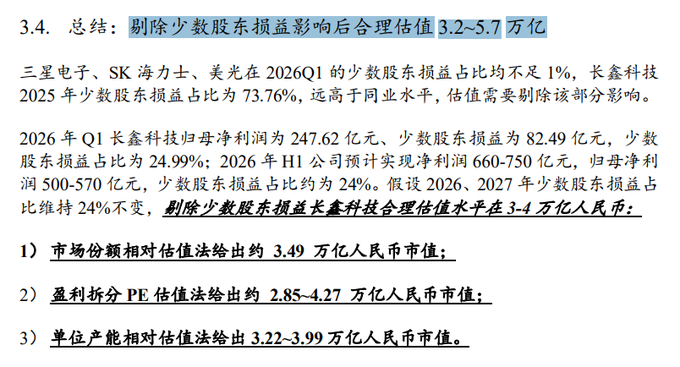
The three perspectives use different data and logical chains, but the ultimate range based on the equity method falls around $30-$43 trillion. This convergence itself is a signal: under current market share and capacity assumptions, pricing in this range is internally consistent.
Nomura Securities: Target Price of 116 Yuan, Implies 1239% Upside
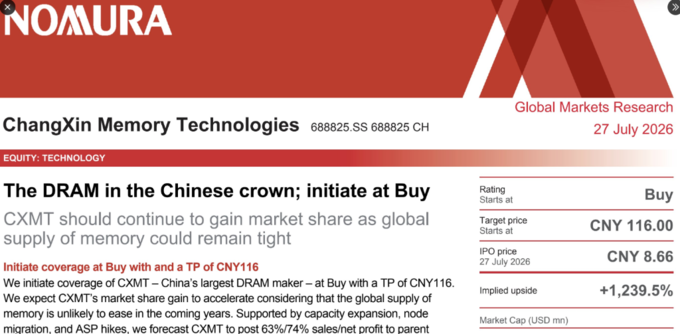
On July 27, Nomura Securities also initiated coverage of Yangtze Memory Technology with a more aggressive outlook.
The firm initiated coverage with a "Buy" rating and a target price of 116 RMB, equivalent to approximately 20 times PE—twice the valuation of Micron (around 10 times) and more than double that of SK Hynix.
Based on an IPO price of 8.66 yuan, a target price of 116 yuan implies an implied increase of 1239.5%, corresponding to a market capitalization of approximately 7.76 trillion yuan.
This number far exceeds Northeast Securities' upper valuation range of 5.7 trillion yuan, with a gap of around 2 trillion yuan between the two. Essentially, this difference is a bet on two core variables: where Changxin's market share ceiling lies and how much growth premium the market should assign to this company.
2026 is Just the Beginning! Domestic Substitution Plus AI Demand, Nomura Grants Changxin a Dual Growth Premium
Nomura's underlying logic for assigning a 20x PE premium is based on a triple judgment.
First, structural tightening on the supply side will continue for several years. The core argument of the bank is: "Global memory supply is unlikely to loosen significantly in the next few years." The capital expenditures of Samsung, SK Hynix, and Micron have shifted massively towards HBM and advanced processes, suppressing the additional supply of commodity DRAM structurally. This means that the commodity DRAM market where Changxin operates will maintain a supply-constrained situation for a considerable period of time, rather than the traditional storage cycle of "rise for two years, fall for two years."
Second, Changxin's share increase logic is "accelerated" rather than "linear." The bank believes that as Changxin's capacity continues to expand, and as the process migrates from the fourth generation to the fifth generation, the speed of its share increase in the global commodity DRAM market will exceed market expectations. The current approximately 8% market share, which corresponds to a far more extensive space in Nomura's model, clearly exceeds the 17% upper limit assumed by Northeast Securities. Nomura's implicit assumption of future market share, combined with the target market capitalization of 7.76 trillion yuan, may correspond to a market share space in the range of 25% to 30%, or even higher.
Third, domestic substitution plus AI demand grant a dual growth premium. The bank believes that Changxin is not just a target for the memory cycle but also a theme target for "domestic substitution." Chinese cloud providers and smartphone manufacturers' willingness to purchase domestic DRAM continues to rise, providing Changxin with additional incremental demand outside the global cycle. At the same time, the exponential growth in AI server demand for DRAM, with the DRAM content per server being nearly 80 times that of a smartphone, will support a long-term upward shift in ASP. With these two synergistic logics, Nomura believes Changxin should enjoy a higher valuation premium compared to overseas peers, rather than a discount.
In other words, Nomura does not consider 2026 as the peak but only as the starting point.
In terms of specific financial forecasts, Nomura predicts that ChangXin's sales revenue and net profit attributable to the parent company will increase by 63% and 74%, respectively. Key drivers include: capacity expansion from 270,000 wafers per month in 2025 to 450,000 wafers per month in 2027, the increase in the value per wafer due to process migration, and the continuous upward trend in DRAM average selling price amidst a tight supply environment. Nomura's profit forecast is more aggressive in absolute numbers compared to Northeast Securities, and the assumption of a 20x PE multiple further amplifies the final valuation result.
Supporting this more aggressive assumption is the supply and demand data: global general DRAM capacity estimates show that a supply gap will still exist in 2027; in the first quarter of 2026, DRAM contract prices surged by 93% to 98% compared to the previous quarter, greatly exceeding previous expectations; ChangXin's gross margin in the first quarter of 2026 had risen to 79.16%, with a single-quarter net profit attributable to the parent company of 24.762 billion yuan.
The intensity of the price increase cycle is real-time adjusting the input assumptions of all models.
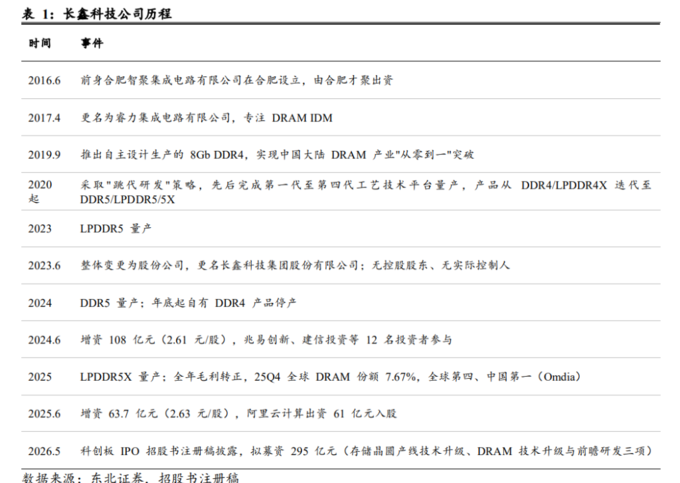
From Zero to Global Fourth Place, ChangXin Took Seven Years
In 2019, ChangXin Technology (formerly known as RuiLi Integrated) launched mainland China's first independently produced 8Gb DDR4, achieving a breakthrough in domestic DRAM production from scratch.
Seven years later, this company has become China's top and the world's fourth-largest DRAM manufacturer. According to Omdia data, in Q4 2025, ChangXin's global market share reached 7.67%.
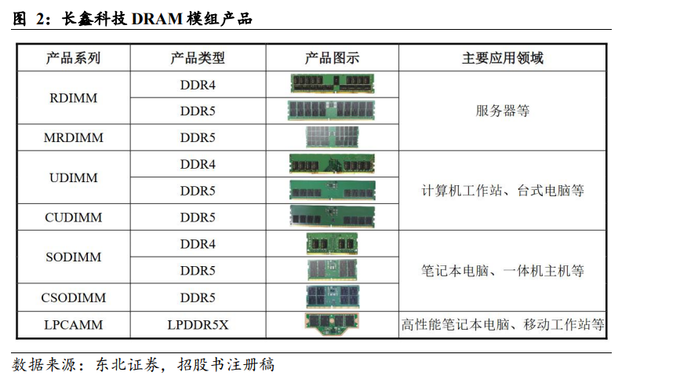
In terms of product lineup, ChangXin has covered the entire generation of DDR4/5 and LPDDR4X/5/5X, and by the end of 2024, it ceased the production of its own DDR4, fully transitioning its capacity to high-value products such as DDR5 and LPDDR5/5X. Its customers include Alibaba, Tencent, ByteDance, and the mainstream mobile phone supply chain.
In terms of capacity, the company has three 12-inch wafer fabs in Hefei and one in Beijing, with Northeast Securities expecting the capacity to expand from 270,000 wafers per month in 2025 to 450,000 wafers per month in 2027, increasing global market share from 14% to 17%.
Financial Turning Point: Remarkable Profit Elasticity in the Price Increase Cycle
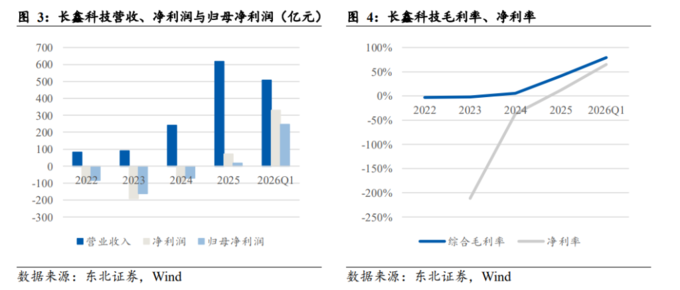
Changxin's financial path follows the typical script of a heavy asset storage fab—fixed costs in the downturn cycle lead to losses upfront, followed by rapid profit unlock in the upturn cycle.
Key milestones are as follows:
· 2025: Net profit attributable to the parent company shifts from a loss of ¥16.34 billion to a profit of ¥1.875 billion, with a comprehensive gross margin reaching 40.99%, on par with Samsung (39.38%)
· Q1 2026: Quarterly revenue of ¥50 billion (up 719% year-on-year), gross margin of 79.16%, and net profit attributable to the parent company of ¥24.762 billion
· First Half of 2026: Management expects revenue to be between ¥110 billion and ¥120 billion, with a net profit attributable to the parent company of ¥50 billion to ¥57 billion
The core driver of the profit surge is pricing. According to the latest TrendForce survey in June 2026, the contract price of mainstream DRAM in Q1 2026 surged by about 93%-98% compared to the previous quarter, far exceeding the earlier double-digit forecast range.
Northeast Securities also outlined four main risks:
1. Lower-Than-Expected Demand: AI server deployment slowdown or weak recovery in consumer electronics.
2. Periodic Price Decline: In 2022-2023, prices experienced a significant decline of up to 50% compared to the previous cycle.
3. Unexpected Capacity and Technology Iteration: If the development of the fifth-generation process platform lags, it will impact volume and price realization.
4. International Trade Frictions and Supply Chain Constraints: Geopolitical tensions may exacerbate industry chain instability.
Original Article Link
Welcome to join the official BlockBeats community:
Telegram Subscription Group: https://t.me/theblockbeats
Telegram Discussion Group: https://t.me/BlockBeats_App
Official Twitter Account: https://twitter.com/BlockBeatsAsia

 Related Articles