White House 'Stenographer to the Stars' Predicts Windfall of Over $100,000 Based on Insider Information

Original Title: "White House 'Preferred' Teleprompter Operator Makes Over $100,000 from Insiders' Tip
Recently, the White House has been hit by yet another insider trading scandal.
An employee at the White House made over $100,000 in profits from insider information in the prediction markets. This insider's true identity turned out to be a long-time teleprompter operator responsible for Trump's speeches. The employee has now been suspended and had their salary stopped.
This teleprompter operator has become the third individual, following the special forces member involved in the Maduro capture operation and a Google security engineer, disclosed by the U.S. Department of Justice to have made significant profits in the prediction markets using insider information.
Reported by Kalshi, Funds Frozen, But No Criminal Charges in the End
The main character is named Gabriel Perez, who has been in charge of operating the teleprompter during Trump's speeches since 2016. Perez's journey to this job is quite dramatic: in 2016, Trump's campaign team urgently needed a teleprompter operator, so when they searched "teleprompter" on Google, they found Perez's company, and Perez was hired by the Trump team.
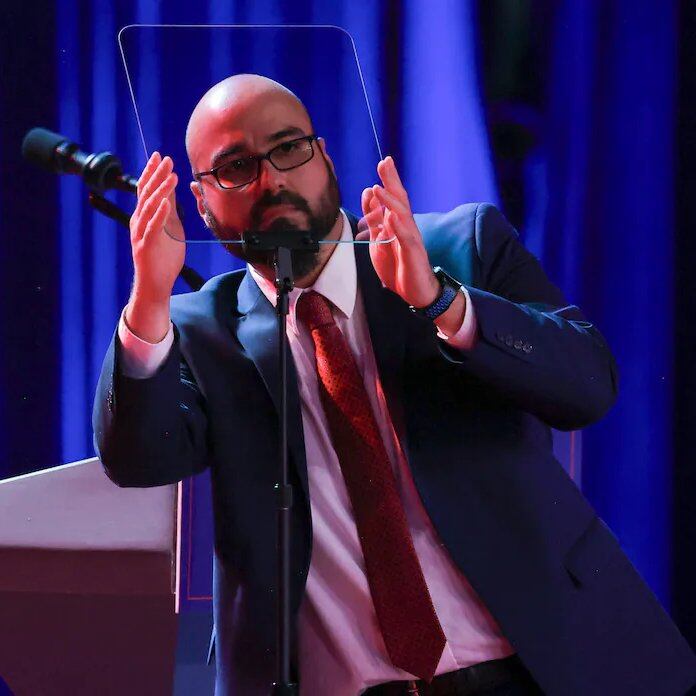
Gabriel Perez
Although Perez was hired by chance, over the course of these ten years, he gradually became one of Trump's closest aides. Politico even referred to him as "the only person Trump trusts," as he often made last-minute changes to Trump's public speeches based on Trump's personal input.
As a result, Perez became one of the few individuals who could get hold of the complete Trump speech in advance and had almost final approval over all of Trump's prepared speech drafts. This seemingly minor but substantial power earned Perez the official title of Deputy Presidential Assistant and Technical Advisor in the White House with a salary of $175,000 per year, only $20,000 less than senior officials like Chief of Staff Susie Wells and Press Secretary Caroline Levitt.
Such a salary is already considered high income in the U.S., but the greedy Perez was not satisfied.
As the prediction market became popular, with numerous players betting on which specific words Trump would "mention" in a speech, Perez realized that his "privilege" could bring him even more wealth.
CFTC investigators found that Perez placed bets on over a dozen of Trump's speeches over a period of about three months, earning a total profit of over $100,000. This included Trump's prime-time speech in December last year, his speech at the World Economic Forum in Davos in January, the State of the Union address in February, and Trump's remarks at the Medal of Honor ceremony in March.
The U.S. President's annual salary is $400,000, and with various allowances, the President can receive about $569,000 per year. If Perez hadn't been caught, at his pace of earning $100,000 in three months, although not as powerful as the President, his annual income would surpass the President's salary.
But even with prior knowledge of the speech content, Perez couldn't always successfully predict which words Trump would mention in his speeches, as Trump often goes off-script and speaks off the cuff. When Trump skipped a word Perez had bet on during the speech, Perez would immediately sell with a stop-loss. Trump himself admitted during a speech at the Detroit Economic Club in January that he doesn't look at the teleprompter 80% of the time.
Similar to encounters with Special Forces and Google security engineers, Perez's exposure also came from a voluntary report by the prediction market platform. Perez often used Kalshi for insider trading, and starting in March this year, Kalshi's monitoring system detected some unusual trades related to specific words mentioned in Trump's speeches, which is how Perez was noticed.
After an internal investigation, Kalshi promptly froze over $90,000 in Perez's account and turned it over to the Commodity Futures Trading Commission (CFTC). Upon learning of this, Trump described it as "disgusting," personally decided to suspend Perez without pay during the suspension.
Due to greed, Perez ultimately lost both the ill-gotten gains from the prediction market and his original job. But compared to the Special Forces and Google security engineer, Perez is lucky because U.S. law enforcement did not bring criminal charges against him, so Perez avoided prison.
During the investigation, the CFTC had informed the U.S. Attorney's Office in Manhattan, but the prosecutor refused to launch a criminal investigation. According to sources, CFTC regulatory officials have expressed willingness to settle with Perez and have discussed terms with him, requiring Perez to return the profits and cease such trading thereafter.
Perez is just the beginning of cleaning up the "mentioned" market insiders
The reason Perez did not go to jail is because the prosecutor believed that Perez did not commit a criminal offense, neither did he leak important government information beforehand nor did he pose a threat to national security. As Trump said, "This is just despicable," undermining the integrity of government officials.
In March of this year, the White House warned staff not to use non-public information to bet on prediction markets. White House spokesman David Engel stated, "The White House has strict ethical guidelines, and we hope all staff and officials will abide by these guidelines."
But Perez is by no means the only White House staff member who has profited from insider information, and Trump, who openly ran a paid access group, is even less qualified to criticize this teleprompter operator.
No wonder Perez couldn't resist the temptation. The "mention" market in the prediction market is indeed the easiest category to manipulate. When the cost of involvement by insiders is pushed to the very low, and the potential return is extremely high, it is no longer a moral issue but a mechanism design problem. When faced with interests, even politicians who appear respectable and stand for justice cannot guarantee that they will never cross that line.
The gameplay of the "mention" market is for users to bet on specific words, phrases, or topics that will be mentioned in a public speech. Compared to other events (such as political elections, sports events, etc.), the cheating cost in the "mention" market is very low. Not limited to people like Perez who can know the speech content in advance, cheating for the speaker is just a matter of a sentence, embodying the concept of "a slip of the tongue may reveal the truth."
At the Grammy Awards ceremony in February, when host Trevor Noah said "Welcome back to the Grammys" and then suddenly shouted "Potato," everyone was puzzled. When Trevor Noah continued, saying, "If you bet on me saying this word on Polymarket, you would have hit the jackpot," and congratulated user 'Noah 22.' However, in reality, there was no option for 'potato' in the Polymarket prediction for "What will be mentioned at the Grammy Awards ceremony," and the user 'Noah-22' was purely fictional.

Grammy host shouts potato at the awards ceremony
Some post-analysis believed this was a marketing stunt by Polymarket, but it has already demonstrated the ability of individuals to manipulate the "mention" market.
There is an even more direct example. In October 2025, Coinbase held its third-quarter earnings conference call. Just as the meeting was about to end, CEO Brian Armstrong said he found many people betting on the prediction market on what I will mention in this call, so he opened Polymarket, read out all the words according to the options, and ultimately caused all the market results to have a 100% win rate, ending in a tie.
Above are just two examples showcasing individuals mentioning market manipulation, and there are certainly many more who have actually profited from it lurking beneath the surface. However, with regulatory scrutiny on prediction markets deepening, future insiders in the "mentioning" market may also be completely purged, with Perez just being a start.
Last month, Kalshi updated its policy, requiring users to disclose their employer. Kalshi's Head of Enforcement, Bobby DeNault, explained the reason behind this move as, "If you have information by virtue of your work or your employment relationship and you have legal obligations associated with that, you are obligated not to make that information your own or use it for your gain." Polymarket has not yet imposed such strict disclosure requirements on users, but in the increasingly regulatory-driven prediction market race, it is believed that Polymarket's stricter compliance requirements are also on the way.
From a Special Forces soldier to a Google engineer to a White House teleprompter operator, the prediction market is gradually purging insider trading. At the same time, the market is also undergoing a demystification of the prediction market. What was thought to reflect collective wisdom here is actually just an ATM for a few insiders.
While the crackdown on insider trading will make prediction markets more compliant, it also distances them from the truth and brings them closer to being just a pure casino.
Original Article Link
Welcome to join the official BlockBeats community:
Telegram Subscription Group: https://t.me/theblockbeats
Telegram Discussion Group: https://t.me/BlockBeats_App
Official Twitter Account: https://twitter.com/BlockBeatsAsia

 Related Articles