Base Acknowledges Pivoting in the Wrong Direction: Abandoning Social Features to Return to the Financial Core

Original Title: "Base Abandons Social Direction, Founder Acknowledges Strategic Failure"
Original Author: Wenser, Odaily Planet Daily
Base, long regarded as the "L2 King," has officially announced the end of its 3-year "Exploration Era."
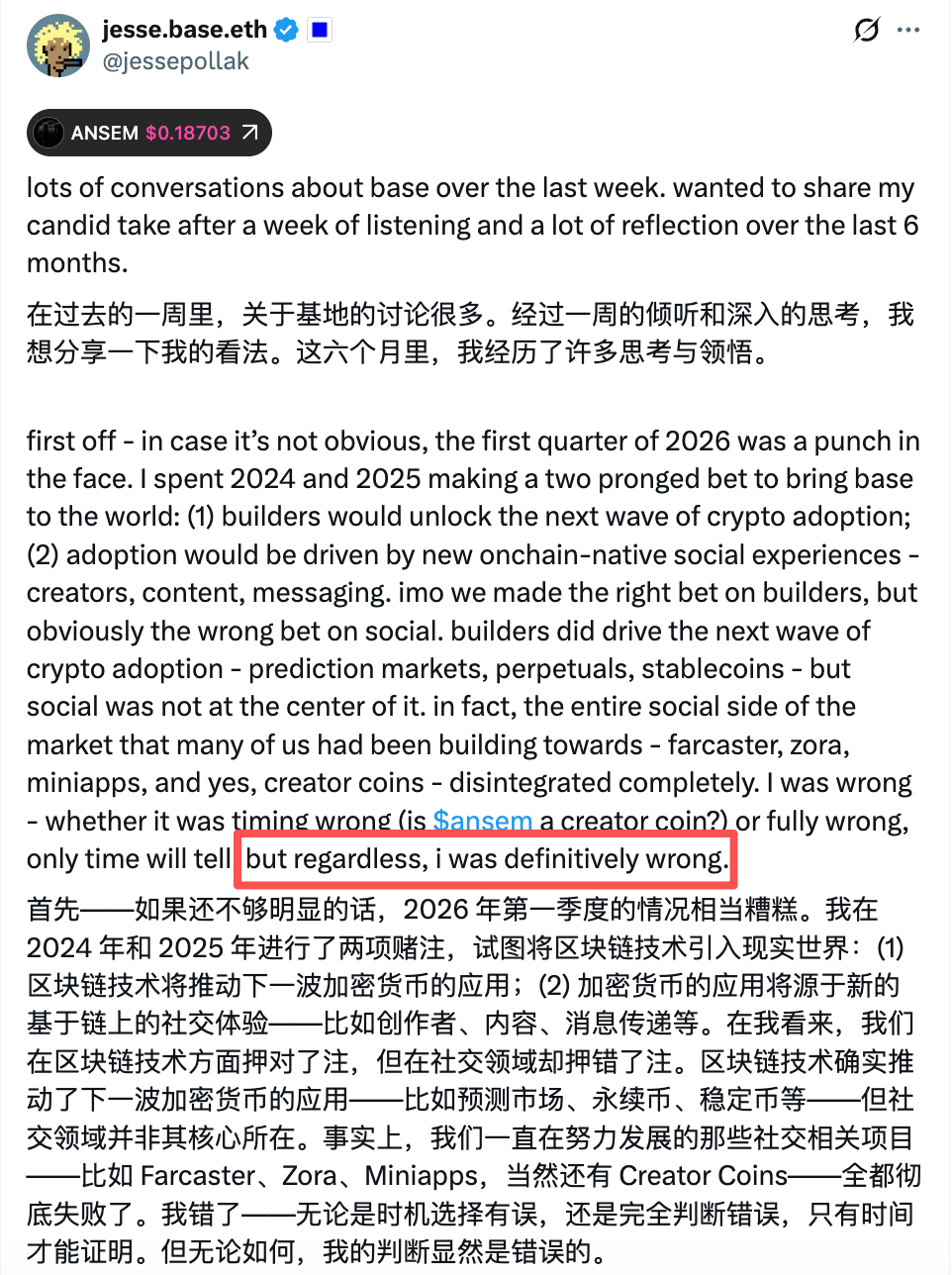
Early this morning, Base co-founder Jesse Pollak published a post reviewing the ecosystem's development direction over the past two years, admitting that their previous bet on on-chain native social interactions was a mistake. He stated that initiatives such as Farcaster, Zora, Miniapps, and Creator Coins failed to become a core driver of crypto adoption. As a result, Base has lagged behind some competitors in fields such as perpetual contracts, prediction markets, tokenization, and payments. Additionally, he emphasized that the Base APP will be handed over to community leader Cobie, who was acquired by Coinbase for a substantial sum.
Prior to this, Coinbase CEO Brian Armstrong also admitted that "content tokenization was a mistake" in response to community concerns.
In the year 2026, Base, which had repeatedly wavered on the token issuance issue, has reluctantly encountered its own awkward developmental phase, perhaps once again reaffirming a truth - no transactions, no crypto.
Base Transformation: Founder Focuses on Coding, All-in-One APP Handed Over to Coinbase Team
Let's first focus on Jesse's "Base Ecosystem Self-Blame Proclamation."
In this lengthy article, Jesse first admitted his mistake - although he bet on blockchain technology to drive the success of crypto applications, he mistakenly bet on enhancing the social experience to drive crypto applications in specific areas.
Looking back, the Base ecosystem has always seemed to be in a state of "self-indulgence" -
· Regarding its leadership, Jesse always emphasized the "creator economy," consistently interacting with community members under the banner of the creator economy, encouraging all creators to issue tokens, mint NFTs, claiming that the "on-chain creator economy will rewrite industry development." However, the reality is that the on-chain creator ecosystem of the Base ecosystem is extremely harsh, with the earnings of most creators not even comparable to developers issuing trendy tokens on pump.fun;
· In terms of development strategy, Base has always held the title of the "Onchain Summer," but the reality is that Base has always followed a strategy of trailing behind Solana and BNB Chain. When the Solana meme coin craze arrived, Base also played with meme coins; when BNB Chain's Chinese meme coins gained popularity, Base quickly took the opportunity to imitate. Previous collaborations with physical brands like McDonald's often ended up as superficial marketing activities, lacking actual follow-through.
· In terms of transaction activity, previous data indicated that over 80% of the on-chain activity on Base was generated by a few addresses engaging in wash trading, with very limited real user engagement; even transactions in areas such as x402 promoted by Coinbase and AI Agent payments have struggled to achieve a significant breakthrough, remaining in a self-contained state.
The failures of SocialFi platforms like Farcaster and Zora have long been evident, with the former's founder moving on to work on payments at Tempo; the latter, after launching its token, can be considered to have "completed its mission," but the token has since experienced a drop of over 80%.
Jesse's vision of "bringing cryptocurrency to billions of people worldwide through social media" has not materialized, after all, Web2 social media products are as numerous as hairs on an ox, not to mention a series of giant products that already have better user experience, more first-mover advantages, and richer creator content.
Many times, you may think you are participating in memes, creating jokes, and engaging with a community, but in reality, you are building your own echo chamber, artificially creating small circles, and deliberately increasing entry barriers.
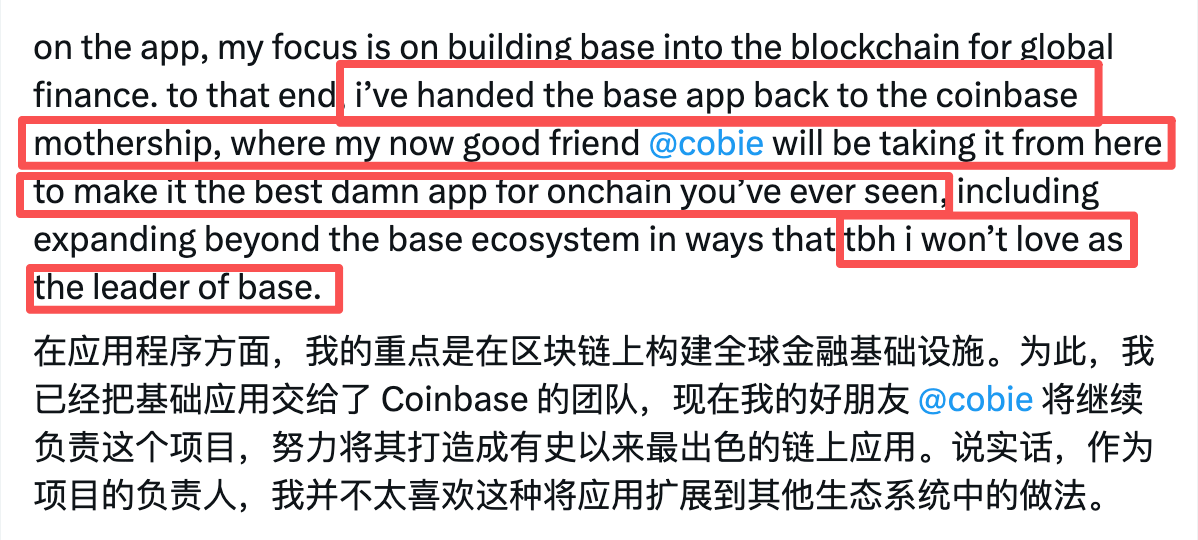
The decision to entrust Coinbase's team with the flagship product Base APP within the ecosystem is more like allowing the Base ecosystem to return to Coinbase's embrace, accepting the latter's unified arrangement, existing as part of the Coinbase ecosystem and a certain segment. This action has to some extent expanded the openness of Base APP, naturally making Base APP no longer exclusively part of the Base ecosystem.
For blockchain projects, focusing on finance, transactions, and investment is still the industry's main theme. Platforms like on-chain Perp and prediction markets that have surged in popularity over the past two years have accurately tapped into this trend, even benefiting from high volatility and high-risk market conditions to earn more protocol and platform revenue.
Recognizing this, Base has finally seen the light, no longer fixating on "decentralized social networking" or the "creator economy," but instead shifting its focus to three main directions—transactions, payments, and AI Agent.
Base Enters a New Era: Focusing on Transaction, Payment, and AI Agent Development
To err is human; to forgive, divine.
Despite Base's previous missteps, it is now apparent that Jesse, along with Coinbase CEO and others, have recognized the issues and proposed their own solutions.
Previously, Brian Amstrong responded to community queries, stating, "**Base's main business focuses on trading, payments, and AI Agent services (in that order). I believe these three are closely intertwined.** For example, conducting a payment transaction requires foreign exchange resources; and agent services involve a large amount of trading and payment business. By the way, most of the resources are currently used for trading business. Perhaps these businesses have not yet been deployed for external applications, but that is indeed the current situation."
In a lengthy post today, Jesse also stated that in the future, Base will be positioned as the "blockchain of global finance," with a focus on trading, payments, and AI Agent by 2026. Among them,
· Trading will cover tokenized stocks, meme coins, and application tokens;
· Payments will revolve around global stablecoins for individuals and businesses;
· The AI Agent will leverage cryptocurrency as the native currency of computers, serving future large-scale machine economic participants.
The future business focus of Base is not just talk, but rather the relative best choice based on current industry trends and its own strengths.
In terms of trading, despite Base's limited active user base, its low gas friction costs, Ethereum ecosystem layer, and the backing of Coinbase's U.S. regulatory background ensure its infrastructure-level advantage and value in the development of tokenized stocks, meme coins, and legitimate projects;
Regarding payments, Base's low interaction costs, x402 protocol foundation, and support for USDC under Circle also lay the foundation for individual and institutional payments, stablecoin adoption, and with apps like Base APP, a "one-stop application," it is expected to drive widespread stablecoin adoption in the U.S. and globally if it can onboard more supply-side brands, merchants, and institutional users in the future;
As for AI Agent services, this step is more like an early layout for the future AI Agent economy. Although AI Agents are still in the early stages of development, based on recent news such as OpenAI's GPT 5.6, Anthropic's Fable 5 model, and Apple's AI slated cooperation partner for Alibaba's Thousand Questions model, the day when AI Agents will extensively conduct payments, transactions, and consumption using cryptocurrency is quickly approaching. Previously, according to official Alibaba news, as of May this year, Alipay AI self-service order payment has completed a cumulative total of 300 million transactions (covering AI smart agent payments, AI orders, AI consumption, and other scenarios fulfilled through AI applications like Thousand Questions, Rokid, etc.).
Of course, the change in Base's strategic direction also brought about changes at the personnel level behind this large organization, Coinbase.
Coinbase Organizational Personnel Changes: Some Exit, Some Continue Coding
Previously, Coinbase's Engineering Lead, Brock Miller, publicly announced his departure and has since joined Anthropic as a member of the technical team. As the cryptocurrency industry is no longer at the forefront, some have chosen to join the AI revolution.
In early July, Coinbase's Chief Legal Officer, Paul Grewal, announced his resignation and will be moving to a startup. He added, "I will continue to serve as an advisor to Coinbase and participate in Coinbase's Trust Charter work through the US Office of the Comptroller of the Currency." Subsequently, Coinbase announced that Molly Abraham will lead the company's legal team as General Counsel, and Ryan Van Grack will serve as Vice Chair, expected to take on broader and more public-facing responsibilities.
This is a case of someone who has resigned but will continue to collaborate with Coinbase.
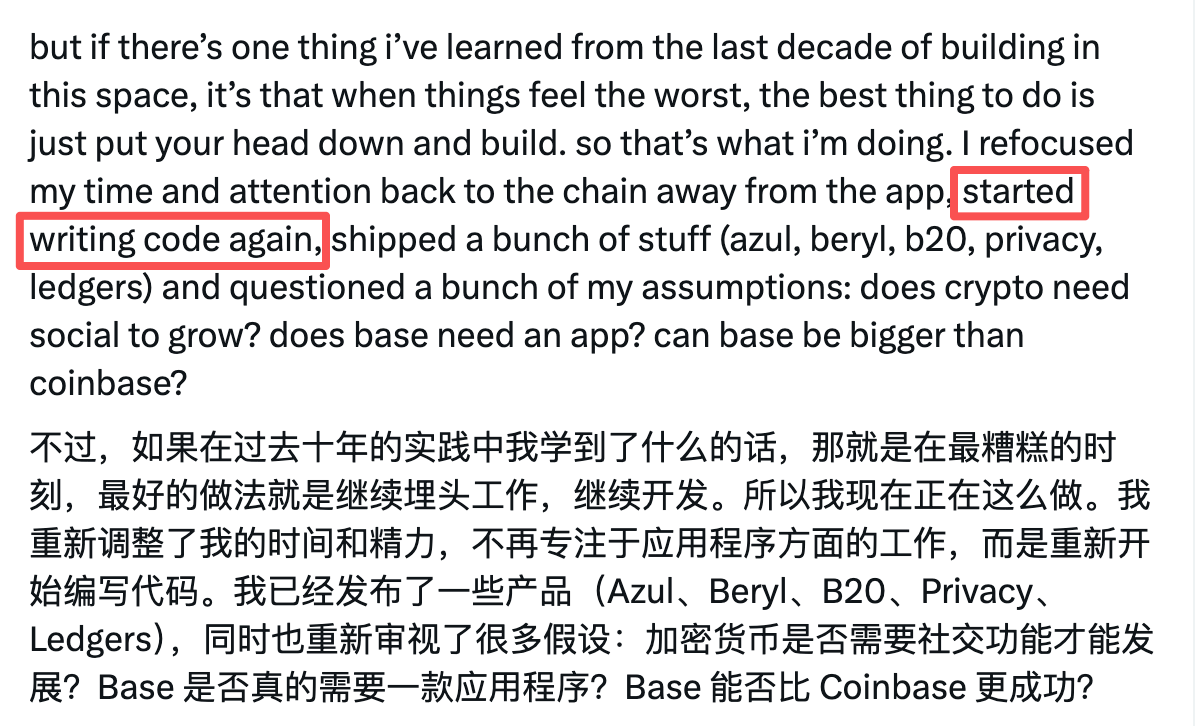
As for those who continue to code, it is none other than Base's founder, Jesse — he stated, "I have started coding again and have launched some products."
Certainly, the departures or changes of the aforementioned individuals may not solely reflect their own will, but also signify the impact of AI Agent development.
Recently, Coinbase's Platform Lead, Rob Witoff, stated that over 95% of the company's code is currently written by AI or completed with AI assistance, a significant increase from the previously disclosed 40% ratio in February of this year. In an interview, he mentioned: "In fact, 100% of Coinbase employees use AI every day." He stated that most Coinbase engineers currently run between 5 and 10 AI Agents simultaneously. The collective operational capacity of these AI Agents is equivalent to about 1200 employees.
He anticipates that by 2030, Coinbase's AI Agents may undertake work equivalent to 100,000 employees. However, he noted that core cryptography and other key areas still require human involvement, with AI primarily used for code testing, vulnerability checks, and prototype development.
Not only is the Base ecosystem poised to serve the AI Agent economy in the future, but perhaps a majority of Coinbase's employees will also be replaced by AI Agents.
Original Article Link
Welcome to join the official BlockBeats community:
Telegram Subscription Group: https://t.me/theblockbeats
Telegram Discussion Group: https://t.me/BlockBeats_App
Official Twitter Account: https://twitter.com/BlockBeatsAsia