Will Micron's ADR Premium Convergence Start with Swapping Soon?
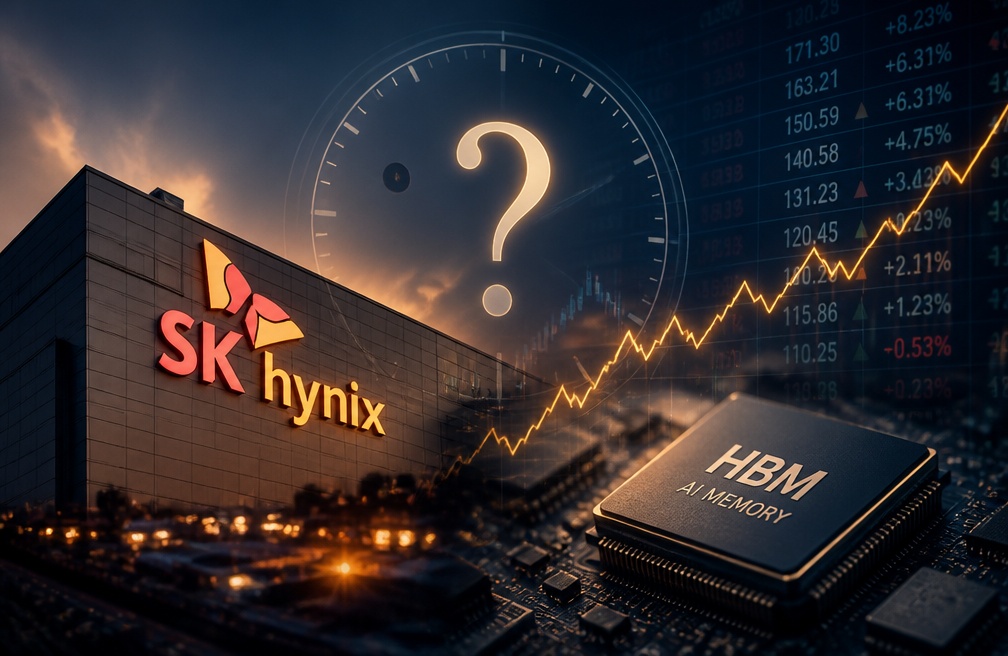
The Korea Securities Depository (KSD) will accept applications for the exchange of SK Hynix common stock and ADR. The specific acceptance time is still pending Citibank's notification.
The most important outcome of this news is that the premium on Hynix's ADR may shrink.
During the initial listing of SK Hynix's ADR, an extreme premium of about 50% was observed. This was a reading of concentrated pursuit of U.S. side holdings while ADR and common stock were not yet exchangeable. The current premium of Hynix's ADR to the Korean common stock is still over 30%.
On July 29, this channel was opened.
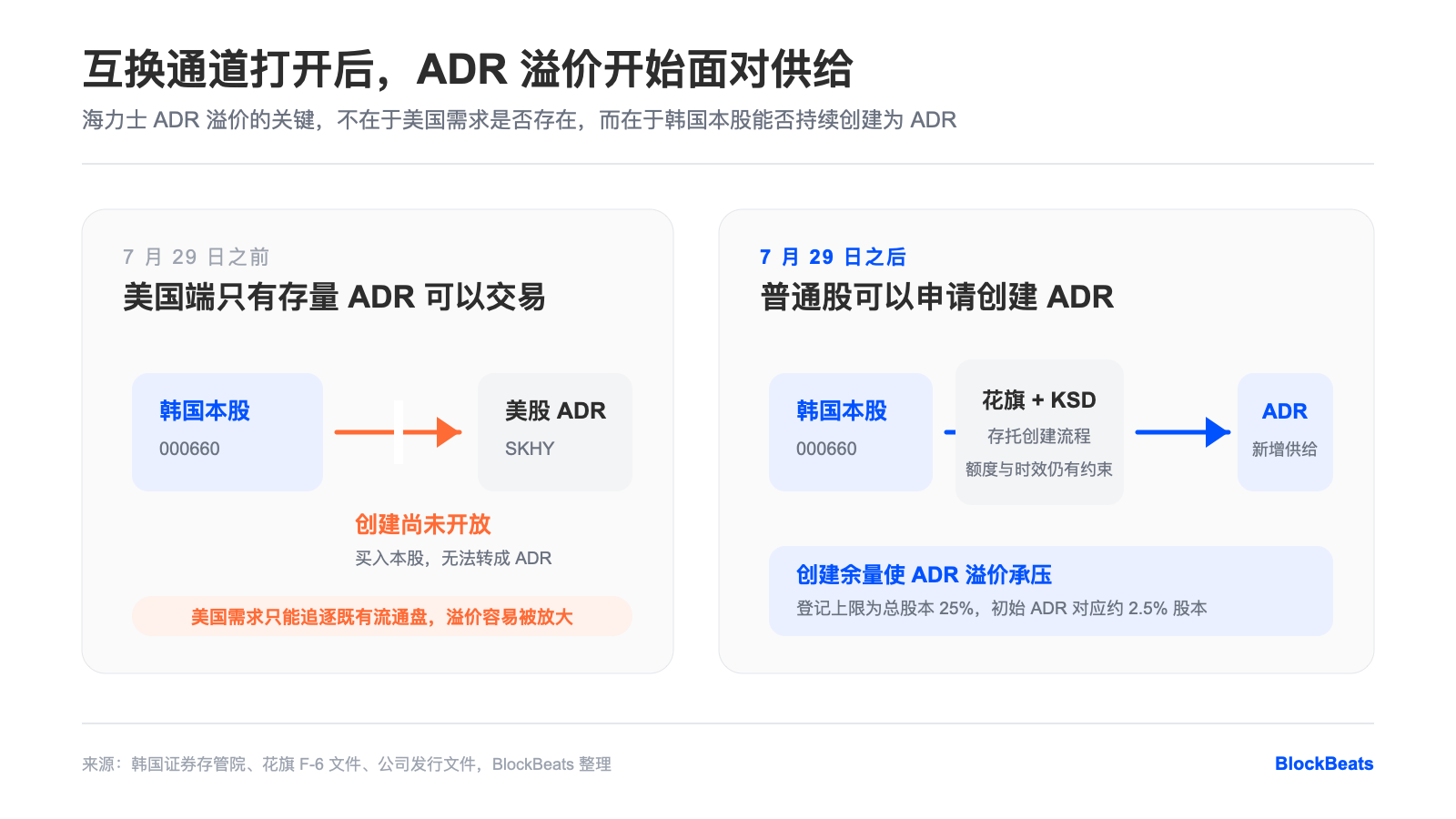
For individual investors, this is not just a button in the trading software. It involves application through a securities firm, custody, foreign exchange, and settlement. However, the market does not need every retail investor to press this button. As long as a group of institutions can do it, the price will start to move.
Reference to TSMC's Logic
Taking TSMC as an example, the ADR premium can persist for a long time. In 2024, quantitative asset management firm Acadian Asset Management noted a roughly 20% premium of TSMC's U.S. ADS compared to Taiwan's common stock. The issue is not in calculation. Everyone knows the corresponding relationship for the same equity. The issue lies in whether common stock can quickly, inexpensively, and infinitely convert into U.S. ADS.
TSMC's experience shows that ADRs can be canceled into Taiwan common stock, but the creation of common stock into ADS is limited by approved total quantities and cross-market friction. The door may be open, but it doesn't mean the elevator has arrived. Arbitrageurs, even knowing that the spread will eventually revert, also face risks such as borrowing, settlement, capital occupation, and the continued widening of the spread.
Hynix was more extreme than TSMC before the 29th. Common stock could not create ADRs, and U.S. demand could only chase the existing ADR float. The premium was driven up, not necessarily by a new story.
After the 29th, the core constraint will shift to quotas and processes, rather than being completely un-creatable. The ADR custody limit registered by Citibank in the F-6 document is approximately 25% of Hynix's total shares outstanding, with the initial issuance this time corresponding to only about 2.5% of the share capital. This remaining capacity is not guaranteed to be immediately available, but it is enough to illustrate that the quota is not temporarily welded shut like a wall.
Once institutions can continuously buy Korean common stock, create ADRs, and sell them in the U.S., the extreme premium will encounter new supply. U.S. demand may still be strong, but it will no longer be confined to mutual price increases in existing ADRs.
This is also why the current over 30% premium is more likely to converge after the 29th.
How Traders Arbitraged Before the 29th
The conversion rate for Hallyuwood was 1 share of Korean common stock to 10 ADRs. When calculated synchronously, the ADR premium is equal to the Hallyuwood ADR price × 10 × USD to KRW exchange rate ÷ Korean onshore stock price - 1.
Before the 29th, the more realistic positions in the market were concentrated between the decentralized perpetual trading platform Hyperliquid's SKHY and SKHX perpetual contracts and the two stocks.
When the funding rate is positive, longs in perpetuals pay and shorts receive. When the rate is negative, it's the other way around. Settlement occurs hourly.
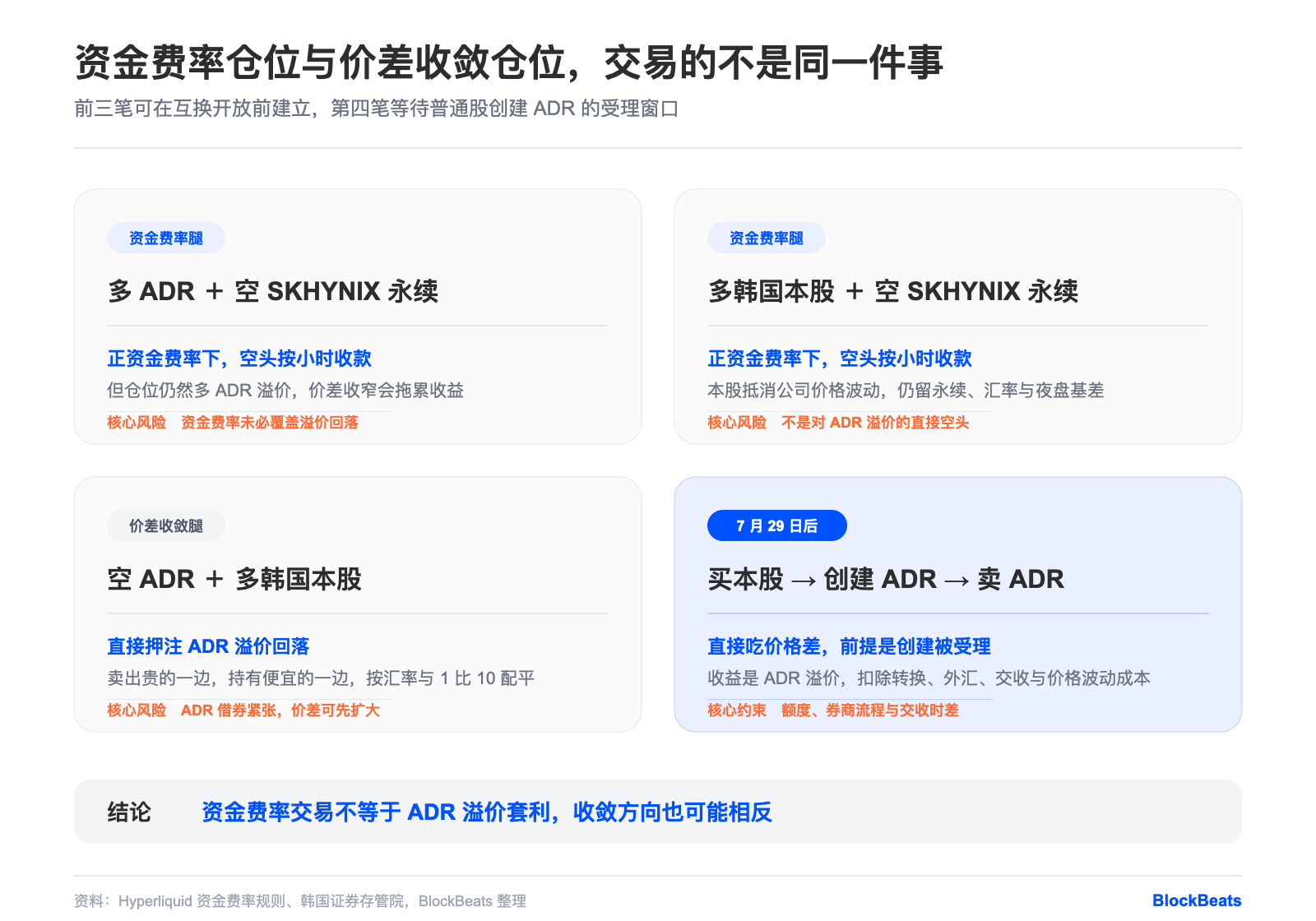
The first strategy is long ADR, short SKHY perpetual. Essentially buying SKHY and then shorting a nominal amount of perpetuals on Hyperliquid. During a positive funding rate, shorts receive payments hourly. This trade seems to be taking advantage of the funding rate but actually retains exposure to the ADR premium. Profits are made as the ADR premium continues to expand. If the spread narrows after the 29th, the funding rate may not be enough to cover these losses.
The second strategy is short ADR, long onshore stock. This is a direct bet on spread convergence. It's akin to the TSMC-style old issue of shorting the expensive side, buying the cheap side, and waiting for the market to reroute. The risk is also similar to TSMC. The spread may take another leg before truly converging.
The third strategy is long Korean onshore stock, short SKHY perpetual. Buying onshore stock at a Korean brokerage and then shorting the perpetual on Hyperliquid. With a positive funding rate, shorts incur fees, but the long stock position hedges most of the company's stock price volatility. This approach is more akin to funding rate trading rather than ADR premium trading. It's also not a truly risk-free position. Perpetuals trade 24/7, Korean stocks do not. Index, mark price, USD to KRW exchange rate, and margin can all leave basis.
This is also why the trading volume of the two contracts SKHY and SKHX on Hyperliquid can exceed Bitcoin.
Welcome to join the official BlockBeats community:
Telegram Subscription Group: https://t.me/theblockbeats
Telegram Discussion Group: https://t.me/BlockBeats_App
Official Twitter Account: https://twitter.com/BlockBeatsAsia

 Related Articles