Is the Price of Robinhood Coin Worth Watching?
Two days ago, $CASHCAT briefly approached a high point of a $2.3 billion market cap, but has now retraced to a market cap of around $1.5 billion, a drop of nearly 35%.
As $CASHCAT retraced, the on-chain market on Robinhood started to show signs of chaos and cooling off. Yesterday, $1 saw a rapid surge from a market cap of around $800,000 to approximately $15 million due to news of a suspected buy-in from the Robinhood CEO's address. However, this news was quickly debunked, and the coin has now plummeted to just over $1 million in market cap.
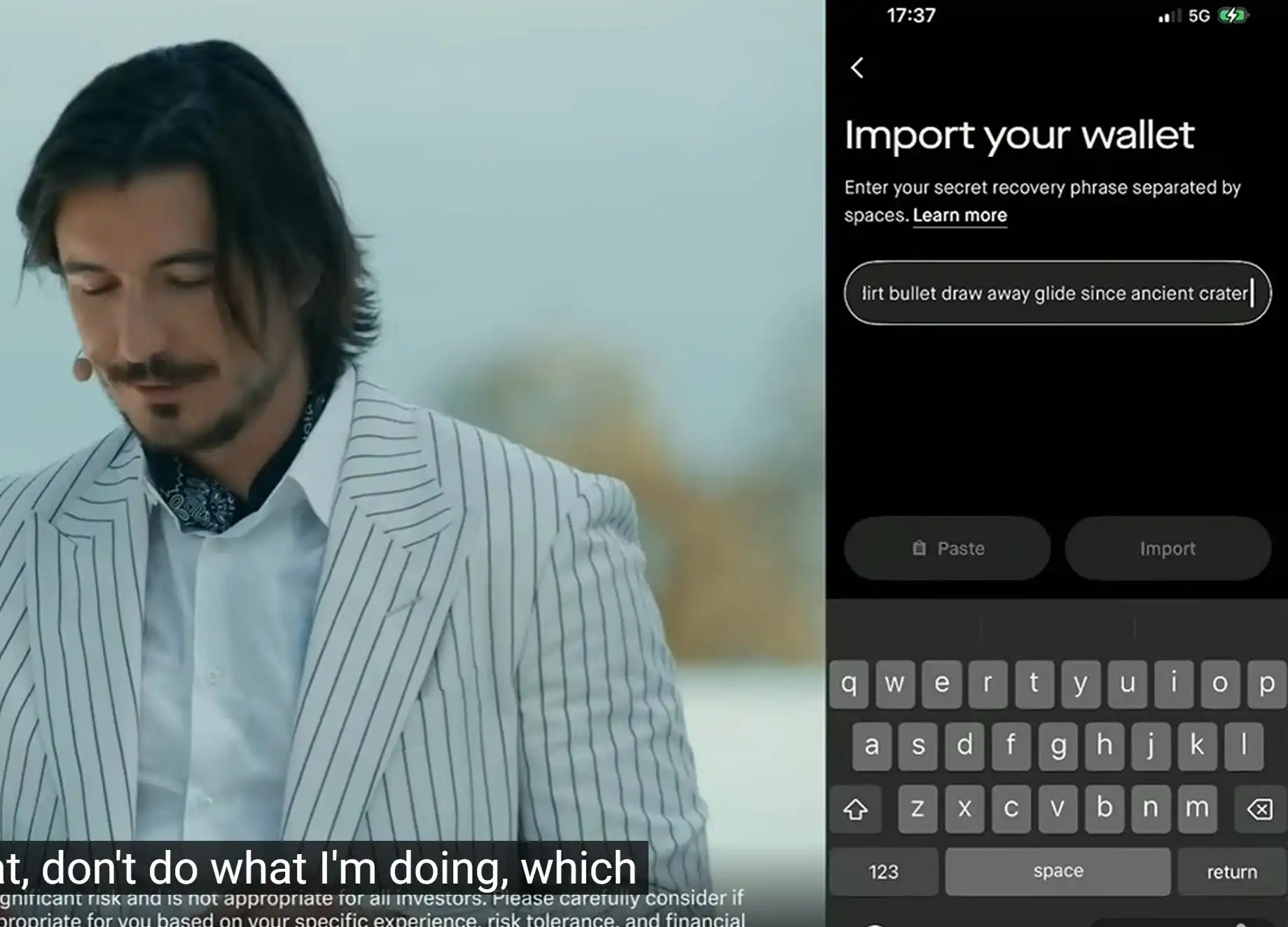
The address was previously used by the Robinhood CEO in a live demonstration where he inadvertently revealed 9 out of the 12 mnemonic words. Due to the partial mnemonic leak, the address was compromised a year ago.
Another coin that experienced extreme volatility yesterday was $SCATMAN, as hackers took over SpaceXAI's official Twitter account, added an emoji to the X address of this coin mocking Sam Altman, and retweeted the post. At its peak, the coin's market cap exceeded $2.5 million, but it is now worth less than $100,000.
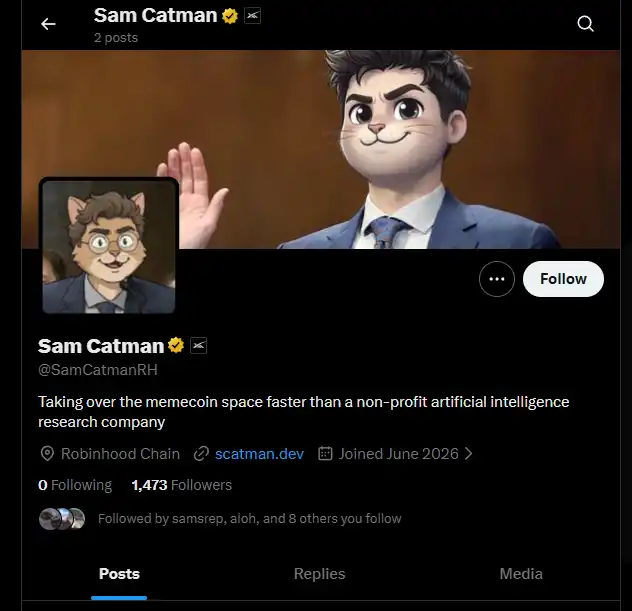
Due to $CASHCAT's retracement, the overall sentiment on the Robinhood chain has already seen a decline. Coupled with incidents such as the "suspected wallet buy-in" and a hacker stealing a social media account to perform a rug pull, which are seen as "doomsday signs," some players have begun to proclaim the "end of the Robinhood market."
Is it really over? To answer this question, we need to look back at several market movements this year to provide short-term and long-term answers.
Short-Term: Normal Retracement
If we reflect on the most direct catalyst for $CASHCAT's surge, one of them was a tweet from Robinhood CEO Vlad Tenev:
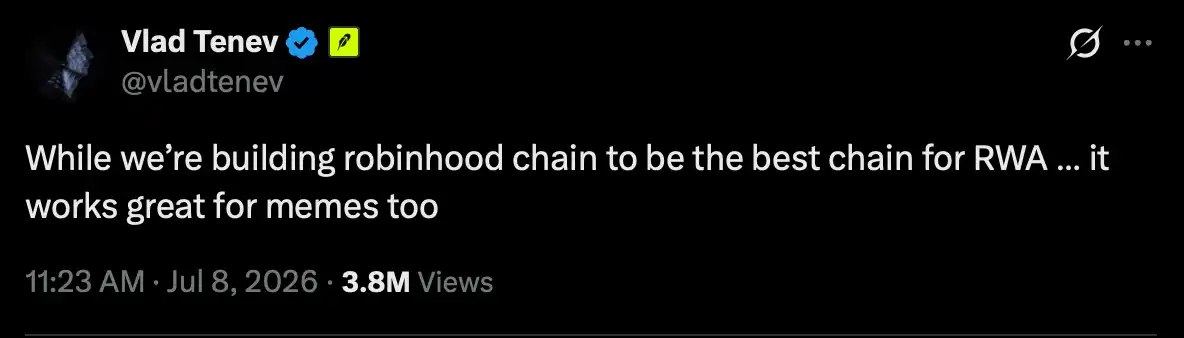
"As we build Robinhood Chain to be the best RWA chain, it's also great for memes."
Also on the morning of July 8, Vlad followed the official $CASHCAT Twitter account on X, causing the coin to skyrocket from a $10 million market cap to nearly $50 million market cap instantly, and it continued to rise.
Both of these catalysts were indispensable. One conveyed the attitude of "Robinhood CEO supporting meme coins on their own chain," while the other conveyed that "CASHCAT is the Robinhood-appointed flagship."
Going back to July 2, when the Robinhood mainnet had just launched, some players were paying attention to this new chain, but not many. Everyone was mainly following the logic of "mining on a new chain." No one could have anticipated that in less than a week, the Robinhood CEO would personally intervene and raise everyone's expectations to a very, very high level.
Due to this "from underground to the sky," completely unexpected change in expectations, the market began to set new expectations for the Robinhood chain's market performance, and set them high. For example, "the Robinhood chain can bring retail stock traders onto the chain," "Robinhood on CASHCAT can replicate what happened with DOGE and SHIB," and so on. $CASHCAT's rapid surge only intensified the market's FOMO sentiment.
However, this day's market also planted some hidden dangers. The danger lies in the fact that apart from $CASHCAT, there was no very obvious second leader, which easily reminds us of the situations in other market trends this year:
"Space Dog" leading the ETH mainnet market trend with $ASTEROID, without a second leader, but fortunately, there were Uniswap v4 hook narratives like $UPEG, $SATO as supplementary targets for the market.
The $ANSEM-led Solana market trend, without a second leader, only related targets around Ansem were able to gain some price appreciation.
In these two market trends, everyone hoped that the flagship could reach a $1 billion market cap, and then the liquidity would overflow to other narratives, expanding the scope of PvE targets. However, this was not achieved. The main reason was still the lack of on-chain capital, a $1 billion market cap is as rare as hen's teeth in the current market environment. Secondly, the explosive rise of these flagship targets all stemmed from sudden attention events. "Space Dog" was because Musk promised to use it as a mascot for SpaceX, and $ANSEM was because Ansem himself claimed it. The rise was due to attention-grabbing events, and subsequent increases would require even larger events to drive them. However, these two targets have not experienced any more attention-grabbing events that could catalyze FOMO.
The nature of the market being driven by "arbitrage" rather than "HODL" is due to the unsustainable and non-amplifiable nature of attention events. When almost all active players on the chain rushed to Robinhood's chain to strike gold, everyone delved into Robinhood's tweets, trying to decipher them from various angles. This situation, where everyone explored Robinhood's CEO's replies to tweets, his favorite meme image $JUGGERNAUT, the $GME market that Robinhood "pulled the plug" on in the past, and the $WALLET allegedly deployed by Robinhood employees, actually reflects the spreading sentiment of being left out of the $CASHCAT, reminiscent of the rush for salt in supermarkets following a past Japanese nuclear leak. Whether the salt was needed or not, people grabbed it first and thought later — if it's useful, then great; if not, then it's not.
Everyone is now chasing the next target that Robinhood may interact with, betting on the unknown. This vividly demonstrates that the current meme coin market is essentially an "attention prediction market." The short-term pullback is understandable as the leader $CASHCAT experienced a retreat, and Robinhood had no further statements that could incite everyone to frenzy. Targets with a "conspiracy" behind them, such as $JUGGERNAUT and $HOODRAT, failed to break through and stabilize at a $20 million market cap, indirectly confirming that, up to now, there isn't much difference between the Robinhood chain market and the markets of $ASTEROID and $ANSEM.
At this stage, aside from the "conspiracy" setups, targets that can relatively maintain stability are also likely to be interacted with by Robinhood from a longer-term perspective. For example, $GME, maintaining a market cap range of $2-3 million, is expected to be mentioned by Robinhood again in the future with a high probability, or events such as GameStop's stock price movement or the sudden return of the roaring cat could trigger another surge. Another example is $JUGGERNAUT, given that the Robinhood CEO mentioned it as his favorite meme image. If he mentions it again, a substantial uptrend is likely to be triggered once more.
However, such setups are very "left-field," betting on potential attention without any connection to the traditional meme coin community building. This includes expectations of Robinhood continuing to support the meme coin ecosystem or launching its own meme coins on-chain in the future; all of these are premature and overly optimistic. Nevertheless, it is through such optimism that massive profits like those of $CASHCAT can be obtained. If you don't buy a lottery ticket, you won't win.
Long-Term: The Presence of Competition Brings Anticipation
The end of the "Dogecoin" trend sees players returning to Solana. After a brief "altcoin season" on BSC, everyone is back to Solana. Solana's dominance in the meme coin market has somewhat reached the level of user habit, where engaging in meme coins means heading to Solana, becoming a habit or even a culture.
Due to this foreseeable competition, Robinhood, this nascent chain, now carries a tantalizing long-term expectation: "What if the Robinhood chain becomes the next Base, surpassing Solana, and triggers a full-blown meme coin bull market on its platform?"
This scenario is not entirely implausible, especially considering the current trend of stock meme-ification, with Robinhood being the very epicenter of the retail investor craze, particularly during the GameStop event. Their user base inherently includes a segment of stock investors who are accepting, accustomed to, and even enjoy meme-ified trading. If the $GME meme coin on the Robinhood chain experiences a continuous surge, coupled with channel outreach to traditional investors, a situation akin to this could potentially onboard users and funds to the chain.
Meme coins, or rather trading around memes, are the way forward. Both positive and negative news revolve around market sentiment, with meme coins making all of this more direct and entertaining. As the market expands, memories of congestion, scams, and other negatives will naturally fade away because players will no longer need to compete for resources in a limited pool.
The long-term expectation for the Robinhood chain is a reflection of the company's enduring and deep support for meme coins, as well as the anticipation for meme coins to attract a broader audience.
Welcome to join the official BlockBeats community:
Telegram Subscription Group: https://t.me/theblockbeats
Telegram Discussion Group: https://t.me/BlockBeats_App
Official Twitter Account: https://twitter.com/BlockBeatsAsia
 Related Articles