Micron Technology Plunges: Earnings Outlook Revised Downward, Is High Valuation Justified?

TL;DR
· According to Korean media citing a KIS report, SK Hynix's future profit forecast has been lowered, but the target price remains unchanged.
· Market consensus is focused on how much profit flexibility the HBM long-term supply contract will constrain.
· Related Tickers: SK Hynix, Samsung Electronics, Micron, NVIDIA, KOSPI Semiconductor Index.
The adjustment of SK Hynix's earnings model by Korean investment firm KIS is causing the market to reassess the pricing foundation of AI memory transactions. According to Korean media citing a July 13 KIS report, SK Hynix may fall below second-quarter profit consensus due to long-term pricing and supply agreements, rather than AI demand weakening.
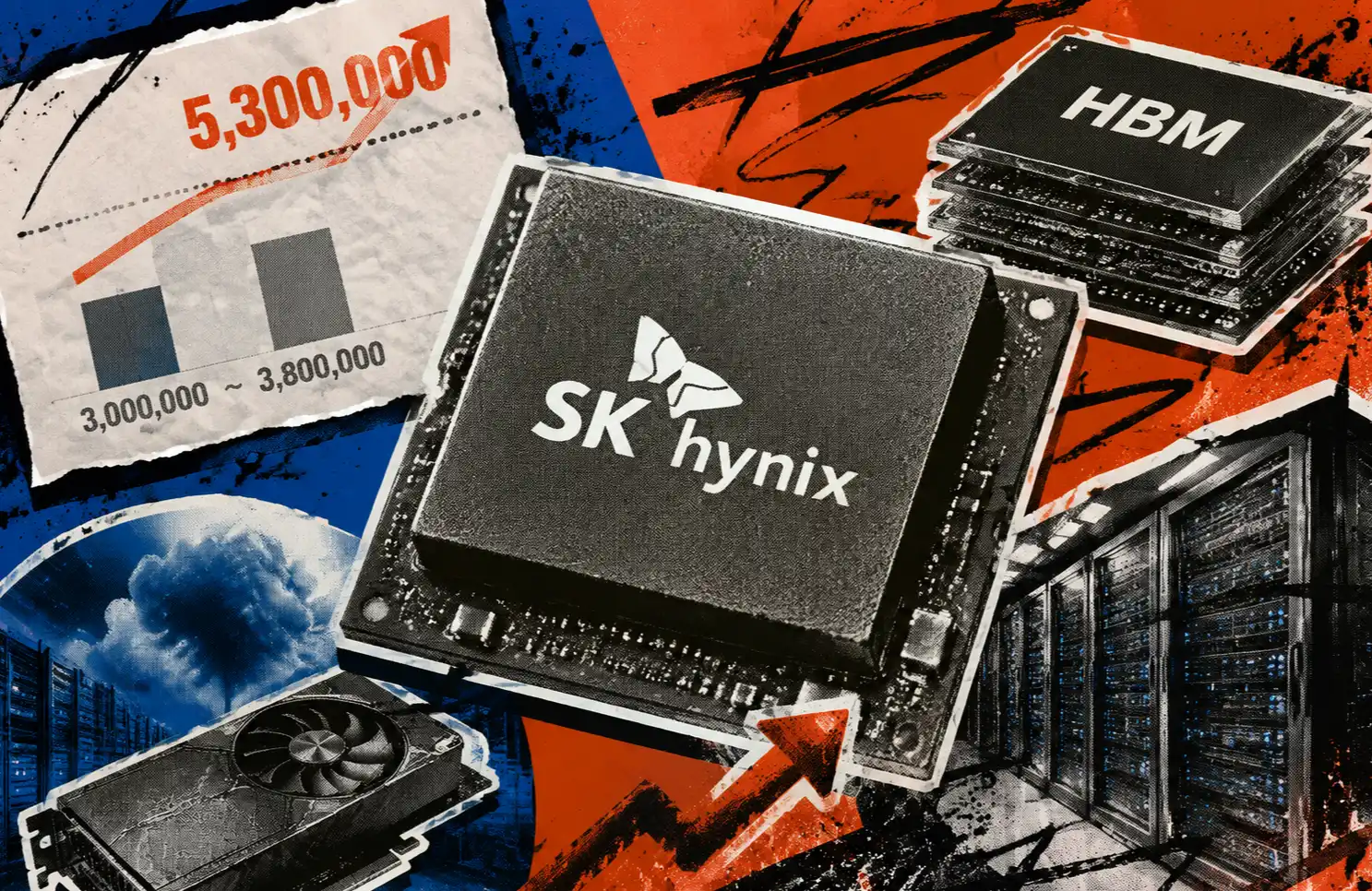
This is not actually a demand peak. The core change at KIS is not a bearish view on HBM (High Bandwidth Memory) demand, but a belief that the future profit release mechanism needs to be reevaluated. As per the media-cited caliber, KIS has lowered SK Hynix's operating profit forecasts for 2026 and 2027 while maintaining a target price of 3.8 million KRW.
For investors, the question is no longer whether SK Hynix can continue to make money, but whether it can sustain the continuous profit upgrades as seen in previous models. AI memory is still scarce, but the scarcity dividend may be already factored into prices and capacity arrangements through multi-year contracts.
Profit Downgrade Doesn't Point to Demand Collapse
The contradiction in KIS's adjustment this time is that profit forecasts are lowered while demand remains strong. According to the report cited by the media, KIS has reduced SK Hynix's 2026 and 2027 operating profit forecasts by 9% and 11% respectively. Second-quarter revenue is estimated at 80.9 trillion KRW, with operating profit estimated at 60.4 trillion KRW, and an operating margin close to 75%.
These figures still represent a high level of profitability and are only brokerage estimates, not formally disclosed company performance. In the first quarter of the 2026 fiscal year disclosed by SK Hynix, revenue was 52.5763 trillion KRW, operating profit was 37.6103 trillion KRW, and the operating margin was 72%.
Therefore, this adjustment seems more like pulling back the overly optimistic slope of future profit, rather than judging the company's loss of money-making ability. Part of the market's previous pricing was based on the imagination of "being able to continue to exceed expectations," which KIS believes needs to be discounted.
Stock price pressure cannot be solely attributed to one report. Earnings revision headlines trigger selling pressure, AI chip trading itself has become crowded, and investors are starting to rethink the HBM long-term pricing mechanism. The KIS report provides a clear explanation, but it is not the only reason.
Long-Term Contracts Turn Shortages into Cash Flow
Long-term supply agreements can be understood as chip manufacturers and major customers agreeing in advance on future supply quantities and price frameworks for the coming years. For AI data centers, HBM is a key enabler for hardware like NVIDIA GPUs, and customers are willing to lock in volume ahead of time to avoid compute expansion being constrained by memory supply.
This will reshape the memory industry's past cyclical logic. Traditional memory profits heavily rely on price fluctuations, with spot prices rapidly increasing during high demand periods, amplifying manufacturer profits. During oversupply, prices fall, and profits quickly contract.
If the industry shifts to 3- to 5-year long-term contracts, manufacturers receive more stable orders, capacity utilization, and cash flow. The trade-off is that even if spot prices continue to rise in the future, the excess price hike space that manufacturers can capture may be smoothed out by the contracts.
However, a long-term contract does not necessarily depress all profits. The contract terms are not entirely public, and whether there is price elasticity, whether it follows spot price adjustments, and whether it includes prepayments or price protection still need to be seen in the company's subsequent disclosures. But as long as profit flexibility is partially locked in, analysts will revise down previously overly aggressive forward profit assumptions.
Optimistic Trading Demand, KIS Trading Flexibility
More optimistic institutions are still viewing the AI memory supercycle. NH Investment & Securities raised SK Hynix's target price to 4.1 million Korean won at the beginning of July and expects its operating profits in 2026 and 2027 to be 289.4 trillion won and 470 trillion won, respectively. KB also once raised the target price to 4.2 million Korean won, emphasizing AI investments and memory shortages.
Company management's statements are also leaning bullish. According to a July 10 Reuters report, SK Hynix CEO Kwak Noh-jung expects that from a supply perspective, 2027 may be the tightest year, and customer demand may still exceed the company's supply capabilities after 2030.
These assessments are not entirely conflicting with KIS. The optimists discuss demand curves and industry supply-demand gaps, while KIS discusses how demand enters the earnings per share model. The former answers "can it be sold well," while the latter answers "even if it is sold well, can it continue to drive profit upgrades."
This difference will directly impact valuation. In the past, the market was willing to pay a higher premium for SK Hynix because it possessed both demand certainty and profit elasticity. Now, long-term contracts have increased certainty but may weaken elasticity. The market needs to rethink how much premium should be paid for earnings visibility and how much premium should be deducted from the imagination of unlimited profit upgrades.
Valuation Anchor Shifting from Exuberance to Sustainability
SK Hynix has not fallen behind in the AI race. On the contrary, because of its strategic position in HBM supply, major customers increasingly require long-term agreements to secure future capacity.
However, stock valuation is not just about how strong a company is, but also whether this strength is already priced in. If the stock price has already factored in years of high growth and continuous upward revisions, a shift to a one-time earnings model becoming reality could trigger a sharp pullback.
This recent decline seems more like a shift in valuation language. The market used to trade based on the idea that "the scarcer AI memory is, the easier prices will rise." Now, another layer of constraint needs to be considered: the more critical AI memory is, the more likely it will be locked in by long-term contracts.
For SK Hynix, this represents a business model upgrade and a form of valuation constraint. Long-term contracts have smoothed out the historically volatile cycles in the memory industry, making future cash flows more predictable. However, the market can no longer simply equate spot shortages with unlimited profit upside.
Contract Flexibility Determines the Pullback Boundaries
The key variable going forward is how demand flows through to the profit and loss statement. If second-quarter results are in line with KIS estimates and the company confirms in guidance that long-term contracts will flatten future price increases, the market may reprice SK Hynix from a high-growth, high-elasticity stock to a high-certainty cycle leader. Valuation may not collapse, but the premium structure will change.
If contract terms are more flexible than the market imagines, or if the price increase for HBM4 is sufficient to offset the smoothing effect of long-term agreements, this earnings downgrade may only be a conservative adjustment. Conversely, if Samsung's and Micron's supply ramp-up accelerates, leading to a faster resolution of shortages than expected by 2027, the downside protection provided by long-term contracts may not be enough to support the previous high valuation.
This pullback is not a test of whether investors still believe in AI memory, but rather which type of AI memory company they are willing to pay for: whether they will continue to pay a high multiple for spot flexibility or pay a more stable premium for sustained high profits locked in by multi-year contracts.
Welcome to join the official BlockBeats community:
Telegram Subscription Group: https://t.me/theblockbeats
Telegram Discussion Group: https://t.me/BlockBeats_App
Official Twitter Account: https://twitter.com/BlockBeatsAsia

 Related Articles