South Korea's "Golden Age" Witness: Foreign Investors Make Profits, Retail Investors Buy the Dip

By Sleepy and Daria
On the morning of July 7th, Samsung Electronics presented its best quarterly performance in history. The preliminary estimate of operating profit for the second quarter was 89.4 trillion Korean won, approximately $58 billion, which was nineteen times higher than the same period last year and significantly exceeded the most optimistic forecasts by analysts.
At one fifty-one in the afternoon, the Korean stock exchange halted the entire market. The KOSPI index plummeted by more than 8% during the trading session, triggering a circuit breaker. Trading was suspended for twenty minutes, and the index hit a low of 7389.22 points.
This marked the sixth circuit breaker of the year. This mechanism, in place for almost thirty years, had only been triggered twelve times in total, with half of them occurring this year. Previous instances include the collapse of Lehman Brothers in 2008 and the market crash due to the pandemic in 2020.
In 2026, when the KOSPI hit a historic high, everyone said it was a golden age. The brakes prepared for a sharp fall were applied more diligently during this golden age than even in disaster years.
There was another abnormality on this day. Before and after the circuit breaker, foreign investors sold off massively, while individual Korean investors became the major buyers. According to intraday statistics, foreign investors were net sellers of nearly 40 trillion Korean won, while individual investors were net buyers of over 45 trillion Korean won.
The best quarterly financial report in history and a circuit breaker occurred on the same day, separated by less than four hours. In recent days, we interviewed several individual Korean investors, discussing those four hours and the entire year before those four hours.
Not Willing to Be Thunderously Poor
Nawon, who just graduated from college this year and has not yet found a job, bought her first stock in May. She bought one share of Samsung Electronics.
She said she had never touched stocks before, but all her friends were talking about them, and she didn't want to be left behind. That one share made her earn 127,000 Korean won, around 600 RMB, the first money she had earned by herself in her twenty-something years of life. She plans to reinvest it in other stocks.
Today, there is a newly created term in Korea, "thunderously poor." 벼락 (thunderbolt), the thunder in a clear sky, refers to those who have been diligently working, saving money, and suddenly find that the people around them have multiplied their assets through stocks and real estate, while they haven't earned a single penny less but have inexplicably become poor.
Ju, a 36-year-old residing in Seoul who calls himself a jobless vagabond, missed out on this surge and hasn't earned a penny. He understands the term better than anyone. He said the term has become popular because in today's Korea, living a stable life solely on a salary is no longer possible.
25-year-old ryang is a sole proprietor who has been trading stocks for four years. In March and April this year, he went long on SK Hynix and made approximately $25,000.
However, what he usually calculates most is not stock prices but vegetable prices. If the ingredients for a meal increase from $20 to $21, it's not a big deal. But for a particular vegetable, the price may have risen from $5 to $15. Eggs are a prime example. In mid-June, a box of 10 high-quality eggs saw its average retail price surpass 5,000 Korean won for the first time, nearly a 40% increase from the same period last year. Watermelons are ridiculously expensive too, averaging $15 each. Considering South Korea's minimum hourly wage is $7, it would take over two hours of work to buy a single watermelon.
"While wages have not increased much, the overall fluctuation in prices in society is sometimes absurdly large. Wages cannot keep up with prices. On top of that, there's still travel, dating, and marriage to consider, so I guess we can only turn to stock trading."
In South Korea, to live decently, you have to make your money work for you. And in South Korea, there have always been only two paths for money to make money.
One Path Costs Billions for Entry, While the Other Only Requires a Smartphone
The first path is real estate, more precisely, apartments.
French geographer Valérie Gelézeau once gave South Korea a name: the Republic of Apartments. In this country, apartments have been the only asset that has not let down its owners for decades. The price of Seoul's real estate has weathered financial crises and the dot-com bubble, only seeing long-term gains without declines. South Koreans call this the invincible myth.
It's not just an asset but also a status symbol. When matchmaking, the mother-in-law wants to see it; the school district for children's education is tied to it. Whether you are considered middle class, your neighbors first look at whether you live in an apartment, in Gangnam or Gangbuk. Real estate accounts for 78.6% of the average South Korean family's assets.
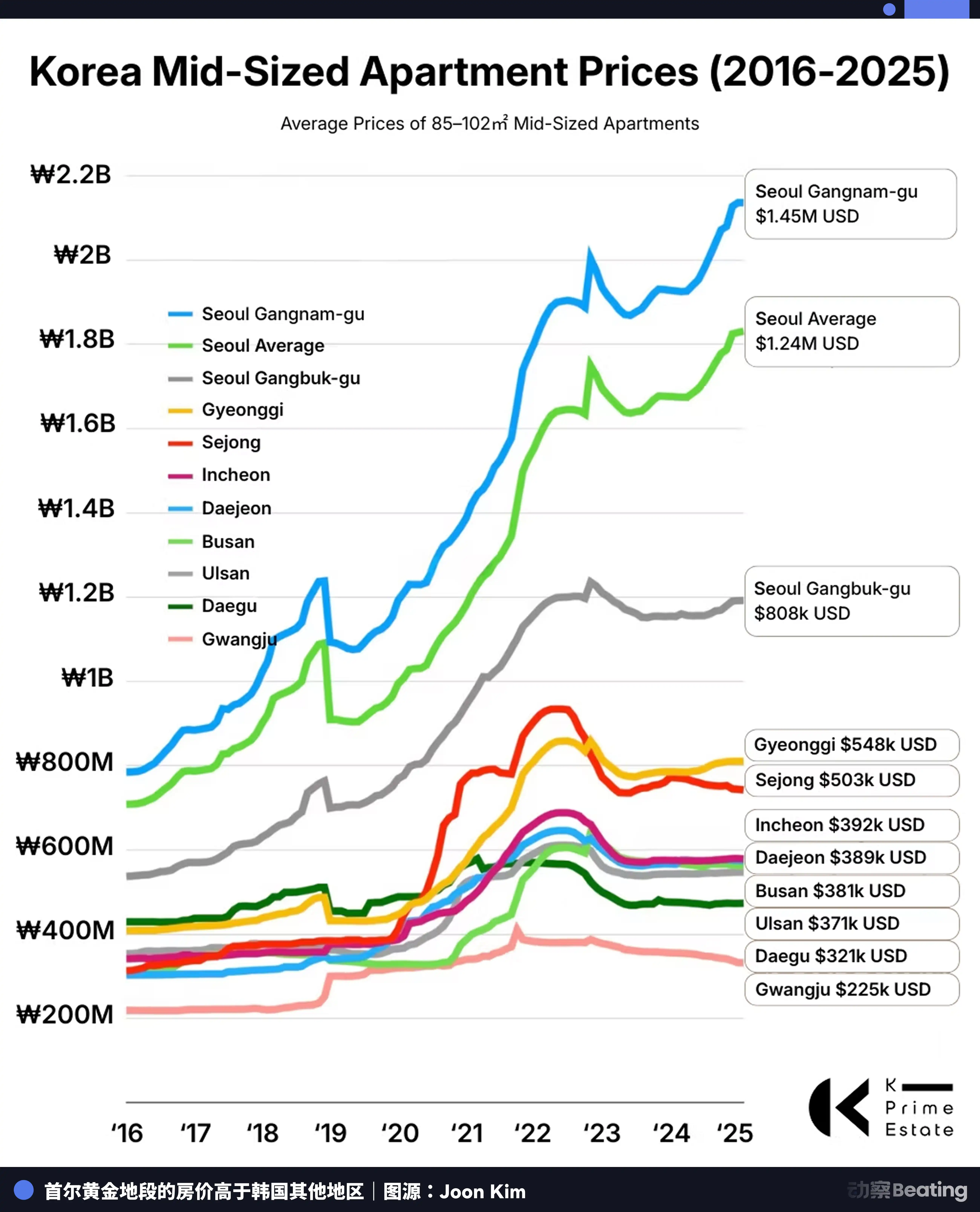
However, young people can no longer go down this path. Since 1988, the price increase in apartments in the three affluent districts of Gangnam has been 43 times that of the wage increase for ordinary workers. Today, the average price of an apartment in Seoul ranks fourth globally, behind only Hong Kong, Zurich, and Singapore. It's a pipe dream to buy a Seoul apartment with a salary.
So, only the second path remains. The ticket to the stock market requires just a smartphone and an account, allowing recent graduate Nawon to buy a share of Samsung Electronics.
As a result, young people flocked to the stock market. According to the Korea Financial Investment Association, an account with deposits exceeding 100,000 Korean won and at least one trade in the past six months is considered an active account. Over the past year, such accounts have been growing at a rate of over a million new accounts per month, reaching 106 million now. With South Korea's total population being over 51 million, there are twice as many accounts as there are people, averaging two accounts per citizen, including babies and the elderly.
The government gave a push from behind. In President Lee Jinmyung's vision, South Korea's wealth should not continue to be locked in houses, as that is an outdated model. The money should be unlocked from real estate and flow into the stock market to nurture future industries such as semiconductors and AI data centers.
In February of this year, he listed his own 164 square meter apartment for sale at 29 billion Korean won, slightly below market price. The President personally set an example: it's time for houses to cool down, and the money should go elsewhere.
Last month, Samsung Electronics and SK Hynix announced a joint investment of 80 trillion Korean won to build a new chip plant. At the press conference, he said, "We must move faster than any other country."
One of the most practical measures in the supporting policy is tax exemption. Those who sell overseas stocks and move the money back into Korean assets by the end of 2026 can avoid paying capital gains tax of up to 50 million Korean won.
All Koreans are pushing their force in the same direction, moving money into the market. However, they seem to have overlooked the fact that while the entrance door is open, the exit door next to it is also open, and many people are walking out through that door.
Foreigners sold for a year, ants bought for a year
On the Korean exchange's books, in the first five months of this year, foreign investors have cumulatively sold more than 96 trillion Korean won on the KOSPI, except for small-scale purchases in January and April. In February and March, hundreds of trillion were moved out each month.
During the same period, Korean retail investors bought a net of 54 trillion, with an additional 50 trillion flowing in through ETFs. The two stocks most bought by retail investors were Samsung Electronics at 28 trillion and SK Hynix at 24 trillion. In March, when the Iran war pushed the index back to 5000 points, retail investors bought 33.5 trillion that month.
The index has risen from 4000 points in October last year to over 8000 points, taking only seven months, surpassing Taiwan, Japan, and Nasdaq significantly during the same period. It is Korean retail investors who have lifted it up, buying it up point by point with real money.
Most of the chipsets in the hands of foreign investors were accumulated over many years at much lower levels. This year, at five, seven, and nine thousand points, they sold off batches of chipsets and converted them into dollars, leaving South Korea. Their profits have been settled, cashed out, converted, and they have left. What retail investors have taken over is the highest cost in history and a string of unrealized numbers. The rise belongs to everyone, but the profits belong to those who left first.
Korean retail investors call themselves ants and are officially known as Donghak Ants. This name was coined in March 2020 when the pandemic triggered a market crash, and foreign investors sold off Samsung Electronics. Retail investors rushed to buy, and in the end, it proved to be the right decision, earning them a sizable profit.
The name is derived from the 1894 Donghak Peasant Movement. That year, farmers wielded bamboo spears against foreign forces and corrupt officials. Many attached talismans to their bodies, believing that reciting the right spell would make their bodies impervious to spear attacks. The uprising was ultimately defeated due to the disparity in weapons; bamboo spears and talismans could not stop gunfire.
When retail investors chose this name for themselves, they probably thought of its heroism and its outcome at the same time. In 2020, Ants won, and the ominousness in the name was forgotten, leaving only the glorious half of heroism.
Looking back, this is not the first time this country has appealed to its citizens' pockets. During the 1998 IMF crisis and the collapse of the Korean won, 3.5 million people stood in line to donate their gold to the country. Wedding rings, athlete medals, and gold rings for children's first birthday celebrations were melted down, totaling 227 tons.
The difference is that in 1998, the citizens gave gold and received assistance for the country to overcome the crisis. In 2026, the citizens gave their principal and received chips in return. The price of the chips fluctuates starting at 9 a.m. every morning.
Winners in Ant, such as 22-year-old software engineer DaXiong, started learning stock trading at 19. At the end of last year, he bought Samsung, SK Hynix, and related concept stocks, with a return rate exceeding 80% at one point.
When asked about his feelings, he said, "It's just numbers changing; my life and bank account have not been affected much."
At that time, hearing such words sounded like Versailles. After July 7, if you listen again, it sounds like a prophecy, as the unrealized return rate indeed is just a number.
"Perhaps this is their destiny."
Recently, after the stock market fell, ryang ryang checked his account. Some stocks were down, some were still rising, and on average, he fortunately did not suffer an overall loss. He is still holding onto the ones that fell and has no plan to sell within the year.
When asked if he had any emotional ups and downs these days, he said, "For me, there hasn't been much change. If you look at just one day, the market may seem extreme, but if you look at it over a three-month period, you will understand."
A circuit breaker is a matter of minutes, at one fifty-one in the afternoon, for twenty minutes. He gave himself a new ruler, one grid for three months. Using this ruler to measure, the large bearish candle on July 7 was just a normal fluctuation.
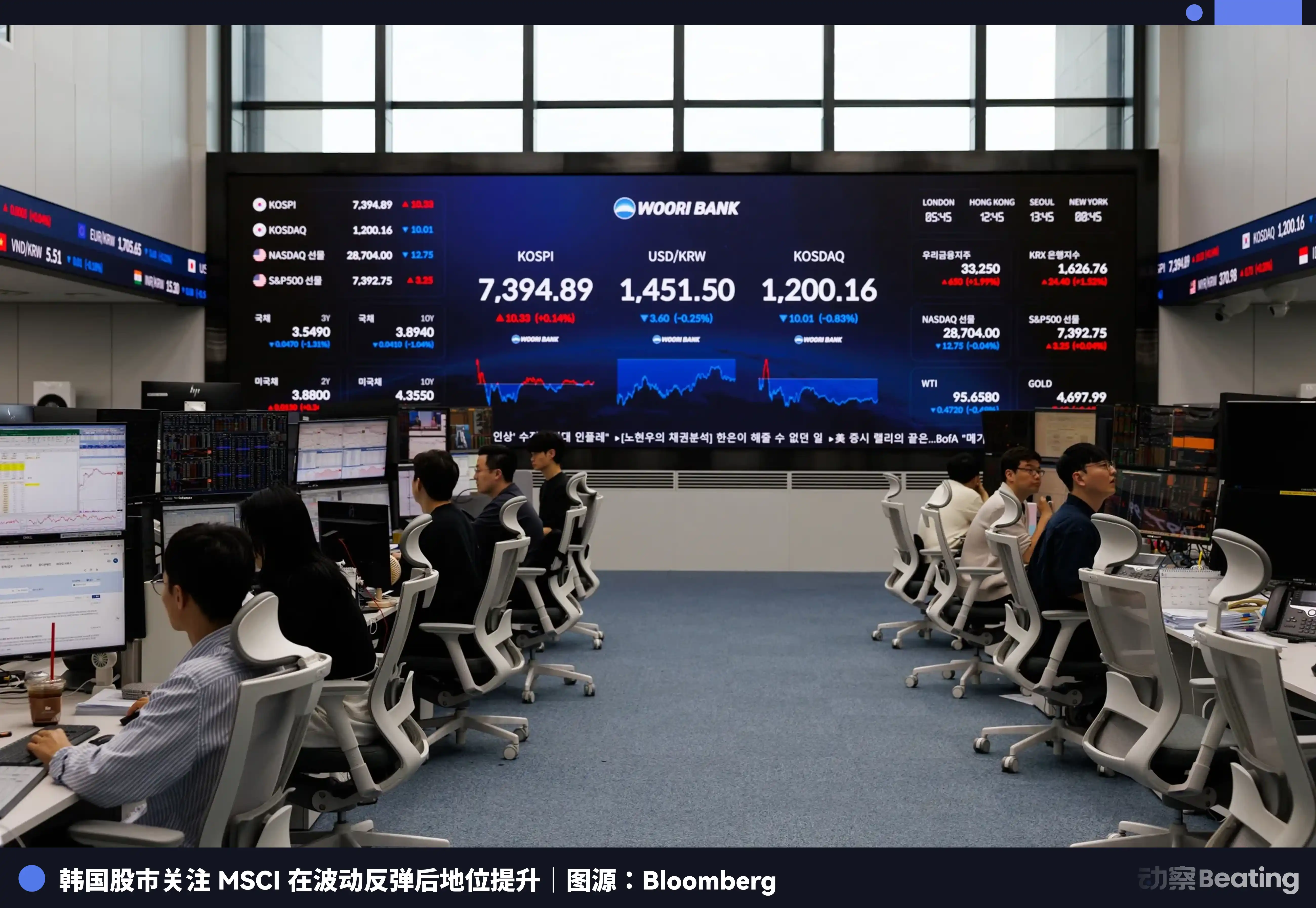
Two weeks ago, there was news in the market that South Korea once again missed the developed market list in MSCI's annual review. On that day, the KOSPI fell by 9.9%. A market boasting the highest increase among major stock indices, with retail investors who have just opened accounts as the main buyers, and the president himself as the top bull. However, on the global capital balance sheet, it is still categorized as an emerging market, alongside the past it desperately wants to bid farewell to.
Subsequently, foreign investment continued to sell for seven consecutive trading days. By the end of June, the selling pressure from foreign investors intensified. According to South Korean media reports, as of early July, foreign investors had sold a cumulative total of over 150 trillion Korean won worth of stocks on the KOSPI this year. On the same day, the Korean won fell to 1545 against the US dollar, marking its lowest point since March 2009. The last time the Korean won was this weak was during the global financial crisis.
These two events are mutually reinforcing. As foreign funds withdrew, the Korean won depreciated. With the Korean won depreciating, the value of Korean stocks held by foreign investors in USD terms shrank, prompting them to sell off quickly. And thus, the snowball effect ensued. As domestic investors bought back the stocks sold by foreigners, the Korean won fell to a 17-year low. Retail investors not only picked up the stocks sold by foreigners but also took over their foreign exchange positions.
ryang량 does not resent foreign investment. He said, "From the perspective of foreign investors, they inevitably consider arbitrage opportunities resulting from exchange rate fluctuations. Perhaps this is their destiny."
On the same candlestick chart, the stock prices and exchange rates both shrunk in the accounts of foreign funds. ryang량's money is denominated in Korean won, and will be spent in Korean won in the future. All he sees is an SK Hynix that is now offered at a discount.
Whether Korea is considered developed or not, and the 96 trillion sold this year, all belong to the same global pool of money. A group of people who solely transact in Korean won took over this 96 trillion.
When asked if he made any mistakes, ryang량 admitted that he occasionally made mistakes. Upon hindsight, it is revealed that there were various signs indicating a downturn at that time, which he failed to notice promptly. This is also normal. After each major drop, a large number of people claiming to have seen the signals clearly would emerge in the market, but before the crash, they would simply dismiss those signals as noise.
When asked about his mindset, he mentioned that since he has not experienced a catastrophic loss himself, he cannot empathize fully. However, even with a certain level of loss, he would still feel unsettled and anxious, indicating that this is a common psychological trait among all investors.
Indeed, some are experiencing that catastrophic scenario in the market. Margin accounts faced forced liquidation, reverting back to a daily level of 50 billion Korean won. Retail investors' margin deposits at securities firms decreased by 20 trillion won in a month. Where did this money go? An optimistic view is that it flowed in to support the market, while a pessimistic view is that it also flowed in to support the market.
Regarding the future prospects, he predicts that stock prices may continue to decline in the short term, but this is only a temporary adjustment, and a subsequent uptrend is likely. The person who said, "There were various signs indicating a downturn, which I missed," is the same person who is now saying, "A subsequent uptrend is likely." Having just missed the previous peak, he is now predicting the next trough.
This is not to ridicule him. The 3.43 trillion-won funding that poured in on July 7, when broken down, is the sum of over a million ryang량s' "no plans to reduce holdings this year." Whether Lee Jae-myung's golden age can hold up depends on how long these people can sustain.
He also gave another ant some advice. When the stock price drops, if you can see the reason behind it clearly, don't panic. Instead, calmly consider whether to sell at the right time.
If you can see the reason, don't panic. The amulet of the past promised invincibility, while today's charm is called seeing the reason clearly. This is probably the only insurance Ant Group can give itself.
Matchbox
The KOSPI dropped from its peak of 9385 to around 7400, a 20% drop, but it is still up by about 80% from the beginning of the year. Samsung's 89.4 trillion, that's also a substantial profit.
This brings us back to the question from July 7th. With the best financial reports in history, why did it lead to a circuit breaker?
The answer lies in what these two companies are selling. Samsung and SK Hynix are in the same business, memory chips. It's a well-known cyclical business, with profits skyrocketing in the upswing cycle and the whole industry going down together in the downswing cycle.
The peak of the last boom was in 2018. That year, Samsung also had its best profit, but the stock price turned around while the profit was still climbing, and the following year, the profit of both companies plummeted by half. Those who have lived through a cycle remember this sequence.
Look at how the chips are stacked. Samsung and SK Hynix together account for more than half of the entire market capitalization. A wealth plan for 50 million people, over 100 million accounts, all riding on the price curve of the same chip.
During this year, what changed hands wasn't just stocks but memories. The 96 trillion won that was sold off still holds memories of 2018. Receivers of these accounts, over 10 million of them opened just in the past year, their memories start from the day they opened the account, and it has only been rising.
Everyone knows the cycle will turn, everyone believes they can get off before it does.
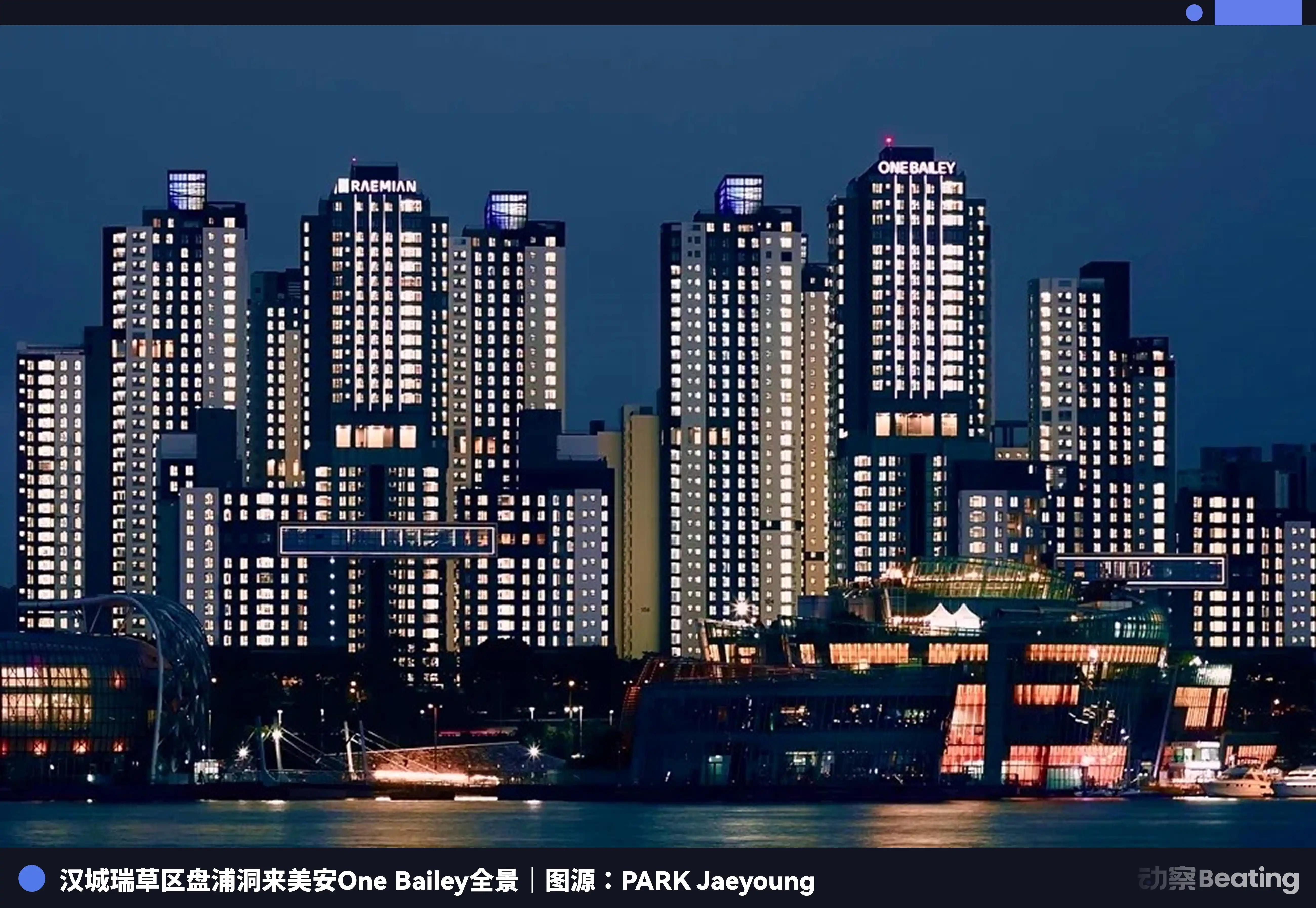
For those who have already gotten off, where did they go? In April of this year, in real estate transactions totaling over 15 billion won, 13.2% of the homebuying funds came directly from selling stocks. This percentage reached double digits for the first time, nearly three times the majority of the months in the past five years. The money earned in the bull market is turning into those rows of apartments by the Han River. Koreans call these square, identical buildings matchboxes. After circling back, the money returns to the box that has never let Koreans down for decades.
But there aren't many who can walk this path. The question of whether there is enough to buy a house, ryang량 never even thought about it. He does see it clearly though, "Most of the people who invest the money they earned from stock speculation in real estate had long started investing in real estate. Only with a certain financial strength can you maximize the returns from stock investment and then channel this portion of funds into real estate. Conversely, there are quite a few who earned money from real estate and then invested it in the stock market."
Money flowed from houses to stocks, and then back to houses. In this bull market, the number of ultra-high-net-worth investors with securities accounts exceeding 10 billion KRW doubled, with their per capita assets increasing by an additional 20%. The bull market indeed distributed money to everyone.
During the half-year of stock frenzy, many heavy aspects of life seemed to have simplified. The unattainable apartments, stagnant wages, $15 watermelons—all appeared to be temporarily lifted by that steep upward curve, making freedom and distant dreams seem within reach.
When the stock prices fell, all those lifted aspects came crashing down, reverting to their original weight.
In the ending of "Parasite," Ki-woo, who lives in a semi-basement, writes a letter to his father. He mentions a plan he has set for himself: to buy the house once he makes enough money so that his father can just walk up from the basement. In the year the movie was released, the media did the math for him, and based on an average person's income, it would take over 500 years. Ki-woo's plan is similar to ryang량's holdings. A young man, facing an immovable house, holding onto the only hope he can grasp.
The subway Line 2 during the evening rush hour is filled with commuters. This is Seoul's only circular line, starting from Gangnam, crossing the Han River, looping around the city, and eventually returning to Gangnam, following the path of the country's money.
Perhaps, there is a young person standing in the train car, quietly staring at the candlestick chart on their phone, the screen lighting up and dimming. Maybe that person is ryang량, holding onto stocks that have fallen but he has no intention of selling, waiting for an uptrend that he believes will come.
Outside the train window, along the banks of the Han River, the apartment buildings Koreans call matchboxes still shine their lights.
References
[1] Samsung Electronics Announces Earnings Guidance for Second Quarter 2026, Samsung Global Newsroom
[2] KOSPI Plummets Nearly 8%, Triggering First Circuit Breaker of the Year, Aju Press
[3] Record-Breaking Profits, Yet the Stock Crashes? The Real Reason Behind Today's KOSPI Circuit Breaker, Devtalk Korea
[4] Number of stock accounts hits a record high on a bull run, The Korea Times
[5] "Now Is the Time to Invest": Number of Active Stock Trading Accounts Up, Financial News
[6] The world's top-performing stock market still isn't a developed market, CNBC
[7] Foreign investors may have more Korean stocks to sell, The Korea Times
[8] Seoul ranks 4th in global apartment prices, but just 34th in quality of life, The Korea Times
[9] On the Republic of Apartments, Taylor & Francis Online
[10] Stock profits shift into Seoul housing as 30s lead buying in South Korea, Chosun Biz
[11] Foreign Media Sees Korea's Stock Boom Fueling Property Market, Seoul Economic Daily
Welcome to join the official BlockBeats community:
Telegram Subscription Group: https://t.me/theblockbeats
Telegram Discussion Group: https://t.me/BlockBeats_App
Official Twitter Account: https://twitter.com/BlockBeatsAsia

 Related Articles