Palantir CEO Lambasts Token-based Pricing Model, Describing AI as a "Bespoke Business"

TL;DR
· Palantir CEO Alex Karp criticizes the token-based pricing model of OpenAI and Anthropic, believing that enterprises struggle to obtain corresponding value.
· The market debate centers around whether enterprise AI budgets should be directed towards model inference or towards business system transformation and outcome delivery.
· Related Tickers: PLTR, NVDA, and the future valuation trajectory of OpenAI and Anthropic.
Palantir CEO Alex Karp criticized the high fees in the AI industry on July 1st in an interview with CNBC, specifically targeting leading model companies' token pricing for enterprise clients. Third-party financial reports further called out OpenAI and Anthropic. Karp's main point was that companies spending on AI may not necessarily receive equivalent value and may even give away data, intellectual property, and business advantages to external labs.
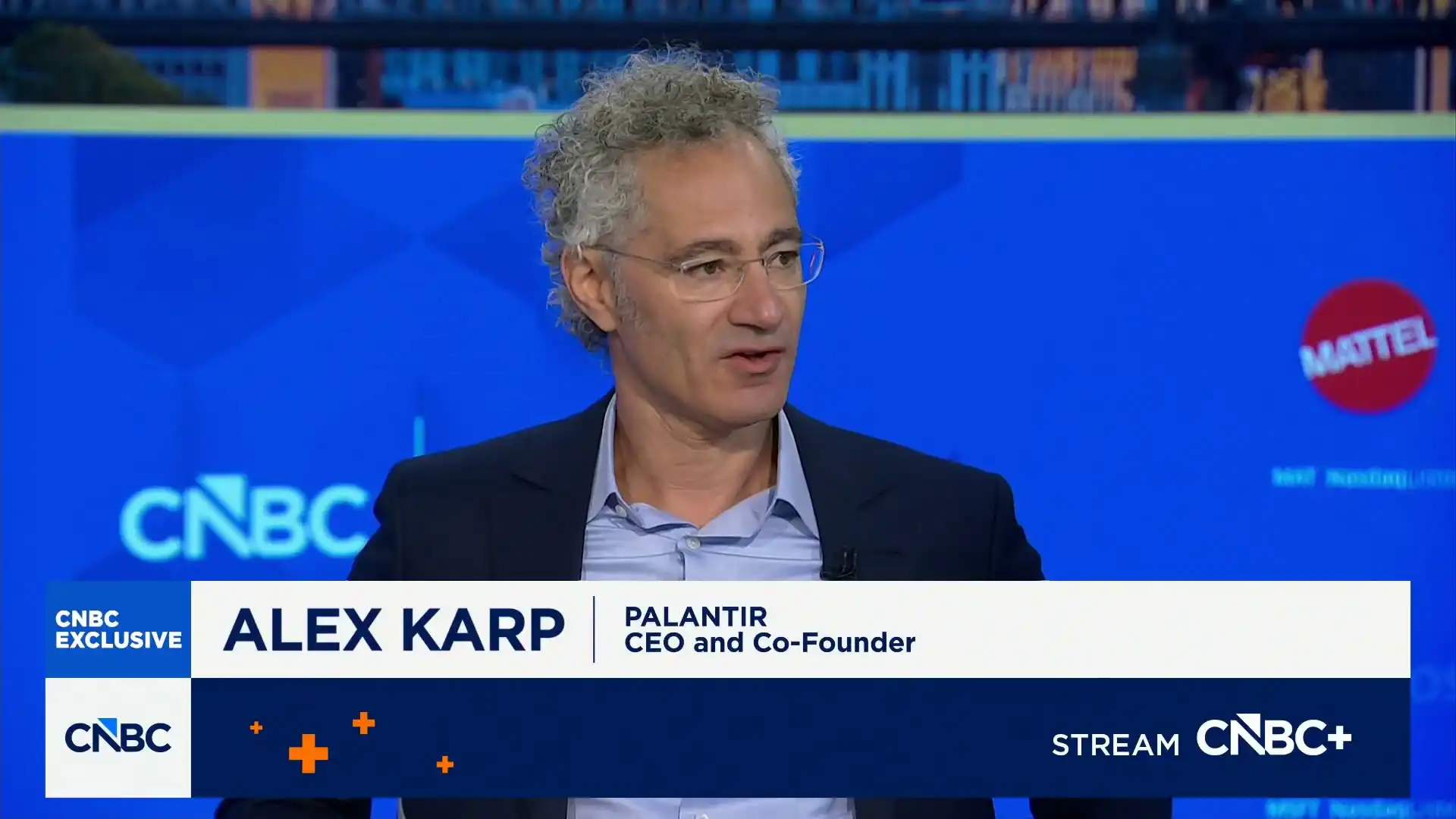
During the interview, Karp stated that enterprise CEOs are dissatisfied with this model. On that day, PLTR rose by approximately 8% to 9% from intraday to close. This increase cannot be solely attributed to the interview itself; during the same period, Palantir's collaboration with NVIDIA on sovereign AI and the Nemotron open model also reinforced the market narrative.
At the core of this debate is who ultimately captures the enterprise AI budget. Are companies buying stronger models, or are they purchasing a production system that can transform business processes, retain data control, and be accountable for outcomes?
Shifting the AI Expenditure Debate to Pricing Power
A token can be understood as a unit of measure for AI processing text and information, similar to paying per word or per page. Each time a company inputs a question, uploads a file, or generates an answer, tokens are consumed. Tokenmaxxing refers to companies continually increasing AI inference usage, hoping to extract value from more utilization.
Karp's critique lies in the fact that this model easily anchors revenue to "consumption" rather than "outcomes." The more a company uses, the higher the model company's revenue, but CFOs and CIOs are more concerned about one thing: whether these inference volumes actually reduce costs, increase revenue, or enhance the efficiency of a particular business line.
OpenAI and Anthropic also have their own business logic. Training and inference costs for advanced models are high, and the stronger the capability and the more calls made, charging based on usage is a natural choice. Public price pages focus on input and output tokens, while large enterprise contracts may typically include discounts, credit limits, dedicated support, seat fees, or custom terms.
What remains opaque is how much the enterprise ultimately paid for “capacity,” “usage,” and “business outcomes” respectively. Karp’s remarks do not prove that the token model has failed, but they indicate that the token, as a valuation anchor for enterprise AI, is being challenged by application-layer companies.
What Palantir Sells Is a Company’s Own AI Operations System
Palantir can adopt this narrative because it sells not a generic chatbot or a single-model API, but a set of AI platforms embedded in the client's business.
An AI Platform can be understood as a company’s “business knowledge map” and workflow system. It connects internal data, approval processes, operational rules, and AI capabilities, enabling AI to participate in production, scheduling, risk management, the supply chain, intelligence analysis, or government missions, rather than just generating a response.
The difference from a pure token call is that Palantir is trying to shift the billing basis from “how many times AI is used” to “how much the business system has been transformed.” What customers purchase is deployment, integration, access control, data governance, and continuous iteration, with the underlying model being just one part of it.
This also explains why Palantir emphasizes sovereign AI, open models, and cooperation with NVIDIA. For scenarios such as government, defense, finance, and energy, factors like data non-egress, model auditability, and system traceability are often more important than a few cents cheaper per single call.
Speaking with Financial Reports
If only Karp's interview existed, this would look more like marketing between competitors. However, Palantir’s Q1 2026 financial report made the market willing to take it seriously.
The company's financial report shows that Palantir had Q1 revenue of approximately $16.33 billion, an 85% year-over-year increase. U.S. commercial revenue was $5.95 billion, a 133% year-over-year increase. The company also raised its full-year revenue guidance to around $76.50 billion to $76.62 billion, with U.S. commercial revenue expected to be at least $32.24 billion, a year-over-year increase of at least 120%.
For investors, this indicates that the AI Platform is at least entering an accelerated stage in the U.S. commercial market, rather than remaining at the conceptual demonstration stage. Over the past two years, the market has been accustomed to paying for computing power, chips, and cutting-edge models, but whether the application layer can generate high-profit, highly sticky revenue has always been a point of contention.
Palantir's counterexample is that if AI is packaged as an enterprise production system rather than a one-time tool, customers may be willing to accept deeper deployment and longer-term contracts. This is still a trend judgment and does not mean that all companies will procure AI along Palantir's path.
Order Fulfillment Determines Valuation Boundary
Karp's criticism is grounded in reality, but OpenAI and Anthropic have not been excluded from enterprise AI budgets. Many enterprises still require state-of-the-art model capabilities, especially in research, coding, automated analysis, and multimodal tasks, where the performance advantage of cutting-edge models may still determine the ultimate outcome.
Model companies can also adjust their business models. They can introduce deeper enterprise customization, lower inference costs, stronger data isolation commitments, and even shift fees from pure usage-based to project-based, seat-based, or outcome-based pricing. Public APIs with token billing do not imply that all enterprise revenue will be token-based in the long term.
For Palantir, the challenge is equally clear. Custom deployments, on-site integration, and complex workflow transformations can bring high stickiness but may also result in higher delivery costs. It needs to demonstrate that AIP growth is not achieved through a few large clients and high-intensity services but can be replicated across more industries while maintaining profitability.
The trading dynamics of PLTR offer a possibility: in the AI value chain, the most lucrative position may not be permanently concentrated at the foundational model layer but could shift towards the integration layer and application layer closer to customer business outcomes. If this assessment holds true, it will impact how investors evaluate model companies, software platforms, and computational power providers.
However, this assessment still requires subsequent data validation. For Palantir, the market will continue to focus on U.S. commercial revenue growth rate, quality of customer expansion, contract duration, and profit margins. If growth relies on high-intensity custom services, valuation elasticity will be limited. Only if more clients expand their deployment on AIP will Karp's challenge to token pricing evolve from a one-time interview into sustainable business pressure.
Welcome to join the official BlockBeats community:
Telegram Subscription Group: https://t.me/theblockbeats
Telegram Discussion Group: https://t.me/BlockBeats_App
Official Twitter Account: https://twitter.com/BlockBeatsAsia