OKX Star: One Individual, One Global Corporation
Original Author: OKX Founder and CEO Star
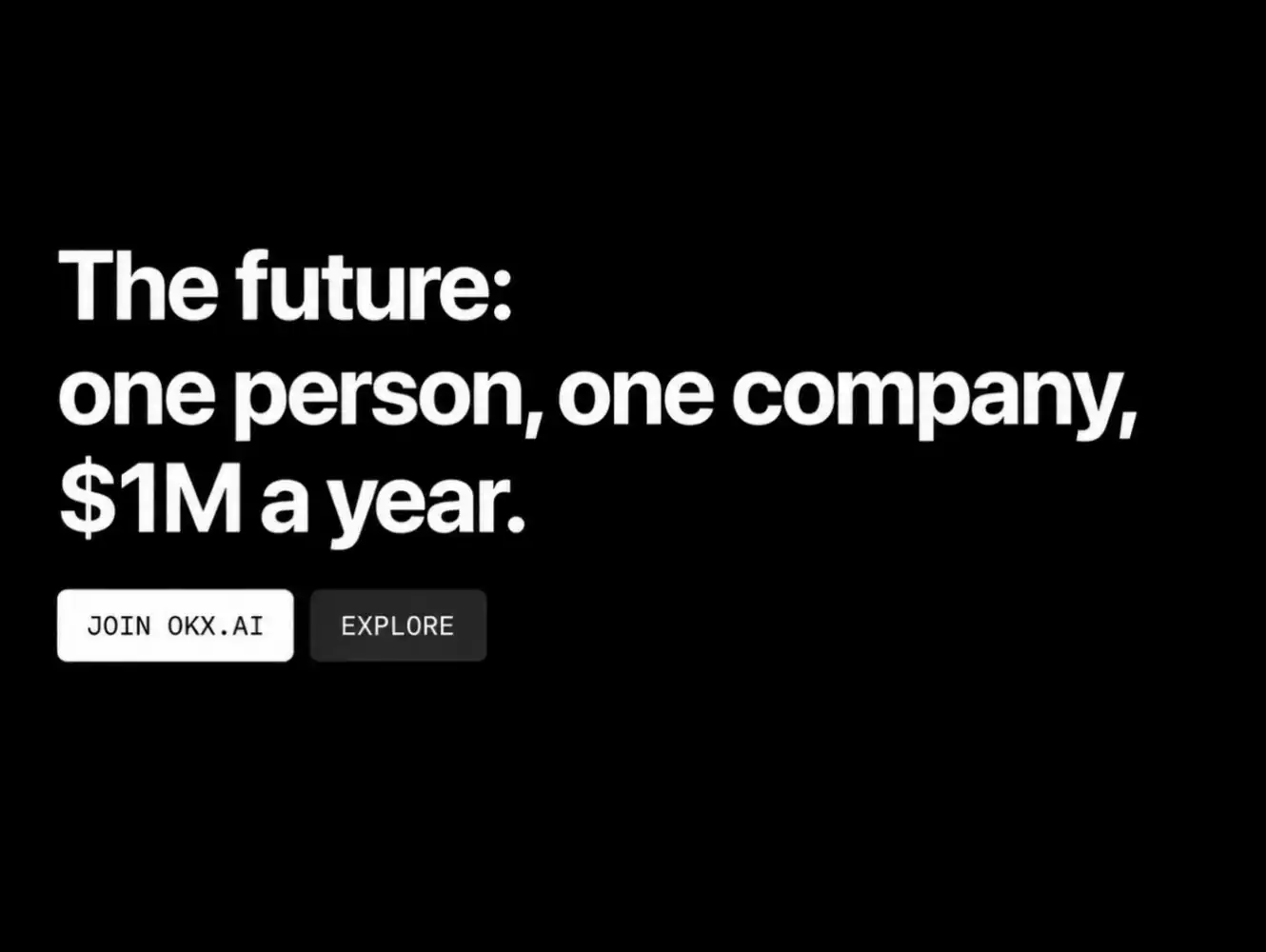
OKX.ai and the Agentic Economy Manifesto
Every truly important technological revolution ultimately changes not just tools, but the structure of the economy itself.
The Internet allowed information to flow freely, giving rise to the information economy.
Smartphones enabled everyone to be online anytime, giving rise to the mobile economy.
Blockchain enables assets, identity, and value to be credibly exchanged globally, giving rise to the on-chain economy.
And today, artificial intelligence is bringing about the next, even greater transformation:
Intelligence itself is becoming a productivity that can be organized, called upon, traded, and combined.
This is what we call the Agentic Economy, the economy of intelligent agents.
In this new economy, an AI Agent is no longer just a chat window, not just a smarter search box, and not merely an automation tool.
It will work.
It will collaborate.
It will create.
It will purchase services.
It will sell capabilities.
It will execute transactions.
It will continuously earn.
It is starting to become a true economic participant.
At OKX, we believe that the Agentic Economy will be one of the most significant economic waves of the next decade.
And OKX.ai is the infrastructure we are building for this new era.
AI Has Crossed the Threshold
For a long time, one of the scarcest resources in human society has been high-quality intelligence.
People who understand math are few.
People who can code are few.
Those who truly understand law, medicine, finance, engineering, product, and complex systems are even fewer.
So companies have had to constantly recruit, expand organizations, and bring scarce talent together to accomplish complex tasks.
But today, this premise is being changed.
Modern AI has already demonstrated capabilities in mathematics, programming, law, medicine, scientific reasoning, and many other fields that exceed those of the vast majority of humans. Whether we call it AGI or not, one thing is very clear:
AI now has the ability to undertake real economic tasks.
So the next question is no longer just "How smart is AI really?"
The real question is:
As intelligence becomes nearly infinite and costs plummet rapidly, how should humans reorganize work, companies, and the economy?
This is not just a modeling issue.
This is an infrastructure issue.
AI is not a deity; intelligence also needs training and organization
Many people think that as long as the model continues to grow in size, AI will naturally solve everything.
But that's not the case.
Imagine a company hiring the smartest MIT Ph.D. in the world today.
And then giving him nothing.
No onboarding training.
No documentation.
No mentor.
No company knowledge.
No industry background.
No system access.
No workflows.
Even if this person is incredibly intelligent, it would be challenging for him to immediately create value. Worse, he might cause chaos due to lack of context and constraints.
That's why any excellent company has a system for onboarding new hires.
Not because new hires are not smart.
But because:
Intelligence will only become productivity when placed in the right environment.
AI is the same.
Large models already possess very powerful reasoning capabilities, but they still need context, tools, memory, permissions, feedback, evaluation systems, and workflows to transform from "smart" to "reliable."
We call this whole system:
Harness Engineering.
At its core, Harness Engineering transforms raw intelligence into a stable, controllable, and sustainable production system that creates value.
Over the past few years, OKX has been building its own Agent Harness. Today, we have close to 50% of engineering Pull Requests completed end-to-end by AI agents. Our goal is to increase this percentage to 95% in the near future.
This is not because the models have suddenly become divine.
It's because we've finally started to build a working environment that truly suits AI.
The future of software competition will not only be about model capabilities.
It will be more about Harness capabilities.
Whoever can better organize intelligence will unleash greater productivity.
The value of humans will not disappear but be redefined
AI will not make people irrelevant.
On the contrary, it will make truly important people even more significant.
Over the past few decades, many companies hired a large number of employees because execution capabilities were scarce.
Coding required people.
Writing documentation requires people.
Designing requires people.
Analysis requires people.
Research requires people.
Operations also require people.
However, in the AI era, more and more execution work will be completed by agents, and it will be faster, cheaper, and more scalable.
This means that the value of humans will shift from "personally completing tasks" to "defining the right tasks."
In the future, what is truly scarce is not execution, but judgement.
It's not about how much code you write, but about knowing what should be built.
It's not about fulfilling how many requirements, but understanding which requirements are truly important.
It's not about repetitive labor, but about industry insights, user understanding, product taste, system architecture, strategic judgement, and organizational collaboration.
In other words:
Execution will become more and more abundant, while direction will become more and more scarce.
AI will raise the bar for talent within companies, rather than lower it.
In the future, the most valuable individuals will not necessarily be the ones who work the hardest, but those who can best understand the world, understand users, understand systems, and make critical judgments.
One Person Can Also Have a World-Class Company
This may be the most exciting aspect of AI.
In the past, even the most capable individual found it challenging to independently establish a truly globalized, scalable company.
Because a company implies organization.
You need engineers.
You need designers.
You need marketing.
You need sales.
You need customer service.
You need legal.
You need finance.
You need operations.
You need to organize many people in order to turn one person's idea into a truly functioning business system.
But agents have changed all of this.
In the future, one person can have an ever-active digital team.
Your marketing agent helps you acquire customers.
Your product agent helps you iterate services.
Your design agent helps you generate content.
Your legal agent helps you research contracts.
Your finance agent helps you with settlements.
Your customer service agent serves global users 24/7.
You no longer need to first establish a company in order to scale your capabilities.
You can first turn your capabilities into a harness.
Everyone has unique value.
Some excel in entrepreneurial judgment.
Some excel in video expression.
Some understand litigation strategy.
Some have extremely strong aesthetics.
Some delve deep into the supply chain.
Some understand a very small but highly valuable industry.
In the past, these abilities could often only be monetized through time.
Consult for an hour, charge for an hour.
Design a graphic, charge for a graphic.
Serve a client, revenue comes from a client.
But in the Agentic Economy, these capabilities can be packaged, deployed, automatically called, and auto-traded.
Your knowledge will become software.
Your judgment will become a system.
Your experience will become an Agent that can serve global clients 24/7.
This is why we believe that in the next decade, millions of "solopreneurs" will emerge.
They may not have offices, large teams, or even employees in the traditional sense.
But they will have world-class production capabilities.
One person is a world-class company.
The Labor Market Will Be Reshaped, but New Opportunities Will Arise
This change will not be without labor pains.
Many companies have already begun to reduce hiring as more and more technical execution work can be done faster, cheaper, and at higher quality by AI.
Some positions will disappear.
More will be redefined.
But this does not mean that humans have lost economic opportunities.
On the contrary, a new role will emerge:
Harness Creator.
In the past, people earned income by joining companies.
Many people worked not because they loved a particular company, but because they needed to earn money, support their families, and live. Companies are organizations that create great products and value, but for many individuals, it has also been the only way to achieve economic security.
AI will change that.
In the future, more and more people can no longer just sell their time but instead package their abilities into an Agent to continuously create value.
You don't necessarily need to join a company to participate in the global economy.
You can become a Harness Creator.
You can create Agents, train Agents, operate Agents, and have them serve others, businesses, and even other Agents.
In the past, one person's abilities were limited by time.
In the future, one person's abilities can be infinitely amplified through Agents.
Why the Agentic Economy Needs Blockchain
The Agentic Economy requires more than just intelligence.
It also needs a new set of economic infrastructure.
Because when Agents start working in earnest, they are not just generating content, but are engaging in economic activities.
They need identity.
They need accounts.
They need wallets.
They need payments.
They need custody.
They need settlement.
They need verification that services are completed.
They need ownership confirmation.
They need to collaborate with others and Agents globally.
Traditional financial systems are designed for humans.
But what the Agentic Economy requires is an economic layer designed for autonomous software.
This is where the importance of blockchain comes in.
Blockchain provides a global, open, programmable, and verifiable value network.
It enables Agents to have wallets, make payments, use custody, settle transactions, and establish trust without the need for traditional intermediaries.
If AI is the intelligence layer, then blockchain is the economic layer of the Agentic Economy.
OKX.ai: E-commerce Platform for AI Agents
OKX.ai is an Agentic Commerce Platform.
You can think of it as:
The Amazon for AI Agents.
On OKX.ai, anyone can become an Agent Service Provider, or ASP.
You can create an Agent.
Package your expertise.
Design your Harness.
Release it on OKX.ai.
Then, human users or other Agents can discover it, test it, invoke it, pay for it, and integrate it into larger workflows.
Today, businesses pay for law firms, consulting firms, software service providers, design agencies, accounting firms, outsourcing teams, and various vendors.
In the future, businesses and individuals will naturally pay for high-quality Agent services.
Entrepreneurs will purchase startup advisory Agents.
Creatives will buy video production Agents.
Lawyers will subscribe to litigation research Agents.
Traders will call upon market intelligence Agents.
Companies will orchestrate a myriad of specialized Agents covering R&D, operations, customer service, risk management, finance, and growth.
More importantly, many future transactions will not be initiated manually by humans.
An Agent will automatically find the most suitable Agent, assess capabilities, compare prices, initiate the call, complete the payment, and bring back the results to its workflow based on the task goal.
This means that businesses can run at machine speed for the first time.
Humans, on the other hand, are freed from extensive execution and coordination, focusing on goals, judgment, and creation.
At the core of OKX.ai lies on top of OKX's accumulated on-chain infrastructure over the years, including:
• OnchainOS
• Agent Payment Protocol (APP)
• X Layer & OKB
• OKX Wallet
• Self-custody
• Escrow and on-chain settlement
These infrastructures together provide the identity, trust, payment, custody, and settlement capabilities needed for the Agentic Economy.
We believe that millions of Agent Service Providers will emerge in the future.
Each ASP is a new digital service provider.
Every outstanding Harness has the potential to become a new global business.
Every individual can turn their knowledge, experience, and judgment into intelligent services that can be discovered, purchased, called, and combined globally.
We are entering a new economic era
Intelligence is becoming increasingly abundant.
What will truly be scarce is no longer intelligence itself.
It will be trust.
Collaboration.
Ownership.
Payment.
Discovery.
And the economic infrastructure that carries all of this.
In the past two decades, the world has been rebuilt around Apps.
In the next decade, the world will be rebuilt around Agents.
Agents will serve humans.
Agents will hire Agents.
Agents will pay other Agents.
Agents will collaborate with other Agents to accomplish complex tasks.
Humans will focus more on imagination, judgment, goals, and truly unique value.
This is not an era of more efficient software.
This is a new economic era.
In the future, it will no longer be just about companies with the most employees.
The future also belongs to individuals with the best Agents.
One individual is a world-class company.
Welcome to the Agentic Economy.
Welcome to OKX.ai.
This article is contributed and does not represent the views of BlockBeats.
Welcome to join the official BlockBeats community:
Telegram Subscription Group: https://t.me/theblockbeats
Telegram Discussion Group: https://t.me/BlockBeats_App
Official Twitter Account: https://twitter.com/BlockBeatsAsia