Goldman Sachs Analysis: Samsung's Investment of 24.5 Trillion Korean Won in 15 Years, with 86% in Semiconductors, Is It Aggressive?

TL;DR
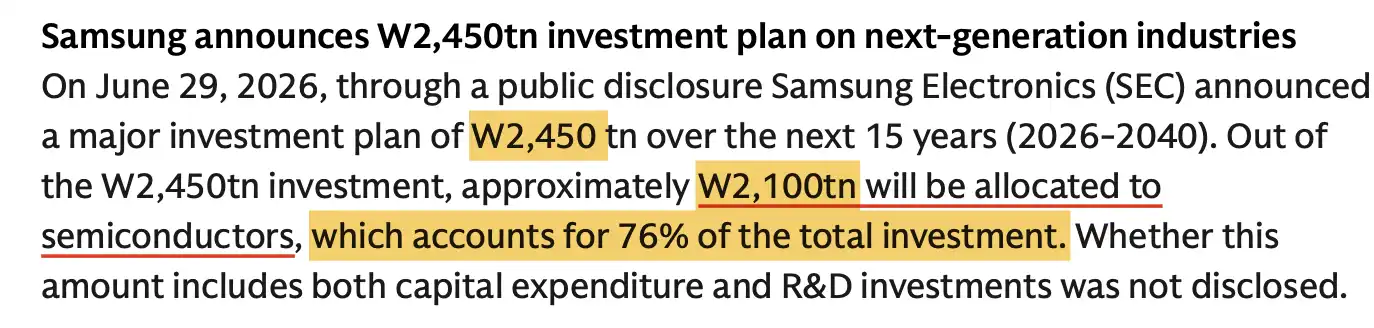
· Samsung Electronics announced its 2026-2040 South Korea domestic investment plan, totaling KRW 245 trillion, with approximately KRW 210 trillion allocated to the semiconductor sector, accounting for about 86%.
· Goldman Sachs estimates that if this investment includes R&D expenses, Samsung's annual domestic capital expenditure and R&D expenditure in South Korea over the next 15 years will be around KRW 163 trillion.
· This annual investment is higher than the 2026-2028 forecast baseline but closer to the existing investment intensity, indicating a continued strategy rather than a sudden aggressive expansion.
· The plan reinforces Samsung's focus on HBM, advanced packaging, and South Korea's domestic semiconductor cluster, but still lacks details on capacity, technology roadmap, and yearly pace.
· The stock price logic still depends on HBM catching up, memory pricing, profit recovery, and long-term execution, rather than just the KRW 245 trillion total.
Samsung Electronics has extended its South Korea domestic semiconductor investment plan to 2040.
On June 29, Samsung announced its mid- to long-term investment plan in South Korea from 2026 to 2040, totaling KRW 245 trillion, with approximately KRW 210 trillion allocated to the semiconductor sector, accounting for about 86%. This is not an announcement of a new plant expansion but a strategic move by Samsung to highlight its future 15-year investment in semiconductor manufacturing, HBM, advanced packaging, displays, and some end-product manufacturing in South Korea.
For investors, the key question is not how significant the KRW 245 trillion figure is, but whether this long-term investment signifies an aggressive expansion or a natural extension of Samsung's existing capital expenditure and R&D pace.
Goldman Sachs leans towards the latter. The report suggests that if this KRW 245 trillion includes R&D expenses, over the 15-year period, Samsung's domestic capital expenditure and R&D expenditure in South Korea will be approximately KRW 163 trillion per year. With the 2026-2028 baseline in mind, this translates to a long-term growth rate of about 5%-6% from 2029 to 2040, a level that Goldman Sachs believes is not excessive.
This also explains why the market's focus quickly shifted from the massive headline figure of "KRW 245 trillion" to investment caliber, project structure, and execution pace. The Samsung announcement itself still has many gaps: whether it includes R&D expenses, annual investment allocation for each project, specific capacity and production timelines have not been fully disclosed.
Semiconductors Receive Approximately KRW 210 Trillion
In this plan, semiconductors take the spotlight.
According to the announcement, Samsung will invest KRW 245 trillion domestically in South Korea from January 1, 2026, to December 31, 2040, with approximately KRW 210 trillion allocated to the semiconductor sector. This proportion continues to concentrate on semiconductors compared to Samsung's past long-term investment structure, indicating that semiconductors will remain at the core of Samsung's capital allocation for the next decade.
Specifically, approximately 16.5 trillion Korean won will be allocated to the Pyeongtaek semiconductor cluster and existing semiconductor facilities. Pyeongtaek is a critical node in Samsung's future semiconductor manufacturing landscape, with the related projects focusing on longer-term advanced processes, memory, and wafer fabrication capabilities.
The announcement also mentions that Gwangju will receive around 4 trillion Korean won for developing a new advanced semiconductor cluster; Hwaseong and Xian will build HBM-related capacity, located near Samsung's existing packaging and backend manufacturing resources. For the storage industry supply chain driven by AI server and accelerator demand, HBM capacity, yield, and customer certification remain one of Samsung's crucial validation points in the coming years.
In addition to semiconductors, investments will also be made in the display business for next-generation smartphone panels and high-resolution microdisplays; Gumi will advance smartphone factories and humanoid robot production lines. Compared to semiconductors, these projects seem more like Samsung's supportive arrangements to maintain domestic manufacturing and next-generation end-device capabilities, rather than the main focus of this investment plan.
Why Goldman Sachs Doesn't See It as Overaggressive
With 24.5 trillion Korean won spread over 15 years, the total amount may seem aggressive at first glance, but when annualized, the conclusion aligns more closely with Samsung's long-term investment capacity.
Currently, Goldman Sachs predicts Samsung's group capital expenditures and R&D expenses for 2026-2028 to be 125 trillion, 140 trillion, and 151 trillion Korean won, respectively. If this domestically announced investment plan is considered to encompass capital expenditures and R&D, averaging around 16.3 trillion Korean won over 15 years, it is not significantly higher than the forecasted levels for 2028.
Crucially, this announcement only discloses domestic investments in South Korea, not global consolidated investments. Referring to Samsung's previously disclosed investment scope, domestic expenditure in Korea has accounted for a significant portion of the group's capital expenditures and R&D expenses. Assuming domestic investments continue to represent a substantial part of the group's capital expenditures plus R&D and grow in the mid-single digits starting from 2029, the cumulative domestic investment scale from 2026-2040 is roughly in line with the 24.5 trillion Korean won.
This is the main reason why Goldman Sachs considers it "not overaggressive." While the market sees a massive figure spanning 15 years, when broken down into annual average investments, it appears more like a modest growth on top of existing capital expenditures, R&D spending, and the domestic contribution, rather than a sudden, leveraged expansion.
It is important to note that this judgment has one critical assumption: the 24.5 trillion Korean won includes R&D expenses. Samsung's announcement itself does not explicitly clarify this. If the final scope does not include R&D, the capital expenditure pressure corresponding to this plan would be significantly higher, leading to a shift in the market's understanding of the intensity of investment.
HBM and Onshore Cluster: The Rationale Behind This Investment
Samsung needs a long-term investment plan as the semiconductor competition has shifted from the ordinary memory cycle to the competition between AI servers, HBM, advanced packaging, and large-scale wafer fab clusters.
HBM is the most direct market focus. In the past AI cycle, HBM supply capability directly impacted whether memory manufacturers could benefit from the growth in AI accelerator demand. Samsung's previous market doubts regarding HBM customer certification and progress, along with the HBM-related arrangements in Pyeongtaek and Asan, at least indicate that the company has included this line in its long-term capital plan until 2040, rather than just focusing on short-term capacity expansion.
Memory pricing is also one of the foundations for Goldman Sachs to maintain an optimistic outlook. If memory prices remain strong and customer long-term agreements are more binding than in the past, Samsung's future profit recovery will come not only from short-term price rebounds in the next few years but also from long-term locking of AI computing power in the supply chain.
The projects in Pyeongtaek and Gwangju lean more towards long-term manufacturing capacity. Planning, constructing, and ramping up wafer fabs and industrial clusters typically take several years. By announcing a 15-year investment vision in advance, Samsung is helping send a more stable capacity signal to the supply chain, local governments, and customers.
However, capital investment does not guarantee winning the competition. Samsung still needs to deliver results in HBM customer certification, yield rates, packaging capabilities, and product iterations. The pace of competitors' capacity expansion, AI server demand, and memory price cycles will also influence the actual execution of this plan.
Target Price is Optimistic, But Investment Has Not Yet Been Realized
Goldman Sachs maintains a "Buy" rating on Samsung Electronics common stock with a 12-month target price of 480,000 Korean won. Based on the current stock price of approximately 323,000 Korean won as stated in the report, this corresponds to a potential upside of about 48.6%. The preferred stock target price is 360,000 Korean won, which represents a roughly 71% upside compared to the current price of about 210,500 Korean won.
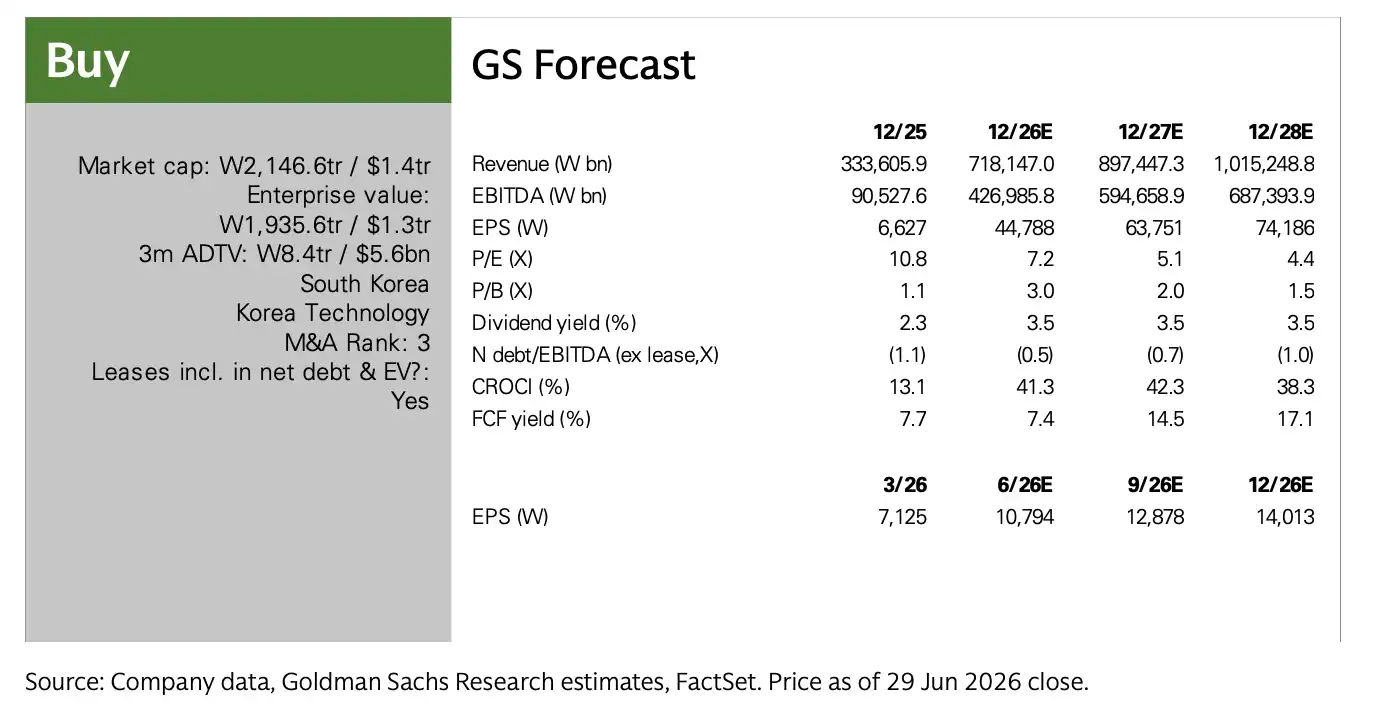
This target price is not solely driven by this investment plan. The long-term investment path, HBM progress, memory cycle recovery, and profit improvement collectively provide valuation support. In other words, the 24.5 trillion won plan reinforces Samsung's commitment to semiconductor and onshore manufacturing in South Korea, but whether the stock price can reach the target price depends on whether the investment can be translated into orders, yield rates, profit margins, and cash flow.
For Samsung, HBM is particularly critical. The demand for AI chips has made high-bandwidth memory a focal point for memory manufacturers in the past two years. The establishment of new HBM-related capacity helps enhance local manufacturing and packaging support, but it is more like preparation for future capacity and processes, not an immediate reversal of market share.
The Biggest Suspense Still Lies in Scale and Execution
The most explicit information in this 15-year plan is that Samsung has placed semiconductor onshore capacity, HBM, and the Korean manufacturing cluster at the core by 2040.
The unresolved issues are also clear. Whether the 24.5 trillion KRW includes R&D is still not directly specified in the announcement. Specific construction details, line allocations, technology roadmap, and annual investment pace for projects in Pyeongtaek, Giheung, Hwaseong, and Pyongtaek have not been fully disclosed.
Samsung also added a caveat to the announcement: this mid- to long-term vision is based on the current market situation and may be adjusted in the future as the market and business environment change. For a semiconductor company, this limitation is not surprising. Factors such as memory prices, AI server demand, HBM customer certification, Korean domestic policy support, equipment supply, and financing environment could all impact the actual annual investment intensity.
Therefore, the 24.5 trillion KRW is more suitable to be understood as the long-term investment framework provided by Samsung, rather than a fixed annual budget. Goldman Sachs believes the figure is not aggressive, under the assumption that this investment includes R&D expenses and Samsung maintains mid-single-digit investment growth for over a decade. What the market will need to validate next is not the total amount of 24.5 trillion KRW itself, but whether it can gradually transform into higher-quality capacity and profits.
Welcome to join the official BlockBeats community:
Telegram Subscription Group: https://t.me/theblockbeats
Telegram Discussion Group: https://t.me/BlockBeats_App
Official Twitter Account: https://twitter.com/BlockBeatsAsia