Citi Analysis: Citron upgrades Murata's rating to "Buy", How does AI Server Boost MLCC Profit?

TL;DR
· Citigroup upgraded Murata's rating to Buy, with a target price raised to 15,000 yen, implying a roughly 39% upside from the June 26 closing price.
· AI server board MLCC usage is over 5 times that of a general-purpose server, with a capacity upgrade driving ASP and profit margin increases.
· The baseline scenario does not include a comprehensive price increase, and the valuation is already above historical peak levels, with AI demand and the Japanese yen exchange rate remaining key risks.
Citigroup has upgraded Murata Manufacturing Co., Ltd.'s rating from Neutral to Buy and significantly raised the target price from 3,900 yen to 15,000 yen, betting on AI servers driving the increase in MLCC unit value and profit margin.
Based on Murata's closing price of 10,770 yen on June 26, 2026, the new target price implies a 39.3% upside. Including a dividend yield of 0.6%, the expected total return is approximately 39.9%. The core of this upgrade is not just optimism about the recovery of electronic component demand, but the fact that AI servers are changing the quantity, capacity, unit price, and profit margin structure of MLCCs.
MLCCs are basic passive components in servers, electric vehicles, smartphones, and other devices. While the price of a single component is not high, the quantity used is enormous. AI servers, especially GPU servers, have higher requirements for power stability, transient power supply, and high efficiency, leading to changes that are not just about "selling more capacitors" but increasing the proportion of high-capacity, high-value-added products.
Behind the Target Price Increase is a Significant Earnings Forecast Raise
Citigroup raised Murata's operating profit forecast for the fiscal year ending March 2027 to 440 billion yen, a year-on-year increase of 56.1%, up from the previous forecast of 380 billion yen. The operating profit forecast for the fiscal year ending March 2028 was raised from 426 billion yen to 630 billion yen, a 43.2% increase; and a new forecast for the fiscal year ending March 2029 is 800 billion yen, up 27.0% year-on-year.
This means that Murata's profit peak is no longer just a repeat of the last MLCC cycle. By the end of March 2029, the operating profit margin for the passive components segment is expected to increase from 27.2% in 2026 to 43.7%, and the company's overall operating profit margin is set to rise from 15.4% to 32.5%.
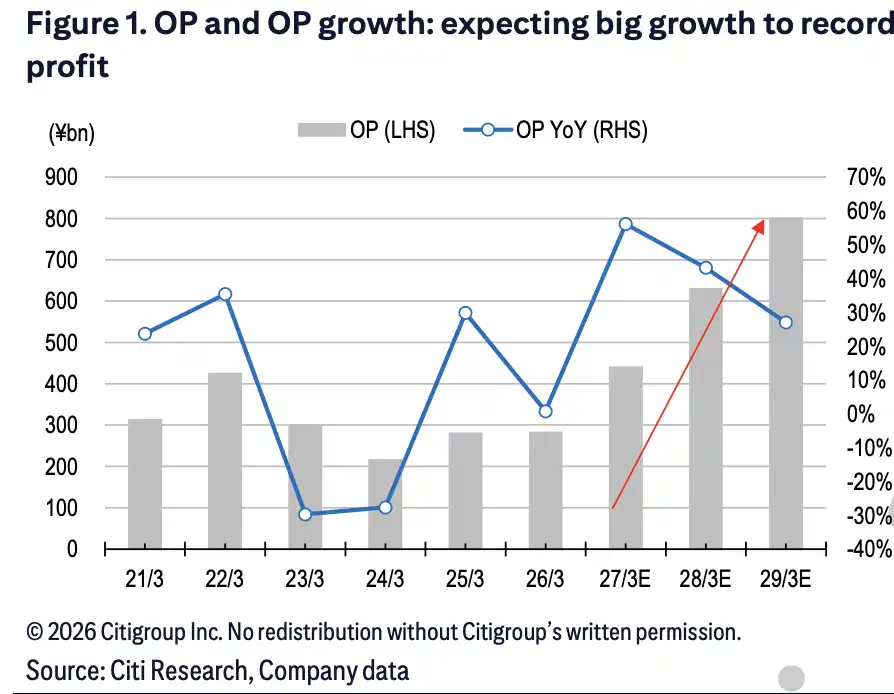
Operating profit is projected to rise from around 280 billion yen in 2025 to 800 billion yen in 2029, with a year-on-year growth rate exceeding 50% in 2027.
The key to the rising profit margin is the increasing proportion of AI server-related MLCC. The sales proportion of server-related MLCC is expected to increase from about 20% in 2025 to about 40% in 2029. In this process, high-end MLCC has a higher unit price and profit margin, and Murata holds approximately 50% market share in this field. The yield advantage further concentrates profit elasticity.
The report assumes that the company's capital expenditure will remain high, and in addition to the regular annual expansion of about 10%, an additional 20% of capital expenditure will be allocated to AI server MLCC. However, due to the higher unit price of AI products, the return on investment capital (RoIC) is expected to increase from about 15% in 2027 to over 25% in 2029.
AI Server Motherboard to Use More and More Expensive MLCCs
The most intuitive number of this profit revision is the change in the quantity of MLCCs per board.
The number of MLCCs per general server board is about 2000, while for GPU servers, it is about 11000, which is more than 5 times that of the former. More importantly, the MLCC capacitance is also being upgraded: from 10μF to 47μF, and is expected to further standardize to 100μF.
The increase in quantity addresses the sales volume issue, while the upgrade in capacitance addresses the unit price issue. Products with higher capacitance have higher manufacturing complexity, stricter requirements for materials, processes, and yield, and can push Murata's product portfolio into a higher gross margin range.
Citi expects that the ASP of MLCC in Japanese Yen in March 2027 will increase by 14% year-on-year, compared to the previous assumption of 6%. The price increase of AI server MLCC is raised from the previous 30% to 50%, while the decline in prices of consumer products narrows.
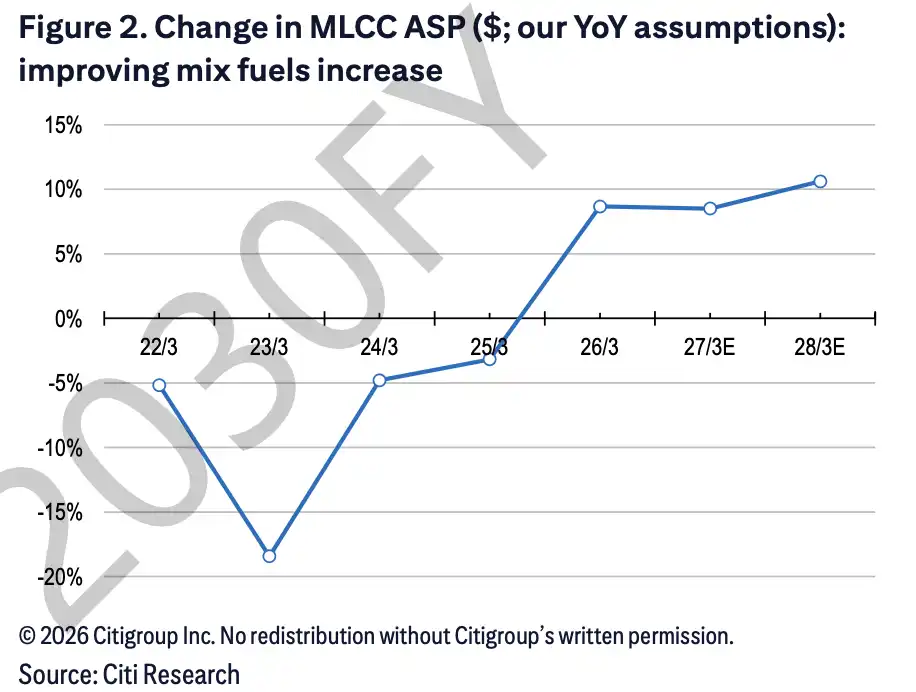
The MLCC ASP, driven by AI, has changed from negative growth to positive growth, with an increase of about 14% in 2027, mainly from the improvement in the AI server product mix.
The expected shipment volume of AI servers has also been raised. The shipment volume is expected to increase by about 15% in 2026, further accelerating to about 27% in 2027; the previous assessment was a slowdown beginning in 2027. In other words, the market has postponed the turning point in expectations for AI server hardware expansion, providing a longer growth window for MLCC demand.
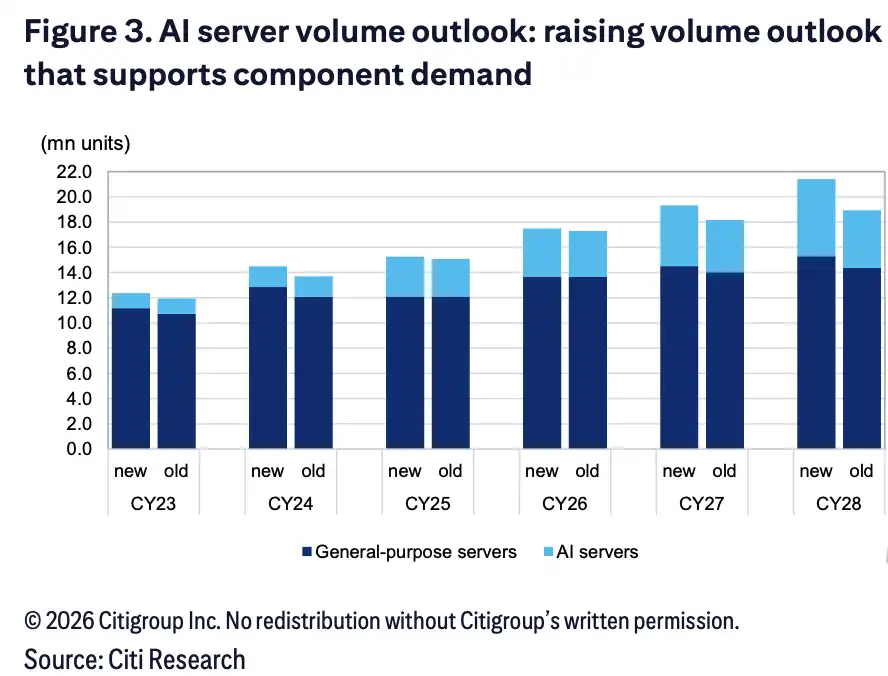
The shipment volume of AI servers is expected to continue to grow from 2025 to 2028, with the growth rate in 2027 increasing to about 27%, significantly outperforming general servers.
This is also why Murata is more closely watched than ordinary passive component manufacturers. Chinese manufacturers are mainly expanding production in the mid-to-low-end products, while the high-end AI server MLCC still relies more on yield, materials, and production stability. As long as the high-end supply does not catch up quickly, the increased demand for AI servers is more likely to be reflected in Murata's ASP and profit margin improvement.
Valuation has also been pushed up, with the 2029 P/E ratio exceeding historical peaks
A ¥15,000 target price is not low. Citigroup uses the RoIC-WACC model, with the benchmark year being the fiscal year ending in March 2029, assuming an adjusted RoIC of 25.5% and a WACC of 5.3%. In this model, the equity risk premium has been lowered from 4% to 3%.
This target price corresponds to a 2029 fiscal year expected P/E ratio of about 43 times, higher than Murata's historical peak of 30-35 times; based on the 2028 fiscal year earnings, it corresponds to a P/E ratio of about 54 times. In other words, if the market accepts this valuation, it needs to believe that the profit improvement brought by AI servers is not a short-term inventory cycle but rather something that can sustain RoIC at a higher level.
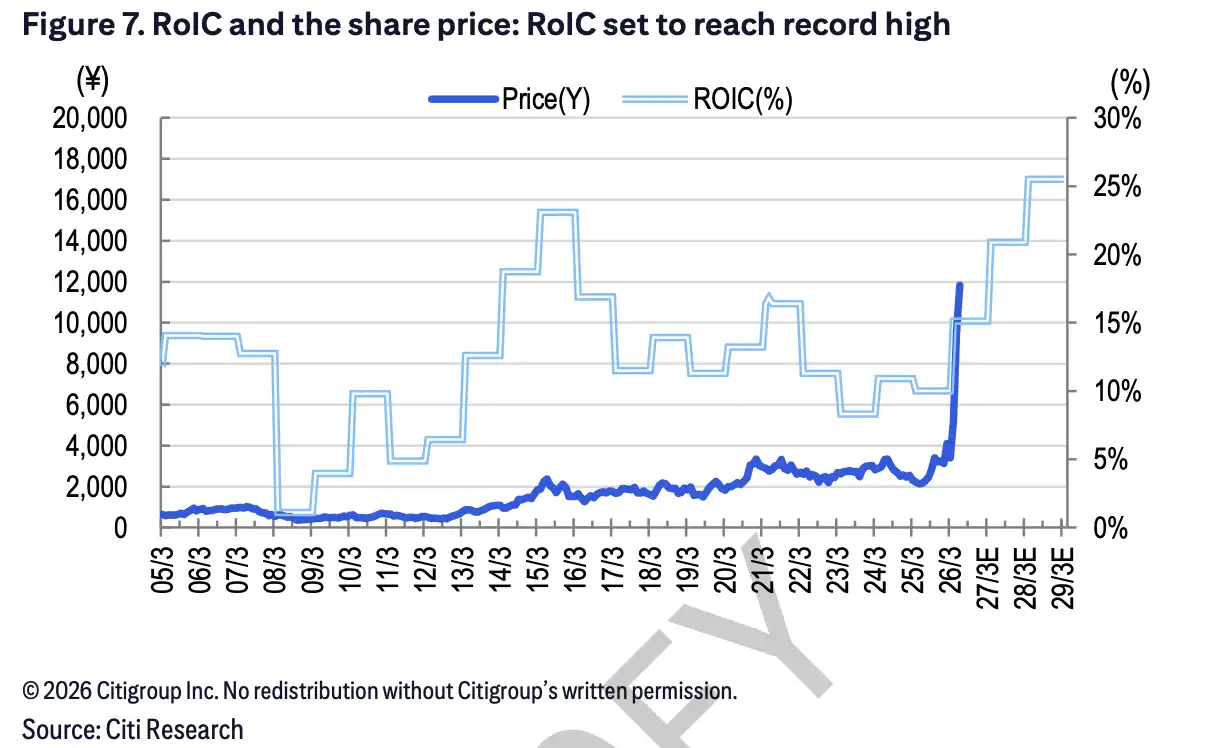
RoIC is expected to rebound as AI server weighting increases, exceeding 25% in 2029, and the target price corresponds to the stock price surpassing previous highs.
The optimistic scenario in the report provides greater elasticity: if the yen depreciates to ¥170 against the US dollar and AI demand continues to exceed expectations, the Bull scenario target price could reach ¥20,000. Conversely, if servers enter inventory adjustment and the yen strengthens to ¥150 against the US dollar, the Bear scenario target price would be ¥9,000.
This also reminds investors that the current target price already includes a high AI realization requirement. AI server shipments, MLCC high-end supply, yen exchange rate, and valuation tolerance will all affect the ultimate return.
The company has not yet implemented across-the-board price increases, disagreements remain on supply and demand and exchange rates
One easily misunderstood point is that the base scenario does not include a price increase across the entire product line.
The 1-3 month MLCC BB ratio has risen to 1.36, the highest in 10 years, and the market has at one point expected Murata to push for a broader price hike. However, the company's management has stated in recent earnings conference calls, analyst roundtables, and a June 17 interview with Nikkei that there are currently no plans for a comprehensive price increase driven by supply and demand.
This means that the current profit upgrade mainly comes from the increased proportion of high-end products in AI servers, that is, "natural ASP improvement," rather than assuming Murata will raise prices across the entire MLCC product line.
If there is indeed a price increase of over 10% across the entire product line in the future, the operating profit for the quarter ending in March 2029 could reach ¥9.2 trillion, corresponding to a fair stock price of about ¥18,000. However, this is not the base case scenario. It still depends on whether the BB ratio can be maintained at a high level, if competitors will follow suit, if customers will accept the price increase, and if the expansion of production will alleviate the degree of supply-demand tightness.
The risks are also concentrated in these areas: a slowdown in AI server demand, adjustment of GPU server inventory, Murata's production expansion falling short of expectations, or a significant fluctuation in the yen exchange rate, all of which would weaken the basis of this round of profit upgrades. For a valuation already trading at 43 times the estimated 2029 earnings per share, the AI server narrative needs to continue to materialize, rather than just relying on a one-time target price increase.
Welcome to join the official BlockBeats community:
Telegram Subscription Group: https://t.me/theblockbeats
Telegram Discussion Group: https://t.me/BlockBeats_App
Official Twitter Account: https://twitter.com/BlockBeatsAsia