Goldman Sachs Analysis: Traditional DRAM Supporting AI Memory, HBM Prices Could Increase by 44% Next Year?

TL;DR
· Goldman Sachs' June DRAM Sentiment Index remains "mildly positive," raising Samsung's 2027 HBM price hike expectation from 14% to 44%.
· Spot price of DDR5 has increased by 20% since May, trading at a 25% premium to May contract prices, with the traditional DRAM price hike setting a higher reference for HBM negotiations.
· South Korea's exports and South Asia's revenues support the optimistic outlook, but with weak smartphone demand, the 44% price hike is still a forecast rather than company guidance.
Goldman Sachs maintained a "mildly positive" outlook on the industry in the DRAM Sentiment Index released on June 30 and raised its forecast for Samsung Electronics' 2027 HBM price growth from the previous 14% to 44%.
This is not a realized price hike or guidance provided by Samsung; rather, it is a prediction made by Goldman Sachs based on HBM supply and demand, traditional DRAM prices, and downstream demand. It is worth noting because HBM is high-bandwidth memory paired with GPUs in AI servers, directly impacting supply to NVIDIA, AMD, and other AI accelerator card manufacturers, and also determining the profit margins of Samsung, SK Hynix, Micron, and other memory manufacturers next year.
A more immediate change comes from traditional DRAM. According to Goldman Sachs' tracking, the spot price of DDR5 has risen by 20% since May 1, trading at a 25% premium to May contract prices. DDR4 saw an 11% increase during the same period, trading at a 45% premium to May contract prices. As the price hike in standard DRAM becomes more pronounced, the reference price for next year's HBM contract negotiations has also been raised.
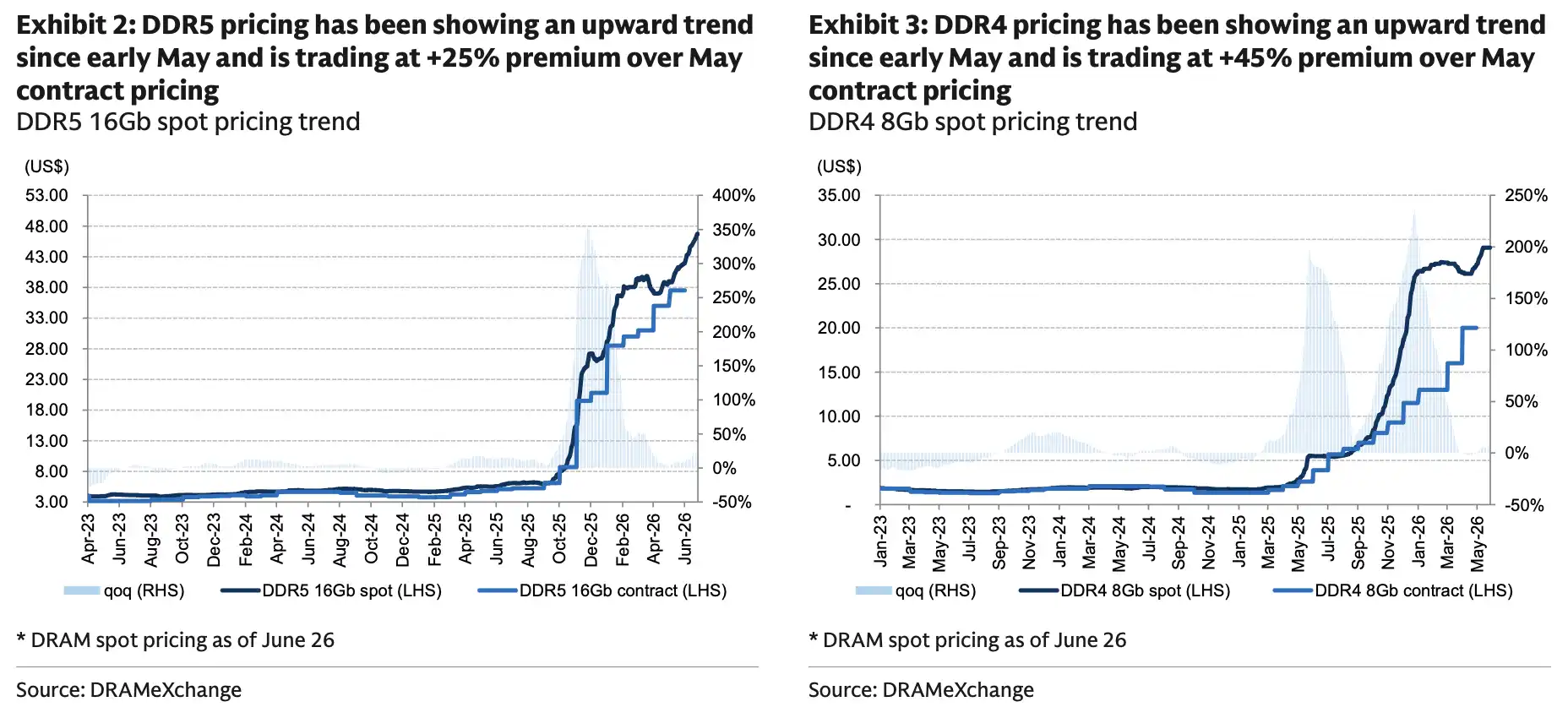
DDR5 has increased by 20% since May, trading at a 25% premium to contract prices; DDR4 has increased by 11%, with a 45% premium.
HBM Price Hike Expectation Raised, Traditional Memory Getting Costlier
The most impactful adjustment in this report is the revision of Samsung's 2027 HBM price growth expectation from 14% to 44%. In Goldman Sachs' model, if HBM supply remains tight, and the price gap between traditional DRAM and HBM continues to widen, this forecast may see further upward revisions.
The logic behind this adjustment is not complex. With prices of traditional memories like DDR5 and DDR4 continuously strengthening, memory manufacturers will have a stronger bargaining position when negotiating next year's HBM supply agreements with cloud and AI chip companies. HBM's production conversion is more challenging, with longer customer certification cycles and lower supply elasticity compared to standard DRAM. If AI server demand continues to grow, price negotiations are more likely to favor the seller.
In June, the DRAM Sentiment Index remained "Mildly Positive," consistent with April. Spot prices, server-related revenue, South Korean exports, Taiwanese manufacturers' revenue, and other sub-indicators are still trending upwards. The drag mainly comes from the second-order change in Samsung's DRAM average selling price growth rate, indicating that the price increase momentum may slow down after the second quarter, but the absolute price remains in an upward trend.
Here, we need to distinguish between two perspectives. The 44% refers to Goldman Sachs' forecast for Samsung's 2027 HBM price growth, not the actual price quotation that has been implemented. The "potential for further increases" is also based on the assumption that HBM supply and demand will remain tight, and traditional DRAM prices will continue to be robust.
Export and Revenue Data Supporting the Price Increase Narrative
In addition to price increases, the export and revenue data for May are reinforcing the view of a warm storage cycle.
Official Korean data already reveals the strength of DRAM exports. KITA's data shows that in May 2026, South Korea's total exports amounted to $87.8 billion, a year-on-year increase of 53.2%. DRAM exports were $18.6 billion, a YoY increase of 369.8%, while NAND exports saw a 206.8% YoY growth.
Goldman Sachs also indicates that South Korea's DRAM export revenue in May increased by 21% compared to the previous month, significantly exceeding the level before March. While this MoM and record-high judgment rely on the source report's perspective, they align with the official year-on-year growth direction.
Taiwanese manufacturers' data more directly reflect DDR4 price elasticity. Nanya Technology's announcement shows that in May 2026, consolidated revenue reached NT$27.67 billion, an 8.55% MoM increase and a 730.14% YoY increase, maintaining high growth for several consecutive months. Distributor WPG Holdings, tracked by Goldman Sachs, saw a 253% YoY revenue increase in May and a 54% MoM increase. These data illustrate that the price increase is not just a change on the quotation screen but has already been reflected in some manufacturers' revenue.
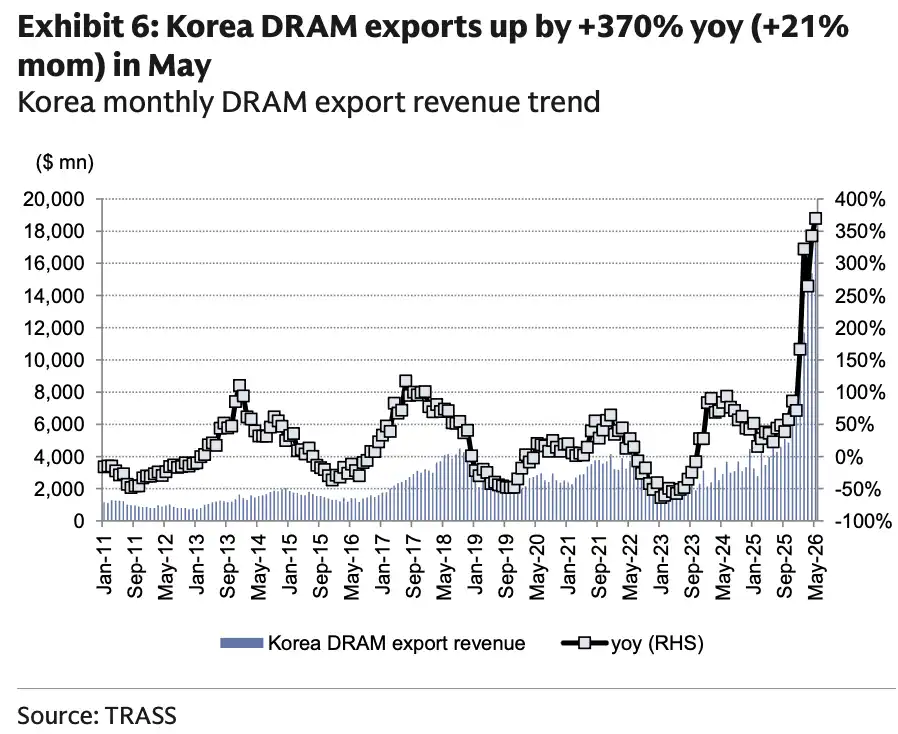
South Korea's DRAM export revenue in May grew by 370% YoY and 21% MoM, reaching another record high.
The server chain is also providing demand-side support. According to Goldman Sachs' tracking data, Taiwanese server ODM manufacturers' monthly revenue in May increased by 53% YoY, driven by the shipment increase of rack-level AI servers and ASIC AI servers. The world's major server BMC supplier, Quanta Computer, saw a 69% YoY revenue increase in May, continuing to grow on top of a high base from the same period last year.
This set of data collectively points to one conclusion: the demand for AI servers and traditional servers is still absorbing higher memory prices. As long as the downstream market is willing to accept the price increase, storage vendors will have a strong position in negotiating the 2027 HBM contracts.
DDR5 Up by 20%, More Critical Than a Single HBM Story
Compared to discussing HBM alone, the performance of DDR5 spot prices is more telling of this expected adjustment.
DDR5 is the mainstream memory specification in servers and high-end PCs, and is also an important part of AI server systems besides HBM. Since the beginning of May, DDR5 spot prices have risen by 20%, surpassing the May contract price by 25%. The spot market's willingness to buy at a higher price usually puts pressure on subsequent contract price negotiations.
DDR4 is also not falling behind. Although DDR4 is not the latest generation of memory, there is still demand for it in certain server, PC, industrial control, and consumer electronics scenarios. After a supply contraction, prices of older product lines are more easily driven up. DDR4 spot prices have risen by 11% since May 1, commanding a 45% premium over the May contract price, showing that tension is not only occurring in high-end memory.
For storage vendors, a traditional DRAM price increase holds two layers of significance. First, it improves current revenue and profit, and second, it alters the relative price relationship with HBM. If ordinary DRAM prices rise, HBM, as a higher-end and scarcer product, will have less room for price discounts, making it easier for next year's price hike expectations to be accepted.
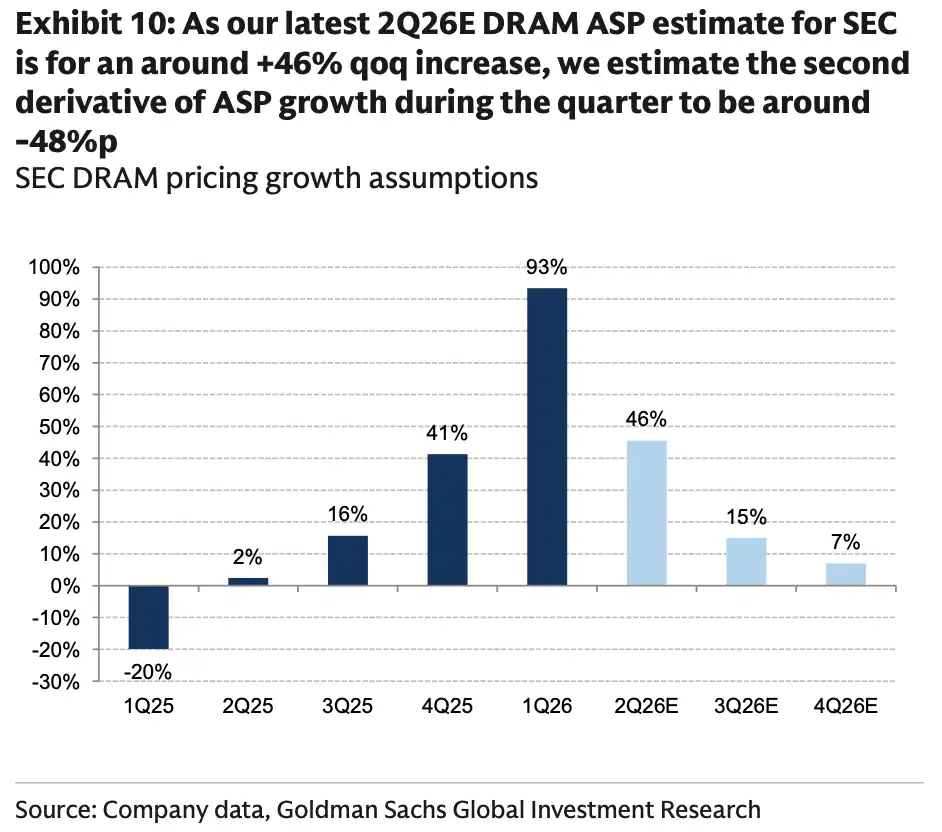
Samsung's 2Q26E DRAM ASP is expected to increase by approximately 46% QoQ, with growth slowing to 15% and 7% in 3Q26E and 4Q26E, respectively.
However, the pace of price increases is not a continuous acceleration. Goldman Sachs estimates that Samsung's average selling price of DRAM in 2Q26E is expected to increase by about 46% QoQ, followed by slower growth of 15% and 7% in 3Q26E and 4Q26E, respectively. Prices may still continue to rise, but the fastest growth phase may occur in the second quarter, and the rapid growth in the second quarter cannot be directly extrapolated to the whole year.
Sluggish Mobile Demand, Target Price Also Depends on Price Increase Fulfillment
The DRAM price hike story also has a limitation: not all segments of end demand are synchronously warming up.
According to the Goldman Sachs China team's tracking, Chinese smartphone shipments increased by 19% YoY and 7% MoM in May, marking two consecutive months of year-on-year growth. However, the cumulative shipment volume in 2026 is basically flat compared to 2025, with 2Q26 shipments still expected to decline by 14% YoY, mainly due to the rise in memory prices potentially dampening end demand. Public institutions have different statistical methodologies for tracking Chinese smartphone sales, with Counterpoint previously mentioning a 16% YoY decline in Chinese smartphone sales during the May Day period.
Price increases themselves may in turn suppress some consumer electronics demand. AI servers and cloud providers are more capable of bearing high memory prices, but if end devices such as smartphones and PCs cannot smoothly pass on the cost, they may reduce purchases, lower configurations, or postpone restocking.
Samsung Electronics remains one of the most direct publicly listed companies in this theme. Goldman Sachs maintains a "Buy" rating for Samsung's common and preferred stocks, with a 12-month common stock target price of 480,000 Korean won and a preferred stock target price of 360,000 Korean won. This target price is Goldman Sachs's own forecast, not a consensus market expectation, and is clearly influenced by assumptions about storage prices in 2026 to 2027.
The downside risks are also clear: a significant deterioration in memory supply and demand, a sharp contraction in smartphone profit margins, and a loss of market share in mobile OLED. If AI server demand falls short of expectations, or if the traditional DRAM price increase overwhelms part of the end device demand, the expected 44% price growth for HBM next year may be revised downward. The spot price increase of traditional DRAM, a surge in Korean exports, and a sharp rise in Taiwanese manufacturers' income are currently supporting expectations for this price hike, but whether it can be realized ultimately depends on AI server demand, the speed of HBM supply release, and whether consumer electronics can bear more expensive memory.
Welcome to join the official BlockBeats community:
Telegram Subscription Group: https://t.me/theblockbeats
Telegram Discussion Group: https://t.me/BlockBeats_App
Official Twitter Account: https://twitter.com/BlockBeatsAsia
 Related Articles