JPMorgan Deciphers South Korea's AI Strategy: Doubling Down on Memory, Samsung and SK Pin the Shortage to 2040
TL;DR
· The South Korean government, together with Samsung and SK, has launched a plan worth about $3.1 trillion to double memory capacity within five years.
· Samsung is focusing on Pyeongtaek and HBM backend, while SK is ramping up memory and a 15GW-class AI data center.
· Equipment, power, and EPC suppliers will benefit first, but memory cycle and pricing litigation continue to dampen short-term sentiment.
The South Korean government, Samsung Group, and SK Group have unveiled a combined AI semiconductor investment plan totaling around 475.5 trillion KRW, equivalent to about $3.1 trillion, with the goal of doubling memory capacity over the next five years and significantly accelerating the production pace of the Pyeongtaek advanced manufacturing cluster.
This is not just a regular expansion. AI servers are driving up demand for HBM, DRAM, and some NAND, with memory manufacturers having gained stronger pricing power over the past two years, causing customers to worry about short-term price spikes and shortages. South Korea's answer this time is to use a long-term capital expenditure spanning until 2040 to seize the next round of AI memory supply.
JPMorgan's interpretation of this plan states that out of the total $3.1 trillion investment, about 60%-70% will go to frontend wafer manufacturing equipment, 20%-30% for infrastructure and cleanroom construction, and the rest to backend packaging. This means that the first to see orders may not only be the memory manufacturers themselves but also semiconductor equipment, power infrastructure, and semiconductor engineering procurement and construction suppliers.
But the market reaction is not just excitement. The stock prices of the two major Korean memory manufacturers showed weakness on the day, underpinned by the same question: if high profits come from scarcity and price hikes, once a massive expansion is implemented, will the memory cycle turn back to suppress profits?
Samsung Bets on Pyeongtaek, SK on Memory and AI Infrastructure
This plan comes from the South Korean Ministry of Trade, Industry and Energy's proposal of the "Three Major Super Project Plan," with semiconductors, AI robots and physical AI, and AI data centers listed as the three major growth pillars. For the capital market, the truly impactful part is the scale and timeline of the semiconductor section.
Samsung Group announced an investment of about 265.5 trillion KRW in South Korea, with Samsung Electronics investing approximately 245 trillion KRW from 2026 to 2040, with about 210 trillion KRW in the semiconductor sector. The core investment is in the Pyeongtaek cluster and existing factories, totaling about 165 trillion KRW; it also includes investments in the new manufacturing hub in Gwangju, HBM backend packaging in Giheung, Yashan, and Usan, as well as the Gwacheon physical AI and humanoid robot production lines.
The total investment provided by the SK Group is approximately 210 trillion Korean won, with around 110 trillion Korean won allocated to the memory sector and about 100 trillion Korean won to AI infrastructure. The memory portion includes about 60 trillion Korean won for the Hwaseong plant, around 10 trillion Korean won for the Cheongju NAND expansion, and approximately 40 trillion Korean won for the next-generation semiconductor cluster in the southeastern region. The startup of the fourth factory in Hwaseong has been accelerated by about 12 years.
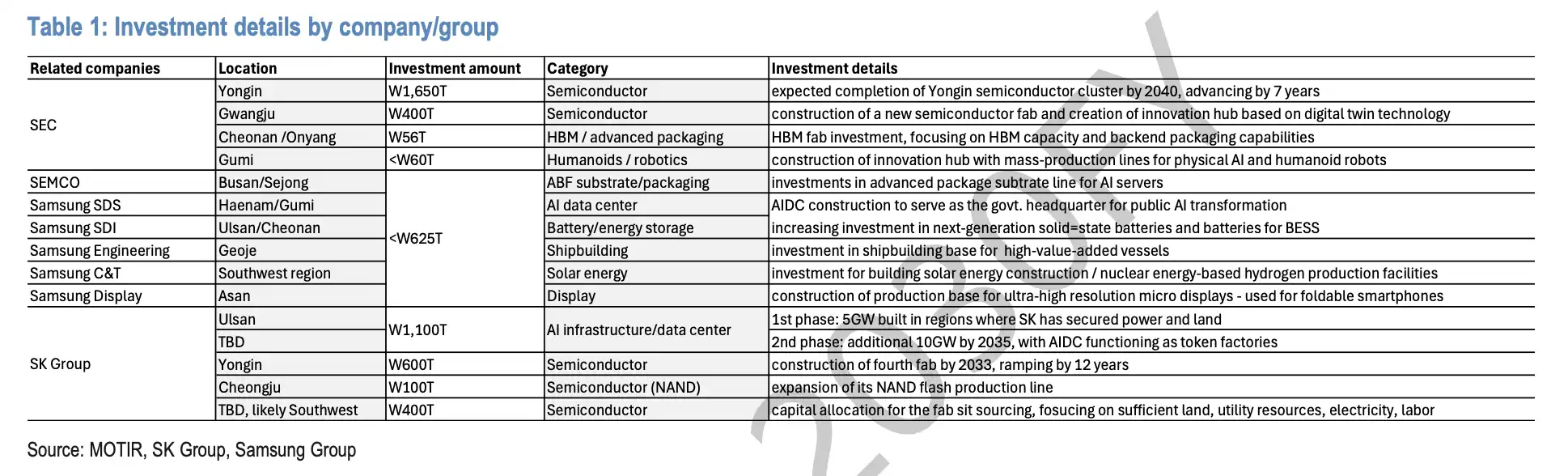
Another focus area for SK is AI data centers. The group plans to build 15GW data centers by 2035, with the first phase being 5GW and the second phase 10GW. It is redefining data centers from traditional "storage assets" to "token-generating" AI factories, indicating that memory manufacturers are trying to position themselves closer to AI infrastructure.
This is also an issue that the South Korean government hopes to solve with "speed": not waiting for shortages to become fully apparent before expanding production, but rather proactively securing capacity, land, power, and supply chains while the demand for AI servers is still increasing.
Supply Only Enough for Half of Demand, Production Pressure Comes from AI Servers
Executives in the memory industry have recently emphasized publicly multiple times that the current supply can only meet half of the demand, and the shortage may worsen in the coming years. This assessment explains why South Korea is willing to launch a decade-spanning expansion plan.
AI training and inference clusters require more HBM, which will also drive the demand for high-end DRAM and server storage. While the traditional consumer electronics cycle will continue to fluctuate, AI servers are reshaping the memory demand structure: memory is no longer just an accessory for PC and mobile phone shipments but rather one of the bottlenecks in AI computing expansion.
JPMorgan's estimate shows that the current investment scale is equivalent to more than twice the installed WSPM capacity of the existing DRAM; the speed of constructing new 1nm-level capacity will be several times that of the past decade. In other words, South Korea is not marginally increasing production capacity but preparing for a much larger-scale AI memory cycle.
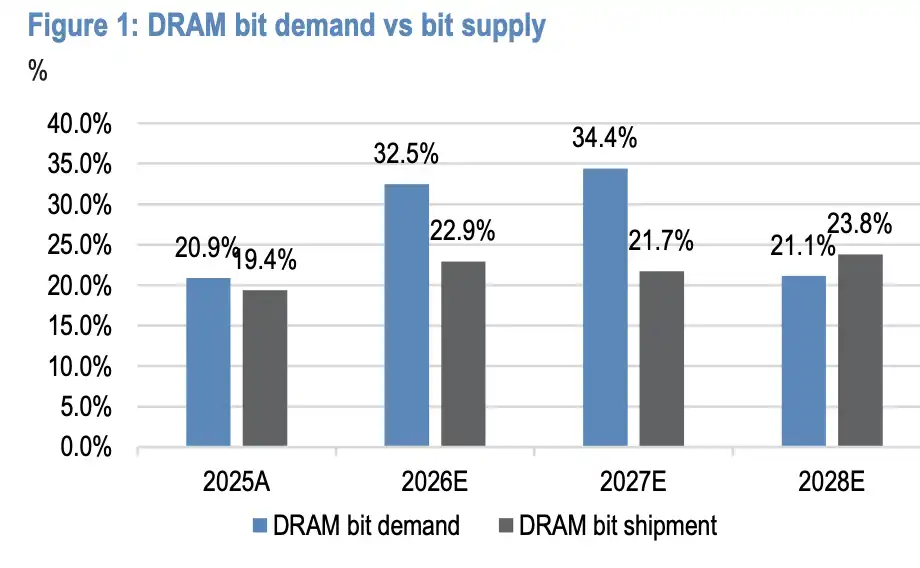
The DRAM bit demand share is projected to increase from about 20.9%-22.9% in 2025A to around 32.5% in 2026E and about 34.4% in 2027E while the supply share lags behind.
NAND is also not completely left out. The storage demand brought by AI servers, enterprise SSD upgrades, and the high-performance data center's need for low-latency storage have all provided support for NAND in certain niche markets. However, compared to HBM, NAND is still more susceptible to traditional cycles and inventory impacts in the long run.
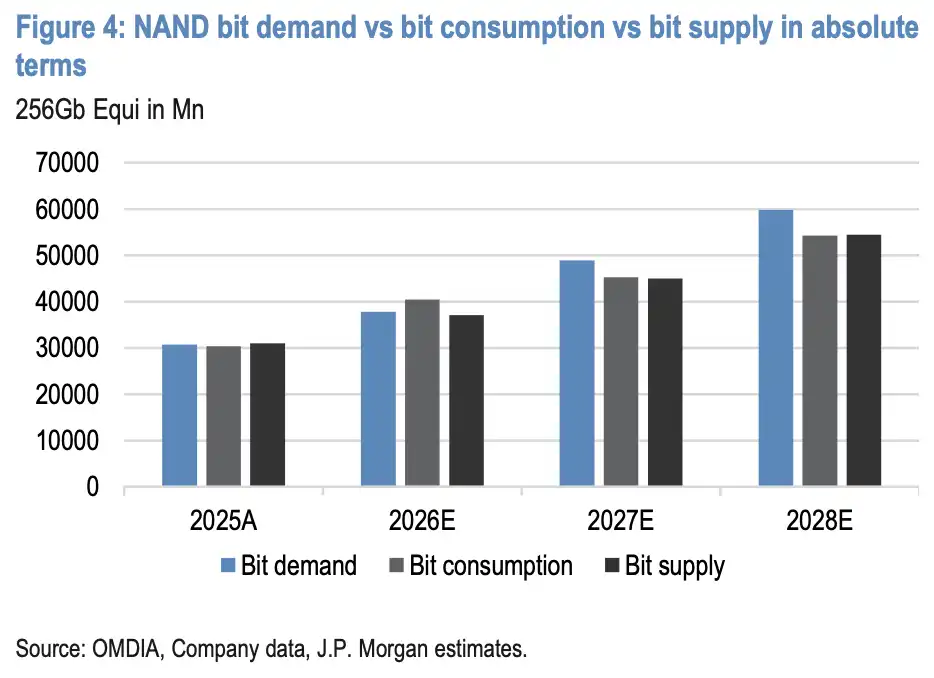
The NAND bit demand share is expected to increase from around 19.3% in 2025A to about 28.4% in 2027E, with the absolute value chart indicating demand outstripping supply.
Imagining Orders for Equipment, Power, and EPC
If 60%-70% of total investment flows to front-end wafer fabrication equipment, semiconductor equipment suppliers will be the most direct beneficiaries. The addition of advanced process DRAM and HBM-related capacity requires synchronous expansion of lithography, etching, deposition, cleaning, and metrology.
The second layer of beneficiaries is infrastructure and clean rooms. Advanced wafer fabs not only purchase equipment but also require land, power, water treatment, clean rooms, and facility systems. The AI data center segment further amplifies the power demand, with the 15GW target itself implying long-term investments in the grid, substations, cooling, and engineering.
This is also why the market is focusing on conglomerates' platforms or engineering and construction-related entities like SK Inc and Samsung C&T. While they may not directly sell memory, they could be involved in factory, energy, infrastructure, and EPC projects.
From a long-term narrative perspective, this plan aims to extend Korea's storage advantage to AI infrastructure: there is DRAM, HBM, and NAND on the front end, packaging on the back end, and data centers and power engineering externally. If AI-related memory demand continues to grow, Korean manufacturers can lock in customers with greater capacity and more complete infrastructure.
However, this long-term order of imagination does not equate to a definite short-term profit increase. Semiconductor equipment orders typically follow the pace of fab construction, and power and data center projects are more constrained by approval, grid connection, and construction cycles. The $3.1 trillion is not a one-time capital expenditure landing but a phased plan unfolding around 2040.
How Long Can High Profits Be Maintained, Market's Greatest Concern
The other side of this round of super investment is that the current high-profit allocation in the memory industry is facing increasing scrutiny.
The Apple-Micron dispute over short-term memory price surges has brought customer dissatisfaction to the surface. In the U.S., there have been consumer class-action lawsuits against the three major DRAM manufacturers Samsung, SK Hynix, and Micron, alleging artificial shortages and price hikes. While it has not yet escalated to a government investigation, the oligopolistic market structure of memory is already prone to triggering antitrust and pricing disputes during price surge cycles.
Historically, the DRAM industry faced fines and criminal penalties in the early 2000s due to cartel cases; similar supply restriction lawsuits also appeared in 2016-2017. The outcome of the current cases remains uncertain, but it serves as a reminder to the market: when supply constraints lead to excess profits, legal and reputational risks also rise simultaneously.
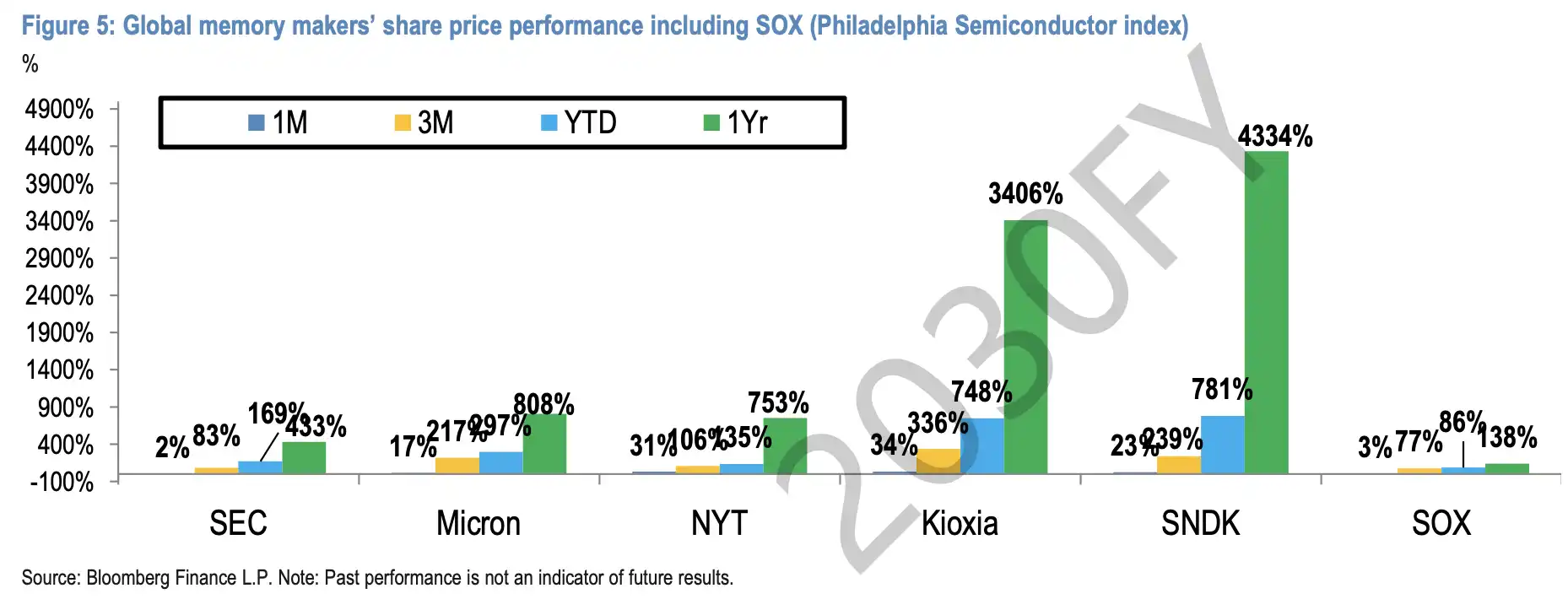
Global memory stocks have risen sharply in the past year; the chart simultaneously shows the 1-month, 3-month, and YTD performance of SEC, Micron, Kioxia, SK Hynix, and the SOX index.
This explains why after the news was announced, Korean memory stocks did not simply trade on the "large investment = long-term positive" thesis. Capacity expansion is usually seen as good news in the early to mid-stage of a cycle, as it signals strong customer demand and high order visibility; however, if the market is concerned that supply will eventually catch up with or even exceed demand, the same capacity expansion may also be interpreted as future price pressure.
The timeframe of Korea's bet this time is too long. By 2040, AI server demand, HBM technology roadmap, customer capex, U.S. and China supply chain policies, power and land constraints may all change the project's pace. The most impactful goal is to double capacity in the next five years, but what will truly determine memory manufacturers' profits is whether the pace of supply release can keep up with demand, rather than the total investment amount announced at once.
Therefore, this plan is more like Korea's long-term bet on AI memory scarcity: infrastructure, power, and EPC are given room for imagination, while Samsung and SK strengthen their global supply positions; however, memory prices, customer rebounds, litigation risks, and cycle reversals will still determine how far this $3.1 trillion story can go.
Welcome to join the official BlockBeats community:
Telegram Subscription Group: https://t.me/theblockbeats
Telegram Discussion Group: https://t.me/BlockBeats_App
Official Twitter Account: https://twitter.com/BlockBeatsAsia
 Related Articles