Citi Analysis: KnightX Target Price Doubled, NAND Shortage Could Last Until 2027

TL;DR
· Citigroup has raised its Kioxia target price from 73,000 yen to 140,000 yen, maintaining a Buy/High-Risk rating, implying approximately 35% upside from the June 25 closing price.
· This upward revision is based on the bet that NAND supply-demand tightness will continue until 2027, with long-term agreements raising prices and shipment visibility, driving Kioxia's valuation discount narrowing.
· Micron's performance validates the short-term price hike, but whether Kioxia can sustain a profit margin of over 80% still depends on LTA execution, supply discipline, inventory cycles, and the yen exchange rate.
Citigroup significantly raised its target price for Kioxia Holdings on June 25, from 73,000 yen to 140,000 yen, while maintaining a 'Buy/High-Risk' rating. Based on Kioxia's June 25 closing price of 103,850 yen, the new target price implies approximately 34.8% upside; adding an expected dividend yield of about 1.0%, the expected total return is around 35.8%.
The core of this upward revision is not just the nearly doubled target price but Citigroup's view that this NAND price hike will last longer. The report bets on AI and cloud vendors driving enterprise SSD demand, with limited supply releases, and long-term procurement agreements expected to enhance manufacturers' visibility of future prices and shipments. In other words, the market now needs to assess whether Kioxia's current high-profit phase is only a rebound in the storage cycle or if it can extend into a high-profit cycle until 2027.
For a NAND flash memory manufacturer, this question is critical. Kioxia has long been constrained by storage price fluctuations, with significant profit elasticity, but profits decline rapidly when the cycle turns down, leading to a long-term valuation discount. Citigroup's target price increase this time is actually a bet on NAND shortages, long-term agreements, and valuation repair occurring simultaneously.
Citigroup Doubled the Target Price Not Just Because of NAND Price Hike
Citigroup's target price increase this time comes from two changes: profit forecasts have been significantly raised, and the valuation benchmark has been shifted.
Previously, Citigroup's valuation basis for Kioxia was the FY3/27 EPS forecast, with an 8x P/E ratio applied. The latest model has transitioned to FY3/28, with EPS calculated at around 12,742 yen, and a P/E ratio of 11x, leading to the target price rising from 73,000 yen to 140,000 yen.
The implication of this change is that Citigroup no longer sees the current NAND price hike as a short-term rebound. With expanded coverage of long-term agreements, the visibility of Kioxia's future profits may increase, and the market's previous discount on storage companies could also partially narrow.
Long-term agreements are crucial in the storage industry. In the past, NAND prices were prone to significant fluctuations along the supply-demand cycle, causing manufacturer profits to fluctuate dramatically as well. If more customers adopt long-term agreements, especially those with more stringent procurement arrangements, manufacturers can secure a portion of demand earlier, and prices and shipments will no longer be fully exposed to short-term spot cycles.
This is the key to Citigroup raising the valuation multiple from 8 times to 11 times. If long-term agreements truly dampen profit volatility, the market may no longer value the company, like Kioxia, solely based on the traditional strong cyclical company metrics.
However, the "High Risk" rating is still maintained. A target price revision does not necessarily indicate reduced risk; Kioxia's stock price will continue to heavily depend on NAND prices, customer order visibility, macroeconomic conditions, and exchange rate fluctuations.
With Over 80% Profit Margin, the Bet is on NAND Price Sustainability
Citigroup's profit forecast for Kioxia for the next two years is the most aggressive part of this upgrade.
Based on the report, Kioxia's FY3/27 revenue is expected to reach 9.463 trillion yen, with an operating profit of 7.68 trillion yen, and the operating profit margin to rise to 81.2%. The operating profit for FY3/28 is further increased to 9.7 trillion yen.
The significant change comes from prices rather than just shipment growth. Citigroup predicts that in FY3/27, Kioxia's bit shipment volume will increase by 20% year-on-year, but the ASP will rise by 261% year-on-year. This means that profit elasticity is mainly driven by the increase in NAND prices rather than by shipment expansion.
The quarterly pace is also aggressive. Citigroup forecasts that in FY3/27 Q1, Kioxia's ASP will increase by 69% QoQ, followed by an 18% QoQ increase in Q2, maintaining the operating profit margin between 77% to 82%. For a storage chip company, these are very high-profit margin assumptions.
Three things need to happen simultaneously for this scenario to materialize: NAND supply remains tight, enterprise-level SSD demand from data centers stays strong, and long-term agreements can keep prices and shipments stable at a high level.
If these three conditions are met, Kioxia will continue to benefit from the price hike cycle over the next few quarters. However, if any of these factors falter, such as customers starting to delay purchases, industry supply being released again, or long-term agreements not being executed as expected, the 80%-plus operating profit margin will be questioned by the market.
Micron Validates Price Hike Signal, But Not a Direct Comparison to Kioxia
Micron's latest performance provides corroborating evidence for the NAND price increase.
As of the fiscal quarter ending on May 28, 2026, Micron's NAND revenue reached $9.9 billion, representing a 99% quarter-over-quarter growth mainly driven by price increases. The company's third-quarter non-GAAP gross margin hit 84.9%, with a non-GAAP operating margin of 81.2%, and the guidance for the next quarter remains strong.
This indicates that the NAND price hike is not a phenomenon unique to a single company. Strong demand for data center SSDs, limited supply release, and customer acceptance of higher prices have translated into storage vendors' revenue and profit margins.
For KnightX, Micron's performance reaffirmed Citigroup's industry view: this round of price increases is supported by real demand, not just short-term trading sentiment.
However, Micron cannot be directly equated with KnightX. Different manufacturers have product structures, customer portfolios, contract terms, cost structures, and exchange rate exposure that are not exactly the same. Micron's disclosed tight procurement arrangements also do not mean that all customers in the industry have accepted the same terms.
Therefore, how much profit KnightX can realize in the next two years still depends on its own long-term agreement coverage, term enforcement, and whether customers are willing to continue to lock in volume in a high-price environment. Citigroup's optimistic outlook is based on the continuation of the tight NAND market until 2027, the ongoing progress of long-term agreements, rather than a single quarter of price increases being sufficient to support an overall valuation adjustment.
Bull Market Sees 157,000 Yen, Bear Market May Fall to 80,000 Yen
The scenario range provided by Citigroup shows that KnightX is not a one-sided deterministic story.
In the base scenario, Citigroup's target price is 140,000 yen. The bull market scenario's target price is 157,000 yen, representing approximately 51% upside, mainly assuming further expansion of valuation multiples. The bear market scenario's target price is 80,000 yen, about 23% lower than the closing price on June 25, primarily corresponding to ASP growth below expectations and a contraction of valuation multiples.
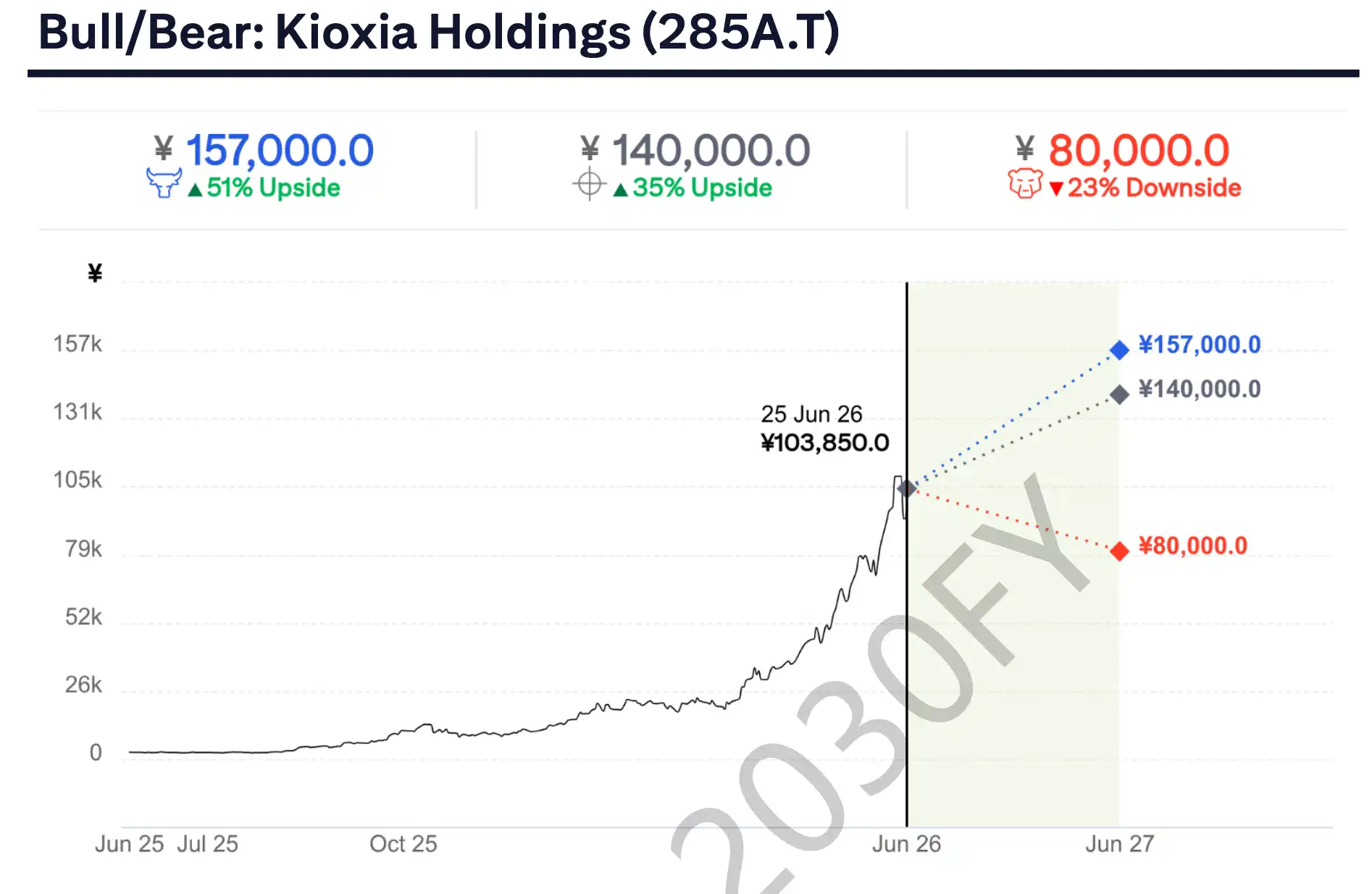
This range serves as a reminder to investors that the current stock price already partially reflects the NAND price increase and valuation discount recovery. If ASP continues to rise in subsequent quarters and long-term agreements are more strongly executed, the market may accept a higher valuation. However, if the pace of price hikes slows down, profit forecasts could come under pressure quickly.
KnightX's historical stock price performance also explains why the market will not easily assign a full valuation to such companies. When storage prices rise, profit elasticity is significant; however, once entering inventory adjustments or production expansion cycles, profits can quickly decline. Citigroup maintains a "high risk" rating precisely because this round of increase is still based on the assumption of a strong cyclical industry.
Profit Margin Must Be Maintained, While Avoiding Supply and Exchange Rate Shocks
The most direct risk still comes from the supply side.
If the US eases restrictions on semiconductor equipment exports to China, Chinese or other manufacturers could enhance their production capacity, potentially disrupting the tight NAND supply-demand balance. If large corporations accelerate capital expenditure again, it would also weaken the sustainability of price hikes.
The demand side should not focus solely on data centers. Enterprise SSDs have been a key support for this round of price increases, but smartphones are still a significant part of NAND demand. Once smartphones experience a seasonal slowdown or data center customers undergo temporary inventory adjustments, the high ASP assumption will come under pressure.
Exchange rates are also a variable that cannot be ignored. According to Citi's model, for every 1-yen appreciation of the Japanese yen, operating profit will be eroded by approximately 40 billion yen. After operating profit forecasts have been raised to the tens of billions of yen level, the impact of exchange rate fluctuations on market sentiment will become more pronounced.
Shareholder returns are not the main reason for this target price increase. Citi's forecast does not yet include share buybacks, and the likelihood of short-term buybacks is low. Dividends are expected to start in the second half of FY3/27, with an annual dividend per share of approximately 1,000 yen for FY3/27. In other words, the current target price increase is mainly based on profit and valuation, rather than a significant increase in buybacks or dividends.
This significant target price increase by Citi aligns NAND price hikes, long-term agreements, and valuation discounts repair on the same path. The real question is whether this path can hold until 2027.
If the NAND shortage persists, LTAs gain more strength, and supply discipline is maintained, profits could continue enjoying high elasticity. However, if any link in the chain of long-term agreements, data center demand, or supply discipline weakens, the over 80% operating profit margin would be the first to be questioned. Citi is betting on a longer NAND high-profit cycle, and what the market will now test is how far this cycle can go.
Welcome to join the official BlockBeats community:
Telegram Subscription Group: https://t.me/theblockbeats
Telegram Discussion Group: https://t.me/BlockBeats_App
Official Twitter Account: https://twitter.com/BlockBeatsAsia
 Related Articles