Citi Analysis: Micron Target Price Raised to $1200, AI Memory Price Increase Has Not Stopped

TL;DR
· Micron's May quarter revenue, profit margin, and August quarter guidance all beat expectations, leading to a big surge in after-hours stock price.
· Citigroup maintains a $1200 target price, betting on HBM, high-end DRAM, and long-term supply agreements.
· This upward trend is still cautious due to competitive expansion and slow AI capital spending, with 2027 pricing not yet locked in.
After Micron reported its performance for the third quarter of fiscal year 2026, Citigroup maintained a Buy rating and a $1200 target price. Micron's June 24 announcement revealed that revenue for the quarter ending May 28 was $41.456 billion, non-GAAP EPS was $25.11, and non-GAAP gross margin was 84.9%, all above market expectations. Reuters and Investing.com after-hours trading on the same day showed Micron's stock price surged about 13%.
The core reason Citigroup is maintaining a high target price this time is not just Micron's quarterly performance beating expectations, but whether AI server demand is pulling the storage cycle to a higher position. Tight supply of HBM and high-end DRAM, along with multi-year customer agreements, is leading the market to believe that Micron's profitability may no longer be estimated solely based on the traditional storage cycle.
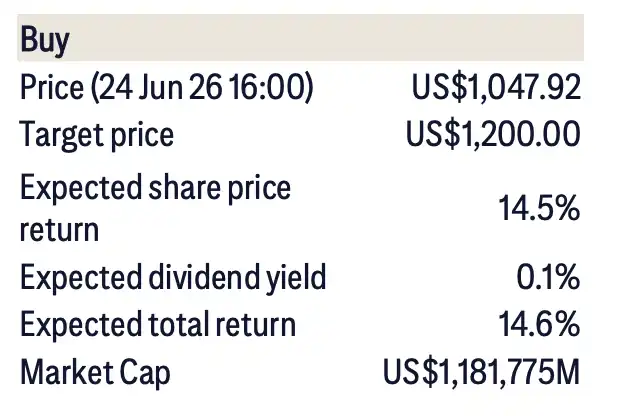
The current price used in Citigroup's research report is $1047.92, and the $1200 target price corresponds to approximately 14.5% upside potential in the stock price. The valuation is based on 10 times the expected EPS for 2027, with a key assumption that HBM pricing will continue to rise in 2027 and more long-term supply agreements will be finalized.
Performance Mostly Upgraded, Gross Margin Near 85%
Micron's May quarter revenue was $41.456 billion, close to Citigroup's rounded-up figure of $415 billion in the research report, higher than Citigroup's estimated $35.5 billion and FactSet's consensus of $35.9 billion. The official disclosed non-GAAP EPS was $25.11, surpassing the market consensus.
The margin better illustrates the strength of this supply-demand cycle. Micron's official disclosure shows that the May quarter GAAP gross margin was 84.6%, and the non-GAAP gross margin was 84.9%. For a storage company, while beating revenue expectations is important, a high gross margin indicates that price increases and product structure improvements are flowing through to the bottom line.
According to Citigroup's analyst assessment, DRAM remains the largest source of growth. DRAM revenue for the May quarter was approximately $31.3 billion, higher than Citigroup's estimate of $28.4 billion and the market's expectation of $27.6 billion. NAND revenue was around $9.9 billion, also exceeding Citigroup's estimate of $6.9 billion and the market's expectation of $8.0 billion.
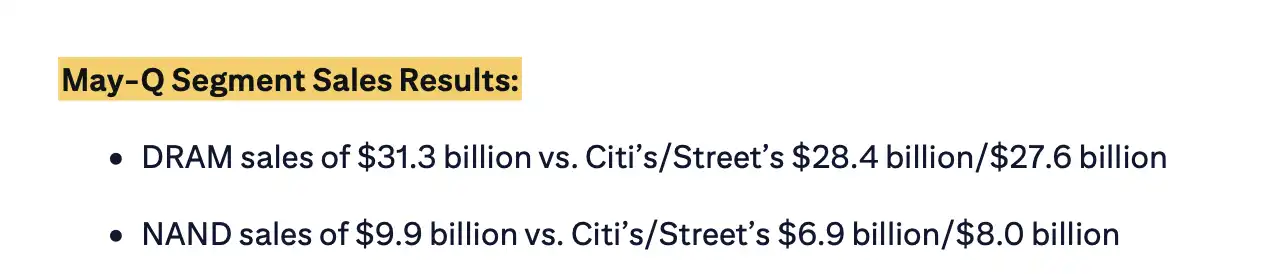
Viewed together, these numbers do not just focus on a single product line. The high-bandwidth memory requirements brought by AI servers have been the main driving force behind Micron's performance improvement. Traditional DRAM and NAND have not dragged down the overall performance either, but instead exceeded the model's expectations.
Stronger August Quarter Guidance, Market Betting on Continued Price Increases
What is more stimulating to the market than the May quarter is the August quarter guidance. Micron officially forecasts that the revenue for the fourth quarter of fiscal year 2026 will be $50 billion, with a fluctuation of $10 billion. The non-GAAP gross margin is around 86%, and non-GAAP EPS is $31.00, with a fluctuation of $1.00.
This guidance is significantly higher than the market's previous expectations. According to the Citigroup model, Micron's August quarter revenue is projected to be $50 billion, EPS to be $30.68, gross margin to be 85.7%, all exceeding the bank's previous estimates and consensus expectations.
For the storage industry, price increases, production discipline, and inventory levels determine profit elasticity. If AI servers continue to absorb HBM and high-end DRAM supply, Micron has the opportunity to maintain its profit expectations for 2027 at a high level.
HBM is not ordinary memory. It is directly tied to AI accelerators and high-end server shipments, with a long customer qualification cycle, tighter supply chain relationships, and easier price and supply rhythm lock-in through long-term agreements. If Micron can continue to improve HBM delivery, pricing, and customer coverage, the market will not just consider it as a traditional storage cyclical stock.
Behind the $1,200, It's HBM and Long-term Contract Lock-ins
Citigroup's $1,200 price target for Micron corresponds to 10 times the expected EPS for 2027, slightly higher than the historical DRAM upturn cycle valuation. Whether this premium can hold depends on whether HBM prices continue to rise and whether long-term supply agreements can enhance future revenue visibility.
The importance of long-term agreements lies in their ability to reduce the most common uncertainty in the storage industry. Traditional DRAM and NAND prices are easily affected by short-term supply and demand. Once customers destock, prices and gross margins may rapidly decline. However, in the AI server chain, high-end memory supply needs to be secured in advance, and customers are more willing to sign multi-year arrangements to ensure supply.
Micron has officially confirmed the existence of multi-year strategic customer agreements and disclosed the strategic and supply arrangements with Anthropic. As for the Dell-related long-term supply agreement mentioned in the Citigroup research report, the company or customer announcement should be the definitive source of information.
This type of agreement does not mean that profits have already been realized. Factors such as the coverage of the agreement, how the price mechanism adjusts, whether customer capital expenditures can continue to grow, will all affect the final revenue and gross margin. Especially in the AI supply chain, if cloud providers or server customers slow down their procurement pace, the assumption of HBM price increase will also be challenged.
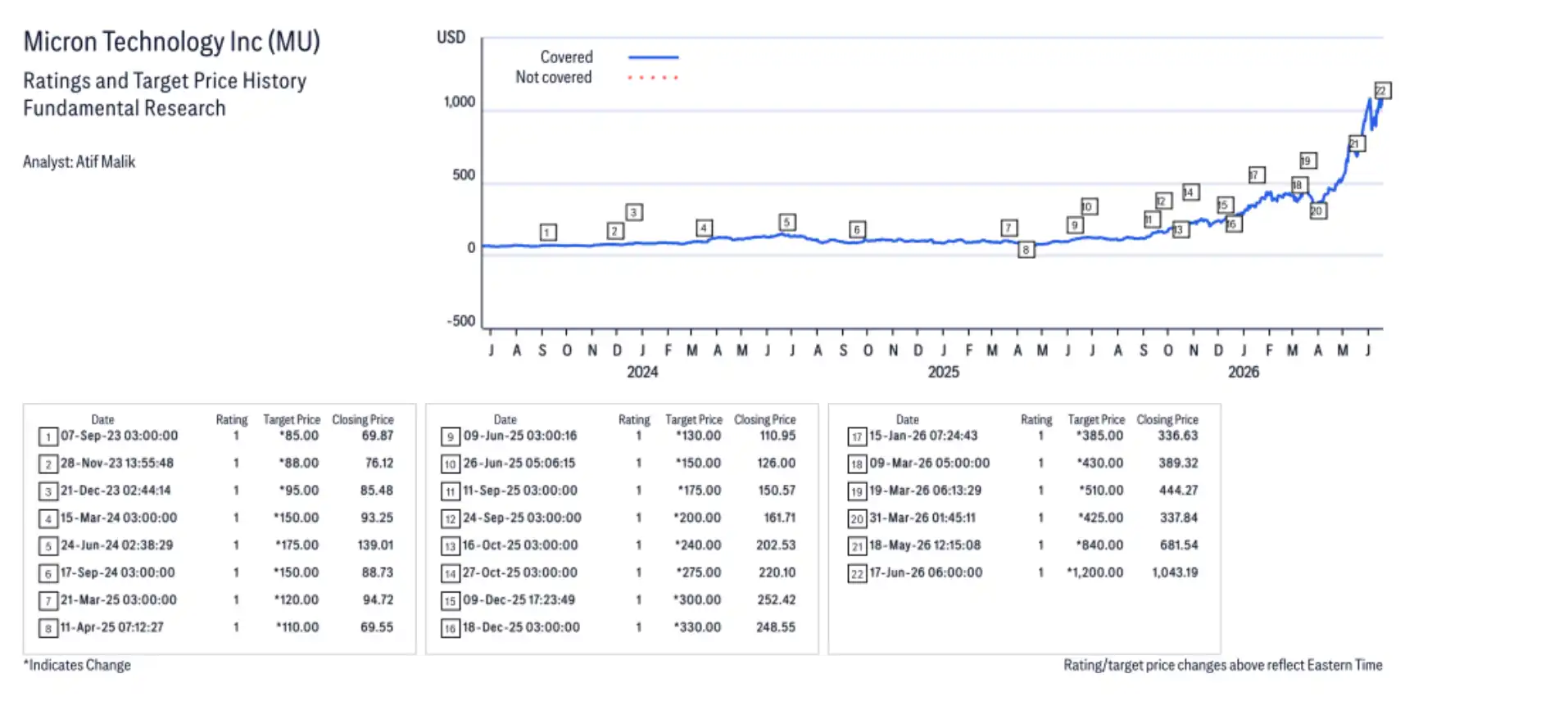
Micron rating and target price historical trend chart. It can be seen that since 2025, Citigroup has raised Micron's target price several times. Especially after entering 2026, the target price has been raised from $385, $430, $510 all the way to $840, and further increased to $1200 in June.
When Supply Increases, Price Becomes Unsustainable
The key to Micron's recent rally is that AI demand has led the market to believe that the storage industry is not just a traditional cycle. However, old issues have not disappeared. The storage industry is most afraid of suppliers expanding production simultaneously, eventually pushing the price hike cycle towards inventory accumulation.
If DRAM or NAND suppliers ship too much, channel inventory rises, price pressure will quickly be reflected in gross margins. If competitors' production expansion speed exceeds AI demand growth, Micron's profit assumptions for 2027 will be weakened, and the valuation premium corresponding to the $1200 target price will also be more difficult to sustain.
Another point of contention is how long AI capital expenditures can be sustained. The reason why the market is willing to pay a higher price for HBM is because AI server demand is strong, and high-end memory supply is tight. However, if AI chip shipments, server deployments, or cloud provider investments slow down, the optimistic expectations for storage demand will also cool down.
Micron's just-released strong performance has pushed the stock price closer to the target price and has left pressure on the next few quarters. August quarterly guidance needs to be met, HBM prices need to continue into 2027, and long-term agreements also need to truly translate into stable revenue. As long as competitive production expansion once again exceeds demand, the storage industry may still return to the old script of price decline.
Welcome to join the official BlockBeats community:
Telegram Subscription Group: https://t.me/theblockbeats
Telegram Discussion Group: https://t.me/BlockBeats_App
Official Twitter Account: https://twitter.com/BlockBeatsAsia
 Related Articles