Ethereum's Second Foundation - Can it Save Ethereum?

On June 23, several former Ethereum Foundation researchers established the non-profit organization Ethlabs, aimed at advancing Ethereum into the next stage of growth and preparing for institutional adoption.
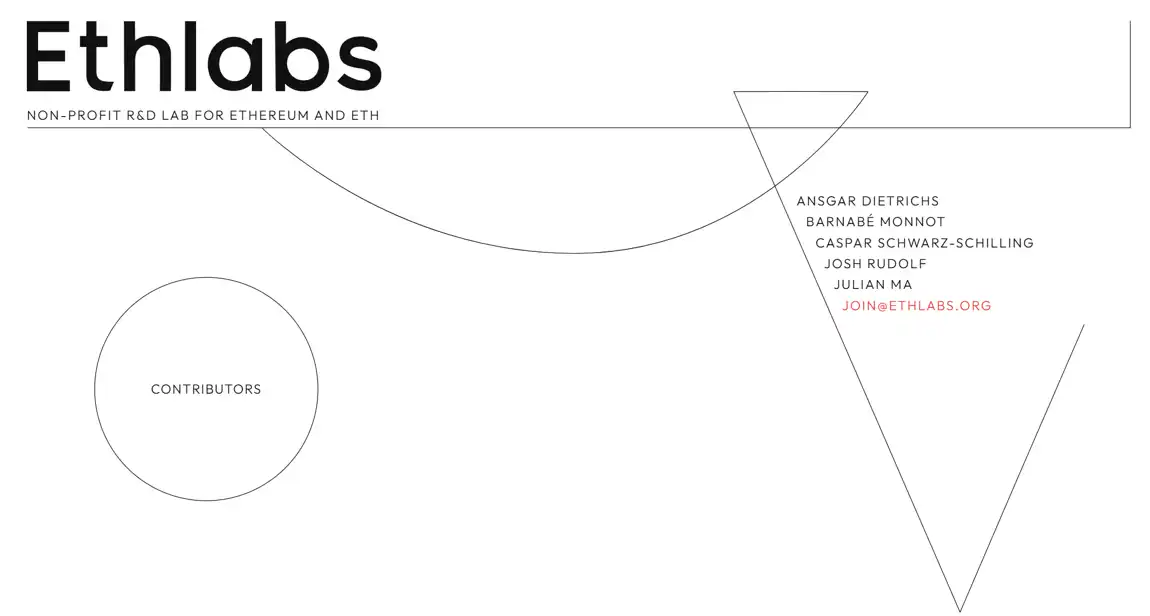
Ethlabs is referred to as the "second Ethereum Foundation" by many, boasting a strong lineup with the names of 5 former Ethereum Foundation senior researchers and contributors prominently displayed on its website:
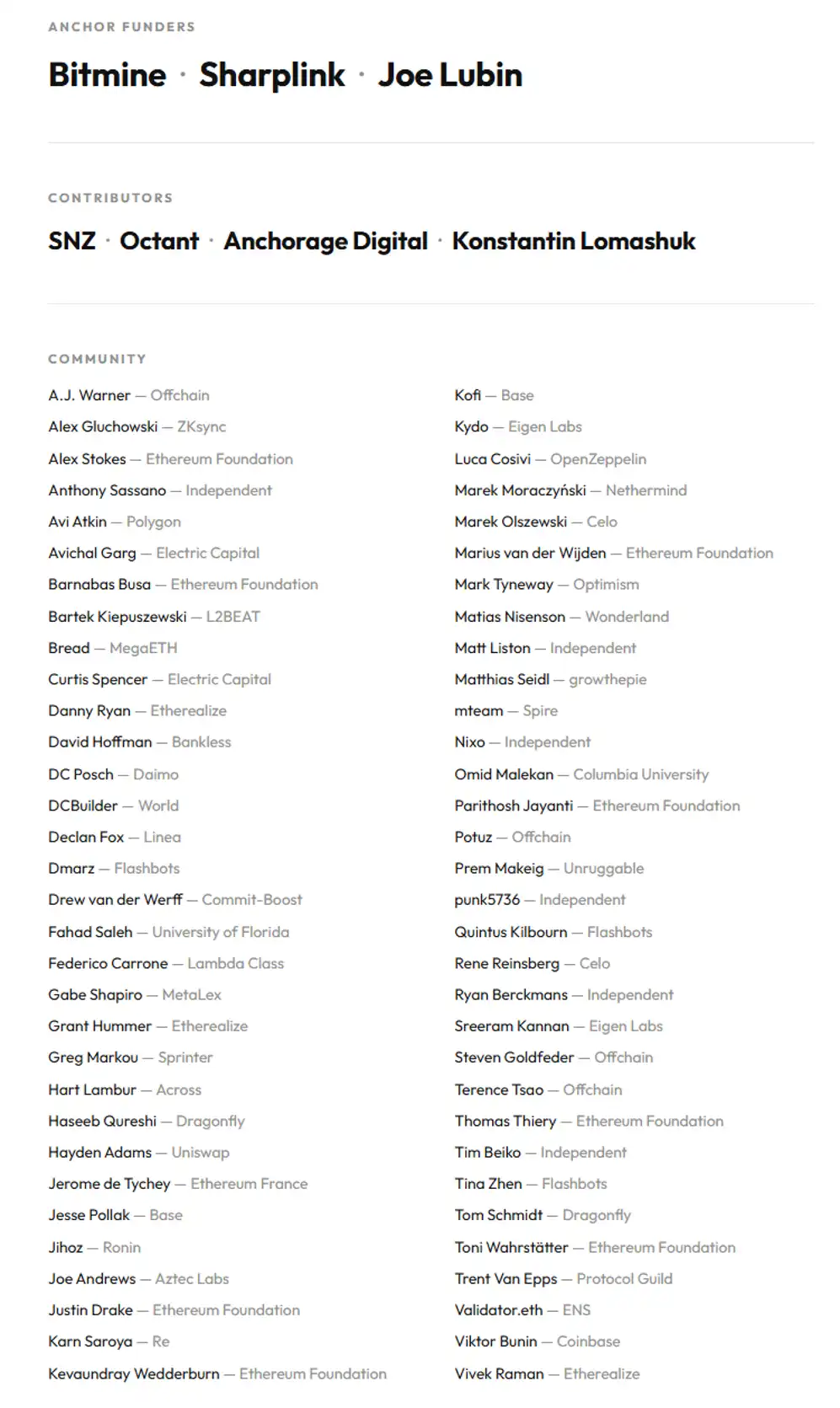
Ethlabs is not lacking in talent or funds. Tom Lee's Bitmine, the leading Ethereum treasury company Sharplink, former Ethereum co-founder Joe Lubin, SNZ Holding, and over 50 prominent ecosystem project builders, L2 founders, core devs, investors, institutions, and researchers have all provided substantial support. Even the funding sources shine brightly:
Ethereum's die-hard fans have been eagerly hoping for Ethereum's development in recent years. To answer whether the "second Ethereum Foundation" can truly save Ethereum, perhaps we need to first review the challenges faced by the Ethereum Foundation.
Talent Drain and Financial Woes
From April to May this year, the Ethereum Foundation (EF) experienced a wave of departures. During this period, a total of 6 contributors left EF or went on long-term leave, with most departing from EF's core engineering team and research department.
Those exiting EF are not insignificant figures; they have all played key roles within EF.
John Stark, EF management, co-founder of ETHGlobal, and co-chair of EF's "Trillion Dollar Security Initiative," departed after 5 years at EF.
Carl Beek, former EF researcher who played a crucial role in the launch of the Beacon Chain, left after 7 years at EF.
Julian Ma, now featured on Ethlabs' official homepage, a former EF mechanism and product researcher, left after 4 years at EF.
Tomasz Stańczak became the Joint Executive Director in March 2025, only to resign in February this year, less than a year later, with the EF stating that he would "focus on AI-related work." Another Joint Executive Director, Hsiao-Wei Wang, also announced his resignation last week, about 15 months after taking office.
According to Token Terminal data, over the past year, the number of Ethereum core developers has been continuously declining, dropping from a peak of 215 to the current 149.
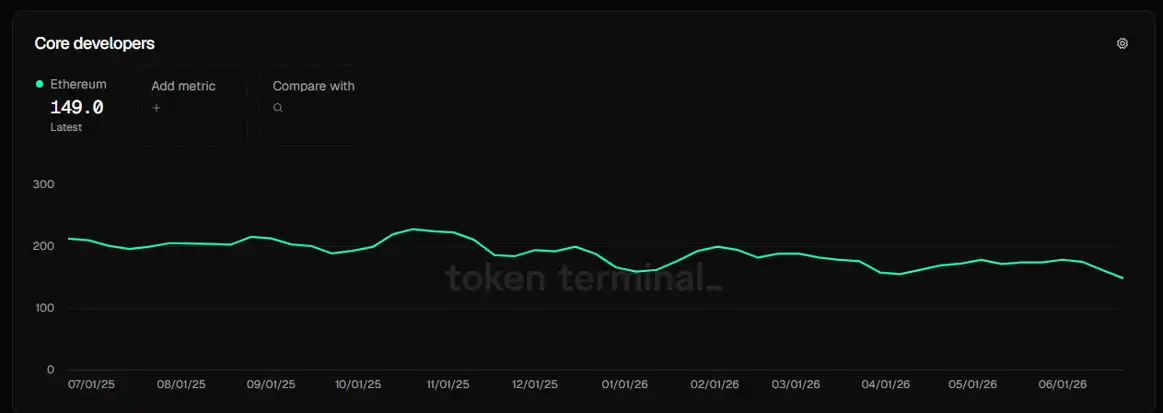
Furthermore, in terms of overall active developers, Solana has also surpassed Ethereum. According to Chainspect's latest data, the current number of active developers on Solana is 10,834, compared to Ethereum's 10,460. Although the difference is not significant, it is a development that was hard to imagine in the past.

Of course, from the above data, although the number of active developers is fewer than Solana, Ethereum's developer activity remains strong. Apart from the number, all other data dimensions still outperform Solana.
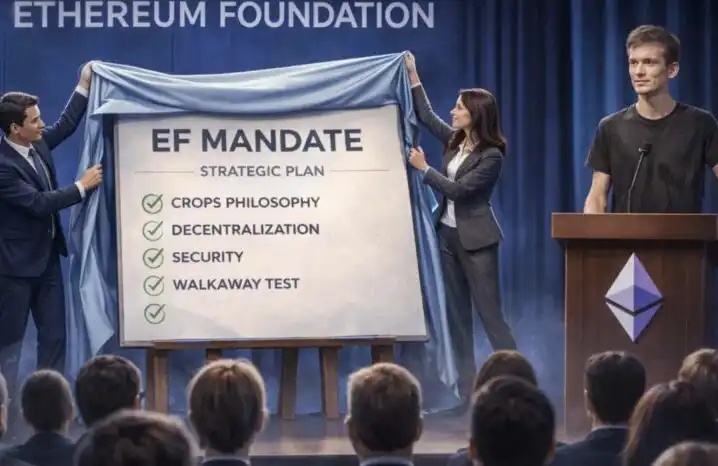
According to an official blog post by the EF on June 23, the Foundation will restructure around clusters such as protocol, access, user, community, and institutional layers and reduce 54 colleagues, about 20% of the EF team. The official explanation states that this adjustment is to implement this year's released Mandate and last year's Treasury Management Policy, aligning the organizational structure more closely with the direction Ethereum most needs to focus on at present.
Vitalik offered a more direct budgetary approach in a lengthy post. According to several cryptocurrency media reports, he mentioned a roughly 40% cut in the EF budget and emphasized that this is not simply removing "dead weight," nor can everyone who leaves be classified as inefficient. Many people have been involved in protocol development for nearly a decade, have written code and documentation, and have also done community coordination, making long-term contributions to the Ethereum ecosystem.
The EF's funding crisis is indeed real. On June 19, Trent Van Epps, former Ethereum Foundation Core Development Coordinator, wrote that as the Foundation continues to advance the "Subtraction" governance strategy, gradually shrinks the treasury, and the four-year Client Incentive Program (CIP) expired in April this year, the Ethereum core development ecosystem may face a slow-brewing funding crisis in the next 3 to 9 months.
Trent pointed out that currently, more than 10 Ethereum client teams, research institutions, and coordination organizations are operating normally, requiring about $30 million in funding annually. If the funding continues to be insufficient, it may lead to key developer attrition, slowing down protocol upgrades, and weakening Ethereum's long-term competitiveness in scalability, quantum computing defense, and network maintenance. The Ethereum Foundation is not designed to be a permanent governor, and new institutions will be needed in the next decade to take on protocol development responsibilities. As the foundation's influence gradually wanes, the Ethereum ecosystem urgently needs to establish a new fund allocation mechanism, governance framework, and institutional succession system to ensure the protocol's long-term sustainable development.
Although the "big donor" and BitMine Chairman Tom Lee quickly responded, stating, "In my view, the probability of this 'crisis' happening to ETH is zero. The funding is in place." However, this does indicate that if he and other supporters do not intervene, Trent's concerns are likely to materialize.
The "Bitcoinization" of Ethereum
Once every wild narrative in the crypto world, Layer 2, NFTs, the metaverse, blockchain games... all happened on Ethereum. But gradually, Ethereum seems to have aged.
Currently, the hottest trend in the crypto world, stock trading, saw Solana just set a record with nearly $1.3 billion in tokenized stock weekly trading volume (from various DEXs). In the same week, the trading volume of tokenized stocks on the Ethereum mainnet was only about $312,800.
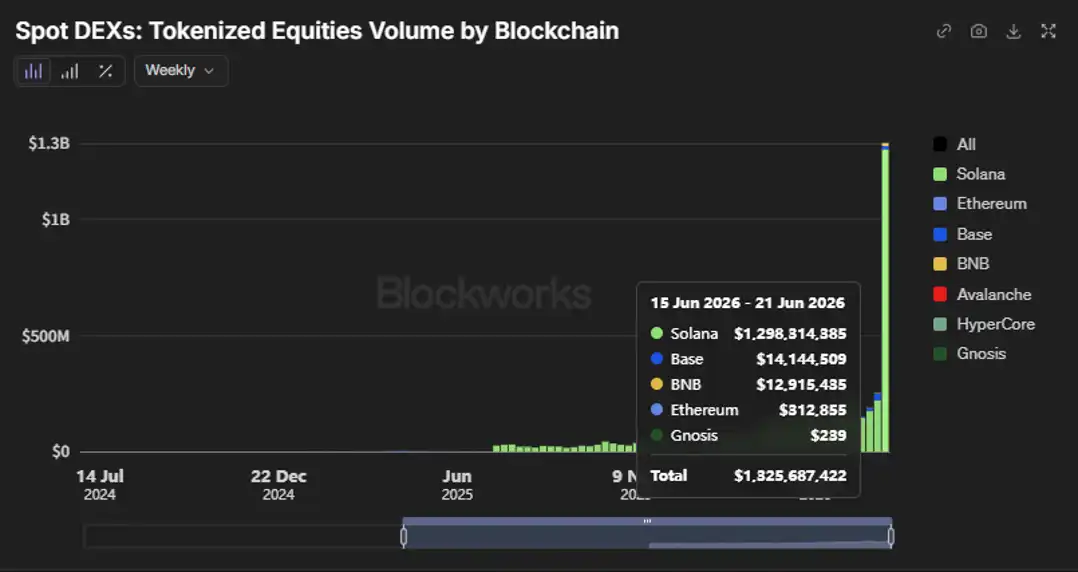
Another popular crypto narrative, the on-chain TCG card pack market, has the two largest platforms, Collector Cards and Courtyard, located on Solana and Polygon, respectively. We can't even point out any notable project in this sector on the Ethereum mainnet.
For Perp DEX, everyone goes to Hyperliquid. For AI-related narratives, everyone goes to Base. The meme coins that once created wealth miracles, young people have all flocked to Solana. Even Circle, Stripe, and others have launched dedicated chains for stablecoins.
It's hard to say what attracts young people to Ethereum now, or whether it's just that specific point that attracts industry players.
Aerugo, the Executive Director of the Ethereum Foundation, recently published a lengthy article discussing "What the Ethereum Foundation should and should not do." Regarding "what it should do," he emphasized the need to address the MEV problem, to continue strengthening privacy, to prevent staking centralization, to promote user self-custody, and for the EF to take the lead in actively using more ETH. As for "what it should not do," he mentioned that the EF should not blindly chase hype, cater to speculators, or compromise on principles for institutional adoption.
All these words ring true, but they are also far from the average player. Just as the average player may enthusiastically enchant on Bitcoin but almost never directly participate in the older "big vs. small block" debate, Ethereum's enthusiastic fans can see that the long-standing L1, L2 divide remains unresolved, and innovation is no longer happening on Ethereum. The Ethereum Foundation seems to be in an ivory tower, constantly discussing directional issues but never personally getting involved in caring for their own ecosystem.
The Ethereum Foundation maintains its idealism and neutrality, which is beneficial for a decentralized ecosystem in the long run. They also hope to see more independent non-profit research institutions like Ethlabs, forming a multi-nodal network for common maintenance and development.
While in the past we used to joke that Solana is a "centralized chain," what ordinary players hope for is a "centralized chain" that continues to experiment and create new narratives. Solana sells phones, does DePIN, ICM, US stocks, TCG cards... Not every new narrative receives a positive response, but they have always strived like a challenger.
On their official website, Ethlabs writes:
"Our mission is to make Ethereum the settlement layer of the global economy."
We still find it hard to expect that Ethlabs will "reignite innovation on Ethereum."
Just as the Ethereum Foundation doesn't want to put itself on a pedestal but is placed there by the public. As long as you have money and influence, it's hard not to endure various expectations and not to be expected to demonstrate the efficiency and impact of "centralization."
While Ethlabs can solve funding bottlenecks and talent drain, it seems to struggle to address Ethereum's "Bitcoinization." But for Ethereum, this may not necessarily be a problem; Ethereum does not need saving, it's just an inevitable trend on the long road to decentralization. It's just that Ethereum is becoming increasingly unfamiliar to the average player.
Welcome to join the official BlockBeats community:
Telegram Subscription Group: https://t.me/theblockbeats
Telegram Discussion Group: https://t.me/BlockBeats_App
Official Twitter Account: https://twitter.com/BlockBeatsAsia
 Related Articles