Even at a new all-time high, storage remains inexpensive


By Ga Liu
Today, Micron delivered a historic earnings report that boosted the confidence of the entire semiconductor sector.
In FY2026 Q3, revenue was $41.46 billion, nearly $6 billion above market expectations. A storage company that has been labeled a "low-margin commodity" for decades provided a gross margin guidance comparable to that of a software company. After-hours, the stock price surged directly by 13% to 14%, pushing the market cap above $1.16 trillion.
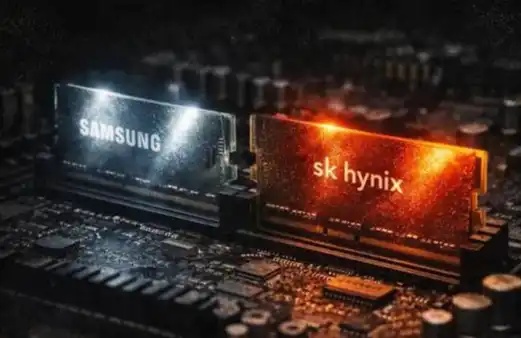
Micron's performance this year has been remarkable. Closing at $1211.38 on June 22, the stock has more than tripled year-to-date and surged over 850% in the past 12 months, making it the third-best performer in the S&P 500 in 2026, following SanDisk and Western Digital, also in the storage sector. The entire sector is on this magnitude of growth. Over the past 52 weeks, Hynix has risen by over 800%, and Samsung by more than 400%.
With such a surge, many people's initial reaction is, of course, "too expensive." However, the fact that the stock price has risen significantly does not necessarily mean the valuation is high. In many respects, storage remains a very "cheap" hot track.
Stock Price Up 9x, PE Ratio Stagnant
One of the most commonly used indicators to determine whether a company's stock is expensive is the PE ratio, or Price-Earnings ratio.
In simple terms, the PE ratio measures how much the market is willing to pay for each dollar of a company's profit. A PE ratio of 10 means investors are willing to pay $10 for every $1 of profit the company makes each year. A high PE ratio usually indicates strong future growth expectations, while a low PE ratio may suggest either an undervalued stock or that the market believes the company's current profit is at a cyclical peak and will soon decline.
The most counterintuitive aspect of storage stocks right now is this: despite the significant stock price appreciation, the PE ratios remain low.
According to FactSet data, market observers provided a set of numbers in mid-June: Micron's forward 12-month PE is around 9x, while Hynix and Samsung are around 6.5x. Barron's, on the other hand, stated that Micron's forward PE is approximately 9.74x, compared to around 25.5x for the Nasdaq Composite Index and 20.3x for the S&P 500. GuruFocus data from June 21 showed Micron's Forward PE at 9.90x, Hynix at 5.92x as of late May, and Samsung around 5.45x.
In other words, most data sources speculate that the forward P/E ratios of the three storage giants range from single digits to just over 10 times.
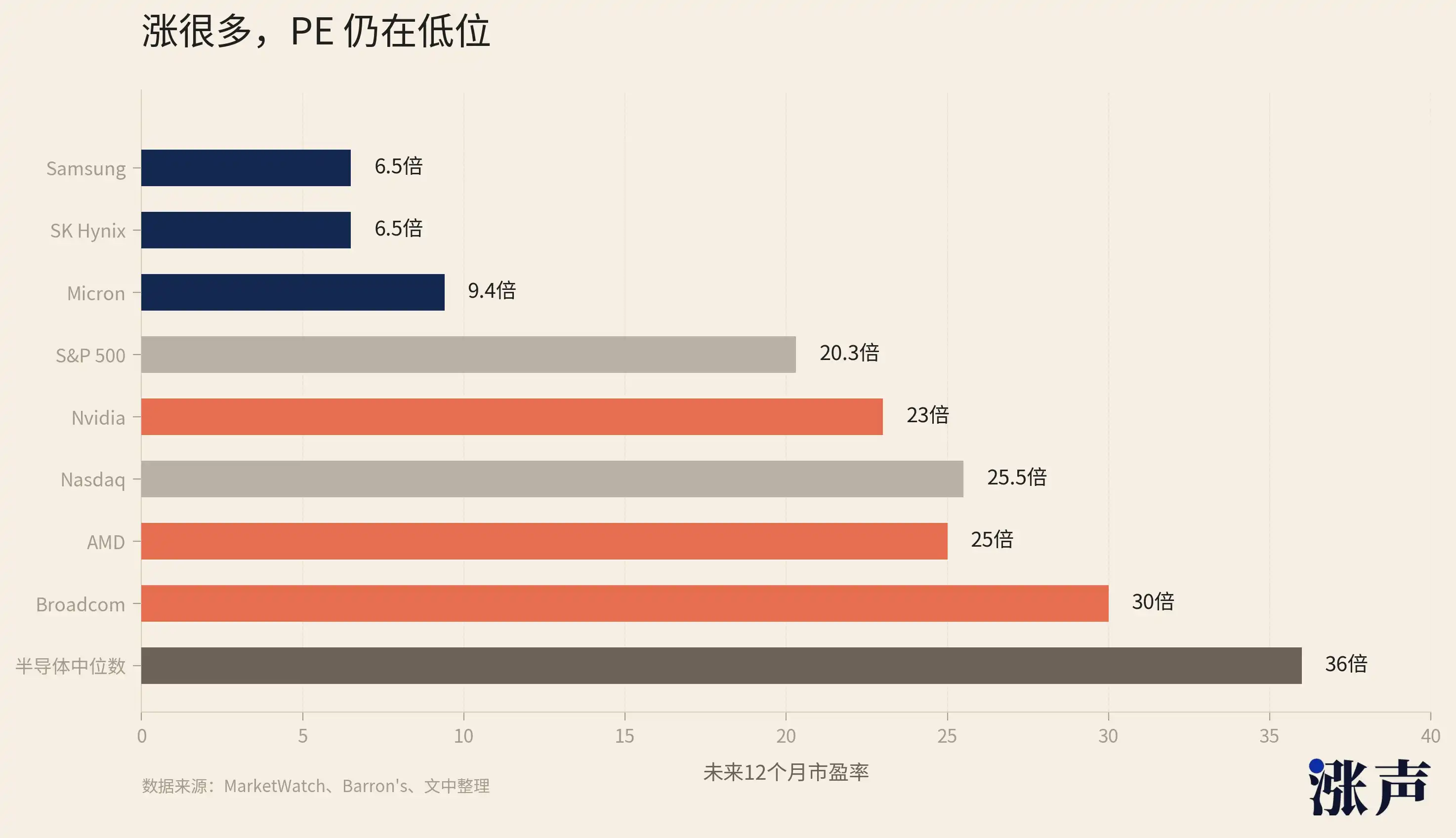
Compared to the entire AI industry chain, this set of numbers is nearly at the lowest level.
NVIDIA's forward P/E is around 23 times, Broadcom around 30 times, AMD around 25 times, TSMC around 20 times, with the semiconductor industry's median around 36 times. This means that the valuation level of the storage trio is roughly only one-third of NVIDIA's and one-fourth of the semiconductor industry median.
Ironically, money in the AI industry is increasingly being earned by the storage sector.
AI servers do not only consist of GPUs. Every high-end AI accelerator card requires HBM, every inference server needs large-capacity DRAM, KV cache, model weights, local cache, and data throughput all rely on SSDs. Without HBM, there would be no GPU training clusters; without server DRAM, there would be no inference clusters; without high-capacity NAND, the storage and caching costs of AI applications would also not decrease.
Storage is no longer just a common accessory in the AI industry chain but a physical bottleneck that all AI capital expenditures cannot avoid. In its latest financial report, Micron provided a number that can explain this issue: in a single quarter, data center revenue was $25 billion, with enterprise SSD revenue at $5 billion, accounting for 20% of data center revenue.
It can be seen that this bottleneck has even begun to affect consumer electronics.
AI data centers have driven up the capacity and prices of HBM, DRAM, and NAND, ultimately forcing even a terminal company with strong bargaining power like Apple to face cost pressures and pass on some of the price increases to consumers. In the past, when people discussed who was making money in AI, the first reaction was NVIDIA; but it is becoming increasingly clear that a significant portion of this AI bill is flowing to storage vendors.
The stock prices of storage companies have risen significantly, but profits have increased even faster.
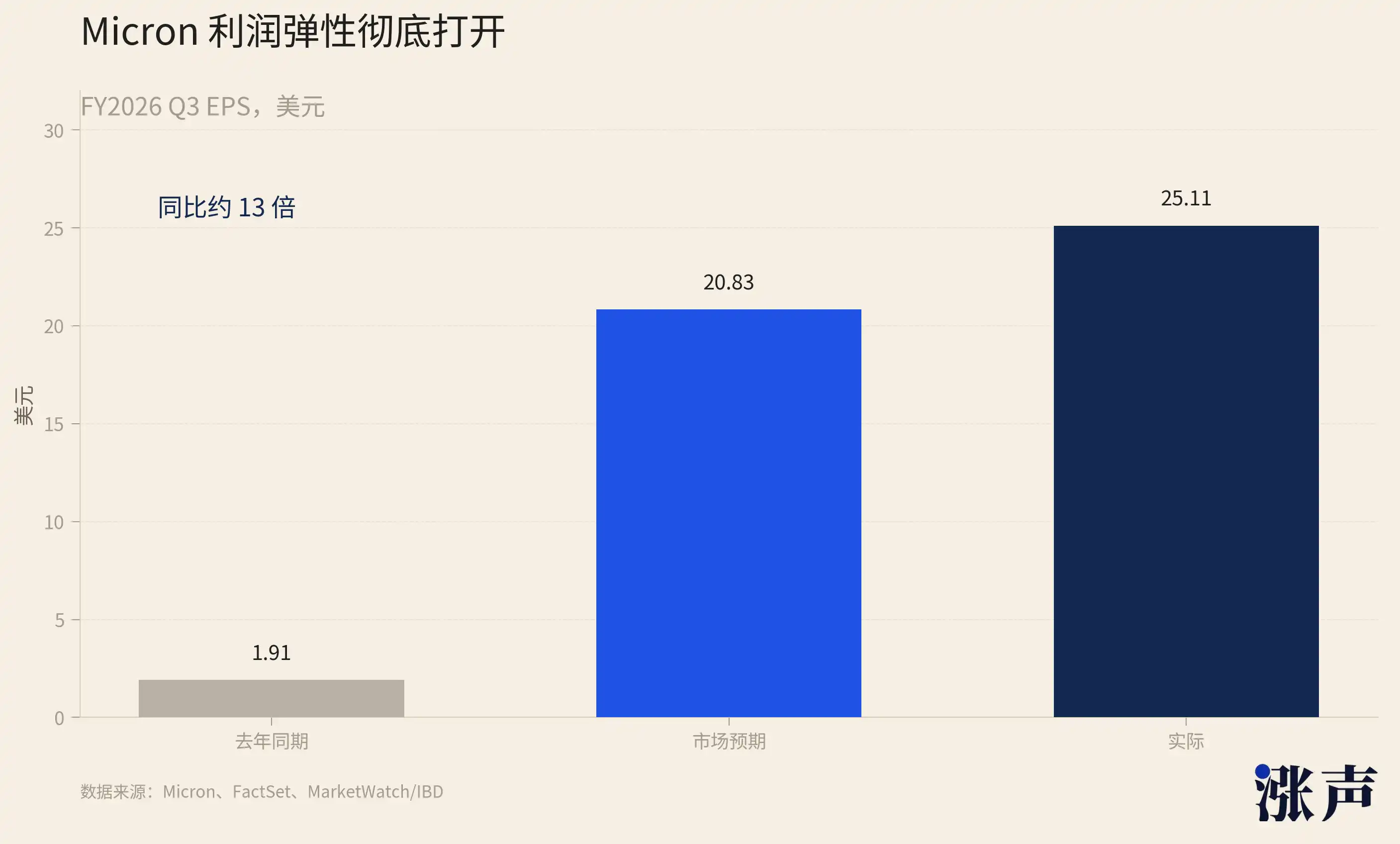
Micron just announced an EPS of $25.11 for Q3, compared to $1.91 in the same period last year, an increase of over ten times in a year. SK hynix reported an operating profit of 37.61 trillion Korean won in Q1 2026, a 405% year-on-year growth. Samsung's semiconductor division saw a more than 8-fold increase in Q1 operating profit year-on-year. While stock prices have multiplied, profits have increased even more, and P/E ratios have not been driven up.
The money of AI is flowing into the storage factory's P&L statement in cold hard cash.
Sector Focus Unleashes Bullish Trend, Micron Just the First Shot
Micron's earnings report marks the beginning of this storage earnings season.
Next, the storage race enters an intensely information-dense month: TSMC on July 16, Samsung on July 23, Kioxia and Western Digital on July 29.
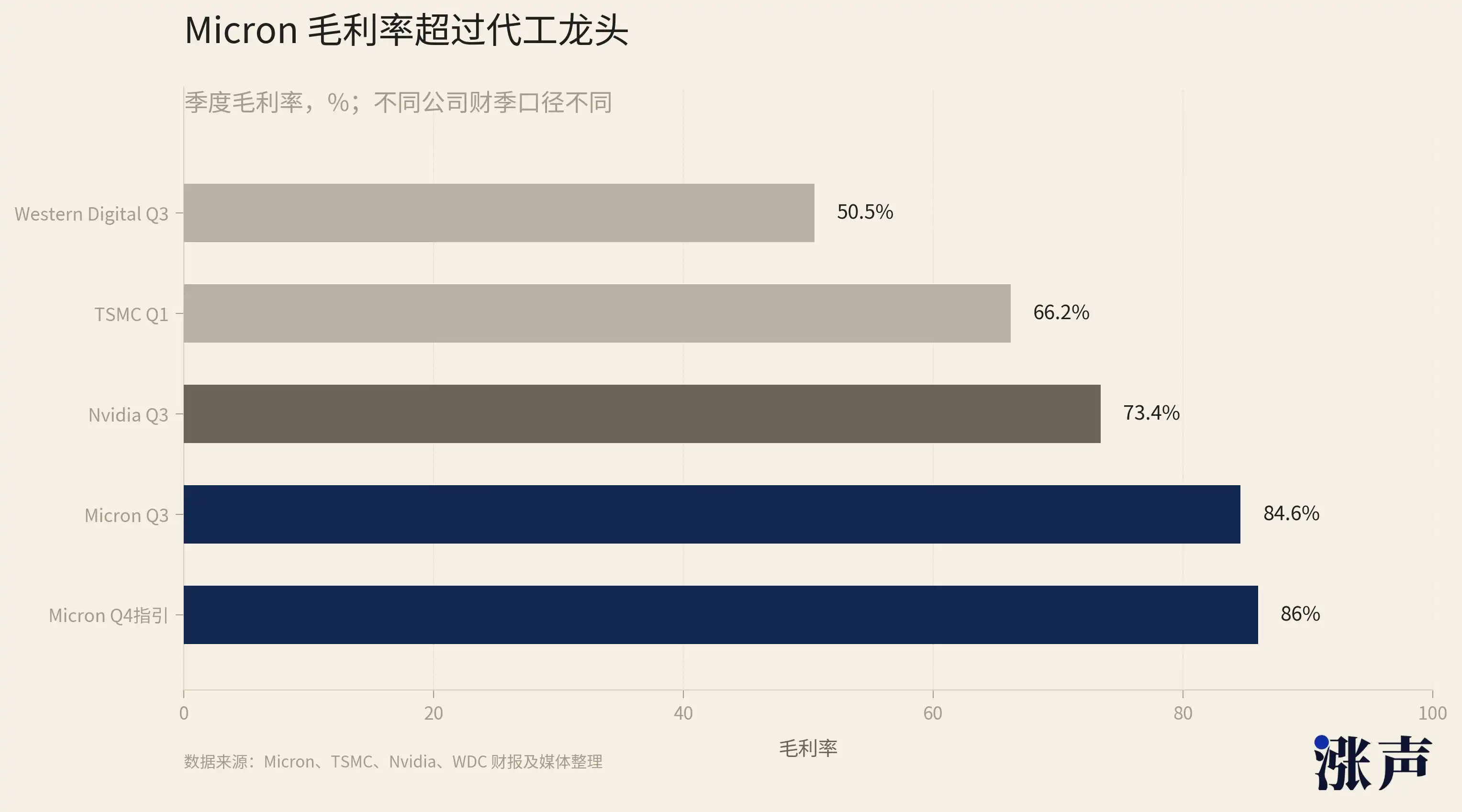
Micron's shot has already set the tone for the others. Its most crucial information is not the super-expected quarter, but the Q4 guidance of $50 billion in revenue and 86% gross margin.
This guidance essentially tells the market that price hikes have not only not peaked but are accelerating. The following four companies, essentially operating in different markets with different product structures, are validating or refuting the same trend revealed by Micron's guidance.
First, let's look at TSMC, which reported earnings on July 16.
TSMC does not do storage, but it is the foundation of the entire AI chip supply chain. NVIDIA's GPUs, Broadcom's custom accelerators, AMD's data center chips, all come out of its production lines. TSMC is addressing a question more fundamental than storage: whether the AI chip production bottleneck has been opened. Q1 revenue was $35.9 billion, a 40.6% year-on-year increase, with a gross margin of 66.2%, and advanced processes accounting for 74% of wafer revenue. Q2 revenue guidance is between $39 billion and $40.2 billion.
There is a multiplier relationship between TSMC and storage. For every additional advanced process wafer sold, downstream gets an additional AI accelerator, and for every additional accelerator, there are more HBM stacks. The capacity of HBM accompanying a single NVIDIA Vera Rubin platform GPU is several times that of the previous generation. The more aggressive TSMC's shipments, the tighter the storage capacity.
July 23 is Samsung's earnings day.
15 brokerages expected Samsung's Q2 operating profit to be around KRW 8.83 trillion, with an operating profit margin equal to or higher than Q1's 66%. A conglomerate involved in everything from mobile phones to home appliances, its profit margin has been lifted to this level by the storage department.
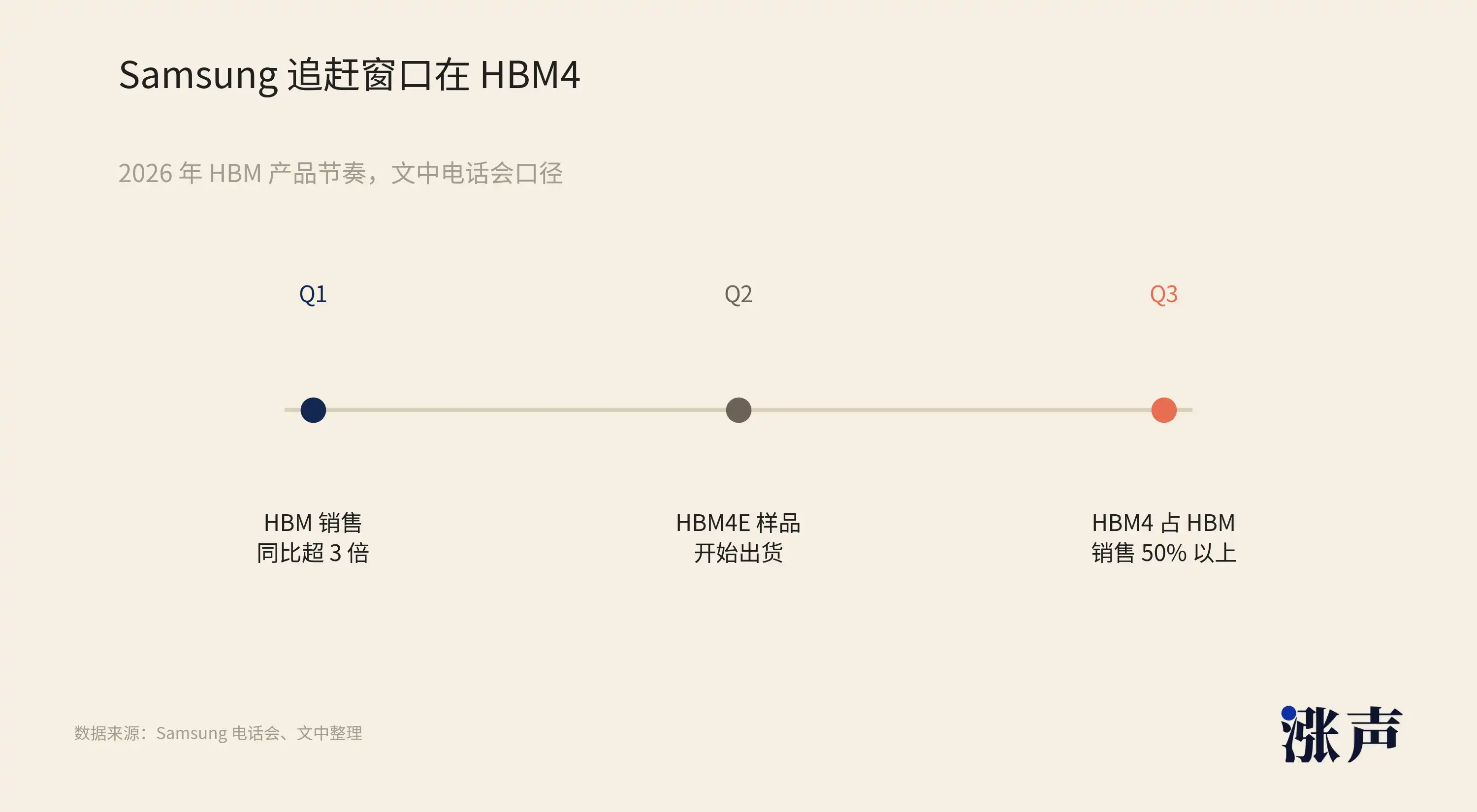
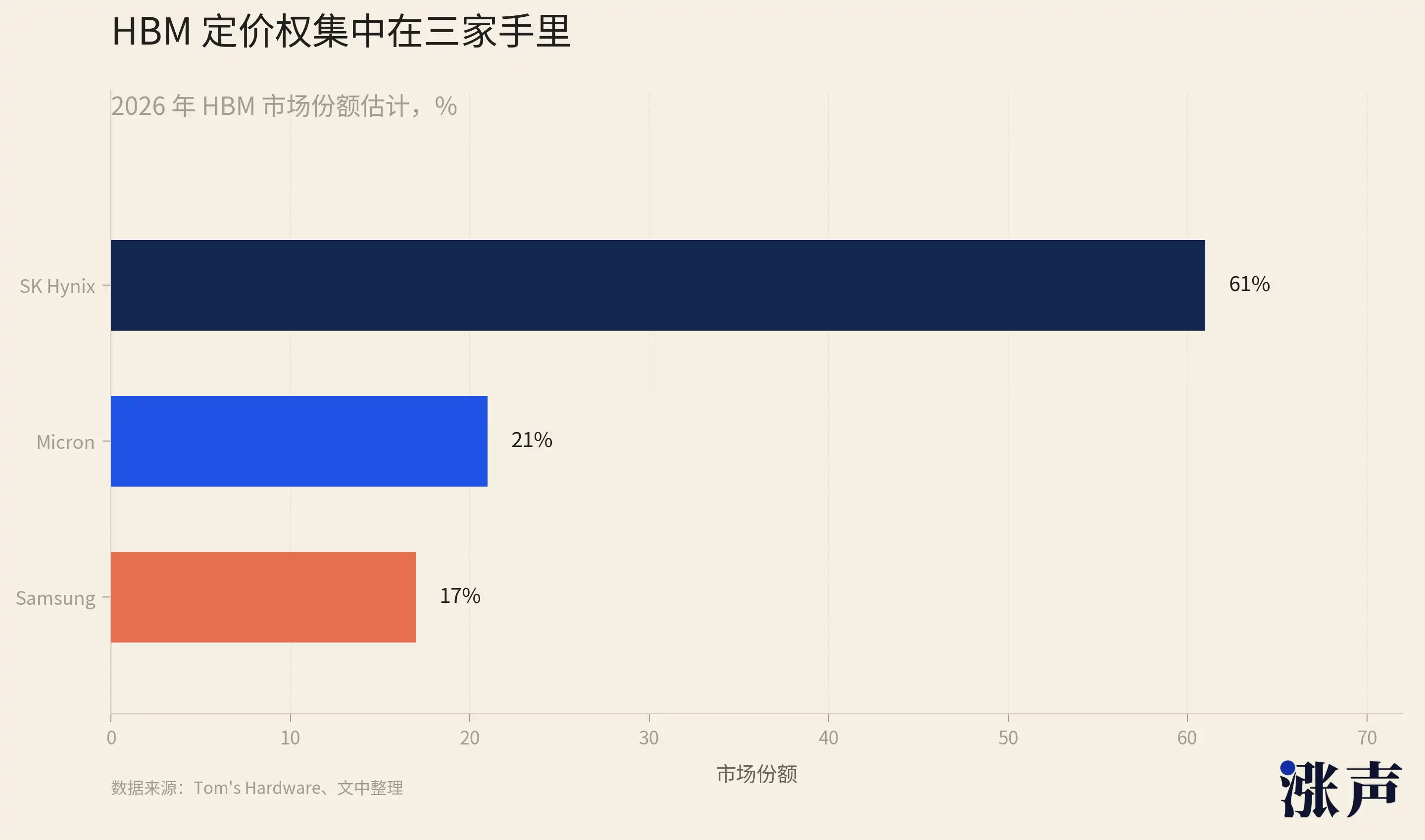
But the most important part of Samsung's earnings report is not the profit figure but HBM4. Samsung has only about a 17% share of the HBM market, far behind Kioxia's 62% and Micron's 21%. The HBM4 generational switch is Samsung's sole opportunity to close the gap. During the Q1 conference call, it said some very specific things: HBM sales are expected to grow over 3 times year-on-year in 2026, with HBM4 accounting for over 50% of HBM sales starting in Q3. Micron has just revealed that the HBM4 36GB 12-Hi is already in mass production. The three-way battle for HBM4 is also the most anticipated showdown in the second half of the year.
On July 29, both Samsung and Western Digital released their financial reports.
Samsung's Q1 results were exemplary: quarterly revenue of KRW 52.6 trillion, a 198% year-on-year growth, operating profit margin of 72%, and net profit margin of 77%. A hardware manufacturer achieving a 77% net profit margin, compared to Apple's approximately 25% and NVIDIA's approximately 58%. Some analysts predict that Samsung's Q2 operating profit margin may approach 80%. Micron has already achieved an operating profit margin of 81.2%, surpassing TSMC. As the leading player in HBM market share, Samsung is highly likely to deliver results in Q2 that are comparable to Micron's. The combined operating profit of Samsung and Micron in Q2 is expected to exceed KRW 150 trillion, and when combined with Micron, the total quarterly profit of the three giants will set a new record.
On the same day, Western Digital reported its Q4 results, focusing on NAND and SSD instead of DRAM and HBM. It caters to another dimension of AI storage demand: large-capacity SSDs for inference KV cache. In Q3, its cloud revenue grew by 48% year-on-year, with a record gross margin of 50.5%. It is worth mentioning that Western Digital and its spin-off SanDisk were the top two performing stocks in the S&P 500 in 2026, ahead of Micron. While NAND's growth is not as explosive as DRAM, the direction is fully aligned.
AI Transforms Storage from a Commodity to a Luxury Good
All-time high stock prices with low PEs, each financial report more explosive than the last.
Despite all this, some may still question whether this is sustainable or just another cycle of euphoria leading to an inevitable crash.
However, let's revisit the analysis by Jukan, a semiconductor analyst at Citrini Research.
Back in Q1 2024, when Samsung and Micron were struggling amid post-pandemic DRAM oversupply and low stock prices, the Citrini team already predicted that these two companies would outperform. Subsequently, these two stocks multiplied several times, nearing a tenfold increase. They nearly perfectly timed this storage market upturn. In early June this year, there was a telling detail that shows Jukan's position in the market: he shared a SemiAnalysis report on NVIDIA's Rubin server memory configuration adjustment, which immediately exerted visible selling pressure on Micron and Samsung.
Jukan's key argument for being bullish on storage is not a short-term assessment that "prices will rise" but rather the belief that: AI has transformed storage from a commodity to a luxury good.
First, HBM interrupted a trend that had lasted for sixty years. From 1957 to 2020, the cost per Gb of DRAM decreased by approximately one order of magnitude every 5 years, and the price always kept falling. This is a fundamental rule of the storage industry, with the entire industry's competitive mode and valuation framework built on this trend. Jukan pointed out that the HBM demand brought by AI has completely shattered this rule. Manufacturers have shifted their capacity to the more complex and larger silicon footprint HBM, squeezing traditional DRAM supply.
Currently, no manufacturer plans to switch HBM production lines back to traditional DRAM. The reason is simple: HBM has a much higher profit margin than regular DRAM, so rational manufacturers will not switch high-profit production lines back to low-margin products. This has transformed the supply tightness from a cyclical phenomenon to a structural phenomenon that will not reverse as long as AI demand persists.
Therefore, the continuous price increase of HBM storage will be long-term.
The annual volume and pricing of HBM were basically settled at the beginning of the year, providing manufacturers with strong profit visibility. TrendForce's data confirms this: in Q1 2026, traditional DRAM contract prices rose by 90% to 95% compared to the previous quarter, marking the largest single-quarter increase on record, and the prices are expected to continue rising in Q2. The price increase phase of normal DRAM cycles usually lasts for 4 to 6 quarters before peaking, but this round has lasted nearly 8 quarters without stopping. JPMorgan even predicts that DRAM prices may rise for four consecutive years, an unprecedented scenario in the industry's history.
So it is almost safe to say that storage has transitioned from a commodity to a luxury item.
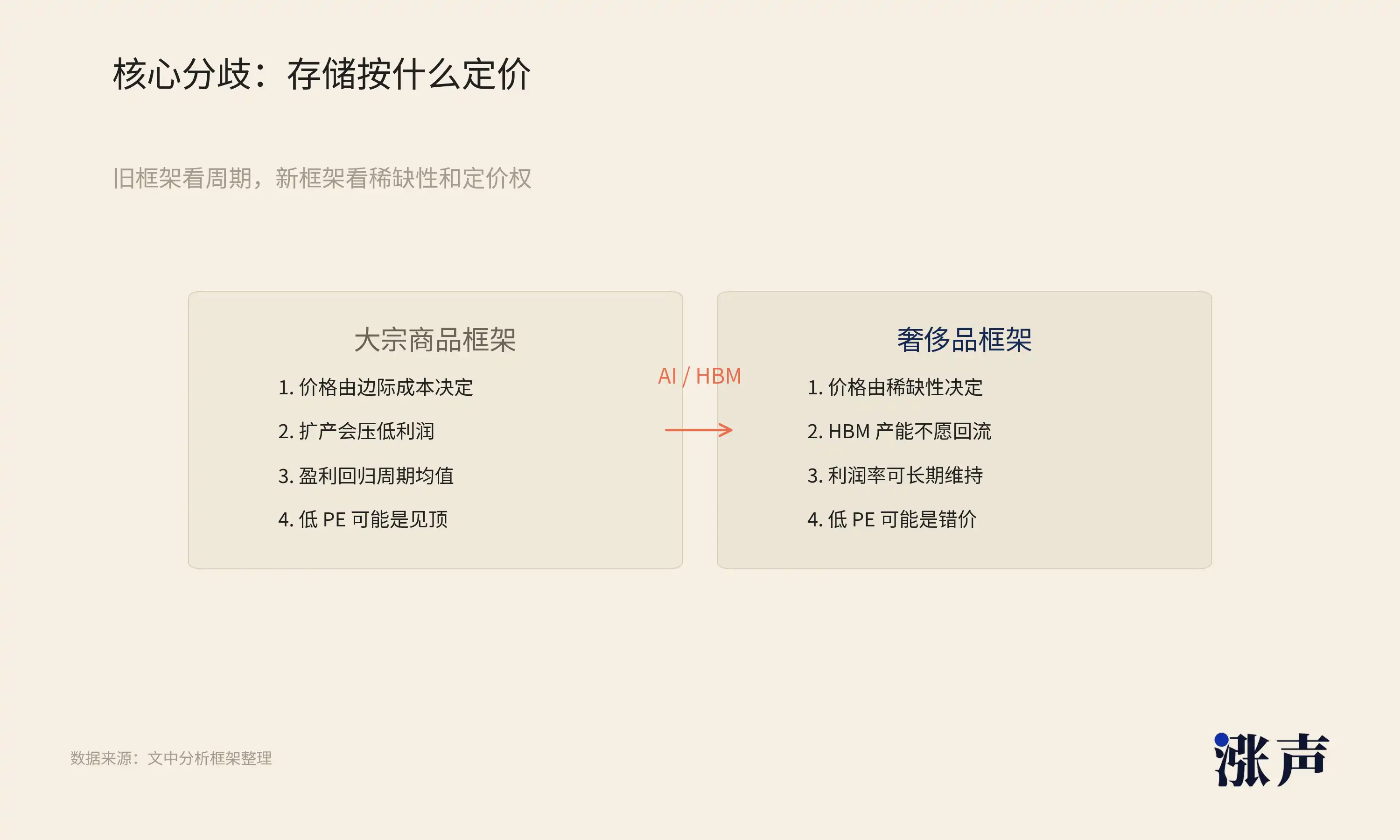
The biggest difference between luxury items and commodities lies in pricing. The price of commodities is determined by marginal cost, anyone can increase production, profits are eventually competed away, leading to a low valuation. The price of luxury items is determined by scarcity and pricing power, supply is controlled, profits can be maintained at a high level for a long time, thus warranting a premium. The premise of the old rule "Low PE equals the peak" is that profits will return to the long-term declining trend line. But if the trend line itself has already turned around, where the return will be is an open question.
Returning to the initial contradiction. Stock prices are at historic highs, while valuations are at historic lows. This anomaly exists because the market is still using the old framework of commodities to price an industry that has become a luxury item. Micron has just dealt a heavy blow to this old framework with a financial report showing an 84.9% gross margin and guidance for an 86% gross margin. If there is no turning back, the current PE ratio of 5 to 10 is wrong.
Therefore, we believe that even though the gains have been significant, storage stocks are still undervalued.
After HBM, Is NAND the Real Star?
During the middle of each major bull run, the market always asks the same question: has the leader topped out, and who will take the baton next.
HBM and DRAM have been the absolute protagonists of this round of the storage market rally, with the surge of the three giants mostly attributed to them, while NAND has always played a supporting role.
However, upon examining the supply-demand structure closely, an counterintuitive fact emerges: the NAND chip, which has always been seen as a supporting act, may actually be the main course. In some ways, its scarcity may be more severe than that of HBM.
Let's first talk about why HBM is so popular. HBM is the standard configuration for AI accelerator cards. It has a high unit price, high profit margins, and high technological barriers. Micron has achieved a 62% market share and a 77% net profit margin relying on it. All of these are facts. However, HBM has a characteristic: although its supply is tight, the expansion path is clear. The three giants are pouring money into expanding their HBM capacity, with Samsung and Micron catching up with Micron. Each generation of HBM4 and HBM4E is moving up. The supply is increasing at a visible speed, but it just temporarily lags behind demand.
Meanwhile, NAND manufacturers have not expanded their capacity for several years.
This is because the sharp drop in NAND prices from 2022 to 2023 scared off all the players. Kioxia, Western Digital, Samsung, and Micron have slashed their capital expenditures on NAND to the minimum, delaying new production lines, with the earliest expected to be in 2027.
The three giants have prioritized wafer capacity and capital expenditures for HBM and high-end DRAM, squeezing resources for NAND. Micron has even directly shut down its consumer-grade Crucial business, reallocating all capacity to enterprise and GPU-level storage.
There is a supply shortage of NAND, but the demand is high.
Large-scale model inference requires massive KV cache and data throughput, leading directly to an explosive demand for enterprise SSDs (eSSDs). In Q1 2026, global eSSD revenue increased by 86% compared to the previous quarter. On the other hand, there is also a shortage of HDDs. The supply of mechanical hard drives is equally tight, forcing data centers to use high-capacity SSDs to replace HDDs, shifting some of the demand that originally belonged to HDDs to NAND.
The CEO of Phison said, "Every NAND manufacturer has told us that they are sold out for 2026." Kioxia also confirmed that all NAND capacity for the full year of 2026 has been sold out. The price of a 1Tb TLC NAND chip increased from around $4.8 in July 2025 to around $10.7 by the end of 2025, more than doubling in just a few months.
HBM is in shortage, but the supply is steadily increasing; NAND is in shortage, but the supply side has almost no incremental growth. There is a remedy for HBM's tightness, but its effects are slow; the tightness of NAND has no temporary solution because no one is even preparing a remedy. From this perspective, the supply-demand gap of NAND is more rigid than that of HBM, and the sustainability of prices may be stronger.
This is also why the top two performing stocks in the S&P 500 in 2026 are not the HBM leaders SK hynix or Micron, but the pure NAND and SSD companies Western Digital and its spin-off SanDisk. The market has voted with its feet, quietly moving NAND from a supporting role to a leading one, although most people have not yet noticed.
Of course, NAND also has its risks. Unlike HBM, it is not tied to a strong demand driver like AI accelerator cards, and downstream demand still fluctuates with the cycles of consumer electronics. The premise of the logic behind NAND's scarcity is that the demand for AI inference and HDD replacement can continue. However, at least for now, from the perspectives of contract prices, inventory cycles, and expansion intentions, the scarcity of NAND is more straightforward than that of HBM.
Welcome to join the official BlockBeats community:
Telegram Subscription Group: https://t.me/theblockbeats
Telegram Discussion Group: https://t.me/BlockBeats_App
Official Twitter Account: https://twitter.com/BlockBeatsAsia

 Related Articles