Option Whale Makes Big Bet, Micron Nears 'NVIDIA Moment'?

On the second to last trading day before the earnings report was announced, Micron's stock price dropped by nearly 10%.
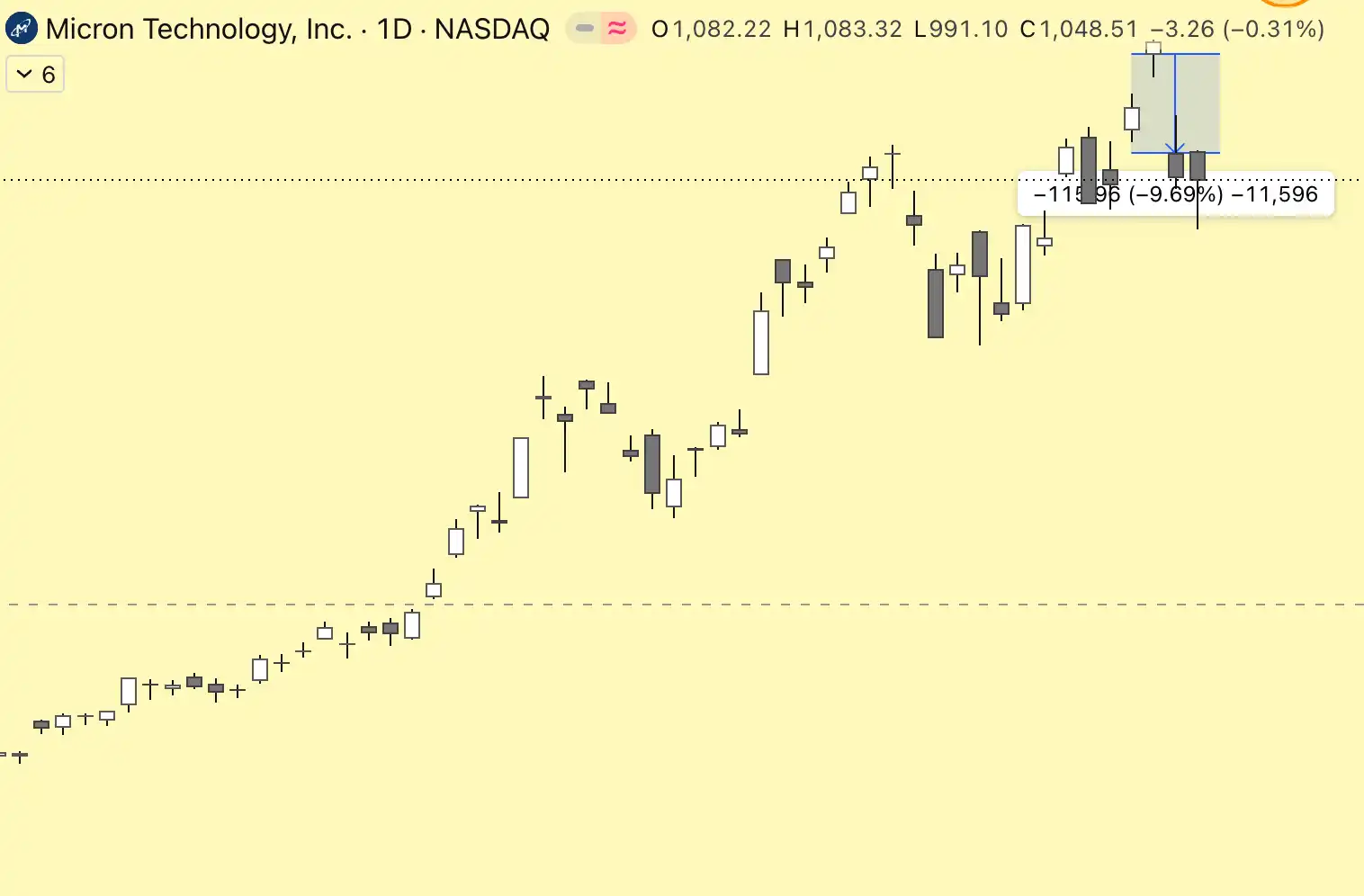
Market concerns were evident in every indicator: the options chain for the earnings report week priced in volatility of over ±11%, the implied volatility spiked to 155%, the put/call ratio approached 1. Many experts predicted that this storage behemoth, which has already tripled in value this year and just crossed the $1 trillion market cap mark, might stumble after the earnings report.
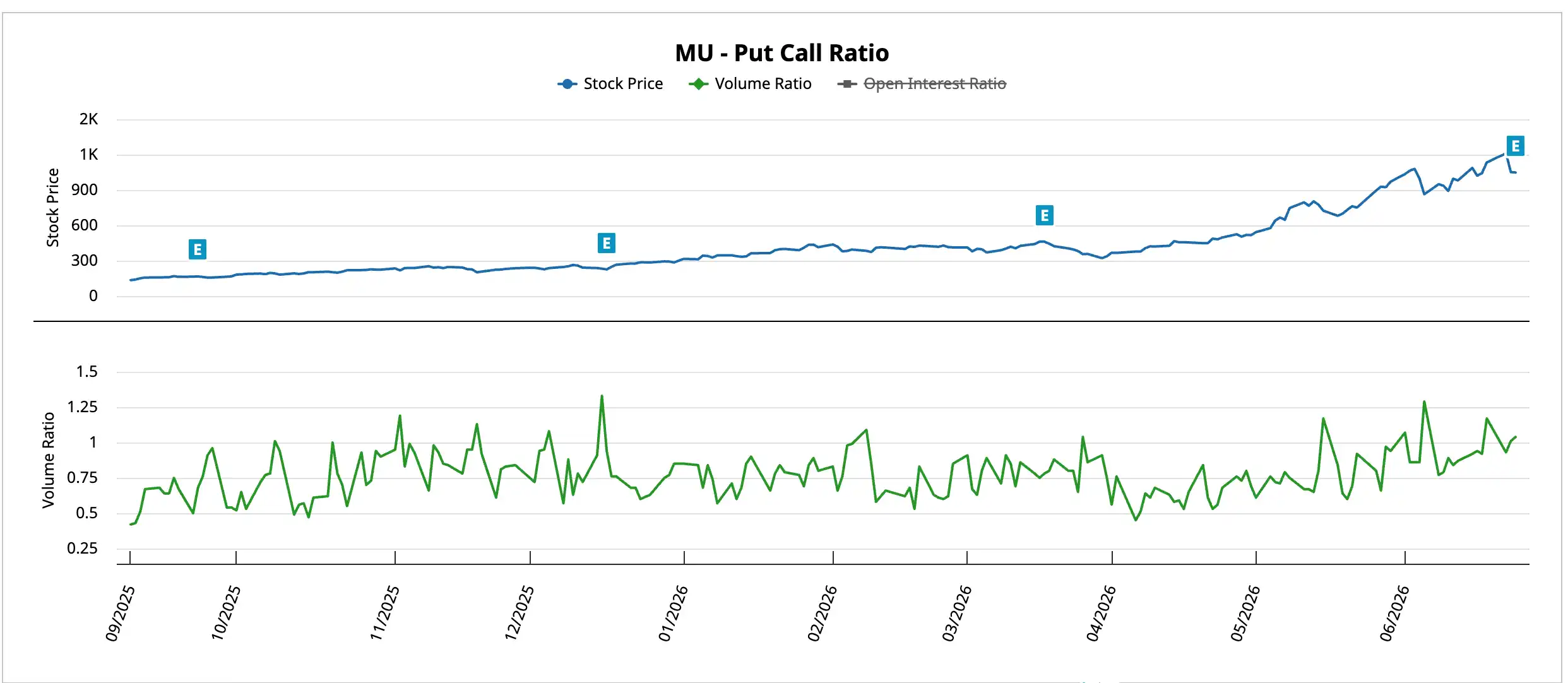
But a group of whales placed bets in the opposite direction.
On the eve of the earnings report, the options market saw several large transactions.
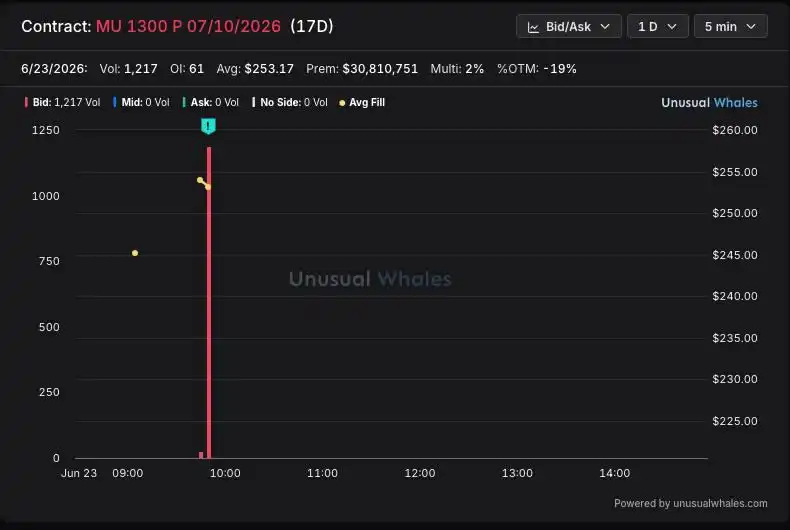
First, a put option expiring in July with a strike price of 1300 was sold for a premium of approximately $30.8 million;
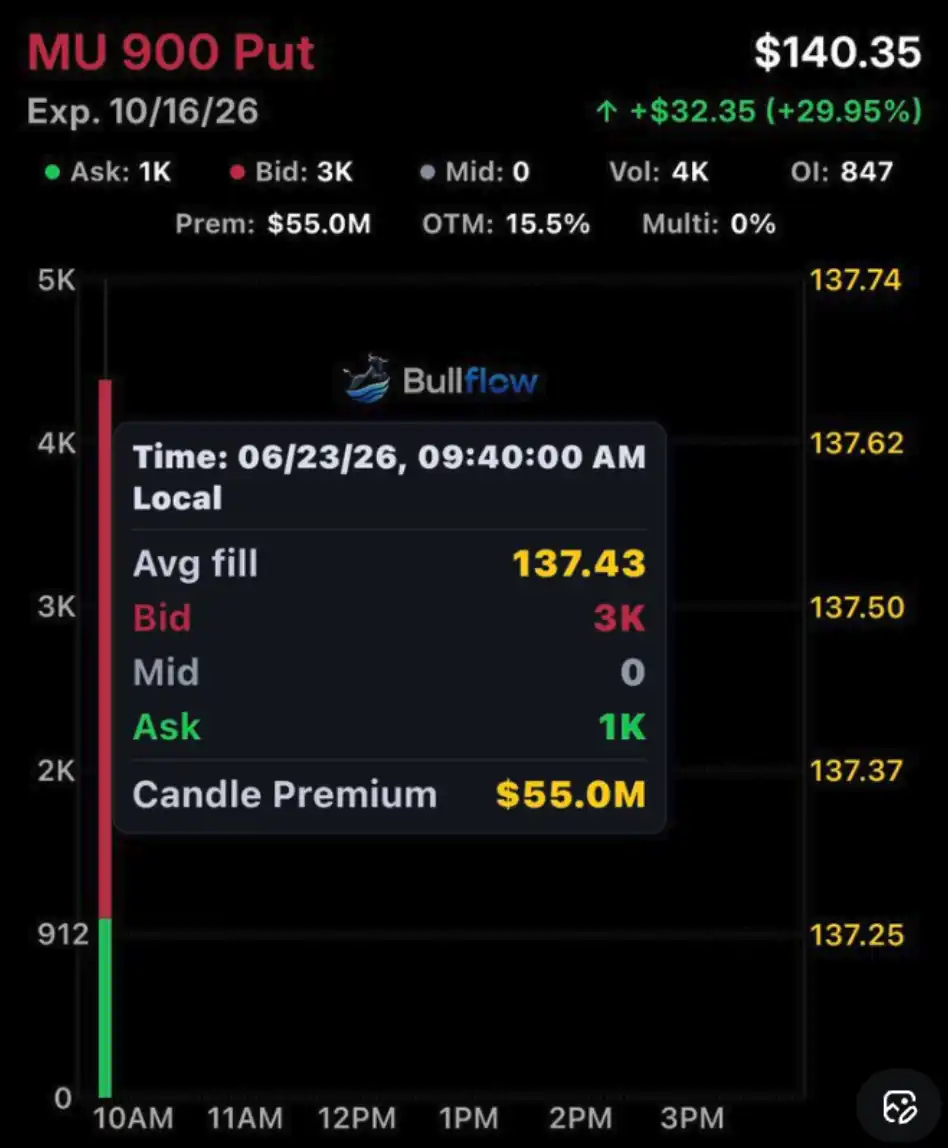
In addition, there was another put option sold with a premium of $55 million and a strike price of $900.
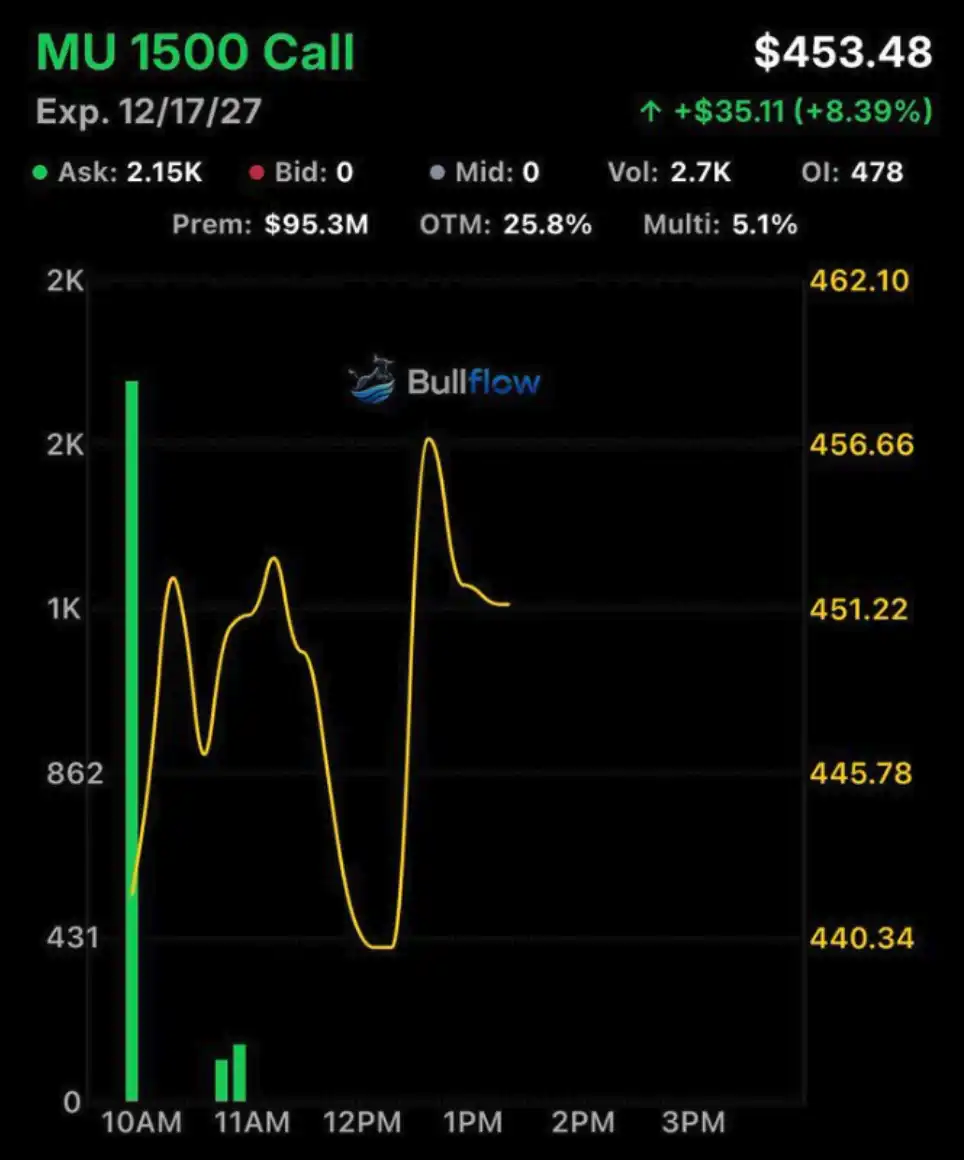
Furthermore, a whale purchased a call option expiring in December 2027 with a strike price of $1500. This trader was anticipating not just bullish earnings data but a revaluation of Micron.
Cloud of Suspicion
The decline in the storage sector before the earnings report was not without reason.
Storage is a well-known cyclical industry, a fact that has been etched into investors' memories for decades: when supply catches up with demand, prices collapse, gross margins plummet, and stock prices retreat. Micron surged too quickly this year, transitioning from cheap to expensive, with its cash flow multiple pushed to fifty or sixty times. For a company regarded as a cyclical stock by default, this multiple itself poses a looming risk. The bearish argument is that after 2027, the depreciation pressure from capital expenditures, the uncertainty of HBM yields, and most crucially—given even a slight slowdown in AI infrastructure purchases, storage prices will reverse, whereas the stock price has already priced in the perfect performance of the next two quarters.
The market doesn't doubt Micron's ability to deliver good numbers; it fears this may be the peak of the storage cycle. With the RSI nearing the overbought zone at 70, the put/call ratio above 1, institutional analysts issuing price targets below the current price, all signs are pointing to "local peak" in bold letters.
Once the earnings report was released, all doubts vanished into thin air.
Earnings Report
Micron's After-Hours Stock Price Surges 15% to $1208.
In the third quarter, revenue reached $41.46 billion, a year-over-year increase of about 346%; non-GAAP earnings per share were $25.11, compared to just $1.91 in the same period last year; gross margin was 84.9%, more than doubling from 39% a year ago, surpassing even AI chip leader NVIDIA. What's more impressive is the guidance for the next quarter: a mid-point revenue of $50 billion, translating to an annualized figure of over $200 billion. Micron's total revenue for the entire previous fiscal year was only $37.4 billion. In one quarter, it's approaching the revenue of the entire past year.
Those who bought bullish options before the earnings report were right. Those who panicked and sold around $1060 watched the stock price soar back to over $1200 overnight.
However, what is truly worth pausing to think about is why the "storage supply-demand cycle," a framework that has been effective for decades, failed so completely this time?
Outdated Mindset
The premise of treating memory as a cyclical commodity is that its price is instantly determined by the spot market's supply and demand. When supply increases, prices immediately drop. Micron is now undermining this very premise.
The revenue surge this quarter is almost entirely due to price increases rather than selling more. DRAM revenue increased by 67% quarter-over-quarter, but shipment volume grew by less than 5%, relying on a 60% increase in average selling price; NAND revenue increased by 99% quarter-over-quarter, with shipment volume increasing by only around 5%, and the average selling price increasing by over 80%. They didn't sell much more, but the profit margin expanded significantly.
A deeper change is hidden within a new business structure. This quarter, Micron signed 16 so-called strategic customer agreements, covering about one-fifth of DRAM shipments and over 30% of NAND shipments, which are expected to account for over half of the company's revenue once completed. The core of these agreements is a provision called take-or-pay.
This can be understood as similar to a restaurant signing a contract with a large customer for a fixed number of tables every year. The customer locks in the number of tables needed annually, and regardless of whether they use them, they have to pay; in exchange, the restaurant offers a price range, with a floor and a ceiling. Micron has essentially turned memory into these contracts—customers buy a certain quantity at a predetermined price each year, they can't cancel, and even if they reduce their orders, they still have to pay. The cumulative revenue from the already signed agreements at the minimum price is around $100 billion, and the customers are required to prepay approximately $22 billion in deposits and letters of credit as a commitment.
The most crucial statement from Micron's management is this: the gross margin corresponding to the floor price exceeds the peak gross margin of any previous cycle in the company's history.
Translate this sentence: Even if the industry enters a downturn and spot prices collapse, the part of the revenue locked in by contracts still maintains a gross margin higher than the best year in history. The bottom of the cycle has been lifted by contracts.
The Journey of NVIDIA
The concept of "storage decoupling from the cycle" needs a reference point to be adequately assessed.
Think of another company. Its product was once considered typical hardware tied to the cycle, relying on gaming GPUs. The industry cycle saw significant highs and lows. It wasn't until AI transformed the demand for its product from cyclical to structural, creating an endless expansion curve, that the market reassessed its value, shifting it from a cyclical stock to a growth stock.
Today, it is the world's most valuable company.
The storage companies are following this same path, with the same driving force.
The expansion of AI computing power requires not only more computing chips but also an exponentially larger amount of memory. Dell's founder did the math: The H100 accelerator of this generation comes with 80GB of high-bandwidth memory, and by 2028, a single accelerator might require 2TB, a 25x increase; and the number of accelerators deployed during the same period is also expected to rise by around 25x. The combination of two 25x increases results in a 625x increase in memory demand. Another figure from a Micron executive: Agentic AI is causing the context length of models to expand at a rate of 30x per year – the longer the context, the more memory each task consumes.
The demand is exponential, yet storage density and speed have struggled to keep up with Moore's Law for decades. On one side, there is an explosive demand expansion, on the other, the supply is lagging behind; take-or-pay contracts lock in the amount customers need to buy each year and the purchase price. Storage is no longer a "cyclical commodity" but is closer to a high-margin strategic asset protected by long-term contracts.
How to Falsify
Before making definitive statements, it is essential to first point out the conditions under which this assessment could be overturned.
Only half of the revenue is currently locked in by contracts. Even if all strategic agreements are completed, nearly half of the revenue remains exposed to the memory spot market, subject to the whims of AI capital expenditure. Beyond the floor price, there is still a ceiling; the largest agreements cap the price of existing products near the current market price—this means that if prices continue to spike, Micron may not capture all of the excess profit. Deposits are not prepayments but commitments to be returned later in the agreement; they cannot be treated as free cash.
More importantly, all of this is contingent on one assumption: that investment in AI infrastructure will not falter. If one day the returns on investments in large models cannot sustain themselves, and major hyperscalers collectively slow down their purchasing, the revenue outside the contracts will be the first to be hit, and agreements will face renegotiation upon expiry. The grand cycle of storage will not disappear forever; it has only been pushed out and propped up.
But the direction is clear. The old yardstick used to measure their valuation is no longer accurate for these companies.
Welcome to join the official BlockBeats community:
Telegram Subscription Group: https://t.me/theblockbeats
Telegram Discussion Group: https://t.me/BlockBeats_App
Official Twitter Account: https://twitter.com/BlockBeatsAsia
 Related Articles