a16z Partner: The Next Space Battle Could Target Commercial Satellites

TL;DR
· Open-source orbit analysis indicates that multiple Russian Cosmos satellites maneuvered close to the ICEYE-X36 satellite in May, with a lateral distance of about 500 meters.
· Proximity maneuvers, interference, and dazzling are harder to attribute than direct destruction, and launch capability, constellation redundancy, and orbital situational awareness are becoming key to national defense.
· The United States still has the advantage of scale with SpaceX and Starlink, but a few expensive large satellites could still be targeted as critical nodes by adversaries.
In May 2026, multiple Russian Cosmos satellites maneuvered near the ICEYE-X36 commercial radar satellite supporting Ukraine. Open-source orbit analysis indicates that the two parties entered a close-proximity orbit, with a lateral distance reaching about 500 meters at one point.
This was not a missile intercept, nor was the satellite openly destroyed, but it brings a real issue to the forefront: when commercial satellites are already providing communication, reconnaissance, positioning, and timing services for warfare, could they also become military targets?
a16z partners Christian Keil and Alex Oliver, in a lengthy article, view this incident as a typical scene of modern space confrontation. Russia has previously stated openly that commercial space facilities supporting military operations could be "legitimate retaliatory targets." In the Russia-Ukraine war, Starlink provides communication, and ICEYE-type synthetic aperture radar satellites provide imaging. Commercial satellite constellations are no longer just civil infrastructure but a part of the battlefield information chain.

500 Meters Proximity: Commercial Satellites in the Military Crosshairs
Dealroom, citing Integrity ISR's orbit analysis, stated that four to five of the Russian Cosmos satellites from 2609 to 2614 performed orbit maneuvers from May 14 to 20, 2026, adjusting their inclination from about 97.0 degrees to around 97.8 degrees, consuming approximately 105 meters per second of velocity increment, and establishing a close-proximity relationship with ICEYE-X36.
ICEYE-X36 is not a traditional military reconnaissance satellite. It belongs to the Finnish and American company ICEYE, using synthetic aperture radar imaging that can continuously observe ground targets at night and under cloud cover. Following the Russia-Ukraine war, the value of such commercial remote sensing capabilities for Ukrainian battlefield awareness has increased, hence placing them on Russia's threat list.
500 meters may not sound close on the ground, but in low Earth orbit, two high-speed spacecraft are flying at several kilometers per second, where any unplanned maneuver could lead to collision, interference, or coercion signals. Close-range operations can serve various purposes: monitoring, simulating attacks, testing responses, demonstrating capabilities, and even preparing for future co-orbital anti-satellite actions.
Space conflict's most challenging aspect lies in many actions falling between normal operations and military coercion. Satellite proximity does not equal attack, and malfunctions are not necessarily due to hostile actions. However, in a wartime environment, a single approach is enough to change the opponent's risk assessment.
Space Is Close Yet Extremely Hard to Enter
The uniqueness of space warfare first comes from physical constraints. The low Earth orbit is only a few hundred kilometers above the ground, where the International Space Station and many Starlink satellites operate. To enter orbit, the key is not how "high" you fly but gaining enough horizontal velocity to make an object continuously fall but always miss the Earth.
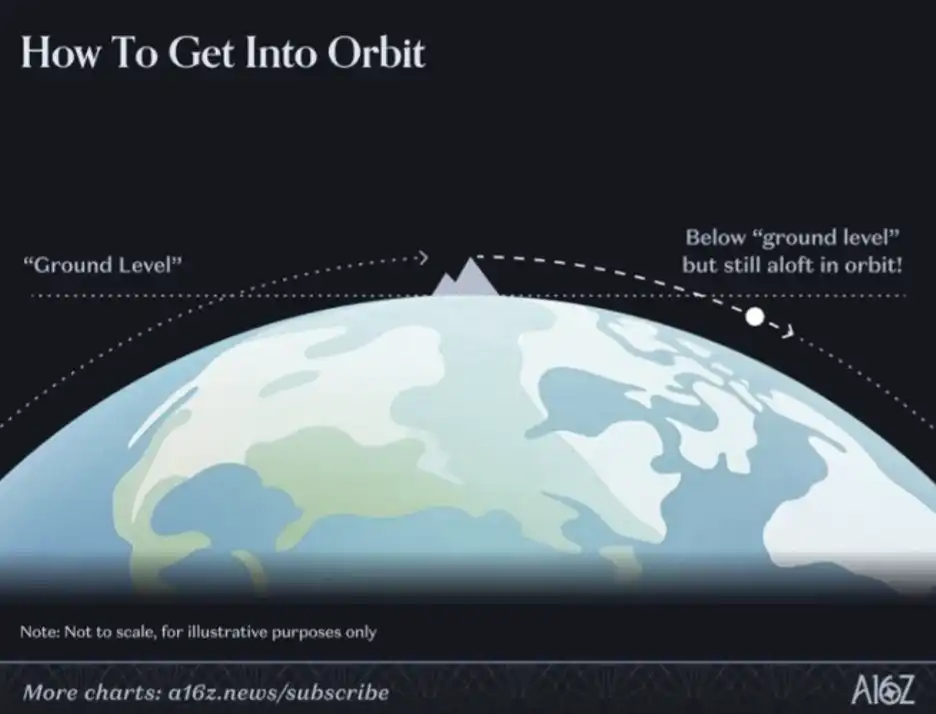
This threshold typically requires a velocity increment of about 9.4 km/s. How much mass can be reliably delivered into orbit determines how many satellites a country can deploy, how much fuel, sensors, protection, and redundancy the satellite can carry.
Traditional satellites are often large and expensive because every gram of mass is scarce, leading to highly compressed designs. However, these "precise large satellites" can become high-value targets in a war. The more functions a satellite undertakes, the greater the loss if it is blinded, jammed, or destroyed. Insufficient maneuverability and redundancy also make it harder to evade threats.
The orbit itself is not as spacious as imagined. Low-orbit constellations operate at different altitudes and inclinations, where orbit planes intersect. While geostationary orbit is at 36,000 kilometers in high space, for communication satellites, it is essentially a limited resource line above the equator. Spectrum is also scarce, and communication resources such as the Ka-band require coordination. Space is vast in physics but very limited in operational resources.
Even more troublesome is debris. Once a kinetic anti-satellite weapon shatters a target, it may create thousands of high-speed fragments. These fragments do not disappear but continue to orbit and threaten other satellites in the future. If collisions trigger more collisions, some orbits may become unavailable for an extended period.
The U.S. Has Scale Advantage, but Advantage Does Not Equal Security
From launch data, the United States still maintains a leading position. According to metrics like Ill-Defined Space, in 2025, the U.S. successfully launched about 192 times, China around 90 successful and 93 attempted launches, and Russia 17 times. Different agencies have slight differences in the metrics of "success" and "attempts," but the U.S.'s leading position is evident.
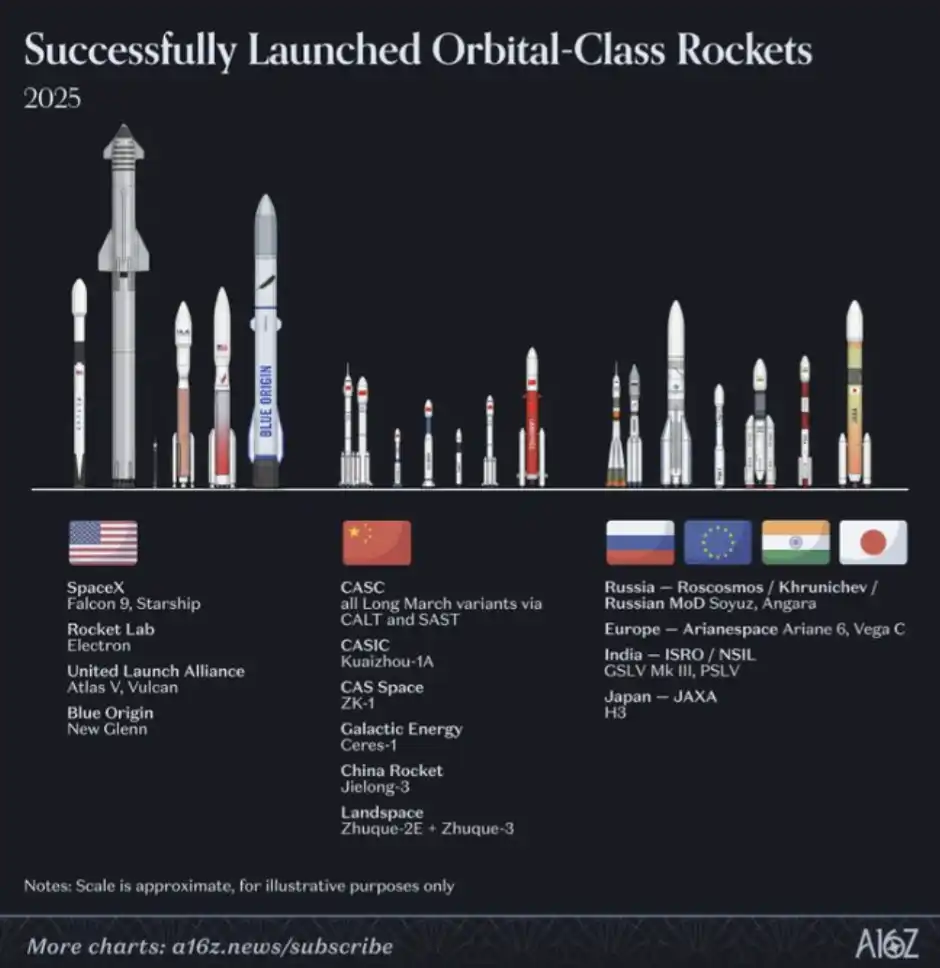
Behind this is almost invariably SpaceX. In 2025, Falcon 9 launched about 165 times, and SpaceX is currently the only company achieving large-scale reuse of orbital-class boosters. Reusability has transformed launches from scarce, expensive, low-frequency events to a higher frequency, more industrialized rhythm. For space military capabilities, this affects satellite replenishment, expansion, replacement, and wartime recovery speed.
Starlink showcases another advantage: scale. SpaceX's EU prospectus unveiled on June 5, 2026, revealed that as of March 31, 2026, approximately 9,600 Starlink broadband and mobile satellites were in orbit. Third-party tracking data in June indicated that the active count had surpassed 10,000.
Starlink's use on the Ukrainian battlefield has demonstrated that a commercial constellation can rapidly transform into wartime communication infrastructure. Its government version, Starshield, is more directly tailored to defense needs.
However, scale also brings new risks. Adversaries may no longer differentiate between commercial and military satellites, instead viewing all satellites that can support warfare as dual-use targets. Russia's close-proximity operation around ICEYE-X36 is a real-world demonstration of this logic.
The true vulnerability of the United States lies in the fact that if key tasks such as high-end reconnaissance, missile warning, nuclear command, and communication remain concentrated on a few expensive satellites, even with a large number of overall satellites, adversaries may exploit these critical nodes. Space superiority cannot only be measured by "how many" satellites there are but also by whether the architecture is distributed, if rapid replenishment is possible, if ground systems are reliable, and if operations can continue after encountering disruptions.
The Future of Space Warfare Likely Resides in the Gray Zone
Winning space warfare does not equate to merely destroying more satellites first. The real goal is to preserve one's own communication, reconnaissance, positioning, navigation, and timing capabilities while convincing the adversary that attacking will not yield decisive benefits.
The first layer is launch capability. Whoever can more quickly, affordably, and at a larger scale send payloads to orbit possesses wartime recovery capability. Reusable rockets, launch pad capacity, supply chains, and regulatory efficiency all become part of a nation's security capability. There are not many globally active orbital launch sites, and the launch infrastructure itself will become a high-value target.
The second layer is satellite manufacturing. Space no longer requires just a few "jewel-like" satellites but rather a plethora of expendable, replaceable, functionally distributed constellations. Military satellites need to disaggregate tasks, deploy them across more platforms, so that a single-point loss does not cripple the system.
The third layer is space situational awareness. In orbit, knowing who is nearby, at what relative speed, and what their intentions might be is more critical than assigning blame after the fact. Satellite disturbances, blinding, collisions, or internal failures could all manifest as failures, with attribution often being challenging. Without sufficient tracking and evidence chains, deterrence is weakened.
The direct cost of destroying satellites is also high. In 1962, the US conducted the Starfish Prime high-altitude nuclear test, detonating a nuclear device at approximately 400 km, creating a long-lasting artificial radiation belt and causing damage or premature failure to multiple satellites. Estimates vary, but the affected satellites at the time accounted for about a quarter to a third of on-orbit satellites. Modern orbital asset density far exceeds that of the past, making the consequences of nuclear anti-satellite or large-scale kinetic strikes harder to control.
A more realistic space confrontation may involve prolonged engagement in electronic interference, GPS spoofing, laser dazzling, cyber attacks, close maneuvering, spectrum competition, and ground station assaults. China and Russia are both developing anti-satellite capabilities, while the United States is advancing towards a more distributed, proliferated military constellation, such as the Proliferated LEO (Low Earth Orbit) Warfare System. The International Telecommunication Union's spectrum and orbital regulations will also become a battleground.
The Most Dangerous Assumption is That Space Remains Peaceful
Space has long been portrayed as a domain of peace, science, and commercial expansion, but modern warfare has demonstrated that it is the infrastructure of the terrestrial battlefield. Without satellite communications, forces struggle to coordinate. Without remote sensing and navigation, missiles, drones, and artillery lose accuracy. Without timing systems, finance, power grids, and communication networks are also impacted.
What sets Russia's approach with the ICEYE-X36 apart is that it did not create an explosion but instead showcased the reality of commercial satellites being involved in military coercion. Future space conflicts may not necessarily begin with a missile launch but are more likely to start with proximity maneuvers, interference, spectrum contests, or unattributable malfunctions.
The current U.S. advantage is tangible: leading in the number of launches, SpaceX has established a reusable rocket advantage, and Starlink has demonstrated the wartime value of a commercial satellite constellation. Blue Origin, Rocket Lab, Chinese commercial space endeavors are all catching up, while Russia and China are also accumulating co-orbital, electronic warfare, and anti-satellite capabilities. If a few expensive platforms continue to undertake critical missions, the high orbits will increasingly resemble an enticing target set.
The goal of space warfare should not be to turn near-Earth orbits into a field of debris. A more controlled outcome would instead maintain operational orbits, facilitate the recovery of communication, reconnaissance, and navigation capabilities under attack, and persuade adversaries that disrupting the order will incur a higher cost. Commercial space activities have provided the United States with an unprecedented scale advantage but have also exposed commercial assets to new military risks. The Russian satellite approaching within 500 meters was just the most explicit reminder at this stage.
Welcome to join the official BlockBeats community:
Telegram Subscription Group: https://t.me/theblockbeats
Telegram Discussion Group: https://t.me/BlockBeats_App
Official Twitter Account: https://twitter.com/BlockBeatsAsia