Institution Makes 100x Gain, Has SmartPeak Stock Price Peaked?
By 加六
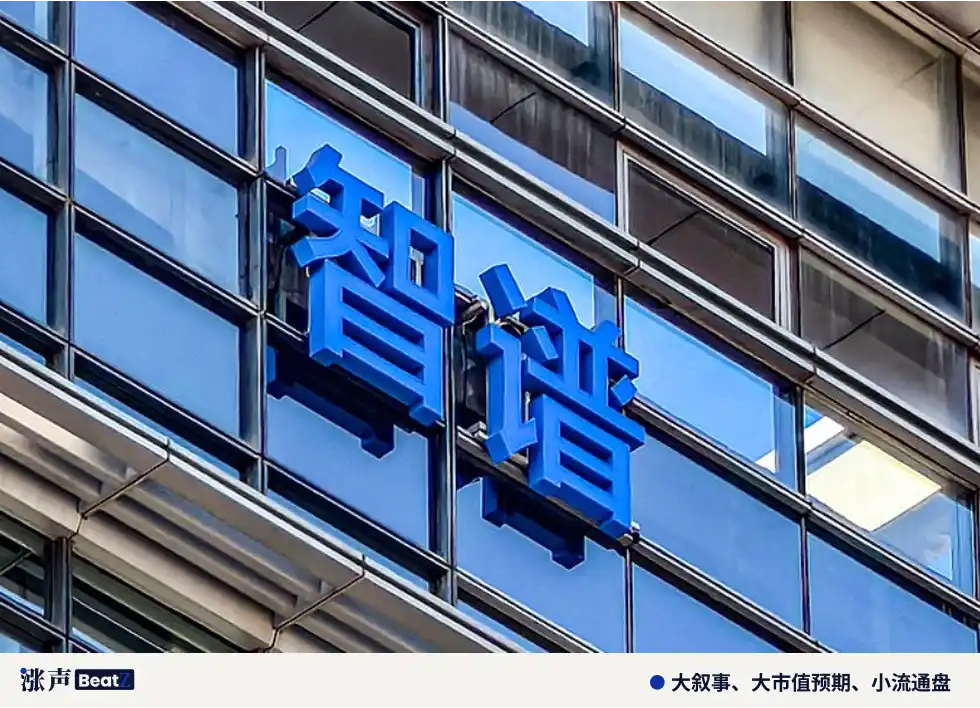
The recent market frenzy surrounds Zhipei (02513.HK), the first AI stock in China.
If you had bought Zhipei for 1 million in January this year, at the highest point on June 22, it had surged to nearly 25 million during intraday trading, with a closing value of over 20 million. This also makes it one of the fastest-growing companies in terms of market cap on the Hong Kong Stock Exchange, transitioning from a billion-dollar IPO to a trillion-dollar market cap in recent years.
Three key questions have been repeatedly raised in the market regarding this stock: Who has made money from this wave? Why has it surged so much? Who will take over next?
This article aims to answer these questions.
The Fastest Wealth Creation Wave in Hong Kong Stocks in Recent Years
From angel investment to IPO, Zhipei's valuation has increased by about 130 times. From the IPO to the intraday high on June 22, Zhipei's stock price has multiplied by 24.6 times.
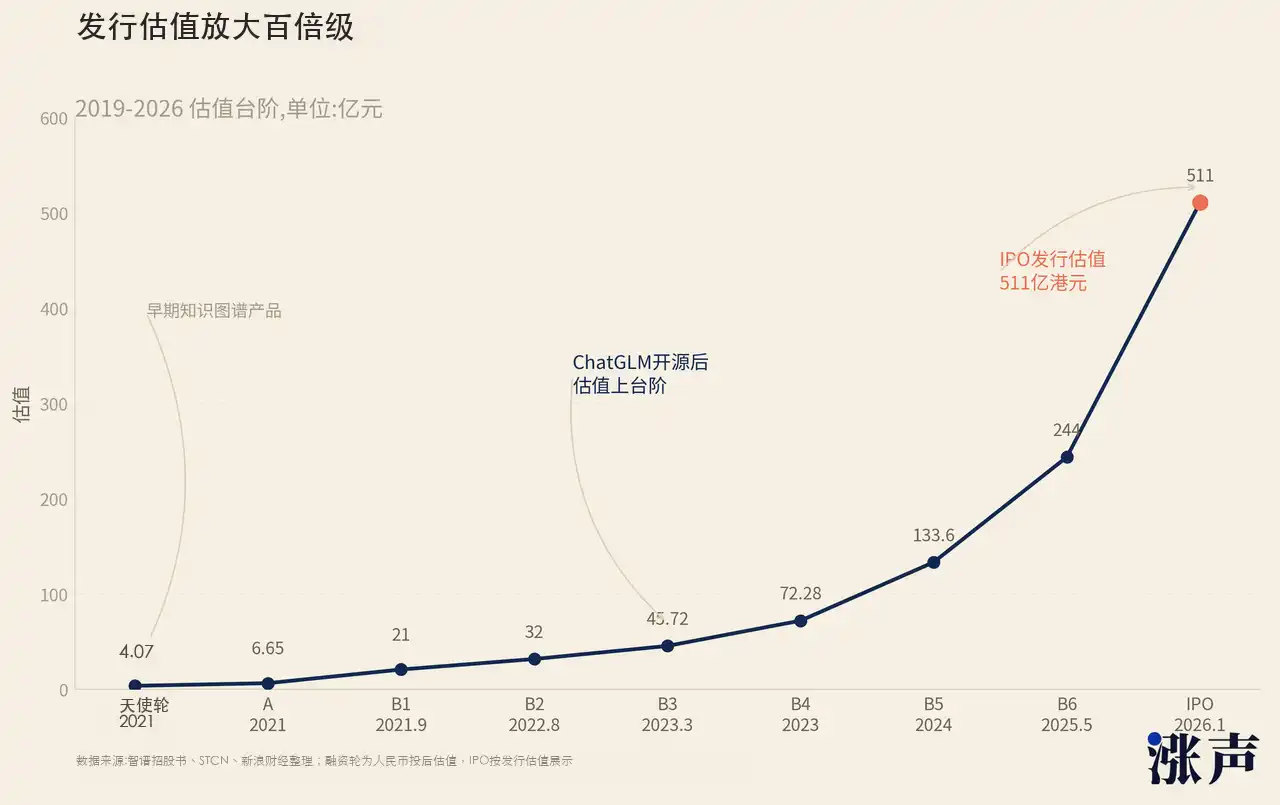
A total of 57 external investors collectively invested 8.36 billion RMB, corresponding to a combined value of approximately 770.8 billion HKD at the intraday high on June 22. The overall return is about 85 times. In the history of China's primary market, cases where all investors achieve an average return of 85 times on a single project can be counted on one hand.
According to the prospectus, Zhipei's financing is classified as "Three Rounds Fourteen Times." The earliest investors, in particular, have seen astonishing returns.
Zhong Ke Chuang Xing has seen the most extreme return multiple. According to the prospectus, it invested around 20.37 million RMB in the angel round, corresponding to a post-investment valuation of about 407 million RMB. At that time, Zhipei was still a knowledge graph team spun off from Tsinghua's KEG Lab, and the concept of large models did not even exist. Turning two-digit millions into hundreds of billions of HKD is one of the most extreme return multiple cases in the history of China's AI primary market.
The investors in the A and B rounds are likewise in the same boat. Roughly estimating based on the high point and market cap on June 22, the funds in the A round have already multiplied by hundreds, and the B round is close to a hundredfold return.
The figures for the later institutions are also out of this world. Xu Xin's ZhenFund invested 255.3 million RMB in November 2023, receiving 11.35 million shares. Based on a rough calculation at the high point on June 22, the book value is about 30 billion HKD, yielding a return of over a hundredfold. Today, ZhenFund has assets under management of approximately 3 billion USD, which means that the book value of this Zhipei investment has exceeded her entire fund size. Xu Xin has previously invested in Netease, JD.com, and BOSS Zhipin, but in absolute terms, Zhipei is likely to be the most profitable deal of her career.
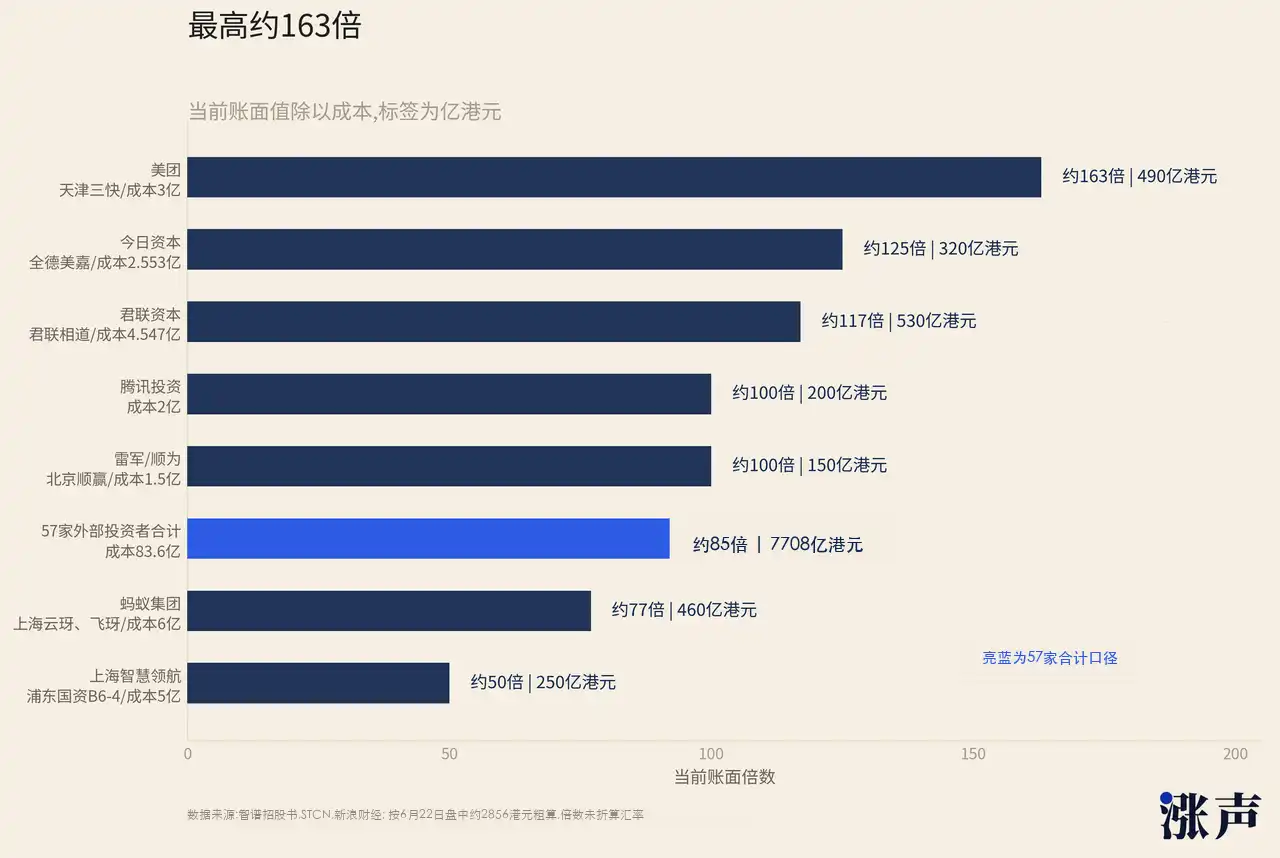
The example of Meituan is also very illustrative. According to existing data, Meituan invested about 300 million yuan that year, and now the return on investment has exceeded 15,000%. In other words, the unrealized gain from an industrial investment has surpassed 5% of Meituan's market value.
Lei Jun's Shunwei Capital invested 150 million yuan through Beijing Shunying, roughly calculated at about 14.8 billion Hong Kong dollars at the intraday high on June 22, with a return of about 9000%. Shunwei manages nearly 50 billion yuan, and this investment accounts for about one-fourth of the total assets.
Junlian Capital earned the largest absolute amount. They followed up on six occasions, with a total investment of 454.7 million yuan, roughly calculated at about 53.3 billion Hong Kong dollars at the intraday high on June 22, yielding a return of about 10,700%. Junlian manages assets totaling over 90 billion yuan, and the unrealized value of this investment in Zhipei is nearly half of its total assets under management. As a veteran PE investor who has participated in projects with iFlytek, Contemporary Amperex Technology, and Wuxi AppTec, Junlian finally achieved a historically high return on a single project in Zhipei.
In addition to market-oriented institutions, Zhipei also has a high density of state-owned shareholders. Beijing, Tianjin, Shanghai, Hangzhou, Zhuhai, Chengdu, and Daxing all have state-owned assets involved. Zhongguancun Science City, Zhuhai Huafa, Haihe Fuxin Uda Fund, Artificial Intelligence Fund, Hangzhou Urban Development Investment, and Daxing Industrial Fund are all well-known local government investment platforms. The Social Security Fund's Zhongguancun Independent Innovation Investment Fund also participated.
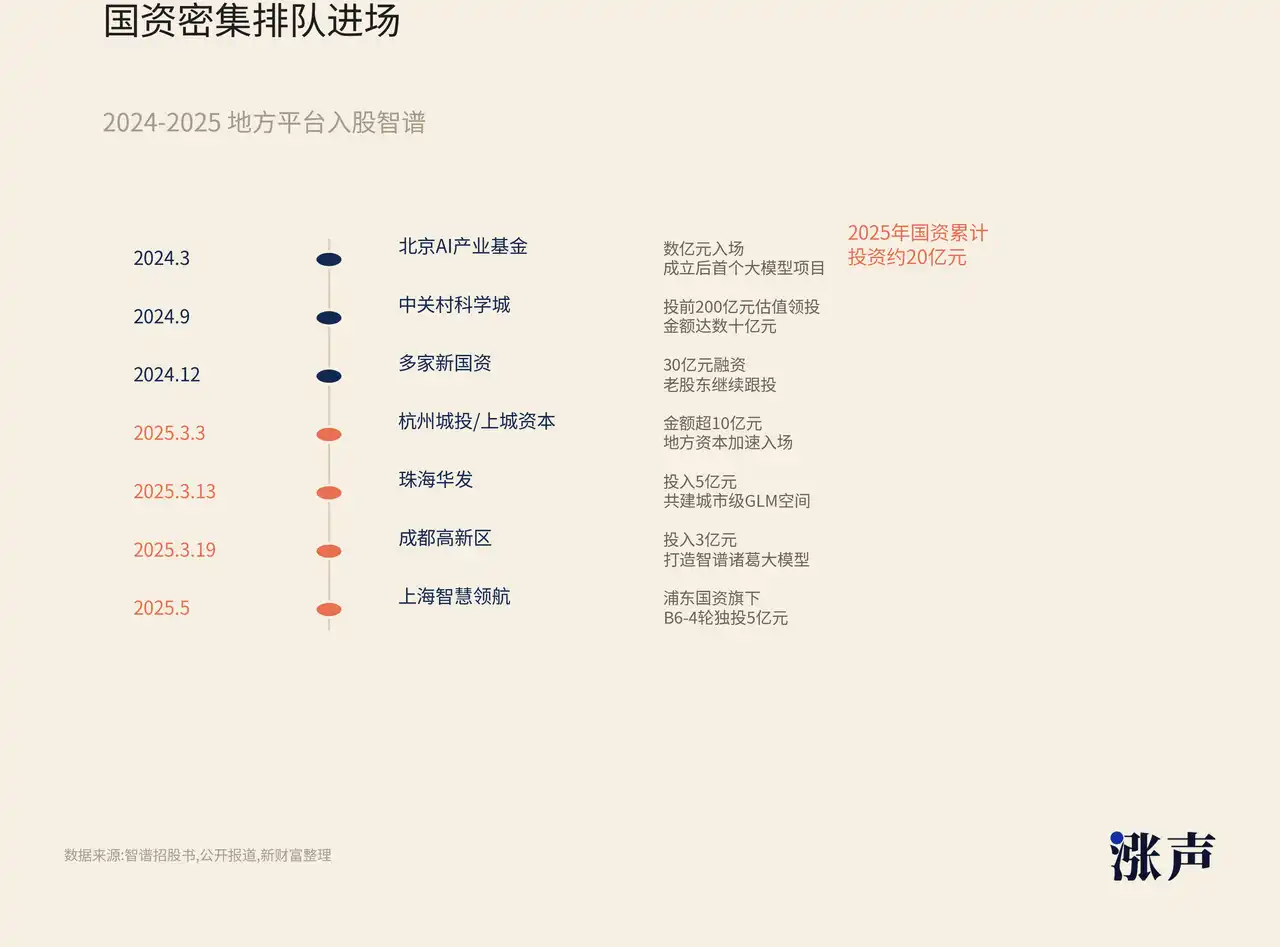
When this money comes in, it's not just financial investment. After these investments, they will drive the government procurement activities in the cities and provinces where they are located. When a local state-owned asset invests in Zhipei, Zhipei gains a natural advantage when the local government selects large-scale suppliers. This is a very obvious feature of China's technology industry: the wealthiest buyer is the government, and a technology project that receives government investment and support is already halfway to success. CIAT and Unisplendour are precedents of this model, where founders bring technology back from overseas, the government invests in establishing factories, and the companies quickly scale up.
Employees are also big winners in this wealth creation cycle. Employee stock ownership is significant in Zhipei, with two employee stock ownership platforms collectively holding about 15% of the company's shares. Twenty-five employees on the Zhideng platform had an average stock value of over 100 million Hong Kong dollars at the time of the IPO. Based on the intraday high on June 22, this has now become several billion Hong Kong dollars per capita. In another platform, Huihui, after excluding founder's equity, the average value held by over 400 employees on June 22 was also in the billion-dollar range.
This company stands out for its wealth creation density, ranking at the forefront in the history of Chinese tech company IPOs.
When Kuaishou went public in 2021, it also created a large number of "paper billionaires," but Kuaishou had a higher market capitalization and a larger employee base, leading to a more evenly distributed wealth. Zhizhi is a company of fewer than 900 people, with core options concentrated in the hands of a very small number of early employees. After the IPO, coupled with an intraday maximum increase of 24.6 times, the book value per person became extremely exaggerated.
Why Did Zhizhi Surge? The Capital Game Behind the Narrative Glow
It was a rare collective wealth creation event: early VCs, local state-owned assets, internet giants, competitors, founding team, and core employees were all repriced in the public market on the same project. So why did it surge to this extent?
What the market first saw was that it indeed had a revenue-generating business.
Zhizhi's most solid revenue does not come from its consumer chat product or developer community, but from local deployment. In simple terms, it means loading the entire GLM large model into the client's own server and intranet, keeping the data local. The main buyers are government agencies, state-owned banks, energy groups, and smart city projects. In the full year of 2025, revenue from local deployment reached ¥534 million, a year-on-year growth of over 100%, accounting for 73.7% of total revenue with a gross margin of 48.8%. For a large model company still operating at a loss, this business segment at least proves it's not just a story.
The pricing for local deployment is roughly divided into several tiers. County government agencies and small business bureaus use the light version with an annual fee of tens of thousands of yuan; municipal governments and regular SOEs purchase the standard general version for one to two million yuan over three years; provincial authorities, top banks, smart cities, meteorology, and energy groups use the flagship version, with annual fees possibly reaching hundreds of millions yuan, plus operation and upgrade fees. Individually, a project may not seem exorbitant, but China has dozens of provincial-level administrative regions, hundreds of prefecture-level cities, thousands of counties, as well as verticals such as finance, energy, and transportation.
As long as the AI budget for government and enterprises remains, Zhizhi's revenue ceiling will not be too low.
The shareholder structure also endorses this business. Names like Zhongguancun Science City, Zhuhai Huafa, Hangzhou Urban Construction, Chengdu Hi-Tech Zone, and Pudong State-owned Assets have entered the shareholder list not just because they want to make money from the stock. After their investment, they often drive local demonstration projects, government system procurement, and industrial park cooperation. In the Chinese tech industry, there has always been a similar path: the government provides funding, scenarios, and orders, and companies quickly scale with projects. Similar paths have been taken in the past with chips, storage, and new energy vehicles, and Zhizhi has simply applied this logic to large models.
But if only government and enterprise deployments, ZhiPu wouldn't have surged as much today. What truly ignited the second wave of enthusiasm was GLM-5.2 being rediscovered in the English tech community.
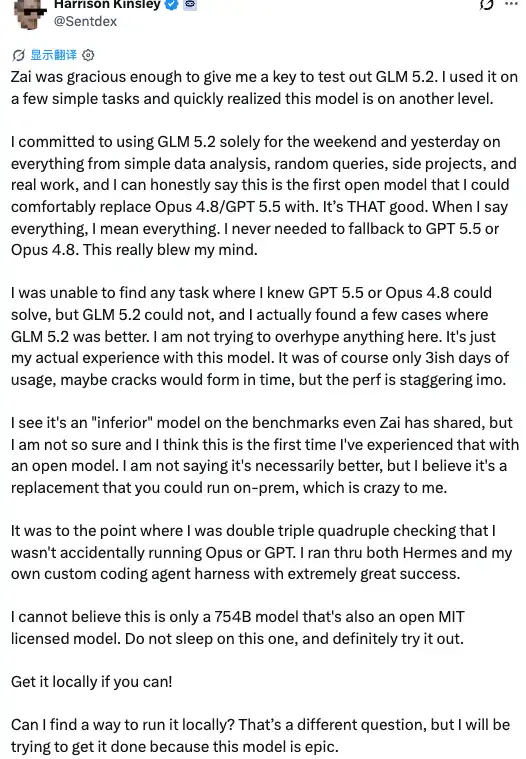
In mid-June, Z.ai released GLM-5.2, focusing on coding and agent, supporting a context of 1 million tokens, MIT open-source weights, with unchanged API pricing. It didn't immediately cause a big stir on the Chinese internet, as discussions on large models domestically are often diverted by DeepSeek, Tongyi, and Huanyuan. But the English developer community reacted very quickly.
Vercel CEO Guillermo Rauch said on X that the programming capabilities of GLM-5.2 impressed him "really profoundly, almost shocked." Matt Velloso, a former Meta, Google DeepMind, and Microsoft executive, also referred to it as the first open-source model to reach the threshold for daily use. Some developers even transitioned their daily work to GLM-5.2 and found that many tasks no longer required switching back to GPT or Claude.
This kind of dissemination is crucial for ZhiPu. Chinese investors looking at ZhiPu see it as part of the Tsinghua system, state-owned assets, government and enterprise deployments, and a scarce AI target in the Hong Kong stock market; the English tech community looking at GLM-5.2 sees another question: Can it replace some of Claude and GPT? Can it be deployed locally? Is it open source? Is the cost low enough?
When overseas developers, AI infrastructure companies, and English-speaking investors all start discussing ZhiPu using this framework, it is no longer just a Chinese local government-enterprise AI story but becomes a target that can be globally revalued by the logic of the model layer asset.
What the market is buying is not just the over 500 million yuan local deployment revenue in 2025, but a possibility: if open-source models can truly approach closed-source models, if Chinese model companies can bring down the inference costs, if unlisted tech giants like OpenAI, Anthropic, SpaceX continue to push up the valuation anchor of the model layer and hard technology assets, then ZhiPu, as one of the few listed model companies that can be bought directly on the public market, will naturally receive a premium.
Of course, there is a big question here. Whether developer interest can eventually translate into API revenue, local deployment contracts, and high-margin cash flow is not yet entirely proven. However, in the stage of stock price increase, the market often trades possibilities first and then asks about the profit and loss statement. GLM-5.2 has given ZhiPu a new narrative entry point and provided overseas funds with a reason to buy in.
Another more direct and important reason is that there are too few circulating chips.
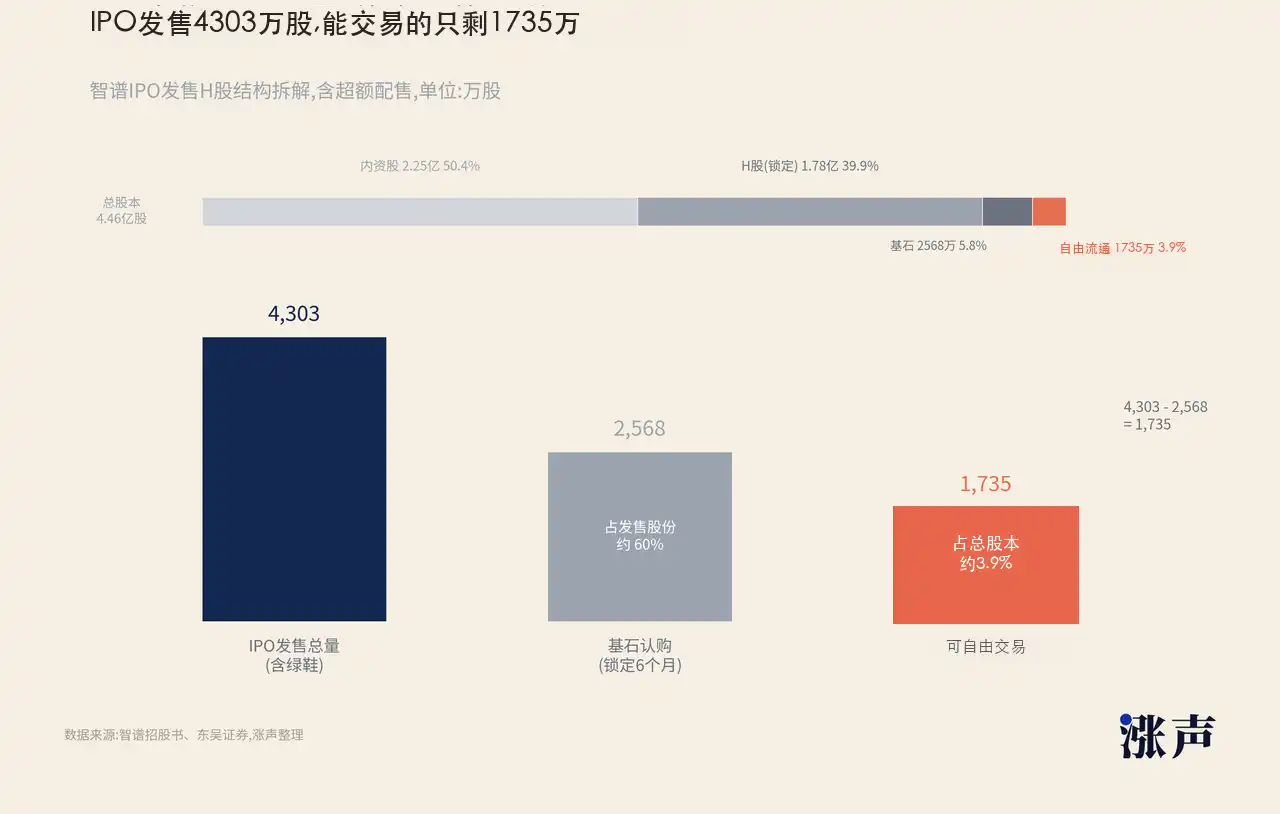
Many people, upon seeing the IPO share figures in a report by Dongwu Securities, would think that Zhipu's circulating shares amount to 221.31 million shares, accounting for approximately 49.6% of the total share capital, which is not low. However, it is important to distinguish between "circulating shares" and "free float." Zhipu is a Mainland China-registered company listed in Hong Kong. The circulating shares in the report are closer to the listed H-share caliber, but a considerable portion of these H-shares are still locked up in the early stages of listing and cannot be freely traded immediately. What truly determines the price elasticity of the stock is how many chips are freely tradable in the market every day.
From the IPO structure perspective, Zhipu globally issued around 37.4195 million H-shares, with a total issue size of about 43.03 million shares including over-allotment options, accounting for approximately 9.65% of the total share capital. This is less than ten percent of the total share capital. More crucially, the bulk of the IPO shares were taken by cornerstone investors. 11 cornerstone investors collectively subscribed to around HK$2.984 billion, accounting for nearly 70% of the shares offered. Cornerstone investors typically have a 6-month lock-up period, and the unlock date for Zhipu's shares is July 8, 2026.
This means, out of the 43.03 million IPO newly issued shares, approximately 25.68 million shares are locked up by cornerstone investors. In the early stages of trading, there are probably only around 17.35 million shares that can be freely traded, accounting for less than 4% of the total share capital. While a company's market capitalization may exceed a trillion Hong Kong dollars, less than 4% of the chips are actively trading. If the buying pressure becomes slightly concentrated, the price will experience significant volatility.
This situation is not unique to Zhipu; the trend of low circulation and high market capitalization has been very popular in the capital markets in recent years.
A prime example is SpaceX's IPO just over ten days ago, with less than 5% of its shares publicly available. Yet, the company's market valuation at IPO was close to $1.77 trillion, with a 19% first-day gain and at one point surging to around 30%. Everyone around the world wants to buy SpaceX, but very few chips are actually available for purchase.
Similarly, the 2025 U.S. stock IPOs of CoreWeave, Circle, and Figma all employed similar strategies. CoreWeave reduced its listing size, had limited tradable shares in the initial stage, and later surged on the AI computing power narrative and Nvidia shareholding catalyst; Circle sold a relatively small number of shares compared to the total share capital, and with the stablecoin regulation narrative, quickly saw a substantial increase in its stock price after listing; at the time of Figma's IPO, the total shares issued and old shares sold accounted for less than ten percent of the total share capital, and the stock price soared several times on the first day.
While companies may have different perspectives, the market structure is very similar: the grand narrative, high market cap expectations, and a small float.
The Hong Kong stock market has its own version as well. When CATL listed on the Hong Kong Stock Exchange, only a small portion of its shares were traded in Hong Kong. However, behind it was the globally recognized electric vehicle battery leader whose A-shares were already priced. On the first day, it saw a double-digit percentage increase. For Hong Kong capital, what they bought was not just a new stock, but a scarce Chinese core asset that could be directly traded in a Hong Kong stock account. Now, Zhidu has a similar logic, except the asset label has changed from power batteries to large models.
Will the Upcoming "Massive Unlock" Cause a Market Crash?
The government-enterprise business provides the revenue base, the GLM-5.2 contributes to the global tech narrative, the low free float provides stock price elasticity, and Zhidu's stock price has been pushed to its current level.
However, the more rapid the rise, the more direct the following question: who will buy in?
First, let's look at the valuation. Zhidu's market cap was approximately $137 billion as of June 22, with expected full-year 2025 revenue of around $100 million, corresponding to a sales multiple of about 1280x. This multiple has already exceeded all traditional valuation frameworks.
NVIDIA, Tesla, Palantir — companies that the market has repeatedly deemed "too expensive" — were mostly priced at dozens of times sales when they were considered expensive. Based on FT's disclosure of OpenAI's expected $13 billion revenue in 2025 and a $730 billion valuation, the multiple is roughly 56x. Zhidu is at 1280x.
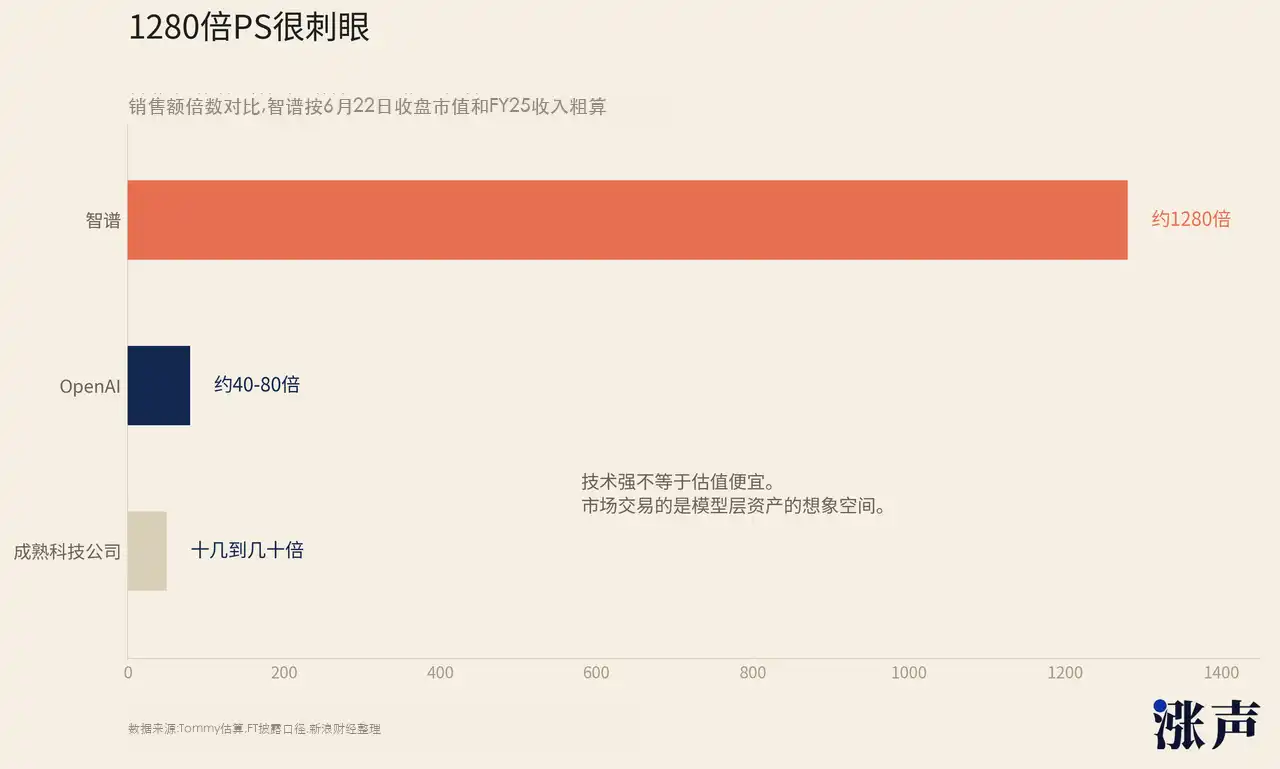
If we apply OpenAI's multiple to Zhidu's revenue, Zhidu's "reasonable" market cap would be approximately between $4 to $8 billion. Even using JPMorgan's projected 534% revenue growth in 2026 (around $640 million) and applying OpenAI's multiple, it can only support a valuation of $25 to $50 billion. There is still a significant gap from the $137 billion corresponding to the June 22 closing.
Zhidu's current price is not supported by the income statement, but by scarcity, imagination, and capital structure. As long as the market continues to treat it as the "China's OpenAI shadow stock" and buy, the valuation can temporarily ignore reason. However, once new chips hit the market, the market will ask a very realistic question: who will continue to buy such an expensive stock?
This question will become very specific on July 8.
Based on the public information currently available, the most certain batch of shares to be unlocked on July 8th is approximately 25.68 million shares held by cornerstone investors. A total of 11 cornerstone investors subscribed to about HK$2.984 billion at an issuance price of HK$116.2, translating to around 25.68 million shares, representing about 5.76% of the total share capital.
As mentioned earlier, initially, only about 17.35 million shares were truly tradable during Zhipu's IPO. After July 8th, the cornerstone unlock will expand the tradable shares from 17.35 million to approximately 43.03 million shares, nearly 2.5 times the original amount. Based on the intraday high on June 22nd, the 25.68 million shares correspond to a book value of around HK$73.4 billion.
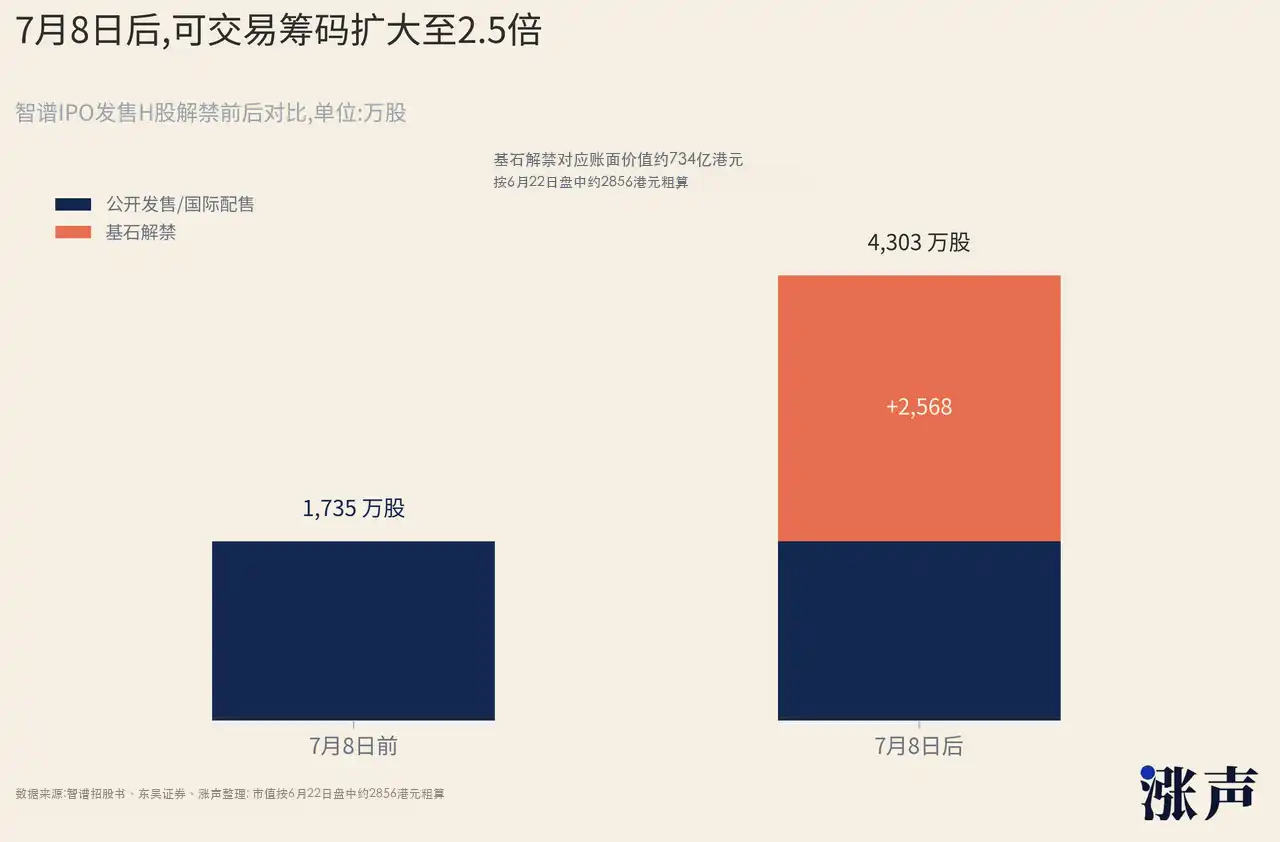
While not a impact in the hundreds of billions, it is enough to alter the supply-demand dynamics of the chips.
In addition to the cornerstone investors, the shares of pre-IPO shareholders, state-owned platforms, strategic investors, and employee stock ownership plans will gradually enter the market in the future. They may not be able to sell on July 8th, but the market will not wait until the details are finalized to react. As long as investors realize that these substantial unrealized gains will gradually become sellable chips, the stock price will begin to discount the potential supply.
We have seen a similar script in the Hong Kong stock market before. After Youzan's one-year anniversary unlock, key shareholders quickly reduced their holdings, leading to a significant drop in the stock price.
If the cornerstone investors and early shareholders only conduct a small exploratory sell-off, the market might be able to absorb it. However, if there are consecutive large discounted sales, key shareholders disclosing reductions, increased trading volume without price increases, the scarcity premium will quickly disappear.
What Zhipu needs to prove most now is twofold. First, whether the developer interest brought by GLM-5.2 can translate into actual revenue. Second, after July 8th, whether the market can absorb the additional tradable chips, transitioning the stock price from being driven by "low float" to "fundamentals."
If both of these conditions are met, there is still room for Zhipu's lofty valuation to be discussed further.


Welcome to join the official BlockBeats community:
Telegram Subscription Group: https://t.me/theblockbeats
Telegram Discussion Group: https://t.me/BlockBeats_App
Official Twitter Account: https://twitter.com/BlockBeatsAsia