27-Year Reign Ends: Micron Overtakes Samsung in Market Cap, Power Shift in Korean Semiconductor Industry Driven by AI
Original Title: "27-Year Reign Ended: SK hynix Overtakes Samsung in Market Value, Power Shift in South Korean Semiconductor Industry Driven by AI"
On June 22, 2026, SK hynix, once burdened with $14 billion in debt and on the brink of bankruptcy, surpassed Samsung Electronics, who had dominated the South Korean capital market for 27 years, to become the new king of the South Korean market value. Behind this was a precise and historic bet—when the AI wave pushed HBM from a niche product to the core of computing power, SK hynix, with a 59% market share and a daily net profit of over 2 billion RMB, achieved a remarkable comeback in business history.
On June 22, 2026, a moment that rewrote the history of the South Korean capital market occurred during trading hours.
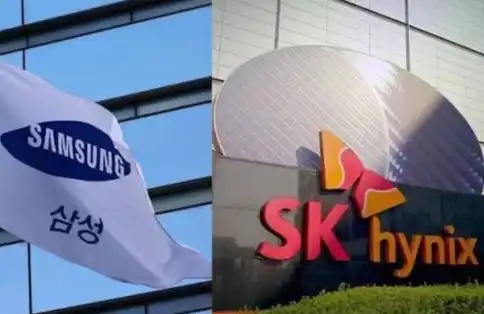
SK hynix's total market value surpassed Samsung Electronics for the first time, becoming the highest valued public company in South Korea. This was the first time since 1999 that Samsung Electronics relinquished its position as the "king of market value" in South Korea. At one point during trading, SK hynix's market value reached 208 trillion KRW (approximately $1.35 trillion), while Samsung Electronics' market value was 206.6 trillion KRW.
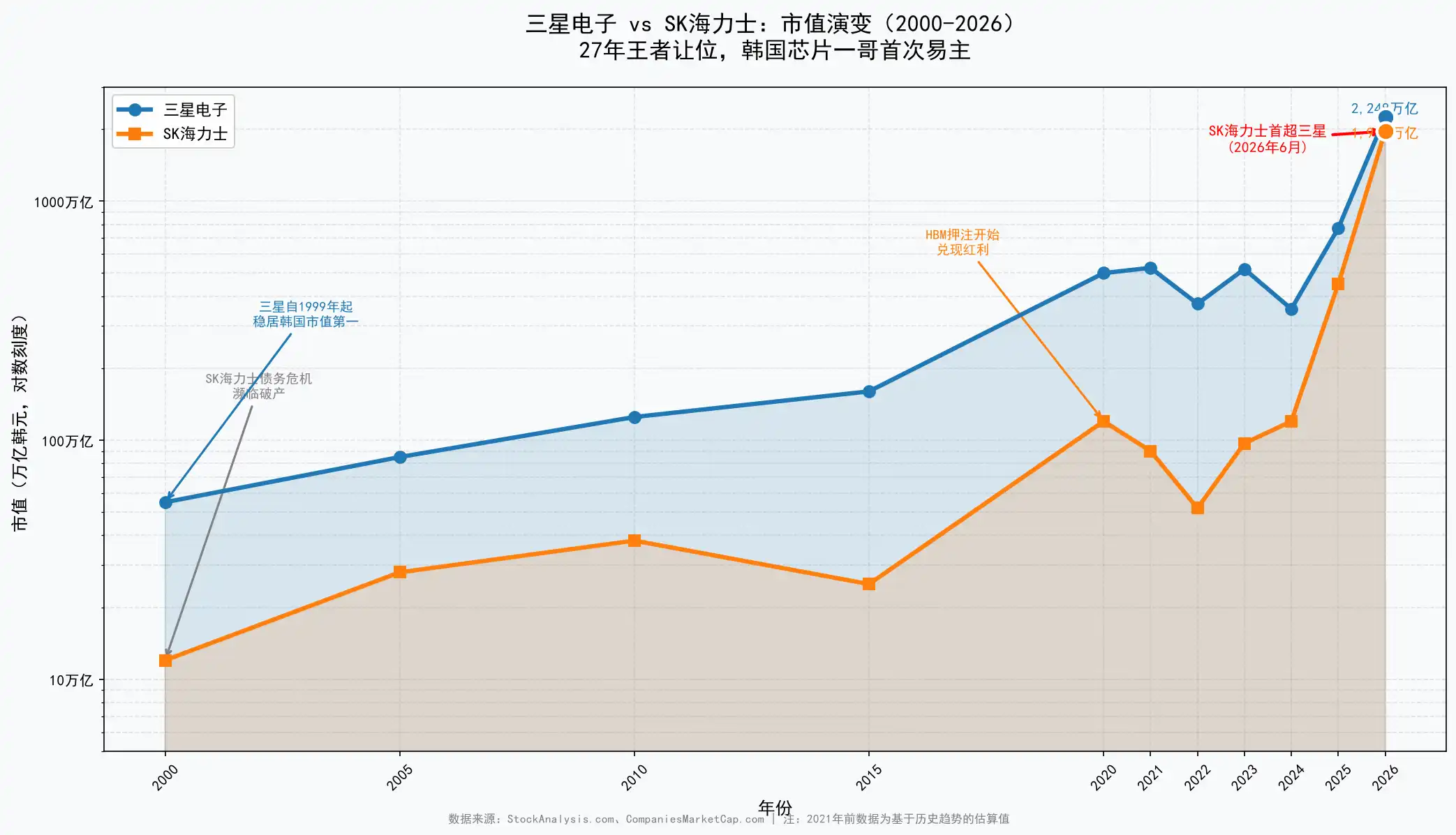
From a debt-ridden company on the verge of bankruptcy to surpassing the national symbol Samsung Electronics and becoming a trillion-dollar empire, SK hynix completed a stunning comeback in the business world over a span of two decades. This was not just a swap in the rankings of two companies but also a microcosm of the AI wave reshaping the global semiconductor industry power structure.
HBM: From Niche Product to Core Infrastructure of the AI Era
SK hynix's comeback was fundamentally a story of "betting on HBM."
High Bandwidth Memory (HBM) was once a niche category in memory chips. However, in AI large model training, GPUs require extremely high-speed data throughput between the GPU and memory—an NVIDIA H100 requires 80GB of HBM, H200 requires 141GB, and the latest B200 requires 192GB. There are only three companies globally capable of producing HBM: SK hynix, Samsung, and Micron.
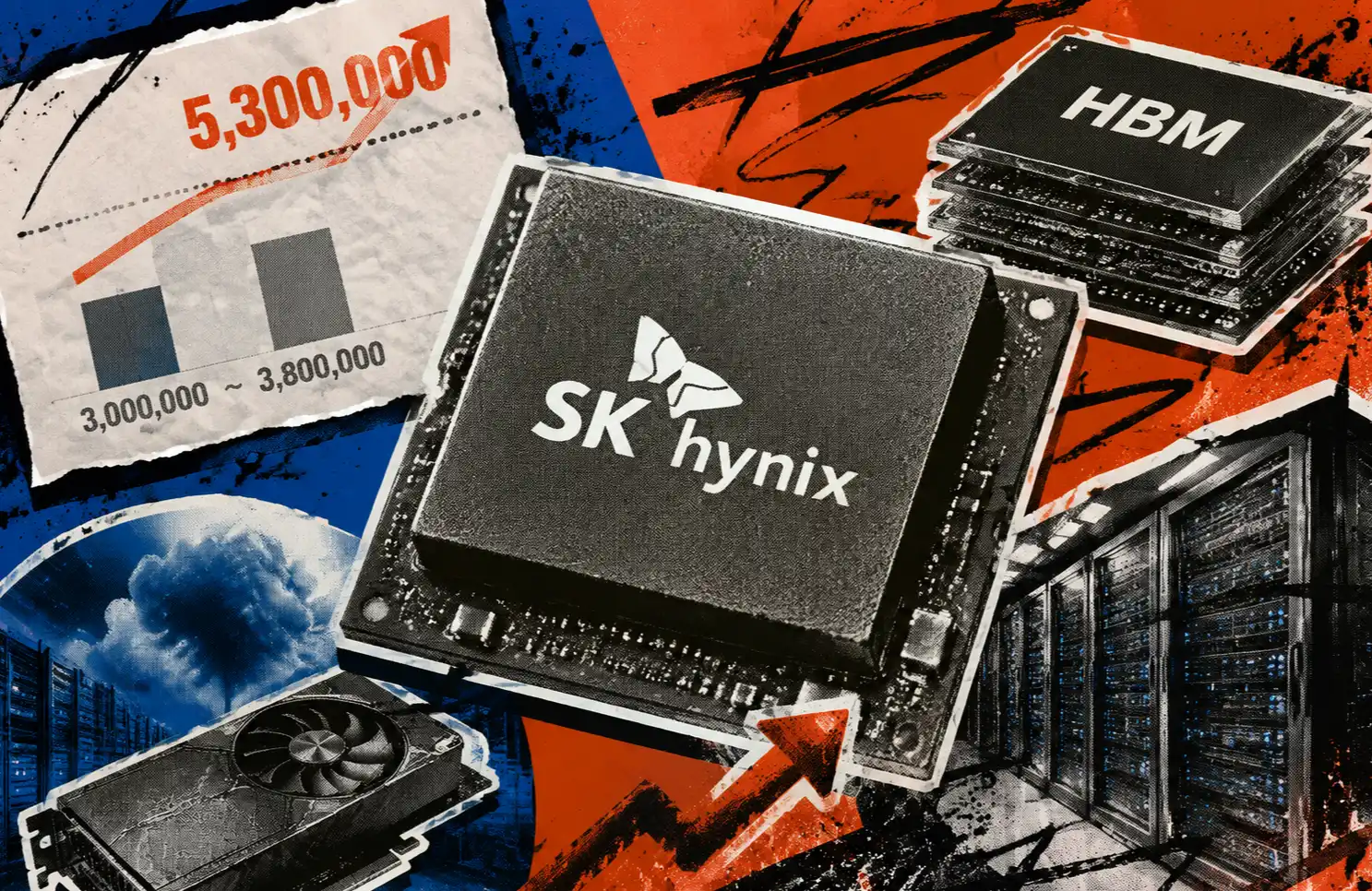
SK hynix has established an almost monopolistic advantage in this race. According to TrendForce data, SK hynix held a 59% share of the global HBM market in 2025. More importantly, in the most profitable HBM4 sector, Counterpoint Research predicts that SK hynix will achieve a 54% market share in 2026 and has already secured over two-thirds of the HBM4 orders for NVIDIA's next-generation Vera Rubin platform, with some institutions predicting a market share exceeding 70%.
This advantage is directly reflected in the financial data. In the first quarter of 2026, SK Hynix's consolidated revenue reached 52.58 trillion Korean won, a year-on-year increase of 198.1%, surpassing the 50 trillion won mark for the first time; net profit reached 40.35 trillion Korean won, nearly quadrupling year-on-year. A simple calculation shows that SK Hynix earned over 2 billion RMB in net profit on average per day in the first three months of this year.
With a 72% operating profit margin, SK Hynix not only exceeded NVIDIA but also left the traditional DRAM business far behind. According to Counterpoint Research, SK Hynix's HBM business has an operating profit margin ranging from 75% to 83%, about 10 percentage points higher than the regular DRAM business. The HBM business now accounts for about 40% of the company's revenue, becoming a true profit engine.
Samsung's Dilemma: The Cost of Being a Jack-of-All-Trades
Compared to SK Hynix's sharp focus, Samsung Electronics's problem lies in the fact that "breadth" has become a burden.
Samsung's businesses span multiple fields, including memory chips, smartphones, semiconductor foundry, home appliances, and more. With a revenue scale of 333.6 trillion Korean won in 2025, far exceeding SK Hynix, the drag from non-memory businesses has dispersed resources and strategic focus.
In the memory chip field, Samsung's layout in HBM is noticeably lagging. Although Samsung is also developing HBM3E and HBM4, it is lagging behind SK Hynix in customer certification and mass production progress. This has resulted in Samsung watching its competitors enjoy premiums while the demand for AI computing power is at its peak.
What makes Samsung even more distressed is the synchronous stumble of its other businesses. The smartphone business's market share has declined from 54% to 45%; the semiconductor foundry business has faced underutilization due to the technological gap, failing to secure orders from high-end customers. The profit that the memory business should have provided has been continuously diluted by the hemorrhage of other businesses.
Furthermore, labor disputes between management and employees continue to escalate. After SK Hynix reached a milestone bonus agreement last year, Samsung's labor conflicts pose an additional challenge to its profit recovery. While SK Hynix's employees are reaping the benefits of the AI boom, Samsung's organizational cohesion is facing a test.
From $14 Billion Debt to Trillion-Dollar Empire
SK Hynix's rise is almost a microcosm of the South Korean semiconductor industry.
Its predecessor can be traced back to Hyundai Electronics, established in 1983. With support from the South Korean government and conglomerate funds pouring in, Hyundai Electronics rapidly caught up, focusing on DRAM chips and growing into the second-largest semiconductor company in Korea by the 1990s. In 1999, Hyundai Electronics merged with LG Semiconductor to become Hynix, under the ownership of the Hyundai Group.
However, the early 2000s semiconductor winter almost pushed the company to bankruptcy. At that time, SK Hynix had a debt of up to $14 billion and was on the brink of collapse. The South Korean government promoted industry consolidation, leading to a duopoly between Samsung and Hynix in the DRAM sector. Subsequently, through several key restructurings and counter-cyclical technology investments, Hynix gradually recovered.
The real turning point was the early layout of HBM. While the market still viewed HBM as a niche product, SK Hynix had already identified it as the future direction for high-performance computing. This strategic vision paid off handsomely during the AI boom—today, HBM has transitioned from a niche product to a key infrastructure component supporting ChatGPT and advanced AI models.
Hynix's comeback also reshaped the ecosystem of the South Korean capital market. The head of the Financial Supervisory Service in South Korea recently expressed regret for not stopping the launch of individual stock leveraged ETFs in the past, noting a significant increase in the negative impact of high-risk products related to Samsung and SK Hynix. Retail investors' demand for leveraged ETFs on these two stocks continues to surge, and regulatory agencies are considering taking separate stabilization measures.
Beyond Market Cap: Deep Restructuring of the South Korean Economic Landscape
SK Hynix surpassing Samsung in market cap signifies more than just a capital market ranking.
The Governor of the Bank of Korea, Lee Ju-yeol, recently stated that the benefits of the semiconductor industry's expansion are increasingly flowing through to the overall economy through improved corporate profits, consumption, and investment. When companies like SK Hynix become the new engine of the national economy, South Korea's growth model is shifting from traditional consumer electronics to AI infrastructure-driven.
From a global perspective, this event marks the transformation of the memory chip industry from "commoditization" to "high-value specialization." Traditional DRAM and NAND are highly cyclical commodities with volatile prices. However, HBM, deeply integrated with AI computing power, is shedding its commodity attributes and becoming a high-end product with long-term pricing power.
Under the Cycle, There Is No Eternal King
Nevertheless, SK Hynix's rise to the top does not mean smooth sailing.
Around 2028, the Micron New York fab, SK Hynix's Cheongju campus, and Samsung's Pyeongtaek expansion will all contribute to increased production capacity. TrendForce predicts that the price hike of memory chips will continue at least until the end of 2027, but the landing of new capacity may change the supply-demand dynamics. At that time, whether the scarcity premium of HBM will shrink remains to be seen, testing the depth of SK Hynix's moat.
Furthermore, Samsung is not willing to give up its throne. With a strong foundation in 3D NAND and advanced processes, Samsung still has a significant advantage. Once it achieves a breakthrough in HBM4, market competition will intensify rapidly. The market value gap today is only about 14 trillion Korean won, and the suspense of a throne change is far from over.
However, on June 22, 2026, SK Hynix did rewrite history. A company that had emerged from a debt crisis, surpassed the behemoth that had dominated the Korean capital market for 27 years by making a precise bet on the core infrastructure of the AI era. This is not the end but the latest testament to the global semiconductor industry's power reshuffle.
Original Article Link
Welcome to join the official BlockBeats community:
Telegram Subscription Group: https://t.me/theblockbeats
Telegram Discussion Group: https://t.me/BlockBeats_App
Official Twitter Account: https://twitter.com/BlockBeatsAsia

 Related Articles