The Trillion-Dollar Market Cap of BrainCoin: Why is the Market Willing to Pay the Price?
Original Article Title: "Trillion-Dollar Metaverse, Why?"
Original Author: Xiaojing, Tencent Technology
When it was at $600 billion, almost everyone thought the Metaverse was too expensive, yet it has now surged to a trillion dollars.
As Soros once said, "The price in the financial markets is always wrong, but the error can self-reinforce for a quite extended period, eventually turning itself into the right price."
On the morning of June 22, the first trading day after the Dragon Boat Festival holiday, Metaverse's Hong Kong stock opened with a more than 13% surge, breaking through 2380 Hong Kong dollars, and its total market value officially exceeded 1 trillion Hong Kong dollars. In less than half a year since its IPO, it has surged over 1900%.
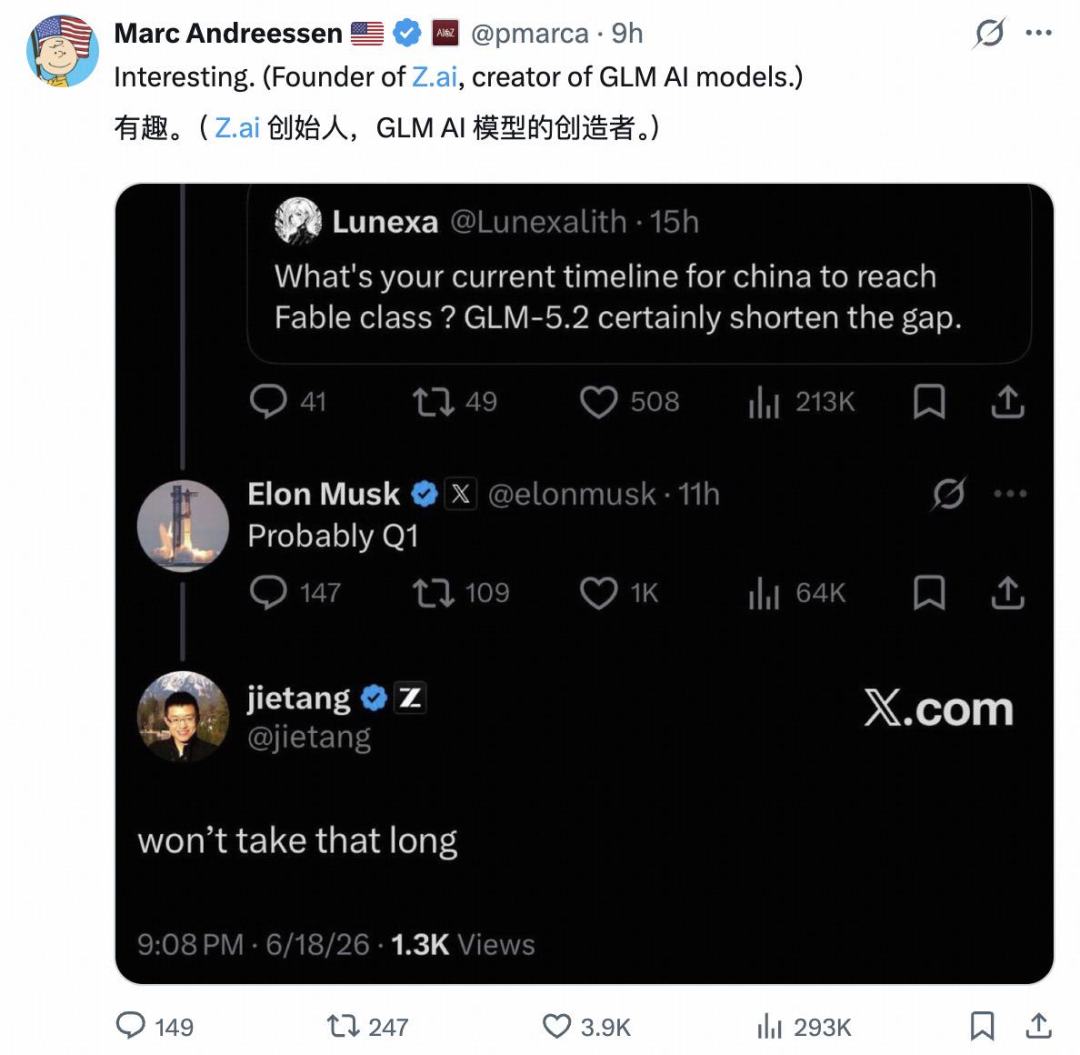
If we rewind time four days ago, a conversation unfolded on the X platform.
Someone asked Musk, "When will the China Mega Model reach Fable level? GLM-5.2 has undoubtedly narrowed the gap." Musk replied with two words, "Probably Q1."
Tsinghua University professor and Metaverse founder Tang Jie directly responded below with four words: "Won't take that long."
Musk added, implying that if you only look at benchmarking, maybe you are right, but creating real practical value that can make money is another matter.
Tang Jie replied again: "Focus is all we need." This retort may not be translated as its meaning might be profound.
a16z co-founder Marc Andreessen retweeted this conversation with a one-word comment: "Interesting."
Three days later at the Hong Kong stock market opening, the Metaverse surpassed a trillion.
01 Everyone Thought Metaverse's Valuation Was Absurd
Turning to the Metaverse's first annual report, the full-year revenue for 2025 was 0.724 billion yuan, with a net loss of 4.718 billion yuan and R&D expenses of 3.18 billion.
As an intuitive reference: Alibaba Cloud's FY 2026 revenue was 158.1 billion, and AI-related revenue has seen triple-digit growth for seven consecutive quarters. Metaverse's annual revenue is approximately 1/218 of Alibaba Cloud's, yet the secondary market has given it a nearly trillion Hong Kong dollar independent valuation. In comparison, Alibaba's market cap is only 1.96 trillion Hong Kong dollars.
Everyone has seen this dramatic number. Some in the investor community have called it "severely overvalued," while others have asked point-blank, "Can we short this?"
The question of "Does this make sense?" is not truly a question that can be answered now; it may not be answered definitively until three years from now. This article attempts to address a different question: Why does everyone think it's expensive, yet the price keeps rising?

Image generated by AI
A trillion is not all hot air; there are indeed fundamentals underlying the surge.
The latest flagship model, GLM-5.2, with a total of 744 billion parameters, a 40 billion activation MoE architecture, and support for 1 million-token context without loss, has emerged. On Arena.ai's Code Arena blind leaderboard, GLM-5.2 Max ranks second with a score of 1593.
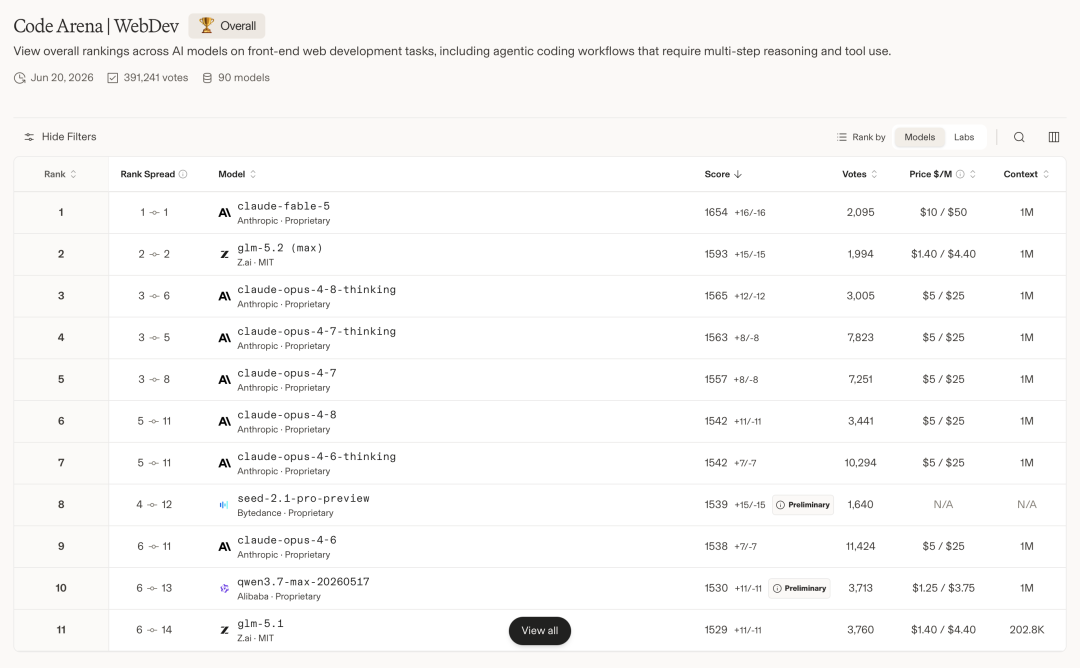
In the Design Arena web design evaluation, the June 20 update shows that GLM-5.2 has claimed the top spot with an Elo rating of 1360, surpassing Claude Fable 5.
The Terminal-Bench 2.1 evaluation scored 81.0, compared to the 63.5 of the previous generation GLM-5.1, marking a 17.5 percentage point improvement in two months of iteration. In the real-world software engineering task evaluation by FrontierSWE, it falls just about 1 percentage point below Claude Opus 4.8, surpassing GPT-5.5.
In the realm of open-source large models in programming, which holds high commercial value, China's model is now on par with Anthropic and OpenAI's flagship models.
However, it must be acknowledged that Musk's comments are not without merit. Proximity in a single benchmark and proximity in model productivity are two different things.
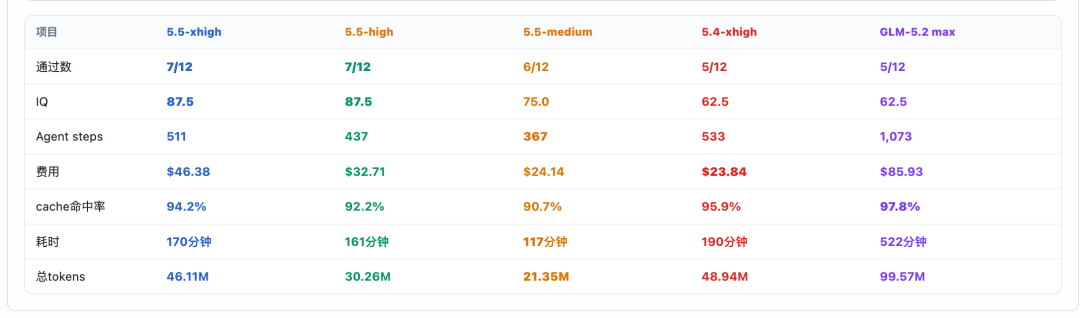
Some developers have even created websites to monitor model usage metrics. In cases where the task pass rates are similar, the time and token consumption of GLM-5.2 Max are several times that of models at a similar level, indicating that the model is not yet efficient enough at "figuring out how to do things" and needs more trial and error.
While this is a personal developer's self-use website and its fairness is yet to be verified, it can be indirectly seen that the GLM-5.2 still has a certain gap in efficiency and cost in complex engineering tasks requiring multi-step reasoning and long-range agent operations.
There is another notable signal where multiple developers have expressed that it is difficult to purchase the SmartSpectrum's Coding Plan. The official documentation indicates that the Coding Plan is already supported by GLM-5.2, but it also sets a 5-hour quota, a weekly quota, and dynamic concurrency limits. During peak hours, the quota for GLM-5.2 is even tripled.
As early as January 23, 2026, SmartSpectrum had issued an official announcement: due to the surge in users after the launch of GLM-4.7 causing a strain on computing power, the daily addition of subscriptions to the GLM Coding Plan was reduced by 80%, and it was switched to a limited daily sale at 10:00. Subsequently, tutorials on "how to grab the Coding Plan" even appeared across the entire network. Even setting alarms to refresh at 10:00 resulted in no availability. In February, SmartSpectrum sent an apology letter for drastically cutting quotas and offered refunds to existing users.
However, the Coding Plan seems more like an "entry-level product" that SmartSpectrum is using to penetrate the developer ecosystem rather than a primary revenue pool. It binds subscriptions to Claude Code, Cline, OpenCode, and other workflows, quickly amplifying GLM-5.2's presence in coding scenarios.
Yet, the issues with the Coding Plan are also evident: coding agents consume a large amount of context and involve multi-round calls, making it easy for subscription-based pricing to not cover the real inference cost.
Therefore, the difficulty in purchasing the Coding Plan after the release of GLM-5.2, the strict quotas, the doubling of deductions during peak periods, are not just sales strategy issues but may also reflect SmartSpectrum's control over inference resources and the subscription-based loss risk. In comparison, API billing based on tokens is easier to establish sustainable revenue and is more suitable for long-term use by enterprise customers.
02. "Scarcity": The Underlying Logic of the 2026 Large Model Valuation
If we observe the valuation ranking of global large model companies in 2026, we will find a counterintuitive pattern: this round of market rewards is not for the "company with the most users" but for the "company in short supply."
The most typical example is when Anthropic surpassed OpenAI. In May 2026, Anthropic completed a Series H funding round of $65 billion, with a valuation of $965 billion, surpassing OpenAI's $852 billion for the first time.
From a product perspective, Claude has always been "harder to use" than GPT. The rate limit of Claude Pro/Max has long been much stricter than that of ChatGPT Plus, with heavy users often being throttled mid-conversation, and Claude Code typically experiencing wait times during peak hours. In terms of API pricing, Claude has always been higher than GPT models of the same level.
Users have formed the perception that "Claude = Scarcity = High-end," similar to a restaurant where you have to queue up to get in, leading them to psychologically assume that it is better than the neighboring empty one.
The capital side is no different. Both companies have not yet gone public, and their valuations come from private fundraising and secondary share sale markets. In October 2025, OpenAI conducted a large-scale Tender Offer, allowing over 600 current and former employees to cash out a total of $6.6 billion, with about 75 people selling the maximum of $30 million each. There is relatively abundant "supply" of OpenAI equity for buyers.
On the other hand, the Anthropic founding team holds a large stake, and early strategic investors such as Google and Amazon are unlikely to sell before the IPO. There are very few willing sellers, while potential buyers are chasing after limited chips to bid.
Scarcity on the product side and scarcity on the capital side resonate with each other, driving Anthropic's valuation to surpass OpenAI.
The scarcity effect on the Intelligence Spectrum is somewhat similar: the Coding Plan on the product side has a daily supply limit, and currently, less than 4% of the company's shares are in circulation on the Hong Kong Stock Exchange. Whether it is its token or its stock, both are in a state of "high demand and low supply."
03 Why Do People Still Buy When They Know It's Overpriced?
However, from a valuation perspective, these fundamentals are far from enough to support a trillion-dollar market cap, and it is a market consensus that the Intelligence Spectrum is overvalued.
Moreover, even when it was at $500 billion or $600 billion, the market said it was overvalued. So why does it continue to rise?
In his 1936 work "The General Theory," Keynes proposed: The stock market is not a game of deciding "who is the most beautiful," but a game of deciding "who most people will think is the most beautiful."
Among those buying into Smart Spectrum, a large portion do not need to believe in its "trillion-dollar" valuation. As long as the circulating supply remains extremely small, passive allocation demand persists, and the narrative of leading coding capabilities remains strong, the existence of the "next buyer" is a high-probability event.
In small-cap stocks, there is a tendency for a short-term amplification effect to occur between index inclusions, passive fund allocations, and limited float. In May 2026, Smart Spectrum was announced to be included in the Hang Seng TECH Index by Hang Seng Indexes Company, with the inclusion taking effect on June 8, with an initial weight of approximately 0.53%.
The uniqueness of this inclusion lies in the fact that although Smart Spectrum's market capitalization is already very high, the freely tradable float unaffected by lock-up restrictions during the initial public offering is limited. The prospectus shows that there were approximately 11.7379 million unrestricted H-shares at the time of listing, accounting for around 2.67% of the total share capital after listing. This means that passive fund buying surrounding the Hang Seng TECH Index rebalancing may encounter a shortage of tradable chips in the short term, thus amplifying stock price elasticity.
Therefore, each participant acts rationally within their own constraints. Passive funds are bound by regulations to buy; short-term traders engage in a game with a clear time window; long-term institutions see the scarcity of a "China AI pure-play target" as part of their allocation logic. Potential competitors like DeepSeek are not going public, and the Dark Side of the Moon has not yet gone public, leaving Smart Spectrum as the most powerful AI base model company in the open market.
No one has gone crazy. It's just that everyone's rational behavior combined has produced a seemingly insane price.
However, this insane price will be a double-edged sword.
For Smart Spectrum, a high valuation is a good thing. Similar stories have unfolded in history: during the peak of the dot-com bubble in 2000, Amazon had a market cap of around $30 billion, losing 90% in 2001, and today its market cap is many times higher than the bubble's peak. It ultimately transformed the window of opportunity given by the capital markets into long-term infrastructure capabilities, paving the way for a second growth curve like AWS.
If Smart Spectrum can leverage the resources obtained from this round of super-high valuation, including money, talent, customers, and computing power, and truly transform them into the status of a Chinese AI infrastructure platform within two to three years, then today's trillion-dollar valuation won't be a bubble.
In Q1 2026, Smart Spectrum's MaaS API's annualized revenue has reached approximately $250 million, with API prices increasing by 83% quarter-over-quarter, and pay-as-you-go token revenue growing fourfold from the previous quarter. If this pace can be sustained, there is a chance that full-year revenue in 2027 could reach $6 to $8 billion, reducing the price-to-sales ratio from over 1,200 times to just over 100 times. Although still high, it falls within the acceptable range for a "high-growth tech company."
Using Soros's concept of reflexivity, market price not only reflects fundamentals but may also in turn alter fundamentals. As long as this loop continues smoothly, simply shouting "P/S is too high" will not burst the bubble because the denominator is catching up to the numerator at a triple-digit pace.
04 Whose Risk?
On the flip side of the coin, for secondary market investors, the current risk-reward ratio is extremely asymmetric. The benefit to the company and the benefit to the investor are two different things.
In the short term, around 25.6816 million shares will be unlocked on July 8, accounting for approximately 5.76% of the total share capital. While this is not the largest unlock, it may still significantly alter the short-term chip structure relative to the current very low float. A larger unlocking window is set for January 8, 2027.
Looking at the next six to twelve months, the revenue growth rate for the quarter is a key variable to watch. The current triple-digit growth, including an 83% increase in API prices and a 4x increase in token volume, is based on the market's willingness to accept a very high P/S (Price-to-Sales ratio).
Once the growth rate for a quarter drops from triple digits to double digits, even if it goes from 150% to 70%, the market will quickly reprice. Being at a 1200x P/S position means the timeline to "catch up to the numerator" is significantly extended, causing a collapse in valuation models.
Conversely, if triple-digit growth rates are maintained for two to three consecutive quarters, the market will believe the reflexive cycle is indeed operational, and the price may rebound after the unlocking shock has been absorbed.
In the long term, over the next two to three years, the key question is whether Spectron's competitive advantage can be sustained.
For example, if DeepSeek releases a coding model in the coming months that is on par with GLM-5.2 and offers it at a very low price or even for free, Spectron's Coding Plan's competitive advantage in "supply outstripping demand" will vanish.
Once substitutes emerge, scarcity disappears, and the pricing power will no longer belong to Spectron.
There is an intrinsic logic to Spectron's trillion-dollar market cap, no doubt, Spectron is also a good company, and the market cannot be summarized simply by irrational exuberance. However, "having logic" and "being a good investment" are two different things. In this price, about 50% of the component attributed to "real growth," while the other 50% belongs to "structural amplification + narrative premium."
The latter 50% must endure the continuous test of time.
Original Article Link
Welcome to join the official BlockBeats community:
Telegram Subscription Group: https://t.me/theblockbeats
Telegram Discussion Group: https://t.me/BlockBeats_App
Official Twitter Account: https://twitter.com/BlockBeatsAsia