Options Not Feasible in DeFi? Vitalik Might Disagree
Original Title: Vitalik's Stablecoin Is Basically a Covered Call
Original Author: Dan Rysk
Translation: Peggy, BlockBeats
Editor's Note: For a long time, DeFi options have not become a mainstream trading category. Compared to perpetual contracts, they are more complex, have more dispersed liquidity, and are harder to form a stable natural demand.
However, Vitalik's recently proposed algorithmic stablecoin concept has opened up another possibility for options: it is no longer treated as a standalone trading product, but becomes a financial foundational module behind stablecoins, yield products, and structured assets.
In this article, the author interprets this proposal from an options perspective. He believes that the stable-side asset in Vitalik's design is essentially similar to a synthetic covered call option: users split 1 ETH into two parts, with one part receiving a "stable value" below a certain strike price, and the other part receiving the upside profit above the strike price. Since the two parts always add up to 1 ETH, the system does not need to introduce debt, collateral, or a liquidation mechanism, thereby avoiding the core liquidation risk of traditional CDP stablecoins.
However, the challenges of this design are also evident. In order to keep the stable-side asset close to a stablecoin, it needs to continuously roll deep in-the-money call options, which brings about issues such as roll slippage, front-running of fixed trading paths, and insufficient liquidity. More importantly, behind each unit of stable asset, there needs to be someone continuously holding the corresponding upside asset, which is a kind of leverage ETH long position without funding rates or liquidation risks. Whether this demand can exist in the long term will determine if the system can truly scale.
Finally, the author, drawing on Rysk's experience, points out that the reason why DeFi options have been difficult to scale in the past is that as a direct trading product, they are too complex, and the user demand is not natural enough. However, if we change perspective and place options at the core of more complex assets such as stablecoins, structured yields, and index products, it may be more suitable as the infrastructure of DeFi. In other words, the opportunity for options in DeFi may not necessarily be to become the next perpetual contract, but to become the pricing and risk distribution engine behind the next generation of on-chain financial products.
The following is the original text:
For years, I have heard the same phrase: "Options do not work in DeFi."
After doing Rysk, I admit that there is indeed some truth in this statement. Most DeFi options products are challenging to scale. Liquidity is dispersed, natural trading flow is difficult to attract, and traders continuously opt for simpler products. Perpetual contracts have become the default tool for expressing directional views, while prediction markets have become a simpler way to trade event outcomes.
It is for this reason that Vitalik's recent proposal caught my attention. He suggested that a stablecoin algorithm could be built using an option-like ownership structure without a liquidation mechanism.
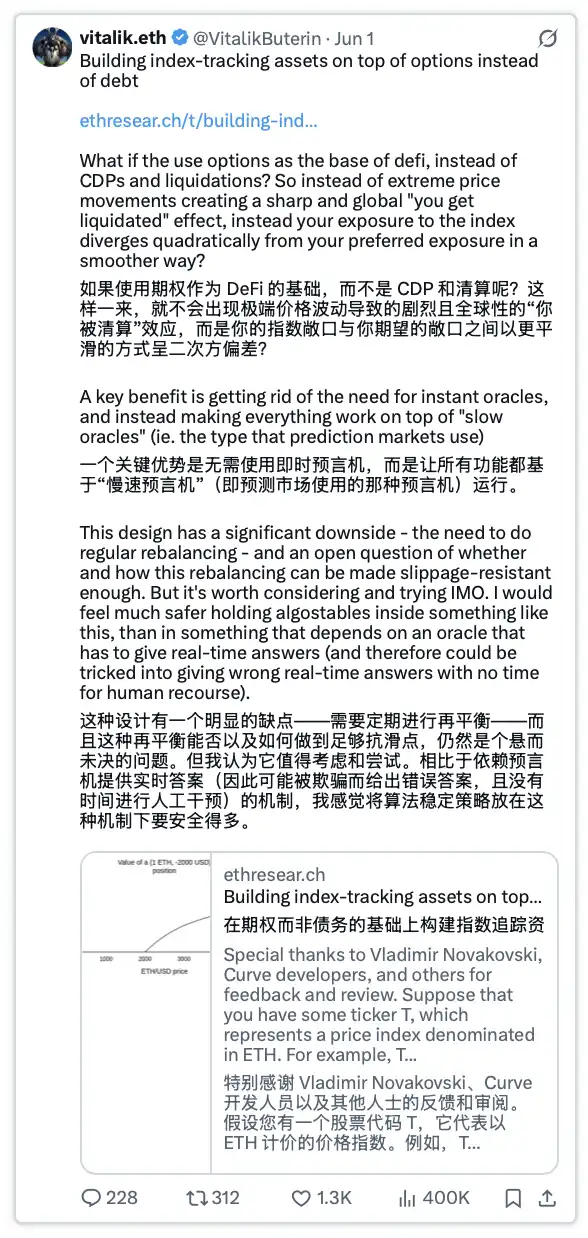
What truly intrigued me was the concept: options are not seen as a tradable product but as the foundational infrastructure of a product.
This is an idea I have been advocating for over the past few years, and it is the core concept behind our development of Rysk V12. For us, the product is yield; for Vitalik, the product is stability. The more I think about it, the more familiar this design feels.
The stable side he describes is essentially a covered call option.
Why It Is a Covered Call Option
His design breaks down one unit of ETH into two types of ownership. One side is P, which holds the value up to a certain strike price, while the other side is N, which receives all upside above that strike price. Together, they always add up to one unit of ETH, so there is no debt, no margin required, and nothing to be liquidated.
Assuming the current price of ETH is $2,500 with a strike price of $1,500. As long as the ETH price stays above $1,500, P acts like an ownership stake stable at $1,500; only if ETH falls below $1,500 does P begin to bear downside risk. N, on the other hand, receives all the upside gains above $1,500.
This is precisely the payoff structure of a covered call option.
The holder retains the asset itself, sells off the upside above a certain strike price, and collects the option premium. P replicates exactly this covered call payoff structure. N is equivalent to the long call held by the buyer.
More accurately, it is a synthetic covered call option. No one externally sells an option; instead, by splitting ownership, the same payoff structure is reconstructed.
This is also the same argument behind Rysk V12. Users hold ETH, BTC, or HYPE and earn upfront yield by selling covered call options. Vitalik, on the other hand, directs the same foundational module towards stability.
One engine, different products.
The Issue Is: It Is a Deep In The Money Option and Must Be Rolled Continuously
Today, most Rysk users are selling out-of-the-money covered call options. The holder owns ETH and selects a strike price higher than the current price: either betting that the price won't reach that level or being willing to sell at a higher price and take profits even if it does, while retaining the option premium.
But Vitalik's envisioned stability end requires a different structure. To behave like a stablecoin, the strike price must be far below the spot price, making this call option deep in the money, with most of its value intrinsic.
In a scenario where the spot price is $2,500 and the strike price is $1,500, $1,000 of this would be the intrinsic value the buyer must pay upfront, significantly increasing the capital at risk for this trade.
However, a call option can only remain stable at a specific moment. Once ETH starts to drop towards the strike price, it begins to bear the downside risk of ETH, requiring constant downward adjustments to lower strike prices, repeatedly rolling over.
Thus, this stable asset is essentially an ongoing program of covered call options rolling.
Vitalik himself has acknowledged this risk. The slippage from repeated rolling is the most significant threat to the entire design, and executing these rolls is the genuinely challenging part.
Any mechanism trading on a fixed, public timetable is vulnerable to frontrunning. This was the issue DeFi option treasury DOV faced: selling options with the same term and strike price weekly, making the market fully aware of what was to come and allowing pre-positioning to extract value from this flow.
In any case, every roll will need a buyer. The question is: Who will buy? At what price?
The Hardest Part Is Who Provides the Funding
In Vitalik's model, someone must deposit a full unit of ETH, split it, sell the stability end, and hold the upside end. This depositor is the linchpin on which the entire system depends.
The most obvious candidate is a liquidity provider.
However, the position they end up holding is, in essence, a leveraged long ETH position. Anyone looking to leverage long on ETH can directly buy call options or trade perpetual contracts in a simpler, more efficient, and familiar manner. This depositor is essentially taking a more challenging route to acquire a position that could easily be obtained elsewhere.
The long side indeed has a real advantage: it provides true leverage without funding rates or liquidation risk, which perpetual contracts cannot offer.
But it still needs to find a buyer, and not just once. For every unit of stable asset in existence, there must be someone on the other side holding the corresponding long position.
For this model to scale, there needs to be a group of people willing to continuously hold ETH leverage long positions in this particular form in any market environment.
Market makers are essentially resource optimizers. There is no obvious reason why they would easily accept something new, capital-intensive, and with high integration costs. "Speculators and market makers will provide liquidity" is the assumption on which the entire design relies. But this behavior will not happen out of thin air.
What We Learned at Rysk
At Rysk, we learned this the hard way. The early versions of the protocol struggled to scale, lacked natural demand, and never found product-market fit.
However, in the current Rysk V12 protocol, both trading parties have strong incentives to participate. Therefore, Rysk caters to two types of people who already wanted to participate. Holders seek to earn from their held assets, which serve as collateral themselves.
Market makers compete within the RFQ (Request for Quote) mechanism to purchase this part of the trading flow. They only pay the option premium, do not need to provide collateral, and ultimately get the option exposure they truly desire, which they can price and hedge on their own books. This is the more capital-efficient end of trading, which is why trading teams spontaneously onboard.
No party is required to hold a position that could have been more easily obtained elsewhere.
This system also does not rely on incentives or token emissions.
Worth Building
I'm glad to see this design being seriously explored. The challenges are indeed real, but they are the kind of interesting challenges. This is exactly the design space DeFi should explore.
What makes me feel validated is that this proposal further reinforces the same choice we made at Rysk: over-collateralization, no liquidations, no counterparty risk, and physical settlement requiring an oracle only at expiry.
Different use case, same foundation. This foundation has already been launched on HyperEVM and validated, with market makers competing for trading flow. We have also deployed to the Ethereum mainnet and will soon open to the public.
If you are exploring stablecoins, structured products, index products, or any product with embedded options, feel free to reach out to me.
Options are the base layer. What's truly interesting is what is built on top of it.
Welcome to join the official BlockBeats community:
Telegram Subscription Group: https://t.me/theblockbeats
Telegram Discussion Group: https://t.me/BlockBeats_App
Official Twitter Account: https://twitter.com/BlockBeatsAsia